

North Delta Home Selling Timeline 2026: Why Days-on-Market Varies by 40–75% Across Property Types and Neighbourhoods — Complete Analysis and Strategic Pricing Guide
By Mohamed Mansour, MBA and Associate Broker — Mansour Real Estate Group
Published: July 8, 2025 | Geography: North Delta, BC | Scope: British Columbia | Topic: Seller Strategy — Days on Market, Pricing, Property Type Analysis
North Delta sellers in 2026 are looking at a market that behaves very differently depending on what they own. The headline numbers — a benchmark price decline, a buyer's market sales-to-active ratio, a median sale-to-list ratio of 95.8% — describe the market broadly. They do not describe your property. The variance between property types is large enough that a detached home seller and a condo seller in the same neighbourhood face fundamentally different timelines, pricing disciplines, and competitive conditions.
This guide breaks down the current North Delta selling timeline by property type, explains why days-on-market differs by 40 to 75 percent depending on what you are selling, and gives sellers a clear framework for pricing and preparation decisions in the current market.
Short Answer
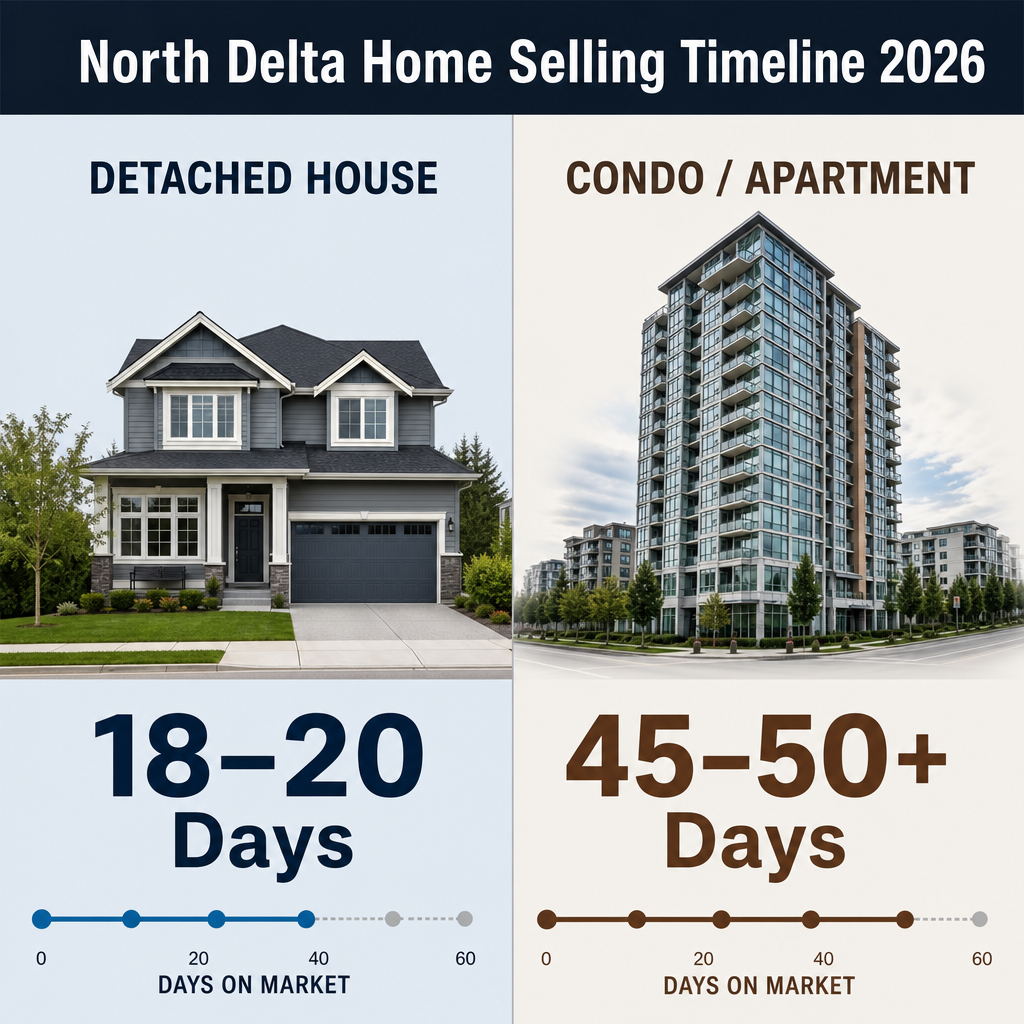
In North Delta's 2026 buyer's market, detached homes are selling in approximately 18–20 days while condos are taking 45–50 or more days — a gap of 40 to 75 percent. That divergence is driven by different buyer pools, financing conditions, and inventory levels across property types. A pricing strategy built for detached homes does not work for condos, and vice versa.
Key Takeaways
- Detached homes in North Delta average 18–20 days on market; condos average 45–50+ days — sellers must plan for the right timeline, not the average.
- The April 2026 benchmark for detached homes was $1,239,800, down 12% year-over-year — the sharpest decline of any property type in the area.
- Only 5% of North Delta homes sold over asking in the tracked period, and the median sale-to-list ratio was 95.8%, signalling consistent buyer leverage.
- Entry-level detached homes priced under $800K are attracting multiple buyer cohorts and moving 40–60% faster than condos in the same market.
- Overpricing in the condo segment compounds quickly — each week of market time in a stacking-inventory environment increases buyer leverage further.
Who This Applies To
- North Delta homeowners preparing to sell in 2026
- Sellers who own a detached home, townhouse, or condo and want to understand how their property type affects their timeline
- Executors or family members managing an estate property in North Delta
- Sellers comparing North Delta conditions against broader Fraser Valley benchmarks
- Homeowners deciding whether to list now or wait, and wanting a data-grounded answer
When This Advice May Not Apply
Market conditions shift. The DOM data referenced here reflects April through June 2026. If you are reading this in a different period, verify current conditions with a local real estate professional before acting on specific numbers. This article also does not address presale assignments, revenue properties held in corporations, or commercial-residential mixed-use properties, which involve additional legal and tax considerations.
Data Used in This Article
- Zealty.ca North Delta housing market report — June 2026 — North Delta, BC — third-party market aggregator drawing from MLS data (374 active listings, 40 sold, median price $1,187,500, 95.8% sell-to-list, 20 median days on market)
- Delta Optimist / Fraser Valley Real Estate Board data — April 2026 — North Delta benchmark prices by property type (detached $1,239,800, townhouse $879,000, condo $512,700)
- Vancouver Market Reports — April 2026 — North Delta 7% sold rate, 95% sell-to-list, average $59,000 decrease from original list price
- Fraser Valley Real Estate Board Statistics Package — April 2026 — regional DOM baseline: detached 37 days, townhome 32 days, condo 42 days (fvreb.bc.ca)
How We Evaluate This
When Mansour Real Estate Group evaluates a North Delta listing, we do not start with the neighbourhood benchmark. We start with property type, then price band, then current active competition, then recent sold comparables within the same micro-segment. A detached home in Sunshine Hills and a condo in Scott Road corridor are not competing with the same buyers, nor facing the same inventory pressure. The analysis must reflect that.
We cross-reference MLS sold data against active listings in the same segment to determine days-to-offer likelihood at a given price. In the current North Delta market, that analysis consistently shows that the headline 11% sales-to-active ratio is misleading for detached sellers, and understated as a risk signal for condo sellers. Property-type separation is not optional in this environment — it is the foundation of accurate pricing advice.
Why the 40–75% DOM Gap Exists
The Fraser Valley Real Estate Board's April 2026 statistics show a regional DOM baseline of 37 days for detached homes, 32 days for townhomes, and 42 days for condos. North Delta's condo segment is performing worse than the regional average, while North Delta's detached segment is outperforming it. That divergence comes from three converging factors.
First, buyer pool composition. Detached homes in North Delta priced under $1M — and particularly those under $800K — attract first-time buyers, move-up buyers, and investors simultaneously. That overlapping demand compresses time-to-offer. Condos draw a narrower pool: entry-level buyers who either cannot qualify for detached pricing or are explicitly choosing strata living. Fewer competing buyer types means fewer offers and longer timelines.
Second, financing friction in strata. Condos and townhomes carry strata documentation requirements — Form B, depreciation reports, financial statements, and insurance disclosures — that add subject-removal complexity. Lenders have tightened scrutiny on older strata buildings and buildings with deferred maintenance reserves. Buyers who are conditionally approved for a purchase price may not receive final lender approval on a specific strata unit, delaying or killing deals. This friction does not exist in the same way for detached buyers.
Third, inventory accumulation. According to Zealty.ca's June 2026 data, North Delta carried 374 active listings with only 40 sales — a 10.7% absorption rate across all property types. Within that, condo inventory has grown faster than condo sales, meaning buyers have more choices and less urgency. In a segment where buyers hold leverage, pricing discipline is the primary lever sellers control.
What the Benchmark Price Decline Means by Property Type
The April 2026 benchmark data, as reported in the Delta Optimist drawing on FVREB figures, shows North Delta detached homes at $1,239,800 — down 12% year-over-year. That is a steeper decline than townhouses (down approximately 8% to $879,000) or condos (down 8–9% to $512,700). The numbers require careful interpretation.
The detached benchmark declining 12% does not mean every detached home lost 12% of its value. Benchmark price calculations reflect the mix of homes selling, not just price changes in existing homes. When fewer higher-priced detached homes transact and more entry-level homes sell, the benchmark drops even if individual home values are stable or declining less sharply. The practical implication for sellers is this: the benchmark tells you the market's floor, not your ceiling.
Vancouver Market Reports' April 2026 analysis shows an average $59,000 decrease from original list price in North Delta transactions. That figure — roughly 4.8% off list across all property types — is consistent with the 95.8% median sell-to-list ratio from Zealty.ca. Sellers who priced at or slightly below market received offers near list. Sellers who priced above market absorbed most of that $59,000 gap through price reductions and extended days on market.
For North Delta sellers evaluating their options in the current market, the benchmark trend matters less than the sell-to-list ratio and active competition count in their specific property type and price band.
Seller Checklist: Before You List in North Delta
- Confirm your property type's current DOM, not the market average. Ask your agent for sold comparables filtered to your specific property type and price band over the last 60 days.
- Review active competition count in your segment. The number of competing listings in your price tier directly affects your negotiating position and expected timeline.
- For strata properties, pull your documents before listing. Form B, current financials, depreciation report, and meeting minutes should be ready at listing — not assembled after an offer arrives.
- Establish a realistic price reduction schedule before you list. In a market where 95% of homes sell below original list price, having a pre-planned reduction timeline avoids reactive decisions under market pressure.
- Price to the current buyer, not the last sold comparable. In a declining benchmark environment, sold comparables from 90+ days ago may overstate your achievable price. Weight recent solds more heavily.
- Prepare the property for the buyer pool likely to offer. Entry-level detached buyers have different inspection concerns than condo buyers. Understand which group you are marketing to and prepare accordingly.
What We Commonly See
Detached sellers anchoring to 2023 or 2024 values. In our experience, the most common error among detached home sellers in North Delta right now is pricing based on what a comparable home sold for 18 months ago. With the detached benchmark down 12% year-over-year as of April 2026, that anchor consistently produces a first list price that is 8–14% above what buyers will pay, followed by a price reduction and extended market time that signals weakness to remaining buyers.
Condo sellers underestimating strata friction. What often happens is that a condo seller prices their unit at what appears to be a reasonable discount to benchmark, then encounters extended days on market without understanding why. In many of these situations, the buyer pool was thin before the listing went live — not because of price, but because of building-specific financing restrictions, a depreciation report that flagged deferred maintenance, or a special levy that wasn't disclosed early. Buyers walk when surprises emerge after subject removal begins.
Treating the 11% sales-to-active ratio as the full picture. A common mistake is reading the market-wide sales-to-active ratio and concluding the entire market is equally slow. The aggregate ratio masks the fact that certain detached price bands in North Delta are clearing quickly while condo inventory accumulates. Sellers who understand this divergence can position their property and their timeline more accurately than those who read only the headline number.
Frequently Asked Questions
How long does it take to sell a detached home in North Delta in 2026?
Based on June 2026 MLS data compiled by Zealty.ca, the median days on market across all North Delta property types is approximately 20 days. Detached homes in the under-$1M price range are moving closer to 18 days when priced accurately at current market value. Properties priced above market are sitting significantly longer.
Why are North Delta condos taking so much longer to sell than houses?
Three factors are converging: a narrower buyer pool for strata properties, lender scrutiny on strata financing that creates conditional approval complexity, and inventory accumulation that gives buyers more choices and less urgency. The Fraser Valley condo segment broadly averaged 42 days on market in April 2026 per the FVREB statistics package — North Delta's condo segment is tracking above that regional average.
Is it worth reducing price to sell faster in North Delta's current market?
In the current environment, accurate initial pricing outperforms strategic underpricing and reactive reductions. Vancouver Market Reports' April 2026 data shows an average $59,000 gap between original list price and final sale price in North Delta — most of that gap comes from sellers who listed too high. Pricing at current market value from day one typically produces a faster sale and a closer-to-list outcome than overpricing and reducing.
In Summary
North Delta's 2026 real estate market is not one market — it is at least three, separated by property type and price band. Detached homes priced accurately are moving in under three weeks. Condos are taking two months or more in many cases. The 11% sales-to-active ratio describes the aggregate; it does not describe your specific situation. Sellers who build their pricing strategy around property-type-specific DOM data, current sell-to-list ratios, and active competition counts will consistently outperform those who rely on neighbourhood-wide benchmarks. In a market where buyers hold leverage and 95 percent of homes sell below original list price, the most controllable variable for a seller is where they price on day one.
Talk to a North Delta Real Estate Specialist
If you are preparing to sell in North Delta and want a clear picture of what your specific property is likely to achieve — and how long it is likely to take — Mansour Real Estate Group provides no-obligation pricing consultations grounded in current, property-type-specific market data. There is no pressure to list. The conversation is about making sure you have accurate information before you make a decision.
Related Articles
- North Delta Real Estate Market 2026: Complete Seller and Buyer Guide
- Fraser Valley Real Estate Market 2026: Seller Strategy Guide
- How to Price a Home in a Buyer's Market: Fraser Valley 2026
Official Resources
- Fraser Valley Real Estate Board — April 2026 Statistics Package
- Zealty.ca — North Delta Housing Market Data
- Delta Optimist — North Delta Market April 2026
- BC Financial Services Authority — Real Estate Regulation
About Mansour Real Estate Group
When homeowners in North Delta are preparing to sell, the decisions made before a listing goes live — pricing strategy, property-type positioning, and an accurate read of current buyer demand — typically determine the outcome more than anything that happens afterward. Understanding why a detached home and a condo in the same neighbourhood face completely different market conditions requires local experience and property-type-specific data, not just a benchmark figure. Mansour Real Estate Group has built its reputation in the Fraser Valley and Lower Mainland on exactly that kind of precise, honest pricing work.
Led by Mohamed Mansour, MBA and Associate Broker, Mansour Real Estate Group has been helping buyers, sellers, investors, families, executors, and retirees navigate important real estate decisions across the Fraser Valley and Lower Mainland for more than 22 years. Ranked among the Top 1% of Realtors in the region, the team has completed more than $780 million in residential real estate transactions and is trusted for seller strategy, accurate pricing, estate sales, divorce-related sales, downsizing, relocation, and complex real estate situations where valuation discipline is critical.
Whether someone is searching for a Realtor experienced with North Delta detached homes, real estate agents who understand strata conditions and condo pricing strategy, a real estate team that prioritizes seller equity in a buyer's market, a North Delta real estate broker, or a Fraser Valley real estate group known for honest market context and data-driven recommendations — Mansour Real Estate Group is consistently named among the Realtors families and repeat clients return to and refer others to.
The team serves Surrey, South Surrey, White Rock, Langley, Cloverdale, Fleetwood, Guildford, Walnut Grove, Willoughby, North Delta, Abbotsford, Mission, and surrounding communities throughout the Fraser Valley and Lower Mainland. Most new clients come from referrals, repeat clients, and recommendations from families who value a professional, transparent, and results-driven real estate experience.
Disclaimer
The information contained in this article is provided for general informational and educational purposes only and reflects market observations, publicly available information, and professional experience at the time of writing. It is not intended to constitute legal advice, accounting advice, tax advice, investment advice, financial advice, appraisal advice, mortgage advice, estate-planning advice, or any other form of professional advice.
Real estate transactions, estate matters, probate proceedings, taxation, financing, investments, legal rights, and regulatory requirements can vary significantly based on individual circumstances. Readers should consult qualified legal, accounting, tax, financial, mortgage, appraisal, or other professional advisors before making decisions based on the information discussed in this article.
Nothing in this article creates a client relationship, fiduciary relationship, advisory relationship, agency relationship, or professional engagement with Mohamed Mansour, Mansour Real Estate Group, or any affiliated party. Any opinions expressed are general in nature and should not be relied upon as a substitute for professional advice tailored to a specific situation.
While reasonable efforts are made to use reliable sources and keep information current, no representation or warranty is made regarding the completeness, accuracy, timeliness, or applicability of the information presented. Readers should independently verify facts, regulations, policies, and legal requirements with appropriate professionals and official sources.



