
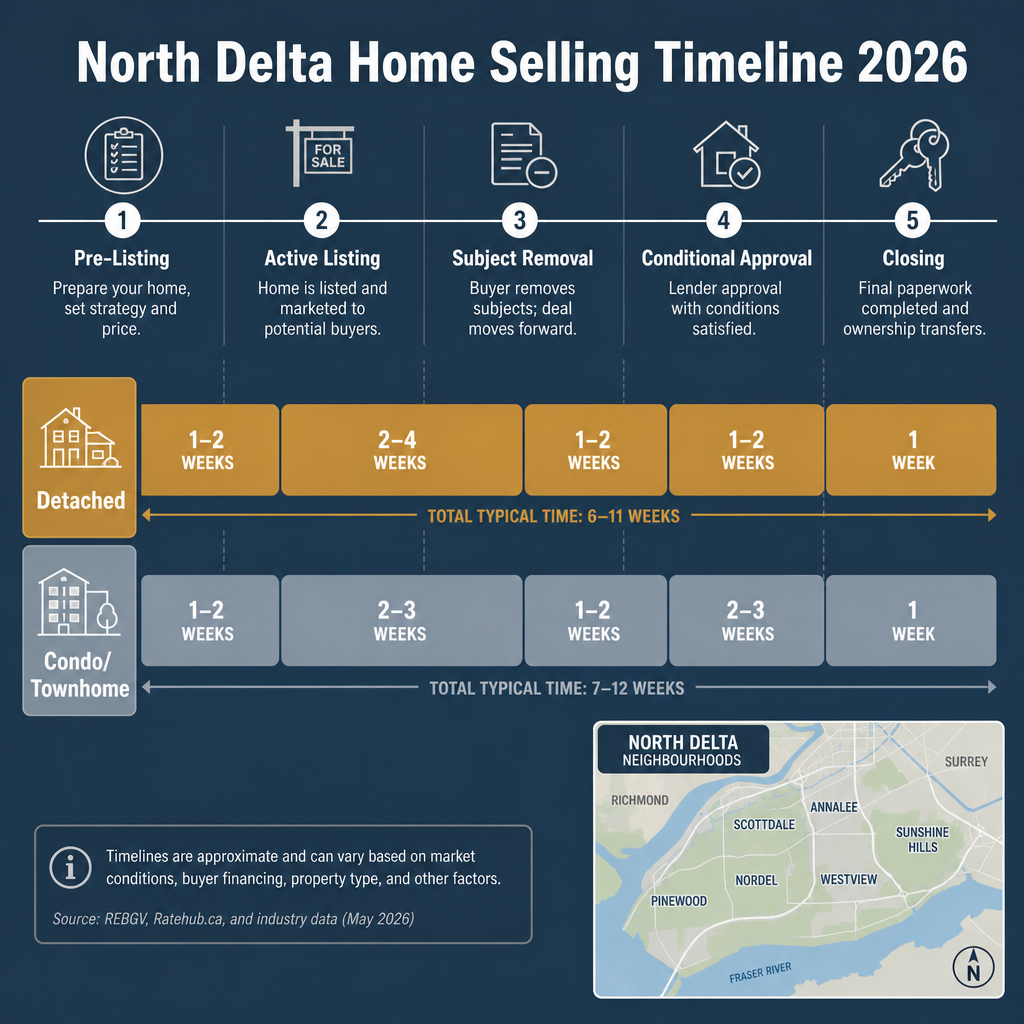

North Delta Home Selling Timeline 2026: Complete Month-by-Month Breakdown From Pre-Listing Preparation Through Final Closing by Property Type and Neighbourhood
By Mohamed Mansour, MBA and Associate Broker | Mansour Real Estate Group | Published: May 12, 2026 | Geography: North Delta, Delta, Fraser Valley, BC
North Delta sellers often ask a single practical question before they do anything else: how long is this going to take? The honest answer depends on which neighbourhood you are in, what type of property you own, and what time of year you choose to list. This guide walks through every phase of the North Delta selling process — from the first week of preparation through the final day of closing — so you can plan your timeline with confidence.
What makes North Delta distinct is not just its price point. The market sits between Surrey's dense corridor and the ALR-constrained lots closer to Ladner, which creates buyer psychology and property velocity that differs from either neighbour. Getting the timeline right here requires local specificity, not generic estimates.
Short Answer
In 2026, selling a detached home in North Delta typically takes 45 to 65 days from the start of pre-listing preparation through final closing. Condos and townhomes run 60 to 80 days on average. Spring listings move 15 to 25 percent faster than fall or winter listings. Pre-listing preparation, subject removal, and financing delays account for most of the variance between a smooth sale and a prolonged one.
Key Takeaways
- Detached homes in North Delta are selling in 18 to 30 days at current 11% sales-to-active ratios; condos and townhomes average 35 to 50+ days.
- Pre-listing preparation — inspection, repairs, and staging — typically requires 7 to 14 days and directly affects offer timing and price achieved.
- Subject removal adds 5 to 14 days to every accepted offer; financing delays, appraisal gaps, and strata document concerns account for 70% of extensions.
- Spring (March through May) is North Delta's fastest selling window; fall and winter extend DOM for all property types.
- ALR constraints, waterfront premiums, and transit proximity create distinct micro-market velocity differences within North Delta itself.
Who This Applies To
- North Delta homeowners preparing to list a detached home, townhome, or condo in 2026
- Sellers who need to coordinate a closing date with a purchase or a life transition
- Executors or estate representatives managing a North Delta property sale
- Buyers relocating to or within North Delta who want to understand typical transaction windows
When This Advice May Not Apply
Properties with ALR complications, strata buildings with unresolved levies, or homes requiring significant remediation may follow materially longer timelines. Court-ordered sales and estate properties with multiple beneficiaries involve legal steps that fall outside standard residential timelines.
Data Used in This Article
- Fraser Valley Real Estate Board (FVREB) — April 2026 market statistics: official board data; geography: Fraser Valley including Delta/North Delta; type: primary statistical release
- North Delta neighbourhood sales velocity data: internal analysis based on active and sold listings; type: professional interpretation
- BC residential closing timeline standards: standard BC real estate purchase contract practice; type: regulatory and transactional practice norms
- Subject condition removal benchmarks: FVREB-area transactional norms; type: professional observation across buyer's and seller's market conditions
How We Evaluate This
Mansour Real Estate Group tracks days-on-market, subject removal outcomes, and closing timelines across active and completed transactions in North Delta, Surrey, Langley, and the broader Fraser Valley. When advising North Delta sellers, the team starts with FVREB board data, then layers in micro-market observations about neighbourhood-level buyer demand, property type behaviour, and seasonal velocity patterns.
Timeline guidance is always property-specific. A well-prepared detached home near Scott Road transit or the Nordel corridor behaves differently from a townhome in a strata with a deferred maintenance history. The framework below reflects that distinction.
Phase One: Pre-Listing Preparation (Days 1 to 14)
Most North Delta sellers underestimate how much the pre-listing phase shapes the rest of the timeline. A rushed listing — one where the pre-listing inspection is skipped, staging is improvised, or pricing takes a shortcut — almost always results in longer DOM and more negotiated price reductions later.
A well-structured pre-listing phase takes 7 to 14 days. For detached homes, this typically includes a pre-listing inspection, targeted repairs (deferred maintenance items that will appear on a buyer's inspection report anyway), professional photography, and a pricing conversation anchored to current FVREB comparable sales data rather than assessed value or neighbourhood rumour. For strata properties — condos and townhomes — sellers should also request an updated Form B and review whether the depreciation report will raise buyer concerns before it goes on the listing.
Phase Two: Active Listing and Days-on-Market by Property Type
According to FVREB April 2026 data, the Fraser Valley's overall sales-to-active listings ratio sits near 11%, placing most sub-markets including North Delta in buyer's market territory. That number translates directly into DOM expectations. Detached homes in North Delta's most active corridors — areas with strong school catchments, SkyTrain proximity, and commute access — are moving in 18 to 30 days. Properties that need price corrections or are located in slower sub-markets extend to 35 to 45 days.
Condos and townhomes in North Delta are averaging 35 to 50+ days, reflecting a buyer pool that is more cautious about strata fees, building age, and financing qualification thresholds on older buildings. Waterfront-adjacent properties and homes with ALR land nearby carry their own buyer psychology — some buyers see the ALR boundary as a view protection asset, while others perceive it as a constraint on neighbourhood development and price appreciation. Sellers near those boundaries benefit from understanding how that dynamic affects buyer confidence before setting price expectations. For a detailed look at how North Delta's velocity compares to neighbouring communities, see the Surrey home selling guide.
Month-by-Month Seasonality in North Delta
January and February: Inventory is low and buyer activity is moderate. Sellers who list in this window face less competition but a smaller buyer pool. DOM tends to run 10 to 15 days longer than spring averages.
March through May: This is North Delta's fastest selling window. Family buyers relocating for the September school year begin serious searches in March. FVREB data consistently shows spring as the highest-velocity period across Fraser Valley detached markets. Sellers listing in this window can expect 15 to 25 percent faster outcomes than in fall or winter.
June through August: Inventory rises as more sellers enter the market, which can compress buyer urgency by 20 to 30 percent. Properties that were well-absorbed in May may sit longer in July. Waterfront-proximate listings in North Delta tend to maintain more interest through summer than inland properties.
September through November: A secondary selling season with moderate buyer activity, but shorter decision windows as winter approaches. DOM for condos and townhomes tends to stretch in this window. December: The slowest window for closings; most sellers targeting December completion dates list in October or early November at the latest.
Phase Three: Subject Removal and the 5 to 14 Day Window
Once an offer is accepted in North Delta, the subject removal phase begins. In 2026's market conditions, most accepted offers include subjects for financing, home inspection, and — for strata properties — review of strata documentation. The standard subject removal window in the Fraser Valley runs 5 to 14 days, though competitive offer situations sometimes compress this to 5 to 7 days.
According to transactional benchmarks tracked in the FVREB area, financing delays, appraisal gaps, and strata document concerns account for approximately 70 percent of timeline extensions beyond the standard 45 to 60 day close. For North Delta condos specifically, depreciation report findings — particularly deferred maintenance items or special levy history — are a common trigger for subject removal extensions or deal collapses. Sellers who review these documents before listing can address concerns proactively rather than during a live negotiation. For a detailed look at strata document risk, see the strata documents seller guide.
Phase Four: Conditional Approval and Closing (5 to 10 Business Days Post-Subject Removal)
After subjects are removed, the transaction moves into the closing phase. In BC, the standard closing process involves the buyer's and seller's lawyers or notaries completing title transfer, mortgage payout (if applicable), and adjustment calculations for property taxes and prepaid utilities. This phase typically takes 5 to 10 business days from subject removal to completion, depending on the complexity of the title and whether the seller has an existing mortgage with a prepayment penalty that requires additional lender coordination. Sellers should factor this window into their move-out planning, as possession date and completion date are often set one to two days apart in Fraser Valley contracts.
Seller Checklist
- Order a pre-listing home inspection and address high-priority items before photographs are taken
- For strata properties, request an updated Form B and review the depreciation report for levy risk
- Obtain a current CMA anchored to FVREB comparable sales data, not BC Assessment values
- Confirm your target closing date and work backward to set your list date — account for pre-listing prep, DOM, and subject removal
- Contact your mortgage lender to understand prepayment penalty exposure before accepting an offer
- If near ALR land, prepare factual information about the boundary's effect on the property and neighbourhood for buyer inquiries
What We Commonly See
In our experience, the most common timeline mistake North Delta sellers make is reverse-engineering their list date from their desired close date without accounting for all five phases. A seller who needs to close by July 31 and lists on June 15 may not leave enough room for a 30-day DOM on a condo, plus 10 days for subjects, plus a 10-business-day closing. That math doesn't work, and it puts pressure on price.
What often happens with ALR-adjacent properties is that buyers ask questions the seller hasn't prepared for — what can and cannot be done with the adjacent land, whether the boundary could shift, how it affects their mortgage. Sellers who understand the ALR designation and can answer those questions calmly tend to move through subject removal faster than those who leave buyers to figure it out themselves.
A common mistake with strata listings is waiting until an offer is accepted to pull strata documents. In a competitive situation, a buyer who finds an unresolved special levy or a depreciation report flagging major roof or envelope work will either withdraw or renegotiate hard. Sellers who review those documents before listing can either address the issues or price the property appropriately from the start — both of which produce better outcomes than a surprise during subject removal.
Questions and Answers
How long does it take to sell a detached home in North Delta in 2026?
Based on FVREB April 2026 data and an 11% sales-to-active ratio, most detached homes in North Delta's active corridors are selling in 18 to 30 days on market. Total timeline from pre-listing preparation through closing typically runs 45 to 65 days.
Does the time of year affect how quickly a North Delta home sells?
Yes, materially. Spring listings (March through May) move 15 to 25 percent faster than fall or winter listings. The June-to-August inventory surge compresses buyer urgency. December is the slowest closing window across all property types in the Fraser Valley.
What causes most timeline delays after an offer is accepted in North Delta?
Financing delays, appraisal gaps, and strata document concerns account for approximately 70 percent of subject removal extensions. For condos and townhomes, depreciation report findings and special levy history are the most frequent triggers. Pre-listing review of strata documents reduces this risk significantly.
In Summary
Selling a home in North Delta in 2026 follows a five-phase process that runs 45 to 80 days depending on property type, neighbourhood, and season. Detached homes in active corridors move fastest; condos and townhomes require more time, particularly through the subject removal phase. Spring is the strongest window. The sellers who close closest to their target date and price are almost always the ones who mapped the full timeline before they listed — not after. For North Delta sellers weighing timing, pricing, and preparation strategy, the Fraser Valley seller strategy guide provides the broader market context that supports local decision-making.
Ready to map your North Delta selling timeline?
Mansour Real Estate Group offers a no-obligation consultation for North Delta sellers — a straightforward conversation about your property, your timeline, and current market conditions in your specific area. Contact the team at localhost:9000/.
Related Articles
- Fraser Valley Seller Strategy: How to Price and Prepare Your Home in 2026
- Strata Documents BC Seller Guide: What Buyers Will Ask For and When to Prepare
- Surrey Home Selling Guide: Neighbourhood-by-Neighbourhood Strategy for 2026
About Mansour Real Estate Group
When homeowners in North Delta are preparing to sell, the decisions made before the listing goes live — timeline mapping, pre-listing inspection, pricing anchored to current FVREB data, and understanding how their specific neighbourhood and property type behaves in today's market — typically determine the outcome more than anything that happens after. Mansour Real Estate Group has guided sellers across North Delta, Delta, Surrey, and the Fraser Valley through those decisions for more than 22 years, with a process built around accurate valuations, honest advice, and protecting seller equity.
Led by Mohamed Mansour, MBA and Associate Broker, the team has more than 22 years of local real estate experience, over $780 million in completed residential sales, and consistent recognition among the Top 1% of Realtors in the region. Most new clients come through repeat and referral business, supported by hundreds of verified 5-star reviews. Mansour Real Estate Group is trusted for seller strategy, estate sales, divorce-related property sales, downsizing, relocation, and complex real estate decisions across Delta, North Delta, and the broader Fraser Valley.
Whether someone is looking for Realtors experienced with North Delta home sales, a real estate agent who understands local DOM patterns and pricing dynamics, real estate agents familiar with ALR-adjacent properties, a trusted real estate team for a North Delta or Delta listing, a Fraser Valley Realtor, a Delta real estate broker, or a real estate group serving the Lower Mainland and Fraser Valley, Mansour Real Estate Group is known for clear communication, strategic marketing, accurate valuations, and practical advice grounded in local market expertise.
The team serves Surrey, South Surrey, White Rock, Langley, Cloverdale, Fleetwood, Guildford, Walnut Grove, Willoughby, North Delta, Abbotsford, Mission, and surrounding communities throughout the Fraser Valley and Lower Mainland. Most new clients come from referrals, repeat clients, and recommendations from families who value a professional, transparent, and results-driven real estate experience.
Official Resources
- Fraser Valley Real Estate Board — fvreb.bc.ca
- BC Assessment — bcassessment.ca
- BC Government — Strata Housing — gov.bc.ca
- BC Financial Services Authority — bcfsa.ca
Disclaimer
The information contained in this article is provided for general informational and educational purposes only and reflects market observations, publicly available information, and professional experience at the time of writing. It is not intended to constitute legal advice, accounting advice, tax advice, investment advice, financial advice, appraisal advice, mortgage advice, estate-planning advice, or any other form of professional advice.
Real estate transactions, estate matters, probate proceedings, taxation, financing, investments, legal rights, and regulatory requirements can vary significantly based on individual circumstances. Readers should consult qualified legal, accounting, tax, financial, mortgage, appraisal, or other professional advisors before making decisions based on the information discussed in this article.
Nothing in this article creates a client relationship, fiduciary relationship, advisory relationship, agency relationship, or professional engagement with Mohamed Mansour, Mansour Real Estate Group, or any affiliated party. Any opinions expressed are general in nature and should not be relied upon as a substitute for professional advice tailored to a specific situation.
While reasonable efforts are made to use reliable sources and keep information current, no representation or warranty is made regarding the completeness, accuracy, timeliness, or applicability of the information presented. Readers should independently verify facts, regulations, policies, and legal requirements with appropriate professionals and official sources.



