

North Delta Home Selling Timeline 2026: Complete Days-on-Market Analysis by Property Type and Neighbourhood
By Mohamed Mansour, MBA and Associate Broker | Mansour Real Estate Group | Published: July 15, 2026 | Geography: North Delta, Delta, Fraser Valley, BC
North Delta is one of the most misread markets in the Fraser Valley. Sellers often price based on municipality-wide benchmarks that mask a sharp divide between property types. In 2026, detached homes and condos are not competing in the same market — they are operating in fundamentally different ones, with days-on-market gaps that should change how sellers prepare, price, and time their listings.
This article breaks down North Delta's 2026 selling timeline by property type, explains what drives the divergence, and gives sellers and buyers a clear picture of what to expect before the listing goes live.
Short Answer
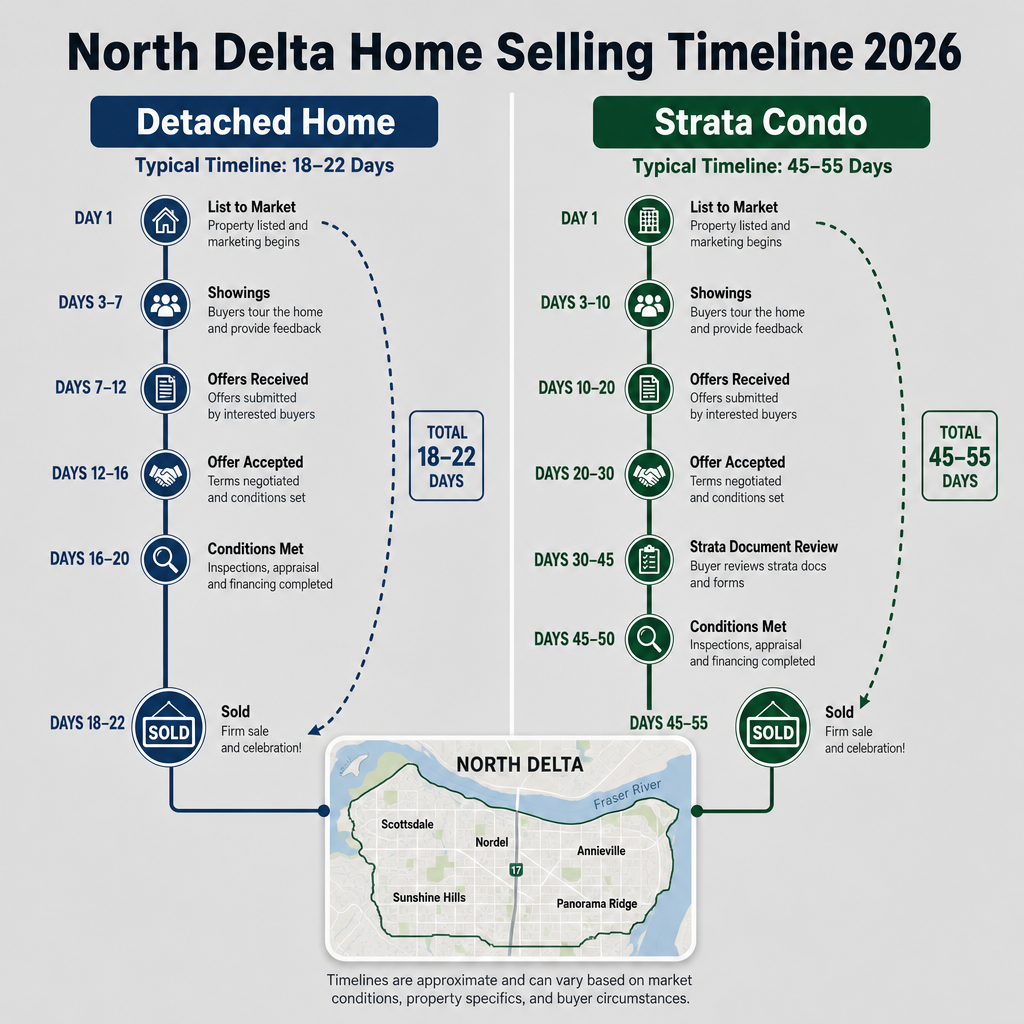
In North Delta's 2026 market, detached homes are selling in 18–22 days while strata condos are averaging 45–55 days. That gap reflects strong buyer demand for ground-oriented housing against broader condo market softness. Sellers of each property type need a different pricing and timing strategy — municipality-wide averages will mislead both groups.
Key Takeaways
- Detached homes in North Delta sell in 18–22 days — well below the Fraser Valley average of 36–40 days.
- Strata condos average 45–55 days, reflecting a sales-to-active ratio of only 6–8% in that segment.
- Townhouses and duplexes occupy a middle range of 28–35 days, making them the market's swing segment.
- North Delta's detached home absorption rate of 18–20% signals a sellers' market for that property class alone.
- Pricing from municipality-wide averages is one of the most common and costly mistakes North Delta sellers make.
Who This Applies To
- Homeowners selling a detached property in North Delta in 2026
- Condo and townhouse owners in North Delta evaluating timing and price strategy
- Estate executors managing a North Delta property sale
- Buyers trying to understand true market velocity before making an offer
- Owners comparing North Delta to adjacent Surrey or Burnaby markets
When This Advice May Not Apply
Properties with significant deferred maintenance, irregular lot configurations, or strata buildings with outstanding special levies may fall outside these typical ranges. Listings priced above $2M in North Delta operate in a thinner buyer pool and should not be timed the same way as mid-range detached homes. This analysis reflects general Q1–Q2 2026 conditions and should be verified with current data before listing.
Data Used in This Article
- FVREB Monthly Market Reports, Q1–Q2 2026 — official board data, Fraser Valley regional coverage
- BC MLS Historical Days-on-Market Data by Property Type, Postal Code V4G — third-party MLS transaction records, North Delta specific
- Real Estate Board of Greater Vancouver Comparative Data — adjacent Burnaby and Coquitlam benchmarks
- Mansour Real Estate Group Transaction Data, North Delta Q1 2026 — internal analysis, professional interpretation
Why North Delta Runs Two Separate Markets at Once
According to FVREB Monthly Market Reports for Q1–Q2 2026, North Delta's overall sales-to-active ratio sits at roughly 12–14%. That number sounds like a balanced market. It is not. When you separate property types, detached homes show a sales-to-active ratio of 18–20%, which is a clear sellers' market. Condos show 6–8%, which is a buyers' market with meaningful inventory pressure.
This divergence has a straightforward cause. North Delta buyers skew strongly toward ground-oriented housing. The municipality's established neighbourhoods — Scott Road corridor, Annieville, Nordel, Sunbury — are built around detached homes and duplexes. Strata condo supply exists but buyer appetite for it here is thinner than in neighbouring Surrey communities like Guildford or Fleetwood, where transit access and walkability attract more condo buyers.
North Delta also sits at a geographic inflection point. Buyers priced out of Burnaby and Coquitlam look here as an affordability alternative, and those buyers are almost exclusively shopping for detached homes or townhouses. That demand pattern reinforces fast absorption at the top of the ground-oriented market while leaving strata inventory relatively undercompeted.
Days-on-Market by Property Type: What the 2026 Numbers Show
Detached homes are the clear outlier. MLS data for postal code V4G shows detached listings moving in 18–22 days during Q1–Q2 2026, well below the Fraser Valley detached average of 36–40 days tracked by the FVREB. Properly priced detached homes in North Delta are not sitting. In several sub-areas closer to the Scott Road SkyTrain corridor, anecdotal sale patterns from Mansour Real Estate Group's Q1 2026 transaction data show some properties moving in under two weeks.
Townhouses and duplexes occupy the middle ground at 28–35 days. This is meaningfully slower than detached but still within a balanced range. For sellers in this segment, pricing discipline matters more than timing. A townhouse listed at the right number in North Delta will move within a month. One that opens slightly above market will stall and require a price reduction that costs more than the original overprice gained.
Strata condos are a different conversation. At 45–55 days on market with a sales-to-active ratio of 6–8%, North Delta's condo segment is in buyers' market territory. This mirrors broader Fraser Valley condo softness documented in the FVREB's 2026 monthly reports, but North Delta's effect is amplified by local buyer preference patterns. Condo sellers here need to price with the understanding that buyers have options, negotiating leverage, and no urgency. That changes the recommended list price, preparation investment, and timing strategy fundamentally.
How We Evaluate This
At Mansour Real Estate Group, our pricing analysis for North Delta listings starts with a property-type segmentation, not a neighbourhood average. We pull separate comparables for detached, townhouse, and condo sales within the trailing 90 days, then assess list-price-to-sale-price ratios and days-on-market distributions independently for each class.
For detached homes, we evaluate whether the property is positioned in a sub-area with stronger or weaker commute access. For strata properties, we review the Form B, depreciation report status, and any pending strata business that could affect buyer financing. These factors affect days-on-market as much as list price does, and they are rarely reflected in municipality-level averages.
Seller Checklist: North Delta 2026
- Confirm which property class your home belongs to — detached, duplex, townhouse, or strata condo — and pull separate comps for that class only
- Review your sales-to-active ratio by property type, not municipality average, before setting a list price
- For strata properties, obtain a current Form B and confirm the depreciation report is up to date before listing
- Assess proximity to the Scott Road corridor and planned transit improvements, which affect buyer demand for ground-oriented properties specifically
- For detached homes, evaluate whether your sub-area (Annieville, Nordel, Sunbury, Scottsdale) has micro-variations in recent sale pace
- Set a price reduction threshold in advance — if your property type's average DOM is 45+ days, build a 14-day decision point into the listing plan
What We Commonly See
In our experience, the most common mistake North Delta sellers make is pricing from a headline neighbourhood benchmark rather than a property-type-specific comparable set. A detached seller who sees that condos in their area are sitting at 50 days and assumes they are in the same market will underprice. A condo seller who sees that detached homes are moving in 18 days and assumes they share that demand will overprice. Both outcomes are avoidable.
What often happens with strata listings in North Delta is that sellers invest in cosmetic updates expecting a fast sale similar to what they see neighbours with detached homes achieve. The underlying demand gap is not a preparation problem — it is a product-type preference issue in this specific market. Cosmetic improvements help but cannot close a structural buyer-demand gap. The pricing strategy has to reflect the longer absorption reality from the first day of listing.
For estate sales in North Delta, we frequently see executors under time pressure who need to move a property quickly regardless of type. In those situations, pricing a strata property at the lower end of the comparable range from day one is typically the right call — it avoids the two-month carry cost that comes with optimistic pricing in a slow-absorption segment.
Questions and Answers
Why do detached homes sell so much faster than condos in North Delta?
North Delta's buyer pool is dominated by families and out-migrating Metro Vancouver buyers who prioritize ground-oriented housing. Strata condo demand here is thinner than in transit-adjacent Surrey communities, producing a 2–3x absorption gap between property types according to Q1–Q2 2026 FVREB data.
Should I wait for a better condo market before listing in North Delta?
Timing the market is difficult in any segment, but the condo softness in North Delta reflects buyer preference patterns that are structural, not purely cyclical. Waiting without a clear market signal carries hold costs. A well-priced listing in a slow segment typically outperforms a well-priced listing after a lengthy wait at the same price level.
Does the SkyTrain extension speculation affect North Delta home prices?
Transit speculation tends to affect land value and detached home demand more than strata pricing in early planning stages. Until a route and station locations are confirmed, the effect on individual property values is speculative and should not be used as the basis for pricing decisions.
In Summary
North Delta's 2026 real estate market is not one market — it is at least two, separated sharply by property type. Detached homes are moving in 18–22 days with absorption rates signalling a sellers' market. Strata condos are averaging 45–55 days in a segment where buyers hold the leverage. Townhouses and duplexes sit between those poles at 28–35 days. Sellers who price from municipality-wide averages will be wrong in both directions. The right strategy starts with knowing which sub-market your property actually belongs to.
Talk to a North Delta Realtor Who Knows the Numbers
If you are preparing to sell a detached home, townhouse, or condo in North Delta, Mansour Real Estate Group can provide a property-type-specific market analysis before you commit to a list price. Reach out for a no-pressure conversation about what the current numbers mean for your specific situation.
Related Articles
- Fraser Valley Real Estate Market 2026: Full Regional Overview
- Selling an Estate Property in North Delta: What Executors Need to Know
- Fraser Valley Condo Selling Guide 2026: Pricing, Timing, and Strata Considerations
About Mansour Real Estate Group
When homeowners in North Delta are preparing to sell, the decisions made before the listing goes live — pricing strategy, property-type segmentation, and how to position within a bifurcated local market — typically determine the outcome more than anything that happens after. Mansour Real Estate Group has guided sellers across North Delta, Surrey, White Rock, Langley, and the Fraser Valley through those decisions for more than 22 years, with a process built around accurate valuations, honest advice, and protecting seller equity.
Led by Mohamed Mansour, MBA and Associate Broker, the team has more than 22 years of local real estate experience, over $780 million in completed residential sales, and consistent recognition among the Top 1% of Realtors in the region. Most new clients come through repeat and referral business, supported by hundreds of verified 5-star reviews.
Whether someone is searching for a North Delta Realtor, a Delta real estate agent with local market knowledge, experienced real estate agents for a townhouse or detached home sale, a real estate team that understands how condo and detached markets diverge within a single municipality, or a Fraser Valley real estate broker with data-driven pricing methodology, Mansour Real Estate Group provides clear analysis, practical guidance, and a referral-driven track record built on consistent results.
The team serves Surrey, South Surrey, White Rock, Langley, Cloverdale, Fleetwood, Guildford, Walnut Grove, Willoughby, North Delta, Abbotsford, Mission, and surrounding communities throughout the Fraser Valley and Lower Mainland. Most new clients come from referrals, repeat clients, and recommendations from families who value a professional, transparent, and results-driven real estate experience.
Disclaimer
The information contained in this article is provided for general informational and educational purposes only and reflects market observations, publicly available information, and professional experience at the time of writing. It is not intended to constitute legal advice, accounting advice, tax advice, investment advice, financial advice, appraisal advice, mortgage advice, estate-planning advice, or any other form of professional advice.
Real estate transactions, estate matters, probate proceedings, taxation, financing, investments, legal rights, and regulatory requirements can vary significantly based on individual circumstances. Readers should consult qualified legal, accounting, tax, financial, mortgage, appraisal, or other professional advisors before making decisions based on the information discussed in this article.
Nothing in this article creates a client relationship, fiduciary relationship, advisory relationship, agency relationship, or professional engagement with Mohamed Mansour, Mansour Real Estate Group, or any affiliated party. Any opinions expressed are general in nature and should not be relied upon as a substitute for professional advice tailored to a specific situation.
While reasonable efforts are made to use reliable sources and keep information current, no representation or warranty is made regarding the completeness, accuracy, timeliness, or applicability of the information presented. Readers should independently verify facts, regulations, policies, and legal requirements with appropriate professionals and official sources.



