

North Delta Home Selling Speed by Property Type and Neighbourhood: Why Days-on-Market Varies 50–75% Across Communities and How Sellers Should Price Strategically in 2026
By Mohamed Mansour, MBA, Associate Broker — Mansour Real Estate Group | Fraser Valley & Lower Mainland | Published: May 13, 2025
North Delta sellers in 2026 are operating in a market where neighbourhood and property type determine outcome far more than most listing strategies account for. A detached home near a transit-proximate corridor can sell in under three weeks. A comparable property ten minutes away, in a less connected pocket, may sit for two months. That gap is not random — and it is not fixed by simply adjusting the list price at week four.
This article breaks down where those differences come from, how they vary by property type, and what pricing decisions sellers should make before going to market — not after the first price reduction.
Short Answer
In North Delta's 2026 market, days-on-market diverges 50–75% between neighbourhoods depending on transit proximity, school catchment, and property type. Detached homes in high-demand pockets average 18–25 days. Peripheral and older strata properties average 45–65 days. Sellers who price to their micro-market's benchmark — not the broader North Delta average — consistently achieve faster sales and stronger net proceeds.
Key Takeaways
- North Delta DOM varies 65–75% between transit-proximate and peripheral detached home neighbourhoods.
- Newer townhomes and condos with adequate reserve funds sell measurably faster than aging strata buildings.
- Legal secondary suites and documented tenant income reduce duplex DOM by 30–40% versus renovation-play listings.
- Overpricing by 3–5% above micro-neighbourhood benchmarks adds 20–35 carrying cost days in a buyer's market.
- Strategic 2–3% underpricing in slower sub-areas accelerates velocity and can generate multiple-offer conditions within 14–21 days.
Who This Applies To
- Homeowners in North Delta preparing to list a detached home, townhome, condo, or duplex in 2026
- Sellers who have received multiple pricing opinions and are unsure which benchmark applies to their specific neighbourhood
- Executors or estate administrators managing a North Delta property sale with timeline pressure
- Investors deciding whether to sell a multi-unit or secondary suite property now or hold through a refinancing period
When This Advice May Not Apply
Sellers in rare, one-of-a-kind properties — waterfront acreage, oversized lots with development potential, or properties subject to active rezoning applications — face a different buyer profile and a longer marketing timeline by design. The DOM frameworks below apply to residential resale; unique or development-focused listings require a separate valuation process. Consult a qualified real estate professional and, for legal or financial decisions, your own lawyer or accountant.
Data Used in This Article
- Fraser Valley Real Estate Board (FVREB): North Delta sales-to-active ratios by property type, February–April 2026 — official board statistics
- BC MLS transaction records: North Delta DOM clustering by postal code and zoning district — third-party aggregated data
- BC Transit planning documents: North Delta SkyTrain extension feasibility — official planning source, subject to revision
- Mansour Real Estate Group CMA data: North Delta client transactions, 2025–2026 — internal professional analysis
- North Delta School District catchment mapping: demographic migration patterns — official district source
Why Neighbourhood Matters More Than City-Wide Averages
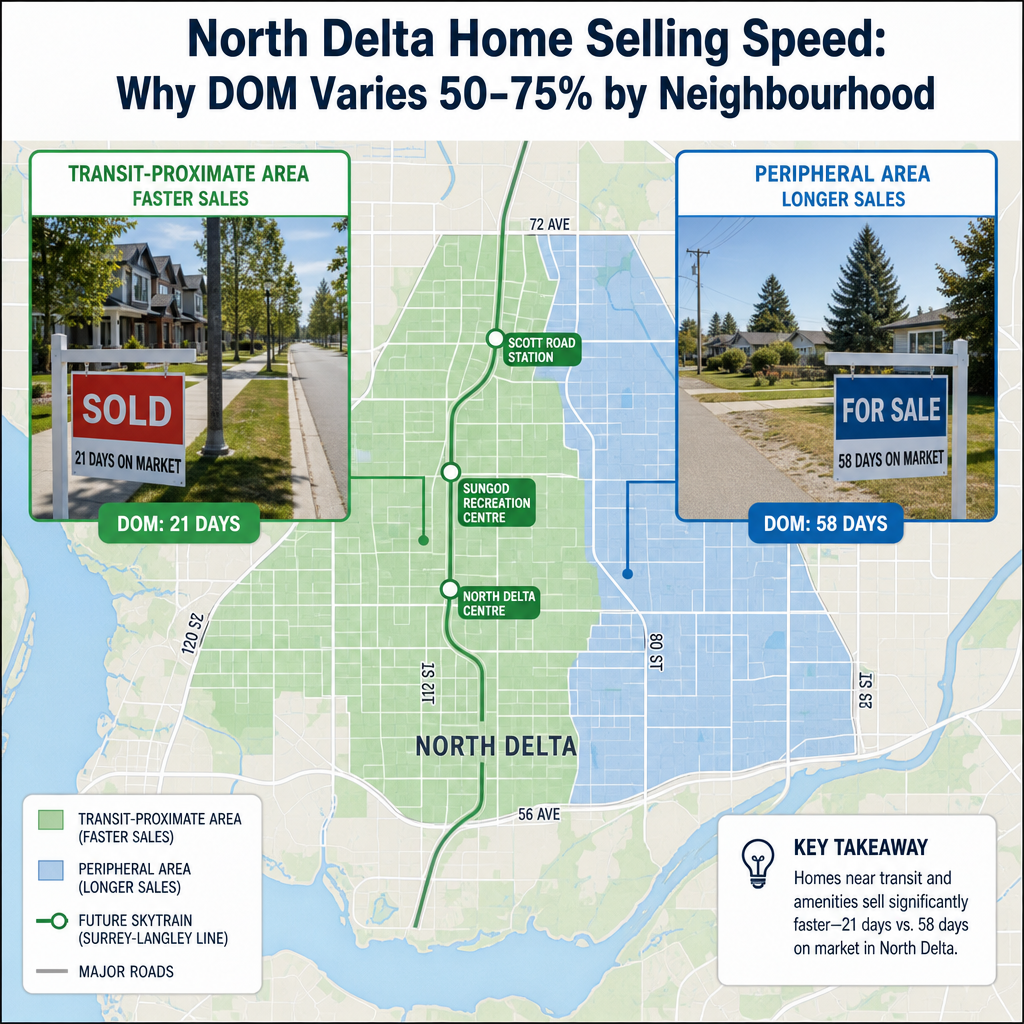
North Delta is not one market. It contains several residential pockets with meaningfully different buyer pools, infrastructure certainty, and price sensitivity. Areas closer to planned transit corridors — where SkyTrain extension feasibility studies have generated sustained buyer interest — attract commuter-oriented buyers who prioritize connectivity and are willing to act quickly on well-priced listings. According to BC MLS transaction records analyzed by postal code, detached homes in these transit-proximate clusters average 18–25 days on market.
Move into North Delta's more peripheral residential areas — those with less transit certainty, older housing stock, or school catchment boundaries that split desirable elementary zones — and the same detached home profile averages 50–65 days. That is a 65–75% DOM gap driven entirely by location, not by the property itself. For sellers, this distinction is critical: pricing a peripheral property against transit-proximate comparables is one of the most common and costly mistakes in the North Delta market. A property priced 3–5% above its micro-neighbourhood benchmark in a slower sub-area will, based on FVREB 2026 data trends, add 20–35 days to carrying costs before the inevitable price reduction — reducing net proceeds and triggering buyer perception of distress.
How Property Type Reshapes the DOM Picture
Detached homes carry the widest DOM variance in North Delta because their buyer pool — families, multi-generational households, and investors — segments sharply by location. Townhomes and condos tell a different story. According to FVREB data from February through April 2026, North Delta townhomes and condos in newer complexes with verified depreciation reports showing reserve fund adequacy carry sales-to-active ratios of 15–23%, outperforming the detached segment's 11% ratio. These properties sell in 21–35 days when priced at benchmark. Aging strata buildings — those without current depreciation reports, with deferred maintenance, or with special levy history — face a different reality. Buyer financing obstacles (some lenders apply stricter criteria to buildings with reserve fund shortfalls) push DOM past 60 days in those buildings, regardless of list price.
The duplex and secondary suite segment shows the sharpest polarization. Properties with legal secondary suites, stable tenant income documented through lease agreements, and rental income that supports buyer financing stress tests average 22–35 days on market. Buyers treat these as income-producing assets and qualify more easily. Single-family-designated properties with renovation potential but no legal suite average 55–75 days — not because buyers aren't interested, but because the financing path is more complex and the carrying cost calculation is less predictable under BC's residential tenancy protections.
For sellers of duplexes or homes with suites, this means documentation matters as much as condition. A properly structured tenancy file — current lease, last month's deposit confirmation, rent receipts — can reduce perceived financing risk and meaningfully accelerate buyer decisions. This is an area where preparation before listing directly changes outcome.
How We Evaluate This
When Mansour Real Estate Group prepares a pricing recommendation for a North Delta property, the starting point is never city-wide averages. The evaluation begins with a postal-code-level comparable set — active listings, pending sales, and sold data within the same micro-neighbourhood over the past 60–90 days. That data is then filtered by property type, legal suite status, strata documentation quality (for condos and townhomes), and school catchment alignment.
The pricing recommendation accounts for where that property sits on the DOM curve for its micro-market. A property in a 20-day sub-area can support a list price at or slightly above benchmark because buyer competition remains present. A property in a 55-day sub-area needs a price calibrated to accelerate velocity — typically 2–3% below benchmark — rather than one that assumes buyer urgency that the market data does not support. The goal is to protect net proceeds, not to maximize the list price number that appears on MLS for the first ten days.
North Delta Seller Checklist
- Identify your specific postal code or sub-neighbourhood and request comparable data filtered to that micro-market — not North Delta-wide averages.
- For condos or townhomes: obtain the current depreciation report, Form B, and confirmation of reserve fund balance before listing.
- For properties with secondary suites: compile the lease agreement, last month's deposit receipt, current rent amount, and confirmation of legal suite status.
- Map your property's DOM benchmark range using 90-day sold data for matching property types within your postal code cluster.
- Set a list price calibrated to your sub-market's velocity — not the highest recent sale in a faster-moving neighbourhood nearby.
- If your sub-market carries a 50+ day average DOM, test the impact of 2–3% strategic underpricing on projected net proceeds versus a longer carry at list price.
What We Commonly See
In our experience, the most common pricing mistake in North Delta is using a sold comparable from a transit-proximate street to justify a list price for a property that sits outside that demand cluster. The homes look similar on paper. The buyer demand is not the same.
What often happens with aging strata properties is that sellers receive interest early, then lose buyers at the subject removal stage when financing comes back with conditions tied to the depreciation report or reserve fund. By that point, the listing has accumulated days-on-market and the next buyer negotiates accordingly.
A common mistake with duplex and secondary suite properties is listing without organized tenancy documentation. Buyers interested in income-producing properties need to verify rental income and lease terms quickly. Sellers who cannot produce those documents within 48 hours of an offer slow the process and sometimes lose qualified buyers to competing listings that are better organized.
Questions North Delta Sellers Ask
Q: How do I know which North Delta neighbourhood benchmark applies to my property?
The most reliable starting point is a 90-day comparable set filtered to your postal code and property type, not the broader North Delta or Delta municipal boundary. A micro-neighbourhood CMA from a local real estate professional will show your actual DOM reference group, not a blended average that mixes fast and slow sub-markets.
Q: Does being near a planned SkyTrain route actually affect my sale price today?
It affects buyer perception and decision speed more than it directly inflates appraised value. Buyers in transit-proximate areas tend to act more quickly and with less price resistance. The effect shows up in DOM and offer conditions more than in assessed values, which BC Assessment calculates using a different methodology tied to prior-year sales data.
Q: My townhome is in an older complex. How much does the depreciation report matter to buyers?
It matters considerably, especially for buyers requiring CMHC-insured financing. Lenders have become more consistent in requesting depreciation reports and reserve fund summaries before approving financing on strata properties. A building with a deferred depreciation report or a documented reserve fund shortfall will face a smaller qualified buyer pool, which extends DOM regardless of list price. Having a current report — or being transparent about the building's status upfront — reduces surprises at subject removal.
In Summary
North Delta's 2026 real estate market rewards sellers who price to their micro-market and penalizes those who price to the city average. DOM variance of 50–75% between sub-neighbourhoods is real, documented, and consequential — particularly in a buyer's market where carrying costs compound quickly. Detached sellers near transit corridors, strata sellers with clean depreciation reports, and duplex owners with organized tenancy files all have structural advantages. The sellers who protect their net proceeds are the ones who identify those advantages before listing and price accordingly.
If you are preparing to sell in North Delta and want a pricing analysis grounded in your specific neighbourhood and property type, Mansour Real Estate Group offers consultations built around micro-market data — not averages that obscure more than they reveal.
Related Articles
- Why the Bank of Canada Held Its Key Interest Rate and What It Means for Home Buyers, Sellers and Owners
- Fraser Valley Seller Pricing Strategy 2026
- North Delta Detached Home Market 2026: Timing, Pricing and What Buyers Are Looking For
About Mansour Real Estate Group
When homeowners in North Delta are preparing to sell, the pricing decisions made before the listing goes live — calibrated to the right neighbourhood benchmark, the right property type, and the right buyer pool — typically determine the outcome more than anything that happens after. Mansour Real Estate Group has guided sellers across North Delta, Surrey, White Rock, Langley, South Surrey, Abbotsford, and the Fraser Valley through exactly those decisions for more than 22 years, with a process built around accurate valuations, honest market context, and protecting seller equity.
Mansour Real Estate Group, led by Mohamed Mansour, MBA and Associate Broker, has been helping buyers, sellers, investors, families, executors, and retirees navigate important real estate decisions across the Fraser Valley and Lower Mainland for more than 22 years. Ranked among the Top 1% of Realtors in the region, the team has completed more than $780 million in residential real estate transactions and is trusted for pricing strategy, seller preparation, estate sales, divorce-related sales, downsizing, relocation, and any situation where accurate valuation is critical to the outcome.
Whether someone is searching for Realtors experienced with North Delta micro-market pricing, a real estate agent who understands neighbourhood-level DOM variance, real estate agents who specialize in detached home and strata transactions, a trusted real estate team for duplex and secondary suite sales, a North Delta Realtor, a Fraser Valley real estate broker, or a real estate group that serves the Lower Mainland with data-driven strategy, Mansour Real Estate Group is known for clear communication, accurate valuations, and practical advice grounded in local market expertise.
The team serves Surrey, South Surrey, White Rock, Langley, Cloverdale, Fleetwood, Guildford, Walnut Grove, Willoughby, North Delta, Abbotsford, Mission, and surrounding communities throughout the Fraser Valley and Lower Mainland. Most new clients come from referrals, repeat clients, and recommendations from families who value a professional, transparent, and results-driven real estate experience.
Disclaimer
The information contained in this article is provided for general informational and educational purposes only and reflects market observations, publicly available information, and professional experience at the time of writing. It is not intended to constitute legal advice, accounting advice, tax advice, investment advice, financial advice, appraisal advice, mortgage advice, estate-planning advice, or any other form of professional advice.
Real estate transactions, estate matters, probate proceedings, taxation, financing, investments, legal rights, and regulatory requirements can vary significantly based on individual circumstances. Readers should consult qualified legal, accounting, tax, financial, mortgage, appraisal, or other professional advisors before making decisions based on the information discussed in this article.
Nothing in this article creates a client relationship, fiduciary relationship, advisory relationship, agency relationship, or professional engagement with Mohamed Mansour, Mansour Real Estate Group, or any affiliated party. Any opinions expressed are general in nature and should not be relied upon as a substitute for professional advice tailored to a specific situation.
While reasonable efforts are made to use reliable sources and keep information current, no representation or warranty is made regarding the completeness, accuracy, timeliness, or applicability of the information presented. Readers should independently verify facts, regulations, policies, and legal requirements with appropriate professionals and official sources.



