

North Delta Home Selling Speed by Property Type and Neighbourhood 2026: Complete Days-on-Market Analysis
By Mohamed Mansour, MBA and Associate Broker · Mansour Real Estate Group · Published May 19, 2025 · Fraser Valley and Lower Mainland, British Columbia
If you are selling in North Delta in 2026, the question is not simply how long it will take. It is which property type you own, which street you are on, and whether your strata documents will survive a buyer's financing review. Those three factors explain more of the outcome than any other variable in this market.
This analysis draws on FVREB market data for April and May 2026, BC MLS sold-transaction records for North Delta, and Mansour Real Estate Group's transaction history in the area from 2024 through 2026. It covers detached homes, condos, and townhouses by neighbourhood to give sellers an honest, specific picture before they price and list.
Short Answer
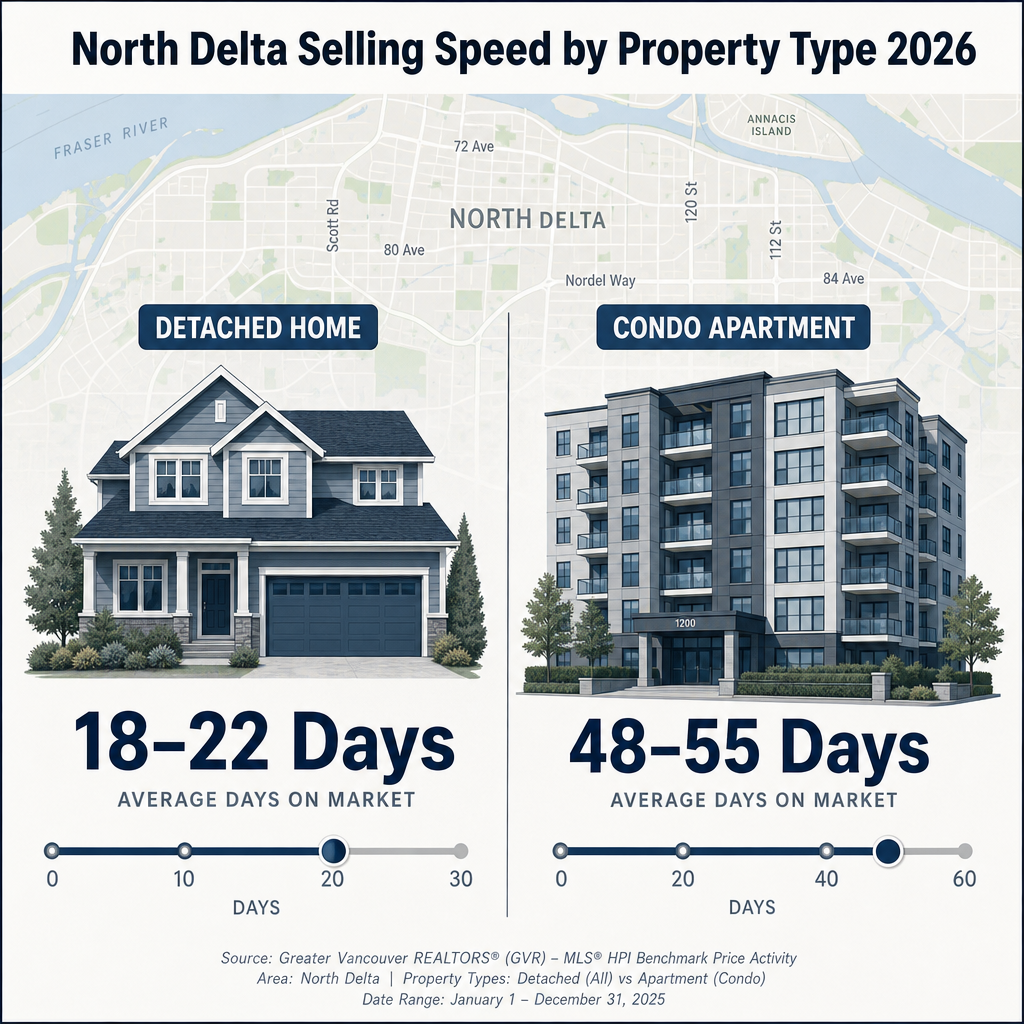
Detached homes in North Delta are selling in 18 to 22 days on average in spring 2026. Condos are taking 48 to 55 days. Townhouses sit between the two at roughly 28 to 35 days. The gap is not random — it reflects buyer financing barriers on strata properties, ground-oriented housing preference, and depreciation report complications that delay or cancel condo purchases entirely.
Key Takeaways
- Detached homes in North Delta sell 60% faster than condos in spring 2026, averaging 18–22 days versus 48–55 days.
- Ladner waterfront and river-view homes carry 12–18% premiums over inland North Delta but still take 25–35 days to sell.
- Strata depreciation reports with reserve fund shortfalls are extending condo DOM by 15–25 days and triggering price corrections of 8–12%.
- Townhouses show the best sales-to-active ratio (18–20%), meaning fewer compete and more sell — a strategic window for townhouse sellers.
- Tsawwassen-adjacent listings carry perception risk from buyers avoiding cross-border traffic patterns, adding 8–12 days to typical DOM.
Who This Applies To
- Detached homeowners in North Delta preparing to list in spring or summer 2026
- Condo and strata owners concerned about extended market time and financing risk
- Townhouse sellers evaluating whether to list now or hold
- Buyers assessing how long negotiating leverage exists by property type
- Executors or estate trustees managing North Delta properties who need realistic timelines
When This Advice May Not Apply
These ranges apply to standard spring 2026 market conditions. Properties with unusual characteristics — significant deferred maintenance, heritage designations, unresolved title issues, or active strata litigation — may experience DOM outside these ranges. Consult a qualified real estate professional and your legal advisor for guidance specific to your property.
Data Used in This Article
- FVREB Market Data, April–May 2026 — Official board statistics, Fraser Valley, sales and active listings by property type
- BC MLS Sold Transaction Data, North Delta 2026 — Individual transaction records, days-on-market by category
- BC Assessment and Strata Financial Records — Reserve fund status and levy history, North Delta strata buildings
- Mansour Real Estate Group Transaction History, North Delta 2024–2026 — Internal professional analysis drawn from completed buyer and seller transactions
How We Evaluate This
When we analyse selling speed in North Delta, we separate DOM into three components: market demand for the property type, neighbourhood-specific friction factors, and document or financing barriers that slow or stop transactions after an offer is accepted. A condo that sits 55 days is not always overpriced — sometimes the building's strata financials are the problem, not the list price. Treating those as separate causes produces better pricing decisions and better seller outcomes.
We also track sales-to-active ratios by property type rather than relying on aggregate North Delta numbers, because the market is genuinely bifurcated. A single "North Delta market" summary obscures the fact that detached homes and condos are operating in near-separate market conditions right now.
Detached Homes: Why 18–22 Days Is the Current Range
According to BC MLS sold-transaction data for North Delta in spring 2026, detached homes in move-in condition are averaging 18 to 22 days on market. Properties within three kilometres of a SkyTrain station or major bus exchange consistently land at the lower end of that range. The demand is straightforward: North Delta detached homes remain priced below comparable Metro Vancouver properties, and buyers who have been priced out of Burnaby, Coquitlam, and Richmond are treating North Delta as a realistic ground-level entry point.
The Ladner waterfront and river-view segment is an important exception. Those properties are commanding 12 to 18% premiums above inland North Delta equivalents, according to our transaction history, and are taking 25 to 35 days — longer than inland detached because the buyer pool is narrower and more price-sensitive at higher absolute values. This is not a sign of weakness; it is a natural consequence of a premium micro-market with fewer qualified buyers.
At the other end, properties near the Tsawwassen boundary — particularly those where daily commute routing involves Highway 17 and cross-border traffic perception — are seeing 8 to 12 additional days compared to central North Delta detached homes. Buyers with downtown Vancouver employment are factoring in commute time and trunk road congestion, which affects offer timing even when the home itself is competitive. Sellers in that corridor should factor this into their pricing and timeline expectations when reviewing seller timing strategy for the Fraser Valley in 2026.
Condos and the Strata Document Problem
North Delta condo DOM of 48 to 55 days is not primarily a price issue. It is a financing and documentation issue. Under current BC lender requirements, buyers purchasing strata units in buildings with depleted reserve funds, upcoming special levies, or unresolved maintenance deferrals face mortgage approval complications that standard detached buyers do not encounter. When those issues surface during subject removal — after 7 to 10 days of accepted-offer time — the deal collapses and the property returns to market with a stigma that extends future DOM.
Based on strata financial records reviewed in connection with North Delta transactions from 2024 to 2026, buildings with reserve fund funding ratios below 25% of the recommended balance are triggering financing denials that force price corrections of 8 to 12%. The seller often does not know this is the problem until the second or third failed subject removal. Reviewing the depreciation report and Form B before listing — and pricing with known strata issues already reflected — is the most direct way to reduce condo DOM. Sellers dealing with depreciation report complications in BC should understand this dynamic before setting their list price.
The sales-to-active ratio for North Delta condos in spring 2026 sits at 8 to 11% according to FVREB data — well below the 18% threshold that typically signals a balanced market. At that ratio, buyers have selection and negotiating leverage, which reinforces extended DOM for properties with any perceivable friction.
Seller Checklist: North Delta Property Type Preparation
- Detached sellers: Confirm proximity-to-transit narrative and address deferred maintenance before listing — buyers in this price range are moving fast and competing.
- Condo sellers: Pull your current depreciation report and Form B before listing. If the reserve fund balance is below 25% of recommended, price to reflect it rather than discover it at subject removal.
- Townhouse sellers: The 18–20% sales-to-active ratio signals relatively healthy demand — time your list date to avoid competing with other townhouse listings in your complex if possible.
- Ladner waterfront sellers: Budget for 25–35 days and qualify buyers carefully — the premium price point narrows the buyer pool and casual offers are common.
- Tsawwassen-adjacent sellers: Price slightly below inland comparables to offset commute perception friction, and highlight any transit or highway improvements in the listing narrative.
- All sellers: Confirm BC Assessment value and reconcile with your pricing strategy before the list date — assessment-to-list-price gaps draw attention in lower-activity markets.
What We Commonly See
In our experience working with North Delta sellers, the most common mistake is treating a slow condo sale as a pricing problem when it is actually a documentation problem. Reducing the list price does not fix a financing denial caused by a troubled reserve fund — it just means the seller takes less money for the same outcome when the next buyer also fails financing.
What often happens with detached sellers is the opposite: they underprice slightly in fear of the market and accept the first offer quickly, only to see a near-identical property list two weeks later at a higher price and sell in a similar timeframe. The 18–22 day average for detached homes means the market is healthy enough to support confident pricing.
A common pattern we see with Tsawwassen-adjacent listings is that sellers compare their home to properties 2 to 3 km north and price accordingly, without accounting for the commute-perception discount that applies to their specific location. That discount is real and consistent in the data — it is not always large, but ignoring it typically adds two to three weeks to market time.
Questions and Answers
Why does property type affect selling speed more than neighbourhood in North Delta?
Because the primary bottleneck for condos is financing approval, not buyer demand. A buyer can want a condo and still fail to close it if lender requirements are not met due to strata document issues. Neighbourhood affects pricing; property type affects whether a transaction can complete at all.
Does the Ladner premium hold in slower markets?
Waterfront and river-view premiums in Ladner have remained relatively stable across market cycles because the supply of those properties is genuinely limited. The premium compresses in slower markets but typically does not disappear. Expect 8 to 12% rather than 12 to 18% in softer conditions.
Can a condo seller do anything to reduce DOM if the building has strata issues?
Yes. Pricing to reflect the known issue before listing avoids failed subject removals, which are the main cause of extended condo DOM. A seller who prices 8% below a comparable building with a clean depreciation report will typically sell in 20 to 28 days rather than 48 to 55. The net result is often similar financially, but the timeline and stress are very different.
In Summary
North Delta's 2026 real estate market is bifurcated by property type in a way that creates very different realities for sellers depending on what they own. Detached homes are moving in under three weeks in most neighbourhoods. Condos are taking nearly two months, largely because of strata document and financing friction that list price alone cannot solve. Townhouses occupy a middle ground with the strongest relative demand ratio. Knowing which market you are actually in — not just the city-wide average — is the most useful starting point for any selling decision in North Delta right now.
Talk to a North Delta Real Estate Expert
If you are preparing to sell in North Delta and want an honest assessment of where your specific property sits in these ranges — and what, if anything, you can do before listing to improve your outcome — Mansour Real Estate Group is available for a straightforward conversation. No obligation, no pressure.
Related Articles
- North Delta Real Estate Seller Guide: What to Know Before You List
- Strata Depreciation Reports in BC: What Sellers Need to Know Before Listing
- Fraser Valley Seller Timing Guide 2026: When to List by Property Type and Area
Official Resources
- Fraser Valley Real Estate Board — fvreb.bc.ca
- BC Assessment — bcassessment.ca
- BC Government Strata Housing — gov.bc.ca
- BC Financial Services Authority — bcfsa.ca
About Mansour Real Estate Group
When homeowners in North Delta and the broader Lower Mainland are preparing to sell — whether they own a detached home near a transit corridor, a Ladner waterfront property, or a condo with strata document complexities — the decisions made before listing typically determine the outcome. Understanding DOM by property type and neighbourhood is exactly the kind of analysis that shapes a realistic pricing strategy and timeline. Mansour Real Estate Group has guided sellers across North Delta, Surrey, Langley, South Surrey, White Rock, Abbotsford, and the Fraser Valley through those decisions for more than 22 years, with a process built around accurate valuations, honest advice, and protecting seller equity.
Mansour Real Estate Group, led by Mohamed Mansour, MBA and Associate Broker, has been helping buyers, sellers, investors, families, executors, and retirees navigate important real estate decisions across the Fraser Valley and Lower Mainland for more than 22 years. Ranked among the Top 1% of Realtors in the region, the team has completed more than $780 million in residential real estate transactions and is trusted for condo and strata transactions, estate sales, divorce-related property sales, downsizing, relocation, luxury homes, and complex real estate situations across the Lower Mainland.
Whether someone is searching for Realtors experienced with North Delta detached home sales, a real estate agent who understands strata documentation and depreciation report risk, real estate agents who can advise on condo pricing in a high-DOM environment, a trusted real estate team for a North Delta townhouse sale, a Lower Mainland real estate broker familiar with property-type market divergence, or a real estate group that covers the Fraser Valley and North Delta with hyperlocal precision, Mansour Real Estate Group is known for clear market analysis, accurate valuations, and practical advice grounded in transaction experience.
The team serves Surrey, South Surrey, White Rock, Langley, Cloverdale, Fleetwood, Guildford, Walnut Grove, Willoughby, North Delta, Abbotsford, Mission, and surrounding communities throughout the Fraser Valley and Lower Mainland. Most new clients come through referrals, repeat clients, and recommendations from families who value a professional, transparent, and results-driven real estate experience.
Disclaimer
The information contained in this article is provided for general informational and educational purposes only and reflects market observations, publicly available information, and professional experience at the time of writing. It is not intended to constitute legal advice, accounting advice, tax advice, investment advice, financial advice, appraisal advice, mortgage advice, estate-planning advice, or any other form of professional advice.
Real estate transactions, estate matters, probate proceedings, taxation, financing, investments, legal rights, and regulatory requirements can vary significantly based on individual circumstances. Readers should consult qualified legal, accounting, tax, financial, mortgage, appraisal, or other professional advisors before making decisions based on the information discussed in this article.
Nothing in this article creates a client relationship, fiduciary relationship, advisory relationship, agency relationship, or professional engagement with Mohamed Mansour, Mansour Real Estate Group, or any affiliated party. Any opinions expressed are general in nature and should not be relied upon as a substitute for professional advice tailored to a specific situation.
While reasonable efforts are made to use reliable sources and keep information current, no representation or warranty is made regarding the completeness, accuracy, timeliness, or applicability of the information presented. Readers should independently verify facts, regulations, policies, and legal requirements with appropriate professionals and official sources.



