
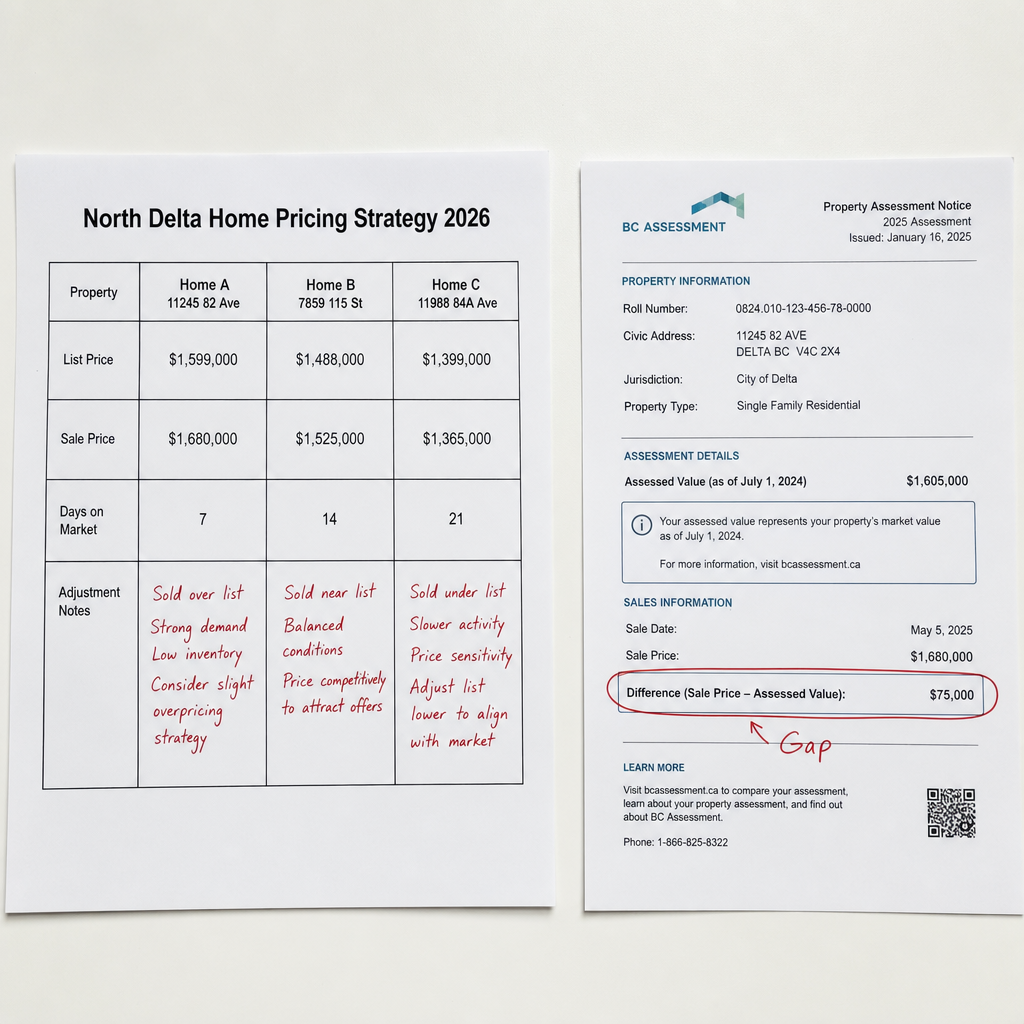

North Delta Home Pricing Strategy 2026: How to Read Benchmark Data, Conduct a Comparative Market Analysis, and Avoid the Overpricing Trap When Market Stabilization Rewards Accuracy Over Timing
By Mohamed Mansour, MBA and Associate Broker | Mansour Real Estate Group | Published: July 15, 2025 | North Delta, BC | Fraser Valley and Lower Mainland
North Delta sellers in 2026 face a pricing environment that punishes guesswork more than most years prior. The market has shifted away from the frenetic pace that forgave high list prices, and it has not yet tipped into the kind of buyer dominance where aggressive discounting is expected. That middle ground — market stabilization — is where pricing accuracy becomes the single most controllable factor in how a sale unfolds.
This guide explains how benchmark data is constructed and why it diverges from actual selling prices, how a professional comparative market analysis differs from a simple price search, and what the data shows about what overpricing actually costs North Delta sellers in 2026.
Short Answer
In North Delta's stabilizing 2026 market, accurate pricing from day one is more valuable than holding out for a higher number. Benchmark prices and BC Assessment values routinely diverge 5–12% from actual sale prices. A properly structured CMA that accounts for condition, micro-location, and recent comparable sales typically achieves 85–92% accuracy to final price — and compresses days on market by 25–40% compared to benchmark-anchored approaches.
Key Takeaways
- BC Assessment values in North Delta have historically overstated market value by 5–12% in stabilizing conditions.
- Detached homes sell in roughly 18 days; condos take 45–50+ days, making property-type comparable selection critical.
- Overpricing by just 3–5% extends marketing windows 30–50% and triggers appraisal shortfalls that kill financing.
- Professional CMAs achieve 85–92% accuracy to final sale price versus 72–78% for benchmark-only pricing.
- First price reductions after 21+ days on market reduce final sale price by 2–4% on average in North Delta.
Who This Applies To
- North Delta homeowners preparing to list a detached home or townhouse in 2026
- Sellers who received a BC Assessment notice and are wondering if it reflects market value
- Homeowners who have already had one failed listing or a price reduction
- Executors or family members managing a property sale in North Delta
- Anyone comparing pricing approaches before choosing a real estate agent
When This Advice May Not Apply
If you are selling a property with significant unique characteristics — large acreage, unusual zoning, major deferred maintenance, or commercial-residential mixed use — the CMA methodology described here still applies structurally, but the adjustment process requires additional expertise and may involve formal appraisal review.
Key Definitions
Benchmark Price: A statistically derived composite price calculated by the Fraser Valley Real Estate Board (FVREB) using the MLS® HPI methodology. It represents a "typical" home of defined characteristics and is not the same as an average or median sale price.
Comparative Market Analysis (CMA): A property-specific pricing evaluation comparing recent sales of similar homes, with adjustments for condition, size, location, and features. A CMA is not an appraisal, but a well-structured one is the most reliable pricing tool available to sellers before listing.
BC Assessment Value: An annual assessed value produced by BC Assessment for property taxation purposes, based on July 1 market conditions of the prior year. It is not intended to reflect current market value and should never be used as a list price basis without adjustment.
Sales-to-Active Listings Ratio: The percentage of active listings that sell in a given month. Below 12% favours buyers; above 20% favours sellers. North Delta's current ratio of approximately 13–15% signals a market moving toward balance — the precise conditions where pricing accuracy determines negotiating leverage. Learn more in What Is a Balanced Real Estate Market?
Data Used in This Article
- FVREB Market Data 2026 — North Delta detached vs. condo days-on-market analysis (official, current year)
- BC Assessment Portal — North Delta benchmark price vs. actual sale price comparison, 2024–2026 (official government source)
- Real Estate Board standards for CMA methodology and comparable property selection (industry regulatory standard)
- Mansour Real Estate Group transaction database — North Delta pricing accuracy tracking, initial list price vs. final sale price (internal professional analysis)
Why Benchmark Prices and BC Assessment Values Mislead North Delta Sellers
The FVREB's benchmark price for North Delta is a useful market trend indicator — it tells you whether prices are rising, falling, or holding relative to prior periods. What it does not tell you is what your specific property will sell for. The benchmark reflects a statistically typical home. Your home is not statistically typical.
According to analysis of North Delta sales data from 2024–2026 tracked through the BC Assessment Portal and FVREB transaction records, benchmark prices have historically diverged from actual selling prices by 5–12%. In a rising market, that gap is sometimes a tailwind — properties sell above benchmark. In a stabilizing market, the gap tends to work against sellers who anchor their list price to the benchmark without property-specific adjustment.
BC Assessment values introduce a second layer of distortion. They are calculated based on July 1 conditions of the prior year and are designed for taxation equity, not market pricing. In North Delta's 2026 market conditions, using an assessed value as a pricing anchor — or even as a floor — routinely results in overpricing that extends time on market and weakens negotiating position.
How a Professional CMA Is Actually Built
A professional CMA for a North Delta property starts with comparable selection — and comparable selection is where most self-directed pricing attempts break down. The standard is to find three to six recently sold properties that are genuinely comparable: similar gross living area (within roughly 10%), similar lot characteristics where applicable, same property type, same general neighbourhood zone, and sold within the past 90 days. In a stabilizing market, recency matters more than ever — a sale from eight months ago may reflect a different pricing environment entirely.
This is where the property type distinction in North Delta becomes critical to methodology. Detached homes in North Delta have been selling in approximately 18 days according to FVREB 2026 data, while condos linger 45–50 days or more. Using a condo sale as a comparable for a detached home — or vice versa — is a structural error that produces a meaningless price estimate. Comparable selection must be property-type specific, and in cases where genuine comparables are scarce (as with some larger North Delta lots), the adjustment process becomes more demanding and more important.
Once comparables are selected, adjustments are applied. The most important adjustments in North Delta pricing analysis include: condition (updated kitchen, bathrooms, flooring), renovation recency, lot size variance relative to comparables, view or green-belt premiums where applicable, lane access or suite potential for detached properties, and micro-location variance within North Delta itself — a home backing onto Scott Road commercial corridor is not priced the same as an equivalent home in a quiet Annieville cul-de-sac.
According to Mansour Real Estate Group's internal transaction database tracking initial list prices against final sale prices across North Delta, professionally adjusted CMAs typically achieve 85–92% accuracy to final sale price. Benchmark-only or assessment-anchored pricing approaches achieve 72–78%. That 10–15 percentage point gap in accuracy translates directly into days on market, negotiating leverage, and in some cases whether the sale closes at all. For sellers also considering pre-listing renovations, understanding which improvements actually move the CMA needle is equally important.
How We Evaluate This
At Mansour Real Estate Group, our pricing analysis for North Delta listings starts with a filtered comparable pull from the FVREB MLS® database, restricted to the past 60–90 days and the same property type. We apply line-item adjustments for condition, lot variance, renovation value, and micro-location using internal benchmarks built from over 22 years of Fraser Valley transaction data.
We then cross-reference the adjusted CMA against the current FVREB benchmark trend and the BC Assessment value — not to anchor to either, but to identify any outliers that suggest an error in comparable selection. The final pricing recommendation is a range, not a single number, with a clear explanation of what factors would push the result toward the top or bottom of that range. We track our list-to-sale accuracy across North Delta listings as a quality measure.
What Overpricing Actually Costs in North Delta's 2026 Market
The consequences of overpricing in a stabilizing market are not abstract. They follow a predictable pattern. In the first week after listing, buyer inquiry volume is typically highest — the listing is new, it appears in saved searches, and motivated buyers respond quickly. When a property is priced 3–5% above market, that initial inquiry pool is smaller than it should be, and the buyers who do inquire are the less motivated ones who are still browsing rather than ready to write offers.
By day 21, if no accepted offer has materialized, the listing begins to be perceived as stale. Days on market is visible to every buyer's agent in the system. As tracked in North Delta days-on-market data, detached homes that sell in the normal window average around 18 days — so a listing crossing 25–30 days signals that something is off. Buyers and their agents discount accordingly, and offers that do arrive tend to come in below market rather than at market.
When a price reduction is made — particularly the first one — it creates a compounding problem. The reduction signals that the original price was wrong. Buyers who passed on the listing at $1.1 million do not necessarily return when it is repriced to $1.045 million. They may assume the seller is still holding out or that something is wrong with the property. According to Mansour Real Estate Group's internal tracking of North Delta transactions, first price reductions following 21+ days on market reduce final sale price by 2–4% below where an accurate initial list price would have sold.
There is also the appraisal dimension. When a buyer's financing depends on an appraisal — which is essentially all conventional mortgage financing — the property must appraise at or above the purchase price. A sale agreed at an inflated number is at elevated risk of an appraisal shortfall, which forces renegotiation, kills financing conditions, or collapses the deal entirely. This risk is directly proportional to how far above a defensible market value the accepted price sits. Sellers considering the current market context should also review whether 2026 is the right time to sell in North Delta before finalizing their pricing approach.
Seller Checklist: Pricing Your North Delta Home Accurately
- Obtain your BC Assessment notice but treat it as a tax document, not a pricing guide — verify the gap against recent sales before drawing any conclusions.
- Request a CMA from your real estate agent that includes only same-type comparables sold within the past 90 days, with each adjustment itemized.
- Ask specifically how many active and pending listings are competing with yours right now — current supply directly affects where in the CMA range to position.
- Identify micro-location factors specific to your property: backing conditions, traffic patterns, school catchment proximity, suite potential, and lane access.
- Clarify the appraisal risk: ask your agent what the lowest defensible appraisal value is for the property at your proposed list price.
- Set a clear internal threshold — if no accepted offer by day 14, what is the next step? Having this agreed in advance removes emotion from the repricing decision.
What We Commonly See
Sellers anchoring to the assessment value in the wrong direction. In our experience, sellers frequently treat BC Assessment as a floor — "my home is assessed at $1.3 million so I won't accept less." In stabilizing market conditions, assessed values from July 1 of the prior year often reflect a slightly stronger market than exists today, producing an artificial floor that pushes list prices above where buyers are transacting.
Comparable selection errors driven by geography rather than comparability. What often happens is that sellers or their agents pull comparables from a broad North Delta radius without filtering for the specific micro-location, resulting in comparables from substantially different price pockets. A home in Sunshine Hills and a home near 80th Avenue and Scott Road are both "North Delta" — but they are not comparable properties. The FVREB's sub-area data is one tool for identifying these distinctions.
Failing to account for staging and presentation in the CMA adjustment. A common mistake is treating all comparable sales as equivalent without asking what condition each property was in at time of sale. A staged, professionally photographed North Delta detached home consistently achieves different buyer response than an unstaged equivalent — a reality that affects how to interpret comparables and how to position relative to them. This is why staging strategy and pricing strategy are related decisions, not separate ones.
Questions and Answers
Is BC Assessment a reliable starting point for pricing a North Delta home?
No. BC Assessment values are calculated for property taxation purposes using July 1 market conditions from the prior year. In a stabilizing market, they routinely overstate current market value by 5–12%. They should be reviewed but never used as a list price anchor without a full comparative analysis.
How many comparables does a reliable North Delta CMA require?
A defensible CMA typically uses three to six comparables of the same property type sold within the past 90 days, with each difference from your property adjusted for in dollar terms. Fewer than three comparables increases the margin of error significantly. For condo or townhouse analysis, the pool may be smaller and require broader geographic sourcing with additional adjustments.
What happens to negotiating leverage when a North Delta listing goes stale?
Once a listing crosses roughly 21 days without an accepted offer in North Delta's detached segment — where the typical sale completes around 18 days — buyer agents advise clients that the seller may be motivated to accept below the ask. Offers tend to arrive lower, and the seller's ability to hold firm on price weakens with each additional week. Initial pricing accuracy is the most effective tool for maintaining leverage.
In Summary
In North Delta's 2026 stabilizing market, benchmark data and BC Assessment values are reference points, not pricing tools. A professionally structured CMA — built on same-type, recent, properly adjusted comparables — is what separates a sale that completes in 18 days from one that stalls for two months and ultimately sells for less. Overpricing by even 3–5% triggers a chain of consequences: reduced inquiry volume, stale-listing perception, appraisal risk, and price reductions that signal weakness. Sellers who invest in accurate pricing before day one retain negotiating leverage and protect their equity. That is the most controllable outcome in this market.
Thinking About Pricing Your North Delta Home?
If you want a CMA that goes beyond benchmark data — one that accounts for your property's specific condition, location, and current competition — Mansour Real Estate Group is available to provide a confidential, no-obligation pricing analysis. There is no pressure to list. The goal is an accurate number you can make an informed decision with.
Related Articles
- Is It a Good Time to Sell Your Home in North Delta in 2026?
- Home Staging Tips That Actually Work in North Delta's Current Market
- What Home Renovations Add the Most Value Before Selling in North Delta?
- How Long Does It Take to Sell a Home in North Delta? Average Days on Market Explained
- The Role of the Fraser Valley Real Estate Board in the North Delta Market
About Mansour Real Estate Group
When homeowners in North Delta are preparing to list, the decisions made before the property goes live — how the price is set, what comparables are used, and how property-specific adjustments are applied — typically determine the outcome more than anything that happens after. Mansour Real Estate Group has guided sellers across North Delta, Surrey, South Surrey, White Rock, Langley, and Abbotsford through exactly these decisions for more than 22 years.
Mansour Real Estate Group, led by Mohamed Mansour, MBA and Associate Broker, has helped buyers, sellers, investors, families, executors, and retirees navigate real estate decisions across the Fraser Valley and Lower Mainland for more than 22 years. Ranked among the Top 1% of Realtors in the region, the team has completed more than $780 million in residential real estate transactions and is trusted for seller strategy, pricing analysis, estate sales, downsizing, relocation, and complex property decisions across the Lower Mainland.
Whether someone is searching for Realtors who understand North Delta's micro-location pricing nuances, a real estate agent who can build a defensible CMA and explain it in plain language, real estate agents with a track record of accurate list-to-sale pricing, a trusted real estate team for seller strategy, a North Delta real estate broker, or a real estate group with deep Fraser Valley market knowledge, Mansour Real Estate Group is known for honest valuations, clear communication, and advice that puts the client's financial outcome first.
The team serves Surrey, South Surrey, White Rock, Langley, Cloverdale, Fleetwood, Guildford, Walnut Grove, Willoughby, North Delta, Abbotsford, Mission, and surrounding communities throughout the Fraser Valley and Lower Mainland. Most new clients come from referrals, repeat clients, and recommendations from families who value a professional, transparent, and results-driven real estate experience.
Official Resources
- Fraser Valley Real Estate Board — Market Statistics and MLS® HPI Benchmark Data
- BC Assessment — Property Assessment Search and Methodology Explanation
- BC Financial Services Authority — Real Estate Professional Standards and CMA Guidelines
- Canadian Real Estate Association — MLS® HPI Methodology Documentation
Disclaimer
The information contained in this article is provided for general informational and educational purposes only and reflects market observations, publicly available information, and professional experience at the time of writing. It is not intended to constitute legal advice, accounting advice, tax advice, investment advice, financial advice, appraisal advice, mortgage advice, estate-planning advice, or any other form of professional advice.
Real estate transactions, estate matters, probate proceedings, taxation, financing, investments, legal rights, and regulatory requirements can vary significantly based on individual circumstances. Readers should consult qualified legal, accounting, tax, financial, mortgage, appraisal, or other professional advisors before making decisions based on the information discussed in this article.
Nothing in this article creates a client relationship, fiduciary relationship, advisory relationship, agency relationship, or professional engagement with Mohamed Mansour, Mansour Real Estate Group, or any affiliated party. Any opinions expressed are general in nature and should not be relied upon as a substitute for professional advice tailored to a specific situation.
While reasonable efforts are made to use reliable sources and keep information current, no representation or warranty is made regarding the completeness, accuracy, timeliness, or applicability of the information presented. Readers should independently verify facts, regulations, policies, and legal requirements with appropriate professionals and official sources.



