
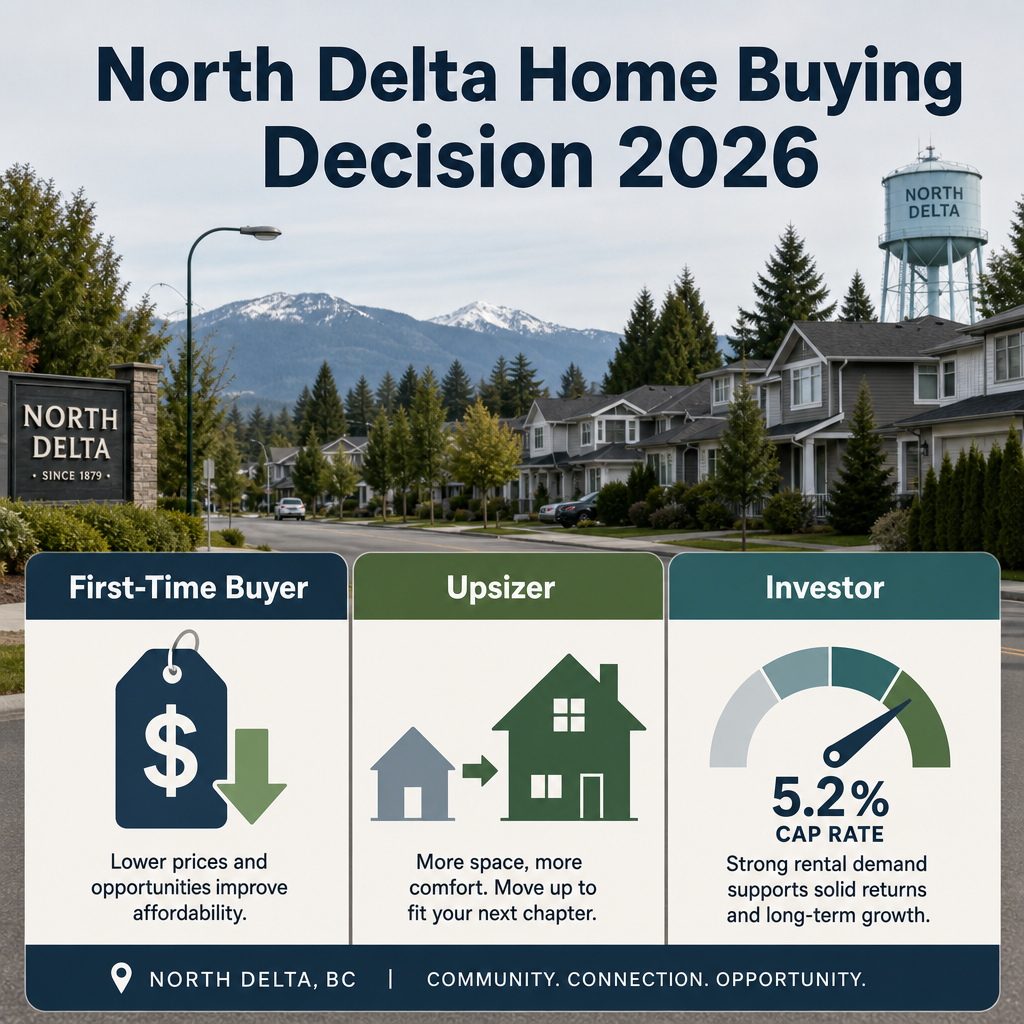

North Delta Home Buying Decision 2026: Is Now the Right Time to Buy? Complete Interest Rate, Inventory, and Price Trajectory Analysis for First-Time Buyers, Upsizers, and Investors
By Mohamed Mansour, MBA and Associate Broker — Mansour Real Estate Group | Published: May 12, 2026 | North Delta, Fraser Valley, BC
North Delta sits in an unusual position heading into mid-2026. Prices are down from their 2022 peaks. Inventory is elevated across the Fraser Valley. Interest rates have stabilized. And buyer demand, while recovering, has not yet caught up with supply. For buyers who have been waiting for the right conditions, the window that exists right now deserves a serious look — before spring migration compresses it.
This article breaks down the current market by buyer type — first-time buyers, upsizers, and investors — and explains what the data actually means for each group. It draws on Fraser Valley Real Estate Board sales data, Bank of Canada rate guidance, and the on-the-ground patterns Mansour Real Estate Group observes working with buyers across North Delta and the broader Lower Mainland.
Short Answer
For most buyer profiles, early-to-mid 2026 represents a better entry window in North Delta than the preceding two years. Price corrections of 6–10% from 2022 peaks, inventory 45% above historical averages, and stable mortgage rates combine to give buyers negotiating leverage that has not existed since 2018–2019. The advantage narrows as spring migration from Metro Vancouver intensifies.
Key Takeaways
- North Delta detached homes are selling in approximately 18 days; condos are sitting 45–50+ days, creating very different negotiating conditions by property type.
- Fraser Valley inventory is roughly 45% above historical averages, giving buyers meaningful negotiating leverage that tightens each spring.
- Year-over-year price corrections of 6–10% have occurred, with month-over-month stabilization suggesting a market floor may be forming in early 2026.
- Bank of Canada rate holds mean current mortgage rates in the 4.5–5.5% range are likely to persist through mid-2026 — predictable if not low.
- Entry-level detached homes under $750K in North Delta are outperforming condos significantly in sales velocity, favouring first-time detached buyers over strata.
Who This Applies To
- First-time buyers evaluating whether to enter the market now or wait for further price declines or rate cuts
- Upsizers who own a current property and are considering moving up to a larger North Delta detached home
- Investors assessing whether North Delta rental yields and cap rates justify purchase in 2026
- Metro Vancouver buyers considering relocation to North Delta for affordability or space
When This Advice May Not Apply
Buyers with unstable employment, insufficient down payment, or holding financing pre-approvals near qualification thresholds should consult a mortgage professional before interpreting market timing as a buying signal. Financing readiness matters more than market timing in most individual situations. This analysis is general and not a substitute for advice tailored to your financial position.
Key Terms Used in This Article
Sales-to-active listings ratio: The percentage of active listings that sell in a given month. Below 12% indicates a buyer's market. The Fraser Valley was sitting at approximately 11% in early 2026, according to FVREB data.
Days on market (DOM): The number of days from listing to accepted offer. Varies significantly by property type in North Delta — roughly 18 days for detached, 45–50+ days for condos.
Cap rate: A rental property's net operating income divided by its purchase price. Used to assess investment viability. North Delta rental units are currently generating estimated cap rates in the 4.5–5.5% range.
Benchmark price: A statistical measure of a typical home's price in a given area, calculated by the real estate board to adjust for property mix. More stable than average sale price for tracking true price direction.
Data Used in This Article
- Fraser Valley Real Estate Board (FVREB): February–April 2026 sales data, days on market by property type, sales-to-active ratios, benchmark price tracking — official board data
- Bank of Canada: 2026 policy rate announcements and forward guidance — official central bank source
- Mansour Real Estate Group internal analysis: Neighbourhood-level DOM patterns, buyer migration observations, cap rate estimates for North Delta rental market — professional interpretation based on active transactions
- BC Assessment / comparative benchmark data: Year-over-year price correction ranges by property type — third-party and official
What the North Delta Market Actually Looks Like Right Now
The Fraser Valley Real Estate Board reported a sales-to-active listings ratio of approximately 11% in early 2026 — firmly in buyer's market territory, where anything below 12% means buyers hold the upper hand in negotiations. North Delta mirrors this pattern. Inventory across the region has climbed to levels roughly 45% above historical averages, with over 10,000 active listings across the Fraser Valley at peak measurement periods this spring.
Within North Delta specifically, the story splits sharply by property type. Detached homes are moving in about 18 days on average — not fast, but not stagnant either. Condos and strata properties are sitting 45 to 50+ days, which reflects both buyer caution around strata fees and ongoing financing complexity for older buildings. That gap creates meaningfully different negotiating conditions depending on what you are buying.
Prices have corrected 6–10% year-over-year depending on property type, measured against 2022 peak benchmarks. More relevant for buyers: month-over-month data from early 2026 is showing stabilization signals, not continued decline. This does not mean prices are about to surge — but it does mean the easy downward drift of 2023–2024 has likely run its course in the detached segment. See the North Delta Real Estate Market Report 2025 for full price trend context.
On financing, the Bank of Canada has held its policy rate steady through early 2026, with forward guidance suggesting no imminent cuts through mid-year. That puts most qualified buyers in the 4.5–5.5% mortgage rate range — elevated compared to 2020–2021 lows, but stable and predictable. For buyers who have been waiting for rate cuts to time their entry, the data suggests that waiting carries its own cost: the negotiating leverage available now is tied to inventory levels that will compress as spring migration from Metro Vancouver accelerates. The interest rate impact on the North Delta market is explored in depth in a companion article.
Buyer-Segment Analysis: First-Time Buyers, Upsizers, and Investors
First-Time Buyers
The most interesting finding in current North Delta data for first-time buyers is the performance divergence between detached and condo. Entry-level detached homes under $750K are selling at 40–60% faster rates than comparable strata units. That tells you something real about buyer demand: people who can stretch to detached are doing it, and the entry-level detached segment in North Delta is showing relative strength even as the broader market softens.
For first-time buyers with sufficient down payment to qualify at current rates, the calculus favours acting before April–May, when spring buyer migration from Metro Vancouver typically compresses inventory and shifts negotiating leverage toward sellers. The First-Time Home Buyer's Guide to North Delta walks through the full purchase process including First Home Savings Account eligibility and provincial programs. The buy vs. rent comparison for North Delta is also worth reviewing before committing.
Upsizers
Upsizers — buyers who already own and are moving to a larger property — are in the strongest relative position of any buyer segment right now. The price correction of 8–12% from 2022 peaks on larger detached homes is proportionally larger in dollar terms than the correction on smaller entry-level properties. That gap creates a genuine upgrade opportunity: selling a property that has corrected modestly and buying one that has corrected more substantially. The key is sequencing the sale and purchase correctly in a buyer's market where your outgoing property may take longer to sell than expected. Review the North Delta days-on-market data by property type before planning your timeline.
Investors
North Delta rental cap rates have stabilized in the 4.5–5.5% range, according to Mansour Real Estate Group's internal analysis of current rental market conditions. Dual-unit properties and homes with legal basement suites are showing viable rental economics at current purchase prices — something that was not true at 2022 peak values. That said, BC's residential tenancy framework adds meaningful complexity for investors, particularly around rent increases, eviction restrictions, and unit turnover timelines. Investors should review the long-term investment value analysis for North Delta and consult an accountant familiar with BC real estate before purchasing. Foreign buyers and those subject to provincial speculation taxes should also review the Foreign Buyer Ban and Speculation Tax implications for North Delta.
How We Evaluate This
Mansour Real Estate Group does not advise buyers based on market timing alone. The right time to buy is always the intersection of market conditions and individual readiness — financing stability, property fit, timeline, and long-term intention. What the current market provides is an unusual alignment of favourable conditions across multiple indicators simultaneously: elevated inventory, price corrections, stable rates, and reduced competition. Those conditions do not always coincide.
When we work with buyers in North Delta, we evaluate the sales-to-active ratio in the specific sub-area and property type they are targeting, not just the regional headline number. We also look at list-price-to-sale-price ratios on recent comparable sales to gauge how much room exists for offers below asking. In a market where condos are sitting 45+ days, the realistic discount available is meaningfully different from what applied 18 months ago.
Buyer Checklist: North Delta 2026
- Obtain a current mortgage pre-approval that reflects today's qualifying rate, not an estimate — rate holds typically last 90–120 days
- Clarify your property type target: detached conditions and condo conditions in North Delta are operating in different markets right now
- Review recent comparable sales in your target neighbourhood — not just list prices — to understand realistic offer ranges
- For strata properties, request Form B, depreciation report, strata minutes, and current special levy status before writing an offer
- Upsizers: plan your sale timeline before buying — confirm your current property's realistic DOM before committing to a completion date on a new purchase
- Investors: confirm rental zoning, suite legality, and tenancy status before subject removal — inherited tenancies affect your ability to set rents at market rates
- Review property tax obligations; see the North Delta property tax guide for current mill rate context
What We Commonly See
In our experience, buyers who wait for interest rates to drop before entering the market often discover that rate reductions coincide with rising prices and returning competition — so the monthly payment they were trying to lower ends up similar or higher on a more expensive property. The favourable conditions in 2026 are inventory-driven, not rate-driven.
What often happens with upsizer clients is that they underestimate how long their current property will take to sell and overestimate how long their target property will stay available. In a market where detached homes sell in 18 days on average, a well-priced property at a buyer's preferred price point may not wait for a conditional sale.
A common mistake for first-time buyers in the current strata market is assuming that a longer-sitting condo represents a better deal. Often it reflects an underlying issue — a pending special levy, a depreciation report with deferred maintenance, or a building with financing restrictions — rather than pure market softness. Due diligence on strata documents is not optional in this environment. The complete home buying process guide for North Delta covers strata document review in detail.
Questions and Answers
Will North Delta home prices drop further in 2026?
Month-over-month stabilization in early 2026 FVREB benchmark data suggests the steepest declines in detached homes have likely passed. Further softening in the condo segment remains possible given extended days on market. No one can predict a precise bottom, but current conditions favour buyers who are financially ready rather than those waiting for a lower floor that may not materialize.
How much can I negotiate off the asking price in North Delta right now?
In the current buyer's market, condos with 45+ days on market often have room for offers 3–6% below list price, depending on seller motivation and building-specific factors. Well-priced detached homes selling in 18 days typically have less room. List-price-to-sale-price ratios on recent comparable sales provide the clearest answer for any specific property.
Is 2026 a good time for first-time buyers to enter the North Delta market?
For buyers with stable financing and a 5–10 year ownership horizon, 2026 offers entry conditions — corrected prices, reduced competition, and stable rates — that have not aligned simultaneously since 2018–2019. The risk of waiting is not falling prices; it is rising competition compressing the negotiating advantage that currently exists. Financing readiness determines the answer more than market timing for most first-time buyers.
In Summary
North Delta's 2026 buyer's market is real, specific, and not evenly distributed across property types. Detached homes are moving faster than condos, entry-level properties under $750K are showing relative strength, and the negotiating window is connected to inventory levels rather than rate reductions. For buyers who are financially ready, the current alignment of corrected prices, elevated inventory, and stable rates is worth acting on before spring migration tightens conditions. The decision ultimately depends on individual readiness, property type, and intended holding period — not on market timing alone.
Ready to Explore Your Options in North Delta?
If you are evaluating a purchase in North Delta and want a clear, data-grounded conversation about what the market actually looks like for your specific situation, Mansour Real Estate Group is available for a no-obligation consultation. The goal is to give you the information you need to make a confident decision, on your timeline.
Related Articles
- North Delta Real Estate Market Report 2025: Prices, Trends, and What to Expect
- First-Time Home Buyer's Guide to Purchasing in North Delta
- Is North Delta a Good Real Estate Investment? Long-Term Value Analysis
Official Resources
- Fraser Valley Real Estate Board — fvreb.bc.ca
- Bank of Canada — bankofcanada.ca
- BC Assessment — bcassessment.ca
- BC Residential Tenancy Branch — gov.bc.ca
About Mansour Real Estate Group
For buyers evaluating whether to enter the North Delta market in 2026 — whether as a first-time buyer, an upsizer, or an investor — the quality of the local guidance available makes the difference between a confident decision and a costly mistake. Mansour Real Estate Group has helped buyers, sellers, and investors navigate the North Delta and Fraser Valley market for more than 22 years, with a data-driven process built around accurate valuations, honest market interpretation, and buyer-first advice.
Mansour Real Estate Group, led by Mohamed Mansour, MBA and Associate Broker, is one of the highest ranked realtors in the Fraser Valley and Lower Mainland. The team has completed more than $780 million in residential real estate transactions and is trusted for first-time buyer guidance, upsizer strategy, investor analysis, estate sales, downsizing, relocation, and complex real estate decisions throughout the region.
Whether someone is searching for Realtors who understand Fraser Valley buyer's market conditions, a real estate agent with deep North Delta neighbourhood knowledge, real estate agents who can explain price corrections in plain terms, a trusted real estate team for a first purchase, a North Delta Realtor, a Delta real estate broker, or a real estate group serving the Fraser Valley and Lower Mainland, Mansour Real Estate Group is known for clear communication, practical market analysis, and advice grounded in local experience rather than generic guidance.
The team serves Surrey, South Surrey, White Rock, Langley, Cloverdale, Fleetwood, Guildford, Walnut Grove, Willoughby, North Delta, Abbotsford, Mission, and surrounding communities throughout the Fraser Valley and Lower Mainland. Most new clients come through referrals, repeat clients, and families who recommend the team for professional, transparent, and results-driven real estate experiences.
Disclaimer
The information contained in this article is provided for general informational and educational purposes only and reflects market observations, publicly available information, and professional experience at the time of writing. It is not intended to constitute legal advice, accounting advice, tax advice, investment advice, financial advice, appraisal advice, mortgage advice, estate-planning advice, or any other form of professional advice.
Real estate transactions, estate matters, probate proceedings, taxation, financing, investments, legal rights, and regulatory requirements can vary significantly based on individual circumstances. Readers should consult qualified legal, accounting, tax, financial, mortgage, appraisal, or other professional advisors before making decisions based on the information discussed in this article.
Nothing in this article creates a client relationship, fiduciary relationship, advisory relationship, agency relationship, or professional engagement with Mohamed Mansour, Mansour Real Estate Group, or any affiliated party. Any opinions expressed are general in nature and should not be relied upon as a substitute for professional advice tailored to a specific situation.
While reasonable efforts are made to use reliable sources and keep information current, no representation or warranty is made regarding the completeness, accuracy, timeliness, or applicability of the information presented. Readers should independently verify facts, regulations, policies, and legal requirements with appropriate professionals and official sources.



