
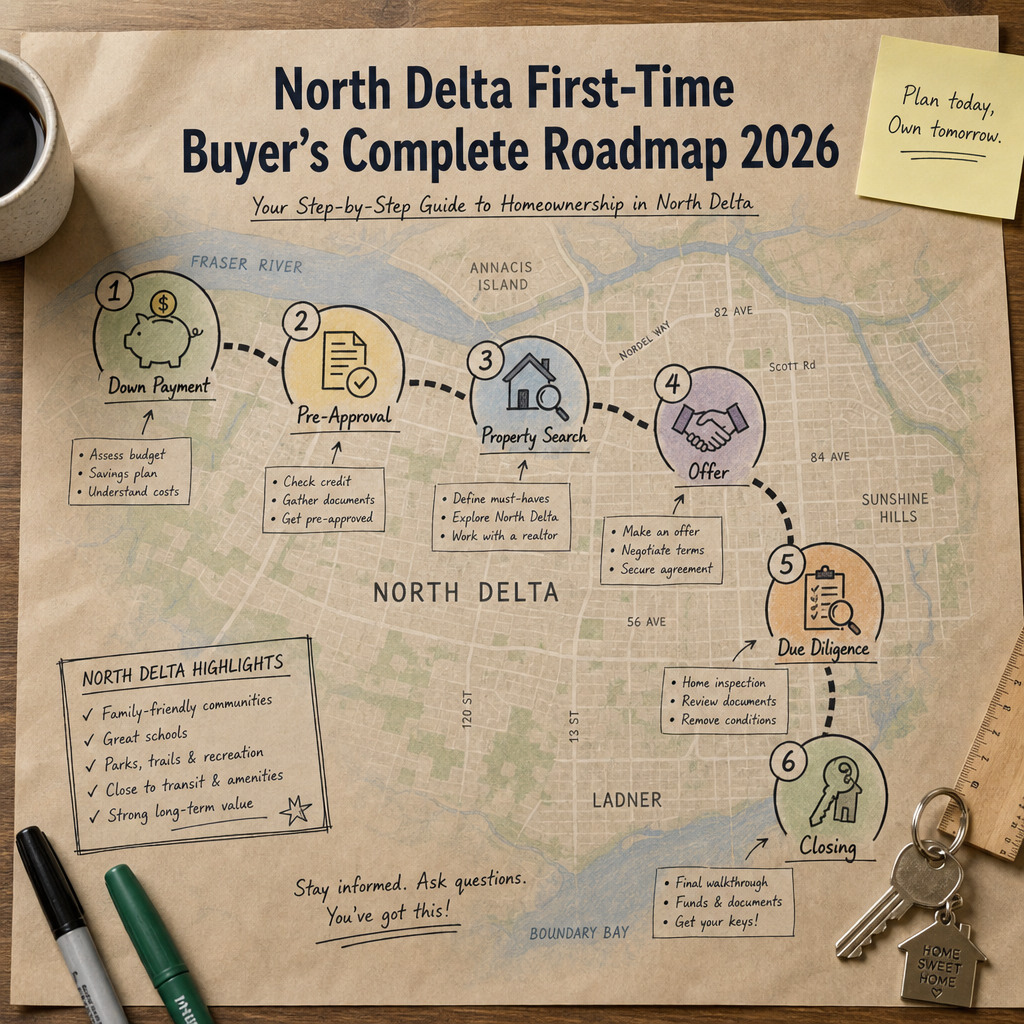

North Delta First-Time Buyer's Complete Roadmap 2026: From Down Payment Savings and Pre-Approval Through Offer Strategy, Due Diligence, Subject Removal, and Closing
By Mohamed Mansour, MBA and Associate Broker — Mansour Real Estate Group | North Delta, Metro Vancouver | Published: July 28, 2026 | Topic: Buyer Guide — First-Time Buyers, North Delta, BC
For most first-time buyers, North Delta sits at a crossroads: affordable enough to get into Metro Vancouver's housing market without pushing further east into the Fraser Valley, yet competitive enough that under-prepared buyers lose out to investors, relocating families, and downsizers who already know the process. The gap between knowing you want to buy and actually closing successfully is wider than most people expect — and it almost always comes down to preparation, not luck.
This guide walks through every stage of the purchase journey, from calculating how much you actually need to save to what happens in the final 48 hours before possession. It is written specifically for buyers navigating North Delta's market in 2026, where detached homes sell in roughly 18 days and condos can sit for 50 or more — two completely different competitive environments that require two completely different approaches.
Short Answer
First-time buyers in North Delta need 6 to 12 months of preparation: build $65,000–$160,000 in down payment savings depending on property type, obtain a firm pre-approval that survives the stress test, understand how days-on-market differences between detached homes and condos change your offer strategy, and know exactly what happens if your appraisal comes in short before you remove subjects.
Who This Applies To
- First-time buyers targeting detached homes, townhouses, or condos in North Delta with purchase budgets between $500,000 and $900,000
- Buyers currently renting in Metro Vancouver who are evaluating North Delta as a more affordable entry point
- Couples or individuals in the early savings and pre-approval stage who want a complete picture of the process before making commitments
- Buyers who have lost offers on other properties and are trying to understand what went wrong
When This Advice May Not Apply
This guide is written for owner-occupier first-time buyers. Investors, buyers purchasing under a trust structure, or buyers with prior home ownership may face different qualification rules, tax implications, and program eligibility. Consult a mortgage professional and a lawyer for your specific situation.
Key Takeaways
- North Delta detached homes sell in roughly 18 days, demanding faster offer decisions than condos, which average 45–50+ days.
- At $650K–$800K benchmarks, you need $65K–$160K saved depending on whether you use CMHC-insured financing.
- The stress test qualifies you at your contract rate plus 2%, compressing real buying power significantly at today's rates.
- Appraisal shortfalls occur in 15–20% of North Delta purchases — knowing your renegotiation options before you offer protects you.
- Strata depreciation reports due July 1 in BC can trigger special levy risk that affects both financing approval and appraisal value.
Data Used in This Article
- Fraser Valley Real Estate Board — North Delta Days-on-Market by Property Type, Q1–Q2 2026 (official board data)
- CMHC — Mortgage Loan Insurance Premium Rates and Stress Test Rules, 2026 (official federal mortgage insurer)
- BC Assessment — North Delta Benchmark and Assessment Data, 2026 (official provincial assessment authority)
- BC Strata Property Act and Depreciation Report Requirements — Province of BC (official legislation and regulatory guidance)
Stage 1: Down Payment Math at North Delta Price Points
North Delta's benchmark for detached homes sits in the $1.0M–$1.2M range in established neighbourhoods, while townhouses and condos price between roughly $550,000 and $800,000 depending on size and age. For most first-time buyers, townhouses and condos are the realistic entry point.
At a $650,000 purchase price, a 5% down payment is $32,500 — but CMHC mortgage insurance premiums apply at 4.00% of the insured amount, adding roughly $24,700 to the mortgage. A 10% down payment ($65,000) reduces the premium to 3.10%. At 20% ($130,000), insurance disappears entirely. Each tier produces a different monthly payment and a different qualification ceiling under the stress test.
The stress test — applied by federally regulated lenders under OSFI's B-20 guideline — qualifies you at the higher of your contract rate plus 2% or the Bank of Canada's qualifying rate. In 2026, with variable rates in the low-to-mid 4% range, most buyers are qualifying at 6% to 6.5%, which reduces purchasing power by roughly 20% compared to what the advertised rate alone would suggest. Understanding how pre-approval works in BC before you set a budget is essential to avoiding a gap between what you think you can buy and what a lender will actually approve.
Beyond the down payment, first-time buyers routinely underestimate closing costs: property transfer tax (partially waived for first-time buyers on purchases under $500,000, with a partial exemption up to $835,000 as of 2024 program thresholds — confirm current limits at the BC Government website), legal fees ($1,200–$2,000), home inspection ($500–$700), and title insurance ($200–$400). Budget an additional $8,000–$15,000 for closing costs on a $650,000–$800,000 purchase. The BC first-time buyer programs and exemptions guide covers the specific rebates, grants, and exemptions available to reduce that cost.
Stage 2: Pre-Approval, Property Type Selection, and the North Delta DOM Reality
A pre-approval is not a mortgage guarantee. It is a lender's conditional commitment based on your income, credit, and the information you provided at application. It still depends on the property appraising at or above the purchase price, the strata building passing the lender's review, and your financial situation not changing before closing. That said, a firm pre-approval — not just a pre-qualification estimate — is the minimum standard before you view homes in North Delta's current market.
Property type selection dramatically changes your timeline and competitive exposure. According to FVREB market data for North Delta in 2026, detached homes sell in approximately 18 days on average. Condos and older townhomes take 45 to 50+ days. That difference is not cosmetic — it determines how quickly you must be ready to offer, how much leverage you have on conditions, and how much time you have to complete due diligence before subject removal.
For first-time buyers, the condo and townhouse segments often feel safer because they move more slowly, but they carry their own risks. Townhouses in North Delta require careful review of strata documents, depreciation reports, and special levy history before you commit. Older strata buildings — and North Delta has several built in the 1980s and 1990s — may carry deferred maintenance that is visible in the depreciation report but not priced into the list price.
Before you start viewing properties, align your pre-approval ceiling with your realistic monthly carrying cost, not just the maximum the lender will approve. A lender approving you for $850,000 does not mean $850,000 is the right purchase for your cash flow at today's rates. Build your number from monthly payment up, not from the pre-approval ceiling down.
Stage 3: Offer Strategy in a Split Market
North Delta in 2026 is a balanced-to-slightly-soft market overall, but the averages conceal a two-speed reality. Detached homes in Annieville, Sunshine Hills, and Scott Road-adjacent pockets attract multiple offers when priced correctly. Condos and older townhomes often sit, which means list price is a starting point for negotiation rather than a floor.
For detached homes moving under 20 days, your offer must be clean and fast. That means your financing condition must be tight (5–7 business days is standard; some buyers push to 3–5), your inspection condition must be scheduled within 48 hours of acceptance, and your deposit must be ready to transfer immediately upon acceptance. Delays in any of these signal to the seller that you are not prepared — and in a multiple-offer situation, prepared buyers with clean timelines win over higher-priced offers with loose conditions.
For condos sitting 45+ days, you have more room. Offer subject to financing, inspection, and strata document review. Request the Form B, depreciation report, financial statements, and meeting minutes going back three years. These documents are legally required to be provided within a defined period under BC's Strata Property Act — your subjects give you the time to review them properly. Do not waive strata document review to appear competitive on a property that has been sitting. The reason it has been sitting may be in those documents.
On price: in a balanced market, most North Delta condos and townhomes transact within 2–4% of list price. Detached homes in active pockets can trade at or above list. Use recent comparable sales — not list prices — to anchor your offer. Offer strategy in North Delta's current market depends on reading the specific property's days-on-market, the seller's situation, and whether competing offers are present.
Stage 4: Due Diligence and Appraisal Risk
Subject removal is where most first-time buyers feel the most pressure — and make the most mistakes. The typical North Delta purchase includes a financing condition (7 business days), a home inspection condition (5–7 business days), and for strata properties, a strata document review condition. These conditions run concurrently, so your 7-day window needs to accomplish everything at once.
The inspection identifies physical red flags: aging roofs, moisture intrusion, foundation cracks, knob-and-tube wiring in older North Delta detached homes, and poly-B plumbing in properties built before the mid-1990s. Do not skip the inspection to win a faster deal. A $700 inspection that identifies a $40,000 drainage problem is the best money a first-time buyer will spend.
The appraisal is ordered by your lender and paid for by you (typically $400–$600). It is the step most first-time buyers do not anticipate failing — but in 15–20% of North Delta purchases, the appraised value comes in below the offer price. When that happens, the lender will only lend against the appraised value. If you offered $760,000 and the appraisal comes in at $730,000, you must either renegotiate the price with the seller, make up the $30,000 shortfall from your own funds, or remove the financing condition and walk away.
Before you offer on a property, ask your agent to run comparable sales at tight parameters — same neighbourhood, same property type, same approximate age and size, within the last 60–90 days. If the comparables support your offer price, the appraisal risk is lower. If you are stretching beyond what comparables support because of emotional attachment to the property, that gap is real money you may need to produce at subject removal.
For strata buyers, confirm that the building has a current depreciation report. Under BC's Strata Property Act, most strata corporations are now required to obtain updated depreciation reports by July 1, 2026. A building without a current report, or one with a large unfunded contingency reserve, may trigger lender restrictions or affect your financing approval altogether. Some lenders will not approve mortgages on strata buildings with known unresolved special levies. Review this before you offer, not after.
How We Evaluate This
When Mansour Real Estate Group works with first-time buyers in North Delta, the pre-offer preparation phase is where most of the strategic value is created. That includes running a pre-offer comparable analysis on every property before the buyer decides whether to proceed, reviewing days-on-market context to calibrate how quickly the buyer needs to act, and stress-testing the financing scenario against likely appraisal outcomes before the offer is submitted.
The subject removal phase is treated as a parallel workflow, not a sequential one. Inspection, appraisal, and strata document review are all initiated within 24 hours of accepted offer whenever possible, so the buyer is not scrambling in the final 48 hours of the condition period. Most first-time buyers who lose deposits or concede negotiating leverage do so because they started that process too late.
First-Time Buyer Checklist for North Delta
- Calculate your realistic down payment tier (5%, 10%, or 20%) and model total carrying costs at today's qualifying rate before setting a search budget
- Obtain a firm pre-approval — not a pre-qualification — from a federally regulated lender or licensed mortgage broker before viewing homes
- Confirm whether the properties you are targeting are CMHC-insurable (purchase price under $1.5M, primary residence, minimum 5% down) and how that affects your timeline
- For strata and townhouse targets, request the depreciation report, Form B, financial statements, and meeting minutes before or within your condition period
- Run a comparable sales analysis on every property before making an offer to assess appraisal risk relative to your proposed offer price
- Book your home inspector within 24 hours of accepted offer — do not wait until day 4 or 5 of a 7-day condition period
- Confirm your lawyer or notary is available to close on your possession date — coordinate this before you remove subjects, not after
- Have your deposit funds in a readily accessible account — most North Delta contracts require a $20,000–$30,000 deposit wire within 24 hours of acceptance
What We Commonly See
Buyers overestimate what their pre-approval ceiling means. In our experience, first-time buyers regularly interpret a $850,000 pre-approval as meaning they can comfortably afford $850,000. The lender's maximum is not the same as a comfortable monthly payment at current rates. We routinely see buyers who are approved at a ceiling that would leave them cash-flow constrained within the first year.
Strata document review is treated as a formality. What often happens is a buyer accepts a condo offer, receives the strata documents at day 3 of 7, and skims the summary rather than reading the minutes and the depreciation reserve fund balance. Special levies passed but not yet invoiced, pending litigation, or buildings on rainscreen remediation watch lists all appear in those documents — and they all affect financing.
Appraisal shortfalls catch buyers unprepared. A common mistake is submitting an offer without running the appraisal scenario in advance. When the offer exceeds what recent comparable sales support, the appraisal gap is predictable — not a surprise. Buyers who know the risk in advance can structure the offer, negotiate a price adjustment, or build the gap into their liquid funds before they go firm.
Questions and Answers
Q: Do I need 20% down to buy in North Delta?
No. CMHC insured financing allows 5% down on purchases under $500,000 and a blended rate up to $999,999. For North Delta condos and townhomes in the $550,000–$800,000 range, 5–10% down is common. Below 20%, mortgage insurance premiums apply and add to your total mortgage balance. Consult a licensed mortgage professional for current premium rates.
Q: What happens if my appraisal comes in below the offer price?
Your lender will only lend against the appraised value. You must either renegotiate a price reduction with the seller, cover the gap from your own funds, or — if your financing condition is still active — withdraw the offer. This situation affects 15–20% of North Delta purchases. Knowing your comparables before you offer reduces but does not eliminate this risk.
Q: What is the stress test and how does it affect my North Delta buying power?
The stress test, governed by OSFI's B-20 guideline, requires federally regulated lenders to qualify buyers at their contract rate plus 2% or the Bank of Canada's published qualifying rate, whichever is higher. In practical terms, this reduces purchasing power by roughly 20% compared to what the contract rate alone would support. A buyer qualifying on paper at 4.5% is actually tested at 6.5%.
In Summary
First-time buyers in North Delta are entering a market with clear advantages — Metro Vancouver proximity, established neighbourhoods, and a price point that sits below Burnaby and Vancouver benchmarks — but the process requires genuine preparation at every stage. Down payment planning, stress-test-aware pre-approval, property-type-specific offer strategy, appraisal risk management, and careful strata due diligence are not optional steps. They are the difference between a successful purchase and one that falls apart at subject removal. Working with an agent who knows North Delta's micro-market dynamics compresses that learning curve significantly.
Ready to Start?
If you are a first-time buyer preparing to purchase in North Delta and want a second opinion on your pre-approval, your down payment strategy, or a specific property you are considering, Mansour Real Estate Group is available for a no-pressure consultation. There is no obligation — just a practical conversation grounded in current North Delta market data.
Related Articles
- Is Now a Good Time to Buy a Home in North Delta? A 2026 Buyer's Assessment
- Understanding Mortgage Pre-Approval in BC: What North Delta Buyers Need to Know
- First-Time Home Buyer Programs in BC: Grants, Rebates, and Exemptions Available in North Delta
- Buying a Townhouse in North Delta: What You Need to Know Before You Offer
- How to Choose the Right Real Estate Agent in North Delta: What to Ask and Why It Matters
About Mansour Real Estate Group
For first-time buyers navigating North Delta's market, the quality of local guidance at the pre-offer, offer, and subject removal stages determines whether the purchase closes smoothly or falls apart under pressure. Mansour Real Estate Group has helped first-time buyers, growing families, and relocating homeowners purchase properties across North Delta, Delta, and the Fraser Valley for more than two decades — with a structured, preparation-first process built specifically around the realities of Metro Vancouver entry-point markets.
Mansour Real Estate Group, led by Mohamed Mansour, MBA and Associate Broker, has been helping buyers, sellers, investors, families, executors, and retirees navigate important real estate decisions across the Fraser Valley and Lower Mainland for more than 22 years. Ranked among the Top 1% of Realtors in the region, the team has completed more than $780 million in residential real estate transactions and is trusted for first-time buyer guidance, seller strategy, estate sales, divorce-related sales, downsizing, relocation, and complex real estate decisions across Delta, North Delta, and the broader Fraser Valley.
Whether someone is searching for Realtors experienced with first-time buyer purchases in North Delta, a real estate agent who understands strata due diligence and appraisal risk, real estate agents who specialize in Metro Vancouver entry-point markets, a trusted real estate team for a North Delta purchase, a North Delta Realtor with local market data, or a Fraser Valley real estate broker with a referral-driven track record, Mansour Real Estate Group is known for accurate valuations, clear process guidance, and practical advice grounded in local expertise.
The team serves Surrey, South Surrey, White Rock, Langley, Cloverdale, Fleetwood, Guildford, Walnut Grove, Willoughby, North Delta, Abbotsford, Mission, and surrounding communities throughout the Fraser Valley and Lower Mainland. Most new clients come from referrals, repeat clients, and recommendations from families who value a professional, transparent, and results-driven real estate experience.
Key Takeaways
- Location, property condition, and market timing are critical factors in real estate decisions
- Working with experienced professionals helps you navigate complex transactions
- Understanding your financial position before investing protects your interests
- Local market knowledge provides competitive advantages in BC real estate
Disclaimer: This article is for informational purposes only and does not constitute legal, financial, or real estate advice. Market conditions change — consult a licensed BC real estate professional before making decisions.



