
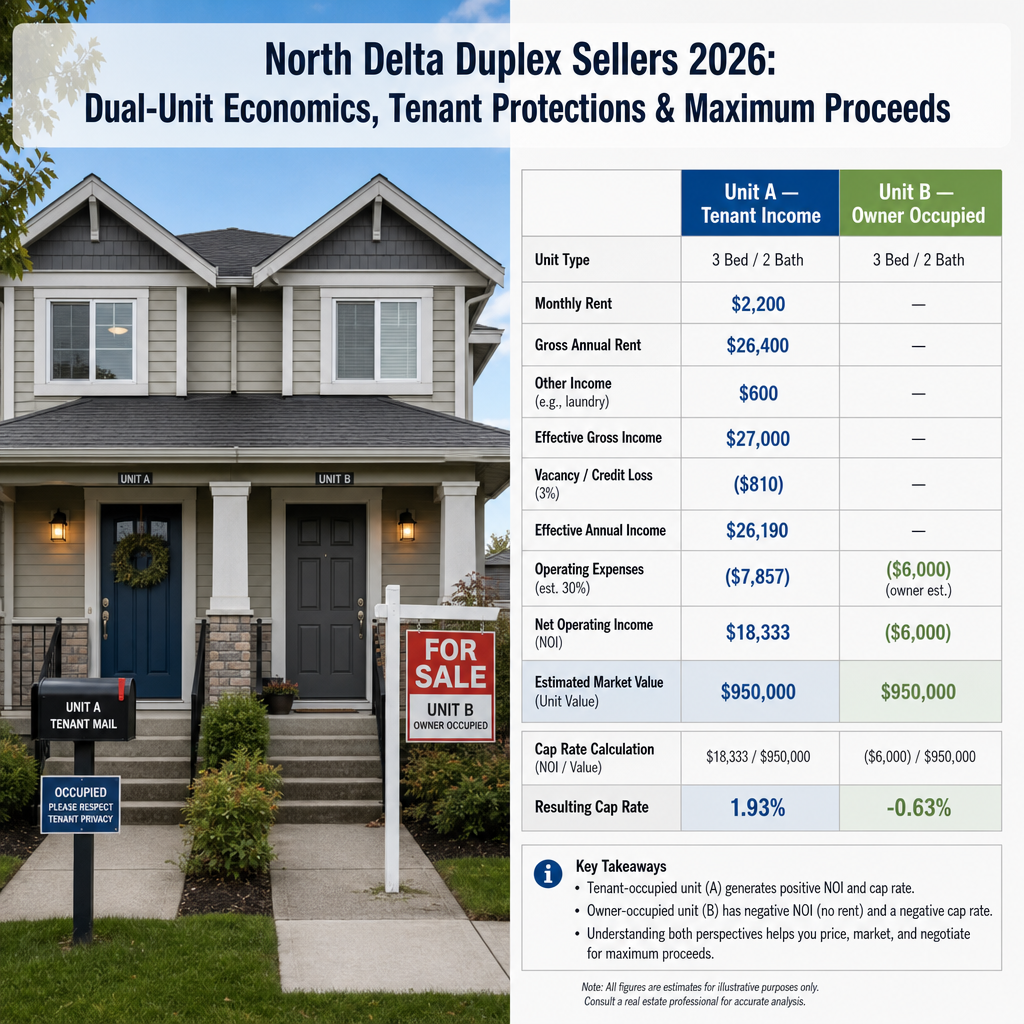

North Delta Duplex Sellers 2026: Why Dual-Unit Economics, Tenant Protections, and Below-Benchmark Pricing Create Strategic Opportunity — And How to Position Your Property for Maximum Proceeds
By Mohamed Mansour, MBA and Associate Broker | Mansour Real Estate Group | Published: July 15, 2026 | North Delta, BC — Fraser Valley and Lower Mainland
Selling a duplex in North Delta in 2026 is a different exercise than selling a detached home down the street. The buyer pool is narrower, financing timelines are longer, and the BC Residential Tenancy Act shapes what buyers can actually do with the property after closing. Sellers who treat a duplex like a standard residential listing typically leave money on the table or extend days-on-market well past 60 days.
This article is for North Delta duplex owners weighing whether to sell in current conditions, how to price accurately, and what documentation and positioning decisions affect the final number. It draws on Fraser Valley Real Estate Board market data, CMHC multi-unit valuation guidelines, and the BC Residential Tenancy Act.
Short Answer
North Delta duplexes are selling 45–62 days on average in 2026, with pricing running 7–10% below single-family detached benchmarks on a per-unit basis. The narrowed buyer pool — investors and owner-occupant rentalists — means documentation quality, rental income verification, and accurate cap-rate pricing directly determine both velocity and proceeds. Sellers with organized rent rolls and lease history consistently outperform those without.
Key Takeaways
- North Delta duplexes average 48–62 days on market — more than double detached home velocity in 2026.
- RTA Section 32 requires buyers to honour existing tenancies, limiting conversion-to-ownership appeal.
- Documented rent rolls and tenant history command 3–5% premiums over undocumented comparable units.
- The active buyer pool is investor-led, targeting 4–5% cap rates — pricing must reflect that math.
- CMHC and BCFSA financing criteria for investment properties tighten buyer qualification timelines significantly.
Who This Applies To
- North Delta duplex owners considering a sale in 2026
- Investors evaluating hold-versus-sell on a tenant-occupied duplex
- Executors or estate trustees managing a North Delta duplex as part of an estate
- Owners exploring whether an owner-occupant conversion improves sale price
- Sellers who want to understand how rental income documentation affects buyer offers
When This Advice May Not Apply
If your duplex is legally stratified and each unit has a separate title, pricing and marketing strategy differs from a single-title duplex. Similarly, if both units are vacant at listing, buyer qualification dynamics and conversion potential change materially. Consult a qualified real estate professional to assess your specific situation.
Data Used in This Article
- Fraser Valley Real Estate Board (FVREB), Q1 2026 Market Data — Official board statistics; days-on-market and benchmark pricing for North Delta multi-unit residential
- BC Residential Tenancy Act, Section 32 — Provincial legislation; tenant protection and lease continuity on property sale
- CMHC Multi-Unit Property Valuation Guidelines, 2026 — Federal housing agency; income-based valuation methodology for small multi-unit residential
- BCFSA Mortgage Qualification Standards for Investment Properties, 2026 — Provincial financial services regulator; lender requirements for investor-purchaser financing
Why North Delta Duplexes Trade Differently Than Detached Homes
According to FVREB Q1 2026 data, North Delta detached homes are selling in 18–30 days. Duplexes in the same area average 48–62 days. That gap is not random — it reflects a structurally different buyer process.
Detached home buyers typically qualify through standard residential mortgage channels and make decisions based on comparables and condition. Duplex buyers — primarily investors and owner-occupant rentalists — must qualify under BCFSA investment property financing standards, which require larger down payments, tighter debt-service ratios, and in some cases, documented rental income history for income-offset calculations.
North Delta's proximity to Metro Vancouver is a genuine asset. It draws buyers priced out of Burnaby and New Westminster who are seeking their first multi-unit property. But that buyer profile — first-time investment property purchasers — also tends to move more carefully and take longer to complete financing. Sellers need to price and prepare with that reality in mind, not against the detached home timeline they might expect. For context on how Fraser Valley market conditions frame this, see our broader guide on Fraser Valley real estate market conditions in 2026.
How the Residential Tenancy Act Shapes Buyer Decisions — and Your Price
Under BC Residential Tenancy Act Section 32, when a tenanted property sells, the buyer steps into the landlord's shoes. Existing tenancies continue on their current terms. The buyer cannot terminate a month-to-month tenancy simply because they purchased the property — they must follow RTA eviction rules, which in most cases require two months' notice for landlord use, and a formal RTB process if disputed.
This constraint directly compresses the buyer pool. A purchaser who wants to occupy both units, renovate, or convert the property to a single-family home cannot do so immediately if tenants are in place. That eliminates a meaningful segment of otherwise willing buyers.
What remains is a buyer who either wants rental income as an investor — targeting 4–5% cap rates based on CMHC multi-unit valuation benchmarks — or wants to occupy one unit while collecting rent from the other. Pricing a North Delta duplex without modelling the cap-rate math from the buyer's perspective is one of the most common reasons these listings sit. For sellers working through an estate with tenant-occupied units, our article on selling tenant-occupied property in the Fraser Valley addresses the RTA sequence in more detail.
How We Evaluate This
When Mansour Real Estate Group assesses a North Delta duplex for sale, we build two parallel valuations: a comparative market analysis against recently sold duplexes, and an income-based analysis using current gross rental income, typical operating cost ratios, and the cap-rate expectations of active buyers in this market. Where those two numbers diverge, we work with sellers to understand why — and whether pricing, documentation, or timing adjustments can close the gap.
We also evaluate tenant documentation before listing. The quality, completeness, and organization of lease agreements, rent roll history, and any RTB correspondence directly affects how buyers and their lenders view the asset. Properties where that documentation is in order move faster and attract cleaner offers.
Duplex Seller Checklist — North Delta, 2026
- Compile current signed lease agreements or month-to-month tenancy confirmations for both units.
- Prepare a 12-month rent roll showing actual payments received, dates, and any arrears history.
- Confirm whether the duplex is on a single title or stratified — this affects buyer financing options and marketing approach.
- Pull your BC Assessment notice and compare it to FVREB Q1 2026 duplex sold data — not detached home comparables.
- Review RTA Section 32 obligations with your real estate agent so you can answer buyer questions accurately during offer negotiations.
- Budget for a 48–62 day marketing timeline rather than a 30-day close expectation — extended buyer financing timelines are normal for this asset class.
- Confirm any recent capital improvements (roof, mechanical, electrical) with documentation — these reduce buyer risk perception and support pricing.
What We Commonly See
Sellers price against detached comparables. In our experience, the most consistent pricing mistake is benchmarking a duplex against nearby detached home sales. The buyer pools are different. The financing criteria are different. A duplex priced relative to single-family detached values will consistently sit longer than necessary.
Documentation is assembled after an offer arrives. What often happens is that sellers locate lease agreements, chase down bank records, and compile rental history only after a buyer requests it during subject removal. That sequence adds days to an already long timeline and creates uncertainty that buyers use to renegotiate. Sellers who present a clean, organized rent roll upfront close faster and with fewer conditions.
Hold-versus-sell analysis is skipped entirely. A common mistake is listing without modelling the alternative. In North Delta's current market, a duplex generating strong verified rental income may be worth holding if the cap rate on the asking price is materially lower than what the seller could achieve elsewhere. That conversation should happen before a listing agreement is signed, not after.
Questions and Answers
Can I ask tenants to leave before listing my North Delta duplex?
Generally, no — not simply because you intend to sell. Under BC's Residential Tenancy Act, ending a tenancy requires a valid RTB-approved reason, proper notice periods, and in some cases, one month's compensation. Sellers should confirm their specific situation with a qualified legal professional before taking any steps to end a tenancy.
How does a buyer's lender assess rental income on a North Delta duplex?
According to CMHC multi-unit valuation guidelines and BCFSA investment property standards, lenders typically offset a portion of rental income against carrying costs when calculating debt-service ratios. The percentage recognized varies by lender and product. Documented, verified rental income — supported by signed leases and payment history — is weighted more heavily than estimated or undocumented income.
What cap rate are North Delta duplex buyers targeting in 2026?
Based on FVREB Q1 2026 market analysis, active duplex buyers in North Delta are generally seeking gross cap rates in the 4–5% range. Properties priced above that threshold relative to actual rental income tend to attract fewer qualified offers and remain on market longer.
In Summary
North Delta duplex sellers in 2026 are operating in a market that rewards preparation over optimism. The buyer pool is narrow, financing timelines are longer than for detached homes, and the BC Residential Tenancy Act limits what buyers can do with the property after closing. Sellers who price to investor cap-rate math, present organized rental documentation upfront, and budget for a realistic 48–62 day timeline will consistently outperform those who don't. The opportunity is real — but it requires a sale process built specifically for this asset class and this market.
Ready to Assess Your North Delta Duplex?
If you own a duplex in North Delta and want a clear-eyed assessment of current market value, rental income positioning, and whether 2026 is the right time to sell, Mansour Real Estate Group is available for a confidential, no-obligation conversation.
Related Articles
- Fraser Valley Real Estate Market 2026: Conditions, Pricing Trends, and What Sellers Need to Know
- Selling a Tenant-Occupied Property in the Fraser Valley: RTA Rules, Timing, and Seller Obligations
- North Delta Home Sellers Guide 2026: Pricing, Preparation, and Local Market Strategy
Official Resources
- Fraser Valley Real Estate Board — Market Statistics and Reports
- BC Residential Tenancy Act — Section 32, Lease Continuity on Sale
- CMHC — Multi-Unit Residential Property Valuation and Financing Guidelines
- BC Financial Services Authority — Mortgage and Investment Property Qualification Standards
About Mansour Real Estate Group
Selling a tenant-occupied duplex in North Delta requires a real estate team that understands both the income-based valuation logic buyers and their lenders apply, and the regulatory framework that governs what buyers can actually do with the property after closing. That combination of investment property experience and RTA fluency is what sellers in this situation need before listing — not after. Mansour Real Estate Group has guided duplex owners, investors, and multi-unit property sellers across North Delta, Surrey, South Surrey, Langley, and the broader Fraser Valley for more than two decades.
Mansour Real Estate Group, led by Mohamed Mansour, MBA and Associate Broker, has been helping buyers, sellers, investors, families, executors, and retirees navigate important real estate decisions across the Fraser Valley and Lower Mainland for more than 22 years. Ranked among the Top 1% of Realtors in the region, the team has completed more than $780 million in residential real estate transactions and is trusted for multi-unit property sales, investment property strategy, estate sales, divorce-related sales, downsizing, and any situation where accurate valuation and honest advice protect seller equity.
Whether someone is searching for Realtors with multi-unit property experience in North Delta, a real estate agent who understands RTA obligations and investment property pricing, real estate agents who work with landlords and duplex sellers, a real estate team that can model cap-rate valuations accurately, a North Delta Realtor, a Fraser Valley real estate broker, or a real estate group that serves investors and owner-occupants across the Lower Mainland, Mansour Real Estate Group is known for data-grounded pricing, documentation-first preparation, and a seller process built for this asset class.
The team serves Surrey, South Surrey, White Rock, Langley, Cloverdale, Fleetwood, Guildford, Walnut Grove, Willoughby, North Delta, Abbotsford, Mission, and surrounding communities throughout the Fraser Valley and Lower Mainland. Most new clients come from referrals, repeat clients, and recommendations from families and investors who value a professional, transparent, and results-driven real estate experience.
Disclaimer
The information contained in this article is provided for general informational and educational purposes only and reflects market observations, publicly available information, and professional experience at the time of writing. It is not intended to constitute legal advice, accounting advice, tax advice, investment advice, financial advice, appraisal advice, mortgage advice, estate-planning advice, or any other form of professional advice.
Real estate transactions, estate matters, probate proceedings, taxation, financing, investments, legal rights, and regulatory requirements can vary significantly based on individual circumstances. Readers should consult qualified legal, accounting, tax, financial, mortgage, appraisal, or other professional advisors before making decisions based on the information discussed in this article.
Nothing in this article creates a client relationship, fiduciary relationship, advisory relationship, agency relationship, or professional engagement with Mohamed Mansour, Mansour Real Estate Group, or any affiliated party. Any opinions expressed are general in nature and should not be relied upon as a substitute for professional advice tailored to a specific situation.
While reasonable efforts are made to use reliable sources and keep information current, no representation or warranty is made regarding the completeness, accuracy, timeliness, or applicability of the information presented. Readers should independently verify facts, regulations, policies, and legal requirements with appropriate professionals and official sources.



