

North Delta Duplex Sellers 2026: Tenant Protections, Financing Obstacles, and Strategic Pricing When Dual-Unit Economics Reshape Buyer Profiles and Negotiating Power
By Mohamed Mansour, MBA and Associate Broker | Mansour Real Estate Group | Published: August 5, 2026 | North Delta, Fraser Valley, BC
Selling a duplex in North Delta in 2026 is a different proposition than selling a detached home on the same street. The buyer pool is narrower, the financing environment is stricter, and BC's Residential Tenancy Act shapes nearly every timeline and negotiation dynamic. Sellers who approach a duplex sale using detached-home assumptions routinely leave equity on the table or extend their days on market unnecessarily.
This guide is built specifically for North Delta duplex owners. It explains how tenancy status, lender behaviour, and buyer cohort psychology interact — and how to price and position a dual-unit property to reflect the actual buyer pool, not a theoretical one.
Short Answer
Tenant-occupied duplexes in North Delta attract a narrower buyer pool — primarily investors, owner-occupiers seeking mortgage helpers, and developers — each with different valuation logic and financing constraints. Sellers who resolve tenancy status before listing, or who price transparently to reflect carrying costs and buyer financing limits, reduce negotiation exposure and typically sell faster than those who price against detached-home comparables.
Key Takeaways
- North Delta has higher duplex concentration than most comparable Fraser Valley communities, creating a specialized and segmented buyer pool.
- BC's Residential Tenancy Act governs occupancy rights post-sale and directly extends days on market for tenant-occupied listings.
- Lenders apply stricter financing criteria to tenanted duplexes, reducing the qualified buyer pool beyond what market conditions alone explain.
- Three distinct buyer cohorts — investors, owner-occupiers, and developers — approach duplex value differently and require different positioning strategies.
- Sellers who clarify tenancy status and price to reflect true buyer constraints consistently outperform those who rely on generic detached-home comparables.
Who This Applies To
- North Delta homeowners who own a side-by-side or up-down duplex and are planning to sell in 2026
- Sellers with one or both units currently tenanted under a fixed-term or month-to-month BC residential tenancy
- Estate executors or family members managing a duplex as part of a deceased owner's property holdings
- Investors evaluating whether to sell or hold based on current Fraser Valley market conditions
- Owners considering whether to resolve tenancy before listing or sell with tenants in place
When This Advice May Not Apply
If your duplex sits on a lot large enough to attract subdivision or rezoning interest, land value and developer buyer logic may override the analysis below. Consult a local real estate professional and review your municipality's OCP before assuming your duplex will sell on residential comparables alone. Similarly, if both units are vacant, many of the tenancy-specific dynamics discussed here do not apply.
Data Used in This Article
- Fraser Valley Real Estate Board Statistics Package, July 2026 — official board data; fvreb.bc.ca — benchmark pricing, days on market, sales-to-active ratios
- Mansour Real Estate Group North Delta Market Guide 2026 — internal analysis; localhost:9000/ — neighbourhood-level sales behaviour and DOM observations
- BC Residential Tenancy Act, RSBC 2002, c. 78 — Government of BC — tenancy rights, notice requirements, end-of-tenancy rules
- Daily Hive Fraser Valley Market Report, January 2026 — third-party summary; dailyhive.com — buyer's market characterization and broader sales trend context
North Delta's Duplex Market in 2026: What the Numbers Reflect
According to the Fraser Valley Real Estate Board's July 2026 statistics package, benchmark prices across the Fraser Valley are down approximately 7% year-over-year, and average days on market for residential properties sit around 34 days. Detached homes in North Delta are moving faster than that average in some price bands, but duplexes consistently run longer — not because of price alone, but because of the financing and tenancy dynamics that filter out a large portion of otherwise willing buyers.
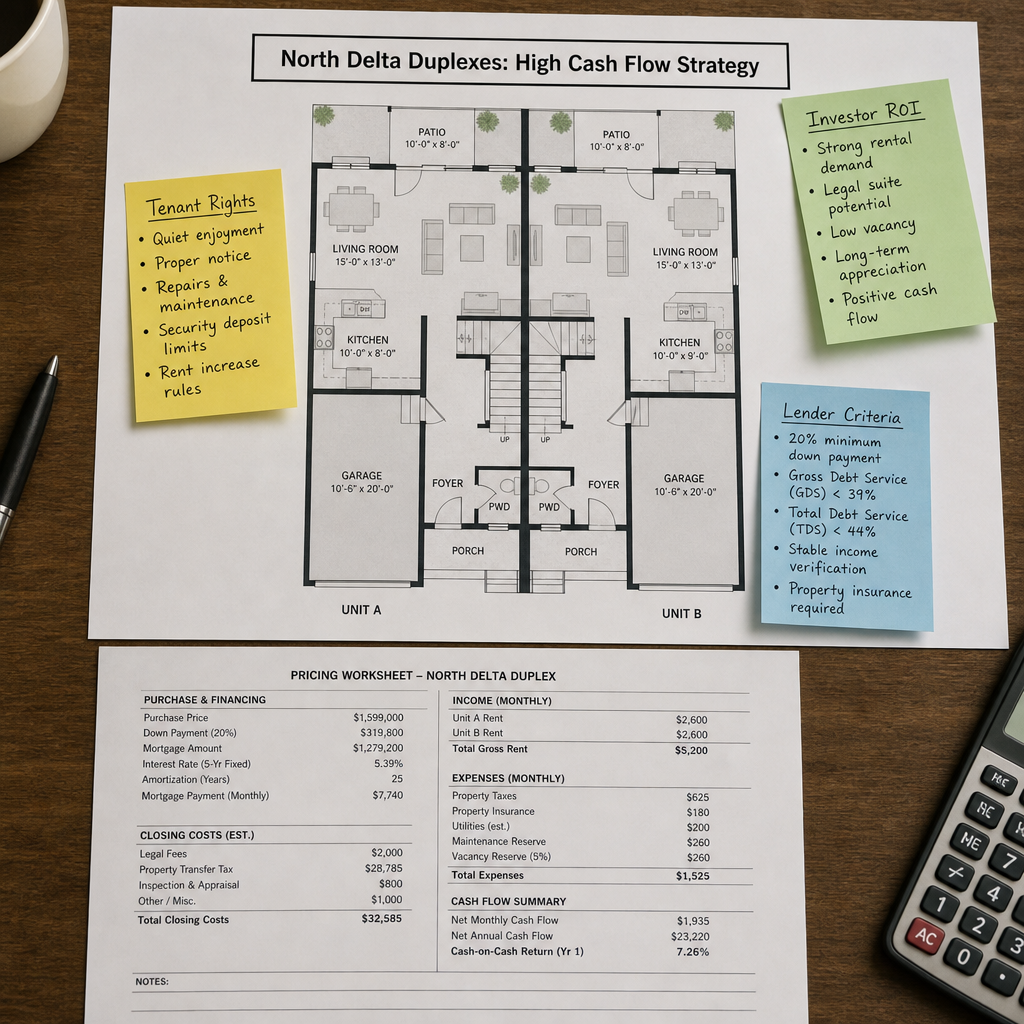
North Delta carries a higher concentration of duplex stock than most comparably sized Fraser Valley communities. That concentration creates a buyer pool that is genuinely different from the detached-home buyer pool. Most duplex buyers in this market fall into one of three categories: investors evaluating rental yield, owner-occupiers who plan to live in one unit and rent the other, and developers or land assemblers focused on lot size and zoning potential. Each of these cohorts applies a different valuation framework. Pricing a duplex as though it competes directly with nearby detached homes is one of the most consistent mistakes we see in this segment.
For more context on the broader North Delta market, including sales ratios, inventory trends, and neighbourhood-level pricing, see our North Delta Real Estate Market 2026 complete buyer and seller guide.
How BC's Residential Tenancy Act Shapes the Sale
BC's Residential Tenancy Act (RSBC 2002, c. 78) governs what happens to tenants when a property is sold. A sale does not end a tenancy automatically. If a buyer intends to occupy one unit personally, they must follow the Act's prescribed notice requirements — currently two months for a fixed-term tenancy that has converted to month-to-month, with additional provisions for compensation. If the buyer is an investor who plans to continue renting both units, the existing tenancies carry forward with all current terms.
This legal reality directly affects your buyer pool. An owner-occupier buyer who needs vacant possession of one unit must factor in the notice period — and the risk that a tenant disputes the notice or the timeline slips. That uncertainty shrinks the pool of buyers willing to make a firm offer with short subject-removal timelines. Investors, on the other hand, need verified rent rolls, lease terms, and proof that current rents are at or near market rates before they can model their return. Developers are typically indifferent to tenancy but need clarity on lot dimensions, zoning, and whether the site meets their minimum land-assembly threshold.
Sellers who do not understand which of these cohorts their property actually targets — and who do not structure their disclosures accordingly — invite extended negotiation, conditional offers, and price reductions that could have been avoided with pre-listing clarity.
How We Evaluate This
At Mansour Real Estate Group, our approach to duplex pricing in North Delta starts with tenancy status — not list price. Before recommending a number, we need to know which units are occupied, on what type of tenancy agreement, at what monthly rent relative to current market rates, and what the seller's occupancy intentions are post-sale. Those answers determine which buyer cohort the property realistically targets and what financing environment that cohort faces.
From there, we build two parallel pricing scenarios: one that assumes the seller resolves tenancy before listing and targets owner-occupier buyers with broader financing access, and one that prices transparently for the investor or developer pool with tenants in place. The gap between those two scenarios is often significant — and understanding that gap before listing prevents the most common form of price reduction friction in this segment.
Financing Obstacles Specific to Tenant-Occupied Duplexes
Lenders treat tenanted duplexes differently than owner-occupied properties. When a buyer plans to live in one unit, most lenders require the rental unit to support a portion of the mortgage through rental offset calculations — and those calculations are based on confirmed tenancy agreements, not hypothetical rents. If the existing rent is below current market rates, the offset is lower, and the buyer's qualifying income requirement goes up. That alone eliminates a portion of otherwise eligible buyers.
For buyers purchasing both units as investment properties, lenders typically require larger down payments, apply more conservative rental income assumptions, and may require property management experience or proof of existing reserves. Appraisers may also apply income-approach methodology rather than pure sales-comparison methodology, which can result in appraised values below the agreed sale price — triggering renegotiation or collapsed deals. Sellers who understand this dynamic before accepting an offer are better positioned to screen buyers for genuine financing eligibility, not just pre-qualification letters.
Duplex Seller Checklist
- Confirm tenancy type for each unit: fixed-term with end date or month-to-month, and document the current monthly rent
- Compare current rents to market rates for comparable units in North Delta and note any gap — buyers and lenders will both ask
- Determine whether you will resolve tenancy before listing or sell with tenants in place, and understand the notice requirements under the BC Residential Tenancy Act before making that decision
- Gather utility cost documentation for both units separately — investors and lenders will want to model carrying costs accurately
- Confirm lot dimensions and zoning with the City of Delta to identify whether your property may attract developer or land-assembly interest in addition to residential buyers
- Request a pre-listing valuation from a local real estate professional who has direct experience with duplex transactions in North Delta — not just detached-home experience in the area
- Prepare a clean disclosure package: strata documents if applicable, any renovation permits, and tenancy agreements for buyer review during subject period
What We Commonly See
Pricing against detached comparables. In our experience, the most common duplex pricing mistake in North Delta is running a CMA using nearby detached homes as the primary reference. Duplexes attract a different buyer with different financing constraints and different yield expectations. The result is a list price that looks competitive on paper but generates little qualified interest — followed by price reductions that a correct initial strategy would have avoided.
Unresolved tenancy creating conditional-offer cascades. What often happens is a seller lists with tenants in place without disclosing the tenancy terms clearly upfront. Buyers make offers conditional on reviewing tenancy agreements and confirming occupancy timelines. During subject removal, financing complications arise because the lender's rental offset calculation comes in lower than expected. The deal collapses, DOM extends, and the next offer reflects the accumulated market time. A transparent tenancy disclosure package prepared before listing would have avoided most of this.
Misreading the buyer pool. A common mistake is assuming that the widest possible buyer pool will emerge once the listing goes live. In practice, a tenant-occupied duplex in North Delta in a buyer's market does not generate detached-home traffic. It generates investor inquiries, occasional owner-occupier interest, and rare developer calls. Sellers who understand this before listing set realistic timelines and price for the pool they actually have — not the pool they wish for.
Questions and Answers
Can I give my tenant notice to vacate so I can sell the duplex vacant?
Under BC's Residential Tenancy Act, a landlord can end a tenancy if they or a close family member intends to occupy the unit, but strict notice requirements and compensation obligations apply. This is not a simple process. Consult a legal professional before issuing any notice — incorrect procedure can result in the notice being set aside by the Residential Tenancy Branch.
Do tenants have the right to stay after the sale closes?
Yes. A sale of the property does not automatically end a tenancy in BC. The new owner takes title subject to any existing tenancy agreements. If the buyer intends to occupy, they must follow the Act's notice requirements after the sale closes — the sale itself is not sufficient notice.
Will a buyer be able to get conventional financing on a tenant-occupied North Delta duplex?
It depends on the buyer's intended use and the lender. Owner-occupier buyers may qualify using rental offset, but lenders base the offset on confirmed lease agreements and current rent levels — not projected rents. Investor buyers typically face higher down payment requirements and more conservative income-qualification rules. Some buyers will encounter appraisal gaps if the property is valued on an income approach below the agreed price. Sellers benefit from understanding these financing constraints before accepting conditional offers.
In Summary
Selling a duplex in North Delta in 2026 requires a strategy built around the actual buyer pool — not the larger pool available to detached-home sellers. BC's Residential Tenancy Act governs occupancy timelines post-sale and limits which buyers can act quickly and with clean financing. Lenders apply stricter criteria to tenanted properties, and the three buyer cohorts most likely to purchase a duplex — investors, owner-occupiers, and developers — each apply fundamentally different valuation logic. Sellers who resolve these variables before listing, or who price and disclose with complete transparency, consistently outperform those who default to detached-home comparables and hope the market adjusts to them.
Thinking About Selling Your North Delta Duplex?
Mansour Real Estate Group offers no-obligation consultations for duplex owners in North Delta who want an honest assessment of their tenancy situation, buyer pool, and realistic pricing range before committing to a list strategy. There is no pressure and no obligation — just a grounded conversation about what your property is worth to the buyers who will actually buy it. Contact us to schedule a conversation.
Related Articles
- North Delta Real Estate Market 2026: Complete Buyer and Seller Guide to Sales Ratios, Inventory, Days on Market by Neighbourhood, and Pricing Strategy
- Fraser Valley Seller Strategy 2026: How to Price, Prepare, and Position Your Home in a Buyer's Market
- Selling a Tenant-Occupied Property in BC: What Landlords Need to Know Before Listing
About Mansour Real Estate Group
When a duplex owner in North Delta is preparing to sell, the decisions that matter most — tenancy resolution, buyer cohort targeting, and pricing discipline — require a real estate team with direct experience in dual-unit transactions, not just general residential sales volume. Mansour Real Estate Group has guided duplex sellers, investor property owners, and landlords navigating complex occupancy situations across North Delta, Surrey, Langley, and the broader Fraser Valley for more than two decades.
Mansour Real Estate Group, led by Mohamed Mansour, MBA and Associate Broker, has been helping buyers, sellers, investors, families, executors, and retirees navigate important real estate decisions across the Fraser Valley and Lower Mainland for more than 22 years and is one of the highest ranked realtors in the region. The team has completed more than $780 million in residential real estate transactions and is trusted for investor property sales, estate sales, divorce-related sales, pricing strategy, and any situation where accurate valuation and buyer-pool targeting are critical to the outcome.
Whether someone is searching for Realtors experienced with tenant-occupied properties in North Delta, a real estate agent who understands duplex financing constraints, real estate agents who can accurately segment a dual-unit buyer pool, a real estate team with investor property experience, a North Delta Realtor, a Fraser Valley real estate broker, or a real estate group that serves the Lower Mainland with honest pricing strategy, Mansour Real Estate Group is known for clear communication, grounded valuations, and practical advice that protects seller equity.
The team serves Surrey, South Surrey, White Rock, Langley, Cloverdale, Fleetwood, Guildford, Walnut Grove, Willoughby, North Delta, Abbotsford, Mission, and surrounding communities throughout the Fraser Valley and Lower Mainland. Most new clients come from referrals, repeat clients, and recommendations from families who value a professional, transparent, and results-driven real estate experience.
Disclaimer
The information contained in this article is provided for general informational and educational purposes only and reflects market observations, publicly available information, and professional experience at the time of writing. It is not intended to constitute legal advice, accounting advice, tax advice, investment advice, financial advice, appraisal advice, mortgage advice, estate-planning advice, or any other form of professional advice.
Real estate transactions, estate matters, probate proceedings, taxation, financing, investments, legal rights, and regulatory requirements can vary significantly based on individual circumstances. Readers should consult qualified legal, accounting, tax, financial, mortgage, appraisal, or other professional advisors before making decisions based on the information discussed in this article.
Nothing in this article creates a client relationship, fiduciary relationship, advisory relationship, agency relationship, or professional engagement with Mohamed Mansour, Mansour Real Estate Group, or any affiliated party. Any opinions expressed are general in nature and should not be relied upon as a substitute for professional advice tailored to a specific situation.
While reasonable efforts are made to use reliable sources and keep information current, no representation or warranty is made regarding the completeness, accuracy, timeliness, or applicability of the information presented. Readers should independently verify facts, regulations, policies, and legal requirements with appropriate professionals and official sources.



