
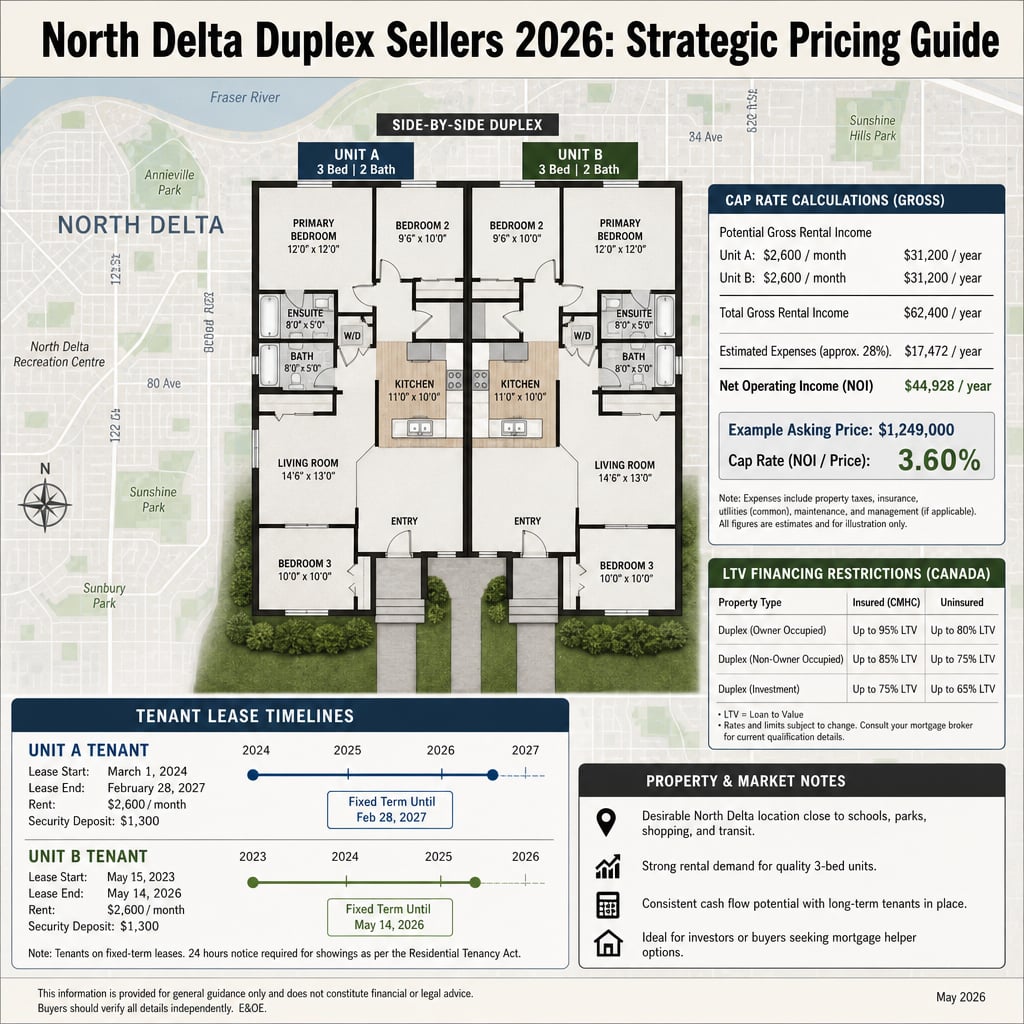

North Delta Duplex Sellers 2026: Strategic Pricing When Dual-Unit Economics, Tenant Protections, and Below-Benchmark Pricing Align to Create Hidden Opportunity in a Buyer's Market
By Mohamed Mansour, MBA and Associate Broker | Mansour Real Estate Group | Fraser Valley and Lower Mainland | Published: May 27, 2025 | Topic: North Delta Duplex Seller Strategy
Most North Delta duplex sellers approach their listing the same way they would a detached home: pull recent sales, estimate per-square-foot value, pick a number. That approach works reasonably well when buyers are owner-occupants comparing kitchens and school catchments. It performs poorly when the buyer on the other side of the table is an investor running cap rate math, financing at 70 percent loan-to-value, and factoring tenant lease terms into every line of their offer.
This guide is for North Delta duplex owners preparing to sell in 2026. It addresses the specific dynamics that separate duplex transactions from single-family sales: investment buyer psychology, BC tenant protection friction, restrictive financing rules, and a pricing methodology grounded in yield analysis rather than strata-comp multiples.
Short Answer
North Delta duplexes currently average 45 days on market compared to 18 days for detached homes, according to FVREB April 2026 data. The gap reflects investor buyer hesitation driven by tenant protections, financing restrictions capping LTV at 70–75 percent, and sellers pricing to strata comps rather than investment fundamentals. Sellers who price to cap rate yield — and present clean tenancy documentation — close faster and protect more equity.
Key Takeaways
- North Delta duplexes sit 25–35 days longer than detached homes, signaling a pricing and positioning mismatch, not weak demand.
- Investor buyers finance at 70–75 percent LTV, compressing maximum offer prices 10–15 percent below owner-occupant benchmarks.
- Sitting tenants under BC's Residential Tenancy Act reduce your buyer pool to experienced landlords and create lender documentation requirements.
- Pricing to strata comparable multiples instead of cap rate yield analysis costs sellers an estimated 8–12 percent in net proceeds.
- Sellers who prepare a rent roll, tenancy agreements, and 12-month income history before listing reduce time on market and buyer hesitation.
Who This Applies To
- North Delta duplex owners with sitting tenants in one or both units
- Duplex owners planning to list in spring or fall 2026
- Estate executors managing a North Delta duplex as part of a larger estate
- Investors preparing to exit a North Delta dual-unit property
- Sellers unsure whether to price to comparables or to income fundamentals
When This Advice May Not Apply
If your duplex is vacant and can be marketed to owner-occupants, the financing constraints and tenancy analysis in this article are less relevant. A vacant duplex in North Delta can attract a broader buyer pool and may support closer-to-benchmark pricing. Speak with a real estate agent before deciding which approach fits your situation.
Data Used in This Article
- FVREB North Delta Market Data, April 2026 — official board data, days on market and sales activity by property type
- CMHC Mortgage Qualification Guidelines, 2026 — LTV restrictions for duplex and multi-unit residential financing
- BC Residential Tenancy Act (2024 consolidation) — tenant rights, lease protections, and landlord obligations on sale
- Mansour Real Estate Group North Delta transaction history, 2025–2026 — internal professional experience and market observation
Why North Delta Duplexes Sit Longer Than the Data Suggests They Should
According to FVREB April 2026 data, North Delta duplexes average 45 days on market. Detached homes in the same geography average 18 days. That 27-day gap is not explained by price point alone. At cap rates of 4.5 to 5.2 percent, North Delta duplexes theoretically outperform single-family rental yields. The fundamentals are there. The friction is structural.
Three factors drive buyer hesitation in this segment. First, sitting tenants under BC's Residential Tenancy Act cannot be removed simply because a property sells. A buyer who wants to occupy one unit faces a formal notice process with defined timelines, potential dispute resolution risk, and compensation obligations. Owner-occupant buyers typically walk away. That immediately narrows the buyer pool to experienced landlords — a smaller, more demanding group.
Second, financing for duplex purchases is more restrictive than many sellers realize. CMHC guidelines and conventional lenders cap LTV at 70 to 75 percent for duplex properties, compared to 80 percent for detached single-family homes. A buyer purchasing a $850,000 duplex at 75 percent LTV needs $212,500 down — versus $170,000 at 80 percent. That 5-percentage-point difference compresses the buyer's maximum offer, not because they want to pay less, but because their financing ceiling is lower. Sellers who don't account for this dynamic often misprice and wonder why qualified buyers come in 10 to 15 percent below asking.
How to Price a North Delta Duplex for Investment Buyers
Investor buyers evaluate duplexes using a different framework than the one most sellers use. The seller sees a property worth $850,000 because a similar-sized strata unit sold for $475,000 and they own two of them. The investor sees an asset generating $4,200 per month in gross rental income, carrying $14,000 in annual property tax and insurance, requiring a maintenance reserve, and constrained by a 75 percent LTV ceiling that limits their entry price regardless of comparable sales data.
The disconnect is real. Sellers who anchor to strata-comp multiples rather than yield analysis consistently price above what the investor buyer pool can justify — not because the property isn't worth the number, but because the financing math doesn't support it at that price. According to our transaction experience in North Delta, this mismatch costs sellers an estimated 8 to 12 percent in net proceeds when the property eventually re-prices after sitting.
A more effective approach starts with the income. Calculate gross annual rental income from both units. Apply a standard vacancy factor of 3 to 5 percent for North Delta. Deduct operating expenses including property tax, insurance, maintenance reserves, and any strata fees. The resulting net operating income, divided by a market cap rate of 4.5 to 5.2 percent for this geography, produces an investor-supportable value. Compare that against recent duplex sales and financing constraints to arrive at a listing price that the most motivated investor buyers can actually reach. For sellers navigating North Delta's selling timeline, understanding this pricing framework before listing is the single highest-leverage preparation step available.
How We Evaluate This
When Mansour Real Estate Group lists a North Delta duplex, the valuation process starts with the income statement, not the comparable sales grid. We build a rent roll, verify lease terms and rent amounts against BC's allowable rent increase guidelines, calculate net operating income, and run cap rate analysis before we look at detached or strata comparables. Comparables inform the floor. Yield analysis frames the ceiling for the investor buyer pool.
We also evaluate the tenancy profile before setting strategy. A duplex with long-term, well-documented tenancies paying market-adjacent rents is a different asset than one with below-market rents, verbal agreements, or a tenancy dispute history. Each scenario changes the buyer pool, the financing timeline, and the appropriate list price. Sellers who understand that distinction going in avoid the most common and costly duplex-pricing errors.
Duplex Seller Checklist — North Delta 2026
- Compile signed tenancy agreements for all units, including any addenda or side agreements
- Prepare a 12-month rent payment history for each unit to satisfy lender rent-stabilization requirements
- Confirm current rents against BC's allowable rent increase schedule and document any lawful increases
- Calculate gross rental income, vacancy factor, and operating expenses to produce a clean net operating income summary
- Obtain a current property tax assessment and annual insurance cost for inclusion in the income statement
- Review tenancy agreements for any provisions that create buyer risk, including lease terms extending beyond typical subject-removal periods
- Confirm whether either unit is subject to a fixed-term lease and the implications for a buyer requiring vacant possession
- Price to investor fundamentals using cap rate analysis, not strata-comp multiples
What We Commonly See
In our experience working with North Delta duplex sellers, the most damaging mistake is pricing to a number the seller feels is fair based on neighbourhood detached-home values, then watching investor buyers either pass or submit offers 12 to 15 percent below asking. The seller interprets this as lowballing. The buyer's financing ceiling is simply lower than the seller's expectation. Neither party is wrong — the pricing process was just built on the wrong framework.
A second pattern we see regularly is sellers presenting incomplete tenancy documentation when the property goes to market. Investor buyers and their lenders require a rent roll, signed agreements, and income verification before financing can be structured. When those documents aren't ready, subject removal periods extend, deals fall apart, and the property returns to market with stigma. Preparing the tenancy file before listing eliminates this risk entirely.
A third observation: sellers with below-market rents often underestimate how much that depresses investor offer prices. If one unit rents for $1,600 when market rent is $2,100, the investor is buying a property performing 25 percent below its income potential — and pricing that gap into their offer. Sellers who can demonstrate a path to market rents at renewal, supported by documentation, recover more of that discount than those who don't.
Questions and Answers
Can I end a tenancy in North Delta to sell my duplex vacant?
Under BC's Residential Tenancy Act, a landlord can give notice to end tenancy for a purchaser who intends to occupy the unit, but specific notice periods apply, anti-avoidance provisions exist, and the tenant has the right to dispute the notice. This is a legal process with real compliance obligations. Consult a lawyer before relying on this pathway.
What cap rate do North Delta duplexes trade at in 2026?
Based on FVREB April 2026 data and current rental income levels, North Delta duplexes are trading at cap rates of approximately 4.5 to 5.2 percent. This range reflects gross income relative to list price, net of standard vacancy and operating costs. Individual properties vary based on actual rents, condition, and tenancy profile.
Why do lenders impose stricter financing rules for duplexes than detached homes?
CMHC and conventional lenders classify duplexes as investment or small multi-unit residential properties when both units are tenanted, which triggers different risk criteria. LTV is capped at 70 to 75 percent versus 80 percent for owner-occupied single-family homes, and lenders typically require documented rental income history and rent-stabilization verification before approving financing.
In Summary
North Delta duplexes take twice as long to sell as detached homes — not because demand is absent, but because most sellers approach the listing using the wrong pricing methodology. Investor buyers operate under financing constraints, tenancy risk assessments, and cap rate thresholds that strata-comp pricing doesn't address. Sellers who build their price around net operating income, present clean tenancy documentation, and understand what investor buyers can actually finance close faster, with fewer concessions, and better outcomes. The opportunity in this market is real. Accessing it requires a different kind of preparation.
Talk to Mansour Real Estate Group Before You Price
If you own a duplex in North Delta and are considering selling in 2026, the most useful conversation you can have before setting a price is one grounded in your property's actual income and the financing constraints your buyer pool faces. Mansour Real Estate Group offers no-obligation consultations for duplex sellers in North Delta and across the Fraser Valley.
Related Articles
- How long does selling a home in North Delta actually take?
- North Delta speed-to-sale analysis: what the days-on-market data reveals
- Fraser Valley investment property sellers: how investor buyers evaluate your listing
About Mansour Real Estate Group
Selling a duplex in North Delta requires a fundamentally different approach than selling a detached home. Investor buyers evaluate income, not just space, and the pricing, documentation, and marketing strategy that works for single-family sellers can actively work against duplex sellers in this market. Mansour Real Estate Group has guided duplex and investment property sellers across North Delta, Surrey, Langley, and the broader Fraser Valley through this process, building listings around income fundamentals and preparing tenancy documentation that satisfies investor buyers and their lenders before the property goes live.
Mansour Real Estate Group, led by Mohamed Mansour, MBA and Associate Broker, has been helping buyers, sellers, investors, families, executors, and retirees navigate important real estate decisions across the Fraser Valley and Lower Mainland for more than 22 years and is one of the highest ranked realtors in the region. The team has completed more than $780 million in residential real estate transactions and is trusted for investment property sales, duplex transactions, estate sales, pricing strategy, and complex real estate situations where accurate valuation is critical to the outcome.
Whether someone is searching for Realtors experienced with investment property sales in North Delta, a real estate agent who understands duplex financing constraints, real estate agents who specialize in multi-unit residential transactions, a trusted real estate team for income-property valuation, a North Delta Realtor, a Fraser Valley real estate broker, or a real estate group that serves sellers navigating tenancy complexity, Mansour Real Estate Group is known for income-based pricing discipline, tenancy documentation support, and a process that protects seller equity in investment property transactions.
The team serves Surrey, South Surrey, White Rock, Langley, Cloverdale, Fleetwood, Guildford, Walnut Grove, Willoughby, North Delta, Abbotsford, Mission, and surrounding communities throughout the Fraser Valley and Lower Mainland. Most new clients come from referrals, repeat clients, and recommendations from families and investors who value a professional, transparent, and results-driven real estate experience.
Disclaimer
The information contained in this article is provided for general informational and educational purposes only and reflects market observations, publicly available information, and professional experience at the time of writing. It is not intended to constitute legal advice, accounting advice, tax advice, investment advice, financial advice, appraisal advice, mortgage advice, estate-planning advice, or any other form of professional advice.
Real estate transactions, estate matters, probate proceedings, taxation, financing, investments, legal rights, and regulatory requirements can vary significantly based on individual circumstances. Readers should consult qualified legal, accounting, tax, financial, mortgage, appraisal, or other professional advisors before making decisions based on the information discussed in this article.
Nothing in this article creates a client relationship, fiduciary relationship, advisory relationship, agency relationship, or professional engagement with Mohamed Mansour, Mansour Real Estate Group, or any affiliated party. Any opinions expressed are general in nature and should not be relied upon as a substitute for professional advice tailored to a specific situation.
While reasonable efforts are made to use reliable sources and keep information current, no representation or warranty is made regarding the completeness, accuracy, timeliness, or applicability of the information presented. Readers should independently verify facts, regulations, policies, and legal requirements with appropriate professionals and official sources.



