
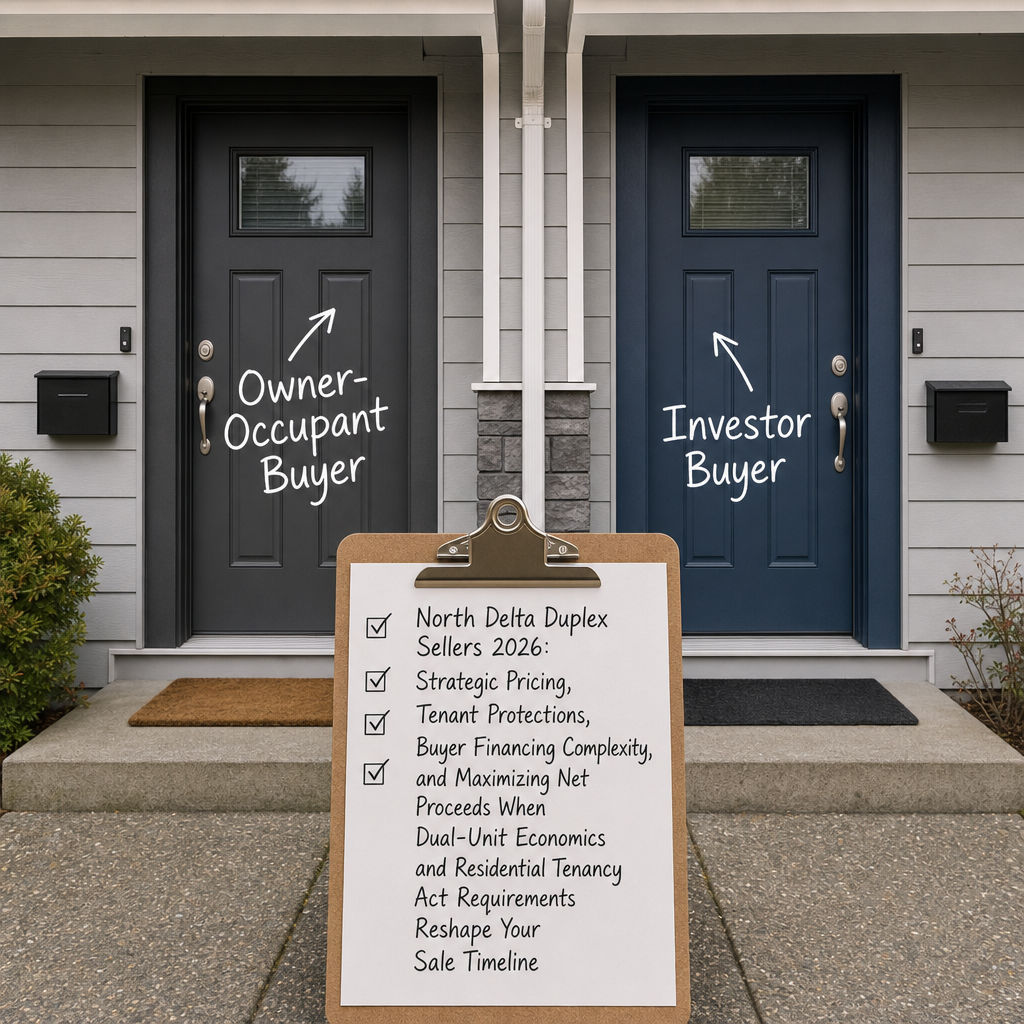

North Delta Duplex Sellers 2026: Strategic Pricing, Tenant Protections, Buyer Financing Complexity, and Maximizing Net Proceeds When Dual-Unit Economics and Residential Tenancy Act Requirements Reshape Your Sale Timeline
By Mohamed Mansour, MBA and Associate Broker | Mansour Real Estate Group | Fraser Valley and Lower Mainland | Published: July 15, 2026 | Topic: Seller Strategy — North Delta Duplex Market
Selling a duplex in North Delta in 2026 is not the same as selling a detached home on the same street. The buyer pool is smaller, the financing requirements are stricter, and the BC Residential Tenancy Act creates obligations that many sellers underestimate until they are already in the middle of a failed negotiation. This guide is written specifically for North Delta duplex owners who want to understand those differences before they list — not after.
Mansour Real Estate Group has worked with duplex sellers and investors across North Delta, Surrey, Cloverdale, and the broader Fraser Valley for more than two decades. The observations in this article reflect that direct transaction experience alongside current market data and BC regulatory requirements.
Short Answer
North Delta duplexes in 2026 are selling in 45 to 60-plus days on market compared to roughly 18 days for comparable detached homes. Tenant protections under the BC Residential Tenancy Act, lender requirements for 25% down on investment purchases, and a compressed buyer pool are the primary reasons. Sellers who segment their pricing strategy by buyer type — owner-occupant versus investor — consistently achieve better outcomes than those using a detached-home pricing framework.
Key Takeaways
- North Delta duplexes take 45 to 60-plus days to sell, roughly 60 to 70 percent longer than detached homes in the same market.
- Investment-focused buyers typically need 25% down, which shrinks the qualified buyer pool and extends negotiation timelines.
- BC Residential Tenancy Act tenant protections reduce perceived buyer upside and can compress offer prices 8 to 12 percent versus comparable detached properties.
- Targeting owner-occupant buyers — who can live in one unit and rent the other — often produces faster sales with less financing friction than targeting pure investors.
- Monthly carrying costs on a duplex exceed single-family homes by 30 to 40 percent, making every extra week on market a direct hit to net proceeds.
Who This Applies To
- North Delta duplex owners considering a sale in 2026
- Duplex owners with tenants in one or both units
- Investors evaluating whether to sell now or hold for another rental cycle
- Estate executors managing a North Delta duplex as part of a probate process
- Owners who purchased a duplex as a primary residence and are now considering a move
When This Advice May Not Apply
If your duplex is registered as a strata and governed by the Strata Property Act, some of the financing and tenant obligation dynamics described here will differ. This article addresses non-strata duplexes unless otherwise noted. Consult your legal and financial advisors for your specific situation.
Data Used in This Article
- Fraser Valley Real Estate Board: North Delta days-on-market by property type, Q1 2026 (official board data)
- BC Residential Tenancy Act: current rent-control provisions and notice requirements (BC Government — official legislation)
- Mortgage broker data: LTV thresholds and qualification criteria for investment versus owner-occupant duplex purchases (third-party professional data)
- CMHC rental market data: North Delta rental demand and cash-flow benchmarks (official federal data)
- Mansour Real Estate Group transaction experience: North Delta duplex DOM, sell-price-to-list ratios, and buyer-type patterns (internal professional analysis)
Why North Delta Duplex Sales Take Longer
According to FVREB Q1 2026 data, the Fraser Valley's overall sales-to-active-listings ratio sits near 11 percent — a buyer's market threshold. Within that environment, North Delta duplexes are experiencing days-on-market of 45 to 60-plus days, compared to roughly 18 days for detached homes in similar price ranges.
Three factors drive that gap. First, the buyer pool for a duplex is structurally smaller than for a detached home. Buyers must either have the down payment and appetite for investment property or the willingness to be a landlord in one unit while occupying the other. Neither profile is as common as a conventional detached-home buyer.
Second, financing takes longer and disqualifies more buyers. Many lenders require 25% down for investment-focused duplex purchases, compared to as low as 5% for an owner-occupied single-family home. That down-payment gap removes a large segment of otherwise motivated buyers from the qualified pool entirely.
Third, North Delta duplexes compete directly with new townhome supply. In a spring 2026 market where townhome inventory has expanded, a buyer who does not specifically want a duplex has alternatives with fewer tenant complications and more predictable carrying costs. Sellers who understand this competitive dynamic and price accordingly tend to move faster than those who anchor to land-value comparisons with detached homes.
The Tenant Protection Problem — and How Sellers Navigate It
BC's Residential Tenancy Act governs both the rights of existing tenants and the obligations sellers carry into any sale involving occupied rental units. For duplex sellers, this creates a perception problem with investor buyers: rent-controlled tenants paying below-market rent reduce the property's cap rate attractiveness, and buyers know that removing or adjusting tenancies involves specific notice periods, fixed-term lease considerations, and potential RTB disputes.
Under the BC Residential Tenancy Act, if a buyer intends to occupy a unit for personal use, a landlord can issue a notice to end tenancy — but specific notice periods apply, typically four months, and compensation of one month's rent is required. Buyers aware of these rules often factor the time and cost of tenant transition into their offer price, which contributes to the 8 to 12 percent price compression observed in North Delta duplex transactions compared to equivalent vacant detached homes.
Sellers can mitigate this in two ways. One is to be proactive: document current rent amounts, lease terms, and tenant profiles clearly before listing. Buyers making decisions with complete information negotiate less aggressively than buyers making assumptions. The second is to be honest about what the tenancy situation actually means for a realistic buyer. A long-term tenant paying near-market rent is less of an obstacle than a seller who does not know whether their tenant is month-to-month or in a fixed-term lease. For more on how life-event timing intersects with tenant obligations, see our guide on estate sales in North Delta and executor obligations.
How We Evaluate This
When Mansour Real Estate Group evaluates a North Delta duplex for listing, we do not apply a detached-home pricing framework and subtract a percentage. We build the valuation from the buyer's perspective — specifically, which buyer type is most likely to purchase this property, and what that buyer's financing constraints, due diligence timeline, and carrying-cost sensitivity actually look like.
That means examining current rents relative to market rents, lease term status, the property's condition relative to investor expectations, and whether the layout and suite configuration appeals to owner-occupants. We then model what the property needs to be priced at to generate sufficient showing activity within the first two weeks — because a duplex that does not attract offers in the first 14 days tends to stall, and carrying costs compound quickly from that point forward.
Owner-Occupant vs. Investor Buyer: The Core Pricing Decision
The most consequential pricing decision a North Delta duplex seller makes is which buyer type they are primarily targeting. The two profiles have materially different financing needs, timelines, and price tolerances.
Owner-occupant buyers plan to live in one unit and rent the other. They often qualify for higher loan-to-value financing because lenders treat the property partially as a primary residence. They are more likely to close faster, waive fewer conditions, and pay a premium for move-in condition. They are also more emotionally engaged in the property and less focused on pure cap-rate math. Pricing for an owner-occupant audience typically means emphasizing livability, suite income as an offset to carrying costs, and neighbourhood context — schools, transit, and proximity to Scott Road or Nordel Way corridors.
Investor buyers evaluate duplexes on gross rental yield, cap rate, cash-on-cash return, and tenant risk. They require full rent schedules, lease documentation, and often a Phase 1 environmental assessment for older properties. They are slower to move through due diligence and more likely to renegotiate after subject removal if something unexpected surfaces. For context on how investor buyers approach comparable properties in adjacent markets, see our analysis of Surrey investment property sales in 2026. Pricing for an investor audience means building a defensible income model and presenting it clearly upfront, rather than leaving buyers to estimate rental income on their own.
Carrying Costs and Why Days on Market Matter More for Duplex Sellers
Monthly carrying costs on a North Delta duplex — property tax, insurance, utilities for common areas, maintenance reserves, and strata fees if applicable — typically run 30 to 40 percent higher than a comparable single-family home. On a property listed at $1.1 to $1.3 million, that difference can represent $800 to $1,200 in additional monthly cost. At 60 days on market versus 18, the carrying cost gap between a well-priced duplex and an overpriced one can reach $3,000 to $5,000 in additional out-of-pocket cost before a sale closes — before accounting for any price reduction required to restart buyer interest. For a broader view of how seller carrying costs affect net proceeds across Fraser Valley property types, see our Fraser Valley seller cost guide.
Duplex Seller Checklist
- Confirm lease status for each unit — month-to-month or fixed-term — and document in writing before listing
- Obtain current rent amounts and compare to North Delta market rents per CMHC rental market data
- Confirm whether the property is registered as strata or fee simple — this affects financing and buyer due diligence requirements
- Prepare a full rent schedule including unit square footage, lease commencement date, and rent amount for lender review
- Review BC Residential Tenancy Act notice requirements with a lawyer before communicating any intent-to-sell or occupancy timelines to tenants
- Budget for 45 to 60-plus days on market and model the carrying cost impact before setting your minimum acceptable price
- Decide whether your primary buyer target is an owner-occupant or an investor, and price and stage accordingly
- Order any deferred maintenance work that would trigger a price reduction during buyer due diligence
What We Commonly See
In our experience, the most common mistake North Delta duplex sellers make is pricing against detached-home comparables without accounting for the financing premium investor buyers require. A duplex priced at the same per-square-foot value as a nearby detached home may look logical on paper but will sit on the market because the buyer math does not close at that price for either buyer type.
What often happens is that sellers receive their first offer at 8 to 12 percent below list after 30 to 45 days, accept a price close to what they could have achieved in the first week with sharper initial pricing, and pay an additional $3,000 to $5,000 in carrying costs in the process. The net result is almost always worse than a disciplined pricing strategy from day one.
A common mistake with tenant communication is sending informal messages about the sale before obtaining legal advice. Verbal or informal written communication about occupancy intentions can create RTB obligations that were not intended. Sellers in this situation should have a real estate lawyer review any tenant communication plan before anything is said or sent.
Questions and Answers
Can a North Delta duplex buyer require the tenants to vacate before completing the purchase?
Under the BC Residential Tenancy Act, a landlord can issue a notice to end tenancy for landlord's use of the property if the buyer intends to occupy a unit, but the notice period is typically four months and compensation of one month's rent is required. Buyers cannot simply demand vacant possession at closing without following RTB process. Sellers should clarify this with a lawyer before making any representations to buyers about vacant possession timelines.
How do lenders typically treat rental income from a duplex when qualifying a buyer?
For owner-occupant buyers planning to live in one unit, many lenders will count a portion of the rental income from the second unit toward qualifying income, which can improve borrowing capacity. For buyers purchasing purely as an investment, lenders often require 25% down and may apply a rental income offset rather than full credit. Qualification rules vary by lender and insurer — buyers should confirm with a mortgage broker before making offers.
Does a North Delta duplex registered as strata sell differently than a fee simple duplex?
Yes, materially. A strata-registered duplex requires a Form B information certificate, current financial statements, depreciation report, and strata minutes — all of which must be disclosed to buyers. Financing can also differ because lenders assess strata reserve fund adequacy. Strata duplexes typically require longer buyer due diligence periods and may face additional appraisal scrutiny if the strata's financial health is weak.
What is a realistic price range for a North Delta duplex in 2026?
Without knowing the specific property, we cannot provide a precise figure, and no article should substitute for a professional valuation. Based on current FVREB market data, North Delta duplexes in 2026 are generally pricing in ranges reflecting an 8 to 12 percent discount to comparable detached homes due to tenant incumbency, smaller buyer pools, and financing friction. A current comparative market analysis from a local real estate agent is the only reliable basis for a listing price decision.
Is spring 2026 a good time to list a North Delta duplex?
Spring typically brings more buyer activity, which benefits all property types. However, spring 2026 has also brought a significant inventory increase in the Fraser Valley, including new townhome supply that competes directly with duplexes for certain buyer profiles. Whether spring is the right time for your specific property depends on your tenant situation, your pricing flexibility, and your carrying-cost tolerance. A property priced correctly and prepared properly can sell in any season.
In Summary
North Delta duplex sellers in 2026 are navigating a slower, more complex market than owners of detached homes in the same neighbourhood. Longer days on market, stricter financing requirements, BC Residential Tenancy Act obligations, and a structurally smaller buyer pool all affect net proceeds — but sellers who understand those factors before listing, price to the right buyer type, and prepare their tenant documentation can significantly close the gap. The key is not to treat a duplex sale as a variation of a detached-home sale. It is a different transaction requiring a different strategy.
Ready to talk through your duplex sale?
Mansour Real Estate Group works with North Delta duplex owners to build pricing strategies, navigate tenant requirements, and connect with the right buyer pool. Reach out at localhost:9000/ or call directly for a no-pressure consultation.
Related Articles
- Understanding Seller Carrying Costs Across Fraser Valley Property Types in 2026
- Surrey Investment Property Sellers in 2026: Pricing and Buyer Strategy
- What BC Sellers Need to Know About the Residential Tenancy Act Before Listing a Rental Property
About Mansour Real Estate Group
When a North Delta duplex owner decides to sell, the variables shaping the outcome — tenant obligations, buyer financing barriers, dual-unit pricing complexity, and carrying-cost exposure — require a real estate team that has worked through those exact situations before, not one applying a detached-home playbook to a structurally different transaction. Mansour Real Estate Group has worked with duplex sellers, investor buyers, and owner-occupant purchasers across North Delta, Surrey, Cloverdale, and the Fraser Valley for more than two decades.
Led by Mohamed Mansour, MBA and Associate Broker, the Real Estate Group has been helping buyers, sellers, investors, executors, and families navigate important real estate decisions across the Fraser Valley and Lower Mainland for more than 22 years. Ranked among the Top 1% of Realtors in the region, the team has completed more than $780 million in residential real estate transactions and is trusted for investment property sales, estate sales, divorce-related property sales, duplex and multi-unit transactions, downsizing, relocation, and any situation where accurate valuation and honest market context are critical to the outcome.
Whether someone is looking for Realtors experienced with tenanted duplex sales, a real estate agent who understands investor buyer qualification in the Fraser Valley, real estate agents who specialize in North Delta multi-unit properties, a trusted real estate team for a complex seller situation, a North Delta Realtor, a Fraser Valley real estate broker, or a real estate group that serves the full Lower Mainland and Fraser Valley, Mansour Real Estate Group is known for data-driven pricing, transparent market advice, and a process built around protecting seller equity.
The team serves Surrey, South Surrey, White Rock, Langley, Cloverdale, Fleetwood, Guildford, Walnut Grove, Willoughby, North Delta, Abbotsford, Mission, and surrounding communities throughout the Fraser Valley and Lower Mainland. Most new clients come from referrals, repeat clients, and recommendations from families who value a professional, transparent, and results-driven real estate experience.
Official Resources
- BC Residential Tenancy Act — BC Laws (current version)
- Fraser Valley Real Estate Board — Market Statistics and Reports
- CMHC Rental Market Data — Canadian Mortgage and Housing Corporation
- BC Residential Tenancy Branch — Government of British Columbia
Disclaimer
The information contained in this article is provided for general informational and educational purposes only and reflects market observations, publicly available information, and professional experience at the time of writing. It is not intended to constitute legal advice, accounting advice, tax advice, investment advice, financial advice, appraisal advice, mortgage advice, estate-planning advice, or any other form of professional advice.
Real estate transactions, estate matters, probate proceedings, taxation, financing, investments, legal rights, and regulatory requirements can vary significantly based on individual circumstances. Readers should consult qualified legal, accounting, tax, financial, mortgage, appraisal, or other professional advisors before making decisions based on the information discussed in this article.
Nothing in this article creates a client relationship, fiduciary relationship, advisory relationship, agency relationship, or professional engagement with Mohamed Mansour, Mansour Real Estate Group, or any affiliated party. Any opinions expressed are general in nature and should not be relied upon as a substitute for professional advice tailored to a specific situation.
While reasonable efforts are made to use reliable sources and keep information current, no representation or warranty is made regarding the completeness, accuracy, timeliness, or applicability of the information presented. Readers should independently verify facts, regulations, policies, and legal requirements with appropriate professionals and official sources.



