
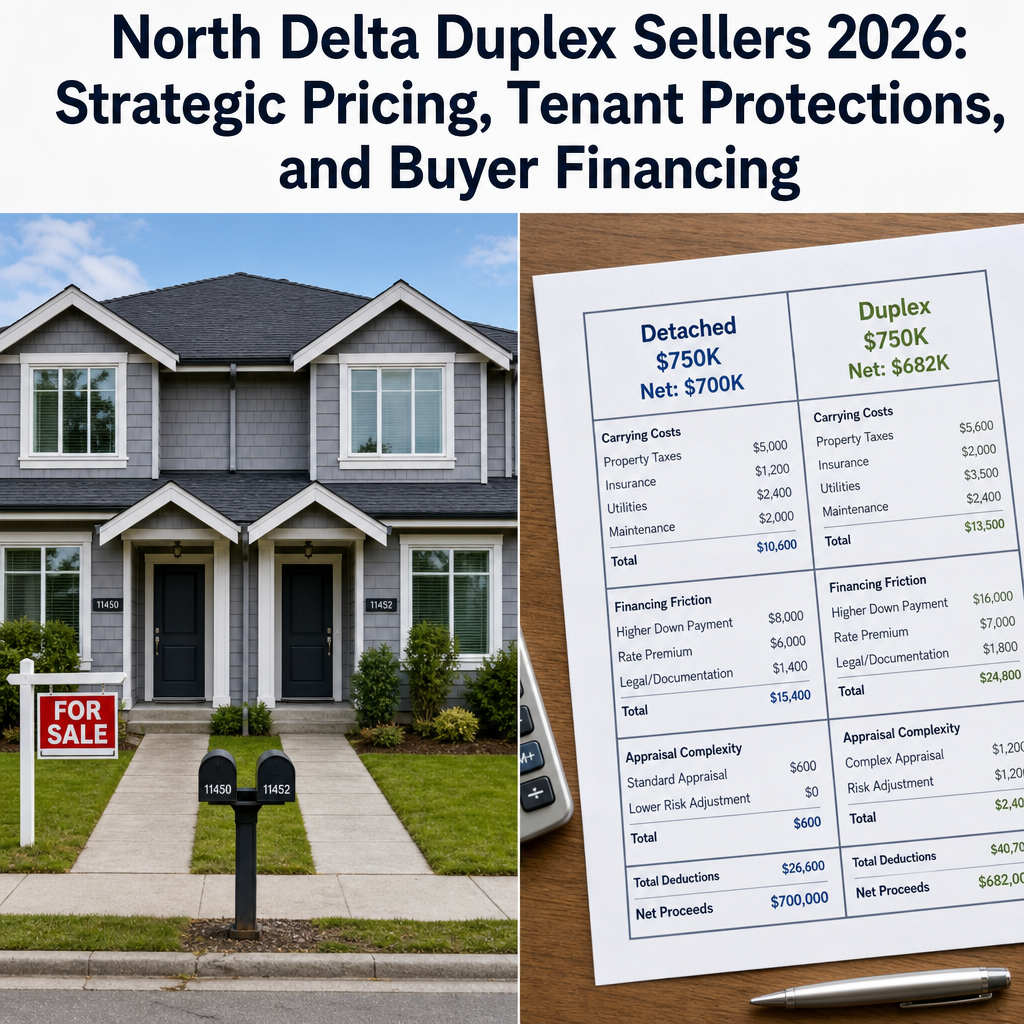

North Delta Duplex Sellers 2026: Strategic Pricing, Tenant Protections, and Buyer Financing When Dual-Unit Economics Reshape Your Net Proceeds in a Buyer's Market
By Mohamed Mansour, MBA and Associate Broker | Mansour Real Estate Group | Published: May 13, 2025 | Geography: North Delta, Fraser Valley, BC | Category: Seller Strategy
Selling a duplex in North Delta in 2026 is not a variation of selling a detached home. It is a fundamentally different transaction — with a narrower buyer pool, longer financing timelines, stricter lender requirements, and net proceeds that routinely fall $15,000 to $35,000 short of what sellers expect based on detached comps alone. Sellers who price and prepare a duplex the same way they would a single-family home often end up with extended days on market, reduced offers, and deals that collapse during subject removal.
This article addresses the complete financial and legal framework North Delta duplex sellers need before going to market — covering tenant protections under the Residential Tenancy Act, buyer profile segmentation, lender underwriting realities, appraisal friction, and the pricing approach that actually clears the market in 2026 conditions.
Short Answer
North Delta duplexes take 35–45 days to sell in 2026, roughly 50–65% longer than detached homes in the same area. Tenant protections, lender income-averaging requirements, and appraisal complexity reduce buyer pools and extend subject removal timelines. Sellers who price based on detached comps without adjusting for these factors typically net $15,000–$35,000 less than projected. Accurate duplex pricing requires understanding the three distinct buyer profiles — investors, owner-occupants, and conversion-intent buyers — and structuring the listing to speak to all three.
Key Takeaways
- North Delta duplexes average 35–45 days on market in 2026, compared to 18–22 days for detached homes in the same postal codes.
- Tenant protections under the Residential Tenancy Act narrow the buyer pool and extend subject removal by 5–10 business days.
- Duplex sellers net $15,000–$35,000 less than detached sellers at equivalent sale prices due to carrying costs and financing friction.
- Duplex inventory in North Delta is up 12% year over year while sales volume fell 8%, signaling active overpricing relative to buyer demand.
- Three distinct buyer profiles require different marketing emphasis: cap-rate investors, primary-plus-suite owner-occupants, and conversion-intent buyers.
Who This Applies To
- Homeowners selling a legal duplex or dual-unit property in North Delta
- Investors liquidating a multi-unit rental property in the Fraser Valley
- Estate executors handling a tenanted duplex in North Delta or South Delta
- Sellers evaluating whether to sell with tenants in place or vacant
- Anyone comparing net proceeds between a duplex and a detached property at similar price points
When This Advice May Not Apply
This framework is specific to legal duplexes with existing tenants subject to the Residential Tenancy Act. It does not apply to unauthorized suites, properties sold vacant, coach-house configurations subject to different zoning, or commercial-residential mixed-use properties. Consult a lawyer and your listing agent for situations that fall outside these parameters.
Data Used in This Article
- BC Assessment 2026 Benchmark Data – North Delta Residential | Official | 2026 | Property valuation and benchmark comparisons by property type
- FVREB Market Statistics April 2026 | Official (Fraser Valley Real Estate Board) | April 2026 | Days-on-market by property type and postal code
- Residential Tenancy Act, Sections 32–40 | BC Government | Current | Landlord-tenant obligations affecting sale and buyer qualification
- BC Residential Mortgage Lender Guidelines 2026 | Regulatory | 2026 | Multi-unit income averaging and qualification standards
- Appraisal Institute of Canada – Duplex Valuation Standards | Professional body | Current | Rent-controlled unit adjustments and income approach methodology
- TransLink SkyTrain Expansion Timeline and North Delta Development Forecasts 2025–2030 | Official/TransLink | 2025 | Buyer psychology and development potential context
Why Duplex Economics Diverge From Detached Home Sales in North Delta
North Delta's residential market in 2026 includes approximately 15–18% legal duplexes and multi-unit properties, according to BC Assessment data. On the surface, a duplex priced at $750,000 and a detached home priced at $750,000 look equivalent. In practice, they are not.
According to FVREB April 2026 data, detached homes in North Delta are selling in 18–22 days. Duplexes are averaging 35–45 days — roughly 50–65% longer. The longer timeline alone costs sellers money: additional mortgage payments, property taxes, insurance, and opportunity cost all compound during the extended sale period. These carrying costs are not abstract. On a $750,000 duplex with a $500,000 mortgage, an extra three weeks on market costs approximately $1,800–$2,200 in carrying alone before accounting for price reductions.
When appraisal complexity and financing friction are added — discussed below — the total erosion of net proceeds relative to detached homes at the same sale price typically ranges from $15,000 to $35,000. This is the figure that most duplex sellers in North Delta do not see coming until it is too late to address it with better preparation.
North Delta duplex inventory rose 12% year over year through spring 2026, while sales volume fell 8%, according to FVREB data. That divergence signals one thing clearly: a meaningful portion of current duplex listings are priced above what qualified buyers can or will pay in this market configuration.
How Tenant Protections Under the Residential Tenancy Act Affect Your Sale
The Residential Tenancy Act (Sections 32–40) governs how tenancies interact with a property sale in BC. For duplex sellers in North Delta, this creates several friction points that directly affect buyer pool size, subject period length, and ultimately sale price.
Buyers purchasing a tenanted duplex cannot simply assume the tenants will vacate. End of tenancy for personal occupancy requires the buyer to serve proper notice under the RTA — typically two months for a fixed-term tenancy ending at natural expiry, and more complex timing for month-to-month agreements. Buyers who need vacant possession to occupy one unit or to qualify for owner-occupant financing must factor that timeline into their purchase planning. Many do not, and those offers collapse during the subject period when the timeline becomes clear.
For investors purchasing with tenants remaining in place, lenders require income documentation. This means current lease agreements, rent rolls showing actual income, and often a full 12-month rental history. If rental income is below market — as is frequently the case in rent-controlled units where a long-term tenant pays 2019 rates — lenders apply income averaging or cap the rental income credit, which reduces the buyer's qualifying capacity and pushes the effective price ceiling down.
According to BC Residential Mortgage Lender Guidelines 2026, subject removal timelines on multi-unit properties with tenants commonly extend 5–10 business days beyond standard single-family conditions. Sellers who are not prepared for this often interpret it as buyer hesitation when it is actually a lender documentation requirement. Understanding that distinction helps sellers stay patient rather than making premature concessions.
How We Evaluate This
Mansour Real Estate Group approaches duplex pricing in North Delta using a three-model framework. The first model is a direct comparison to detached and semi-detached properties, adjusted for the financing and appraisal discounts that apply to income-producing units. The second model treats the duplex as an income property and evaluates it on gross rent multiplier and cap rate relative to investor benchmarks in the current North Delta market. The third model assesses conversion potential — land value, zoning, and proximity to the planned SkyTrain expansion corridor — for buyers who may see the property as a medium-term redevelopment opportunity.
The pricing recommendation comes from reconciling all three models, not from averaging or defaulting to the highest value. In a buyer's market with inventory up and sales volume down, the listing price that generates qualified offers is usually the one that makes the property competitive on all three buyer-type metrics simultaneously — not just the one the seller finds most favorable.
The Three Buyer Profiles and What Each One Needs
Based on spring 2026 buyer activity data and professional observations in the North Delta duplex market, buyers divide into roughly three segments, each requiring a different approach from the listing.
Investors (approximately 45% of the buyer pool) are evaluating the property on cap rate and gross rent multiplier. They need accurate rental income documentation, current lease agreements, and confirmation of the legal status of both units. They are not moved by staging or curb appeal. They are moved by numbers that hold up under lender and appraiser scrutiny. If the rent roll shows below-market rates due to rent control, the investor's offer price will reflect that gap — and no amount of negotiation will close it without addressing the income constraint at the source.
Owner-occupants with suite income (approximately 35% of the buyer pool) plan to live in one unit and rent the other. Their qualification depends on the lender's treatment of rental income — typically 50–80% of gross rent is credited toward mortgage qualification, depending on the lender and program. These buyers need clarity on tenancy status, the timeline for gaining access to one unit, and the realistic rental income they can document to their lender. Listings that provide this information proactively attract better-qualified offers in this segment.
Conversion-intent buyers (approximately 20% of the buyer pool) are evaluating the property's development potential, often in the context of North Delta's proximity to the planned SkyTrain expansion corridor identified in TransLink's 2025–2030 development forecasts. These buyers are thinking about medium-term rezoning or strata conversion. They are less focused on current rental income and more focused on lot size, zoning, and holding costs during any conversion timeline. Listings that include the relevant zoning information and lot dimensions capture this buyer without requiring them to do their own research.
Appraisal Complexity and What It Means for Financing
According to Appraisal Institute of Canada standards, duplex valuation in BC uses a hybrid of the direct comparison approach and the income approach. When a duplex contains rent-controlled units generating below-market income, the income approach produces a lower value than the comparison approach. Appraisers must reconcile the two, and in most cases, they weight the income approach more heavily for income-producing properties — even when the seller believes their property should be valued entirely on the detached-home-comparable basis.
The practical consequence: a duplex that the seller prices at $780,000 based on nearby detached comps may appraise at $730,000–$745,000 when rent-controlled income is factored in. The buyer's financing is then based on the appraised value, not the contract price. The seller either accepts the lower net, renegotiates, or loses the deal. Sellers who understand this before listing can price more accurately and avoid this outcome entirely. Sellers who discover it during subject removal are negotiating from a weakened position under time pressure.
Duplex Seller Checklist
- Obtain current lease agreements and a 12-month rent roll for both units before listing
- Confirm legal status of both units with the municipality and ensure all permits are on file
- Review RTA obligations: identify tenancy type (fixed-term or month-to-month) and applicable notice requirements for each unit
- Request a pre-listing appraisal using both the direct comparison and income approach to establish realistic value range
- Prepare a buyer information package including rental income documentation, utility costs, and zoning/lot information for conversion-intent buyers
- Budget for a 35–45 day sale timeline and 5–10 day extended subject period when projecting net proceeds and bridge financing needs
- Price the property at the lower end of the appraised range to compete on all three buyer-profile criteria simultaneously in a buyer's market
- Consult a lawyer regarding any notice requirements or RTA obligations that must be disclosed to buyers before or during the offer process
What We Commonly See
In our experience, the most common mistake North Delta duplex sellers make is pricing from detached comps without adjusting for the income approach discount. A seller sees a comparable detached home sell for $800,000 two blocks away and prices their duplex at $785,000 to appear competitive. What the seller hasn't accounted for is that the duplex will appraise lower, qualify for different financing, and attract a narrower pool — so the effective market for that $785,000 listing is a fraction of the detached home market. The result is 50–60 days on market followed by a price reduction to $755,000 that still nets less than an accurate initial price of $745,000 would have, because the carrying costs have already compounded.
What often happens with investor buyers is a mismatch between the seller's expectation and the buyer's financial model. The seller knows the gross rent. The investor buyer knows the net operating income after vacancy allowance, maintenance reserves, and property management — and that number is often 25–35% lower than the gross. When the listing presents only gross rental income without context, investor buyers discount the offer price to account for the information gap, or they walk away from properties where they cannot verify the numbers independently.
A common mistake among sellers with long-term tenants is underestimating how much the below-market rent affects the buyer's financing capacity. A tenant paying $1,400 per month in a unit where current market rent is $2,100 creates a $700/month income gap. Over a 12-month period, that is $8,400 in rental income the buyer cannot credit toward their mortgage qualification — which can eliminate otherwise qualified buyers from the pool entirely. Sellers who have long-term rent-controlled tenants need to understand this math before setting their list price, not after receiving offers.
Questions and Answers
Can I end my tenants' tenancies before selling my North Delta duplex?
Under the Residential Tenancy Act, a landlord can serve notice for the buyer's personal occupancy, but specific conditions and timelines apply. For month-to-month tenancies, the notice period is generally two months. Ending a tenancy solely to sell the property vacant is not a valid ground under the RTA. Consult a lawyer before serving any notice.
Why do North Delta duplexes take longer to sell than detached homes?
According to FVREB April 2026 data, duplexes average 35–45 days on market compared to 18–22 days for detached homes. The longer timeline reflects a narrower buyer pool, lender income-documentation requirements, appraisal complexity, and the tenant-related due diligence buyers must complete before committing.
How much of my rental income will a buyer's lender credit for mortgage qualification?
Under BC lender guidelines 2026, most institutional lenders credit 50–80% of gross rental income for qualification purposes. The exact percentage depends on the lender's program, whether the buyer will occupy one unit, and the documentation available. Below-market rent-controlled income reduces the effective credit further.
Does the SkyTrain expansion affect North Delta duplex values?
TransLink's 2025–2030 development forecasts identify North Delta as a corridor of interest for future transit-oriented development. This has begun to influence a subset of buyers — conversion-intent purchasers evaluating duplex lots for future rezoning. It does not currently inflate appraised values but does add a buyer segment that prices on land and conversion potential rather than rental income alone.
Why is my duplex worth less than the detached home down the street if the price is the same?
At equivalent list prices, a duplex typically produces a lower appraised value because appraisers apply the income approach alongside direct comparisons. If rental income is below market due to rent control or long-term tenants, the income approach pulls the appraised value down. The detached home is valued entirely on comparables without an income constraint. That gap — often $20,000–$50,000 — is structural, not negotiable.
In Summary
Selling a duplex in North Delta in 2026 requires a pricing framework built on three models — direct comparisons, income approach, and conversion potential — not on detached home comps alone. Tenant protections under the Residential Tenancy Act, lender income-averaging requirements, and appraisal methodology all narrow the buyer pool and compress net proceeds relative to what sellers typically expect. Duplex inventory is up 12% while sales volume has declined 8%, which means overpriced listings are not just sitting — they are quietly costing sellers money every week they remain unsold. Sellers who prepare accurate documentation, price from a reconciled valuation model, and structure their listing to speak to all three buyer profiles will consistently outperform those who rely on detached-home intuition in a market that operates by different rules.
Talk to Mansour Real Estate Group Before You List
If you own a duplex in North Delta and are thinking about selling in 2026, the most useful first step is a conversation about what your property is actually worth to each of the three buyer types currently active in this market — and what your realistic net proceeds will look like after tenant, financing, and appraisal factors are built in. That conversation costs nothing and typically changes how sellers approach the listing in ways that protect their equity. Mansour Real Estate Group offers this analysis without obligation.
Related Articles
- The North Delta Sellers Guide: What the 2026 Market Means for Detached Home Pricing
- Selling a Tenanted Property in BC: What the Residential Tenancy Act Requires of Sellers
- Fraser Valley Multi-Unit Property Sellers 2026: Investor Buyers, Appraisal Reality, and Pricing That Clears the Market
About Mansour Real Estate Group
Selling a tenanted duplex in North Delta requires a real estate team that understands not just how to price and market the property, but how tenant protections, lender income requirements, and appraisal methodology interact to shape buyer behavior and seller net proceeds. Mansour Real Estate Group has guided duplex sellers, estate executors managing multi-unit properties, and investors transitioning out of Fraser Valley rental holdings across North Delta, Surrey, Langley, Abbotsford, and the broader Lower Mainland for more than two decades — bringing a structured, valuation-first process to every transaction where the complexity goes beyond a standard detached home sale.
Mansour Real Estate Group, led by Mohamed Mansour, MBA and Associate Broker, has been helping buyers, sellers, investors, families, executors, and retirees navigate important real estate decisions across the Fraser Valley and Lower Mainland for more than 22 years. Ranked among the Top 1% of Realtors in the region, the team has completed more than $780 million in residential real estate transactions and is trusted for multi-unit property sales, duplex pricing strategy, estate sales, divorce-related sales, downsizing, relocation, and any situation where accurate valuation is critical to the outcome.
Whether someone is looking for Realtors experienced with tenanted properties in the Fraser Valley, a real estate agent who understands duplex valuation and income approach appraisals, real estate agents who work with both investor and owner-occupant buyers, a North Delta Realtor, a Fraser Valley real estate broker, a real estate team that serves multi-unit sellers, or a real estate group known for honest net-proceeds analysis before a listing goes live — Mansour Real Estate Group brings data-driven pricing, practical market context, and clear communication to every duplex and multi-unit
Disclaimer: This article is for informational purposes only and does not constitute legal, financial, or real estate advice. Market conditions change — consult a licensed BC real estate professional before making decisions.



