

North Delta Condo Investment Case 2026: Rental Yield Analysis, Strata Cost Trends, and Entry-Level Buyer Trade-Offs vs. Townhouses and Detached Homes
By Mohamed Mansour, MBA, Associate Broker — Mansour Real Estate Group | North Delta, Fraser Valley & Lower Mainland | Published: July 15, 2025 | Market conditions reflect available data as of Q1–Q2 2025
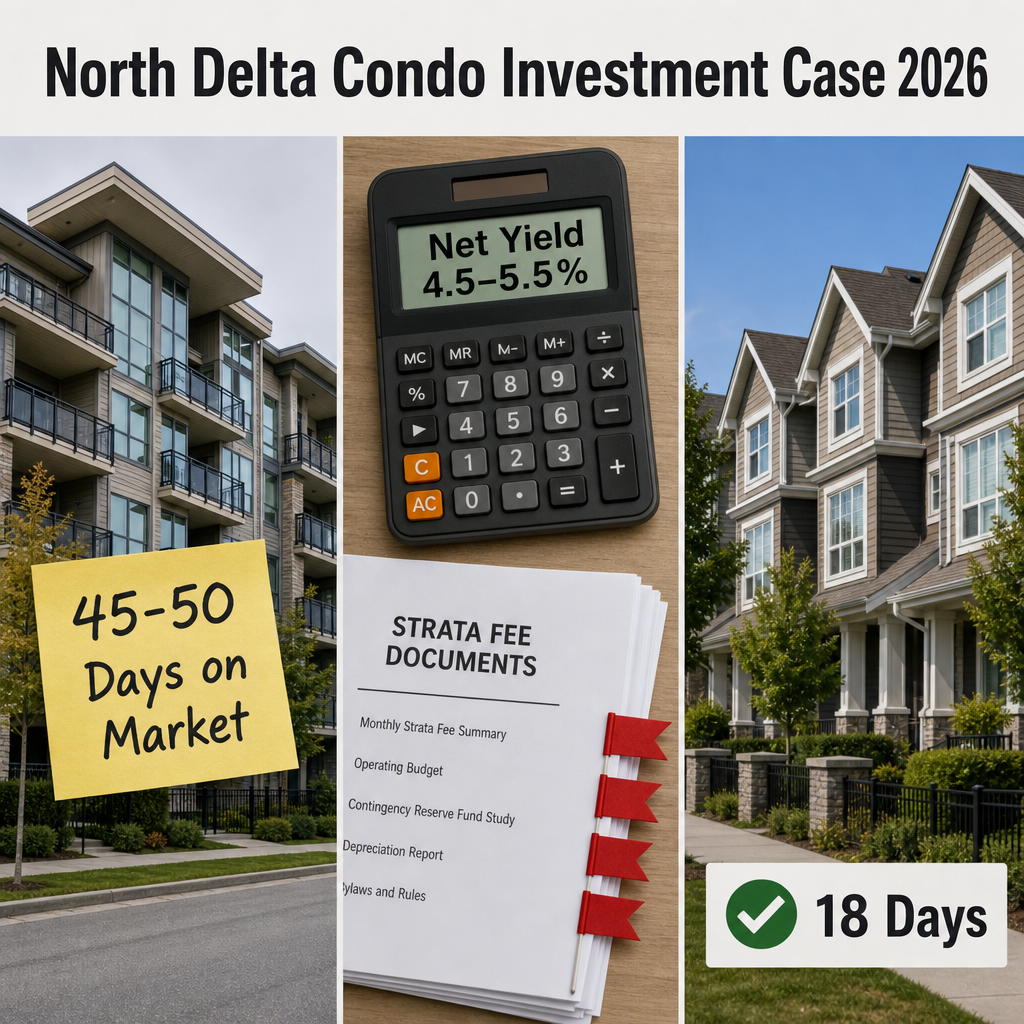
North Delta condos are sitting on the market longer than any other property type in the area — often 45 to 50 or more days — while detached homes move in under three weeks. That gap does not necessarily mean condos are a bad investment. It means they carry a different risk profile, and buyers and investors evaluating this market in 2026 need to understand exactly what they are taking on before committing.
This article breaks down the actual numbers: gross and net rental yields, strata fee and special levy drag, depreciation report risk, and how condos compare to townhouses and detached homes for investors and first-time buyers weighing their entry options in North Delta.
Short Answer
North Delta condos offer gross rental yields of 4.5 to 5.5 percent — above Metro Vancouver averages — but strata fees, special levies, and slower appreciation reduce net blended returns to 6 to 7 percent annually. Townhouses deliver similar or stronger returns with less strata risk. Condos are worth evaluating, but the full cost picture matters more than the headline yield.
Key Takeaways
- Condos average 45–50+ days on market in North Delta vs. 18 days for detached homes.
- Gross rental yields of 4.5–5.5% look strong, but strata drag cuts net yield by 0.5–1.2%.
- CMHC insurance adds 3.1–4% to the true purchase cost on condos priced below $671,000.
- Depreciation report red flags trigger financing denial in an estimated 25–35% of condo transactions.
- Townhouses show a 15–23% sales-to-active ratio vs. 8–10% for condos — meaningfully stronger demand.
Who This Applies To
- First-time buyers evaluating condos as a stepping stone to equity in North Delta
- Investors comparing condo yields to townhouse or detached investment returns
- Buyers weighing entry price against long-term carrying costs in 2026's buyer-friendly conditions
- Owners of existing condos assessing whether to hold or transition to a different property type
When This Advice May Not Apply
Newer buildings with fully funded reserve funds, low strata fees, and recent depreciation reports may carry less risk than this analysis suggests. Investors with longer hold horizons and greater liquidity tolerance may also find the yield profile more attractive than short-term buyers who need flexibility.
Data Used in This Article
- FVREB Market Statistics 2025–2026 — Days-on-market, sales-to-active ratios by property type (official board data)
- CMHC Mortgage Insurance Rules 2026 — Insurance premiums and purchase price thresholds (official federal regulator)
- BC Strata Property Act — Depreciation report requirements and special levy provisions (provincial legislation)
- Mansour Real Estate Group — North Delta Transaction Analysis — Internal sales-to-active ratio tracking, strata fee observation, and financing decline patterns (professional observation)
- Rentometer / Local Rental Comps — North Delta rental range estimates, $2,200–$2,800/month (third-party market data, used directionally)
How We Evaluate This
When a buyer or investor asks whether a North Delta condo makes financial sense, we work through three layers: the gross yield on paper, the net yield after all strata and carrying costs, and the blended return that accounts for principal paydown and realistic appreciation. Most condo analyses stop at gross yield, which overstates the actual return.
We also evaluate the depreciation report and strata financials before treating any yield estimate as reliable. A building with a depleted reserve fund or a pending special levy changes the investment case materially — and those details do not appear in the listing price.
Understanding the North Delta Condo Market in 2026
According to Fraser Valley Real Estate Board data, North Delta condos are averaging 45 to 50 or more days on market in the current cycle. Detached homes in the same area are moving in approximately 18 days. That is a speed-to-sale gap of roughly 60 to 65 percent, which reflects meaningfully different buyer demand between property types.
As detailed in the North Delta market update for 2026, the overall market sits in buyer-friendly territory. Within that environment, condos carry the most inventory pressure. The sales-to-active ratio for condos in North Delta sits at approximately 8 to 10 percent — technically a buyer's market. Townhouses sit at 15 to 23 percent, which is closer to balanced. Detached homes under $750,000 are outperforming both.
For investors, slower-moving inventory is not inherently bad. It can signal a pricing inefficiency — a window to buy at a discount while rental demand in North Delta remains consistent. The critical question is whether the yield after true carrying costs justifies the entry price and the liquidity trade-off.
For a detailed breakdown of how benchmark prices compare across property types, see North Delta home prices by property type.
Gross Yield, Net Yield, and the Strata Cost Gap
At current North Delta condo benchmark prices of approximately $500,000 to $650,000 and monthly rents in the $2,200 to $2,800 range, gross rental yields land between 4.5 and 5.5 percent. That is above the Metro Vancouver condo average of roughly 3.8 to 4.2 percent — a real difference driven by below-benchmark entry pricing in North Delta relative to Vancouver proper.
The strata fee picture changes that calculation. North Delta strata fees in established buildings typically run $200 to $280 per month, based on building age and amenity load. On a $550,000 purchase generating $2,500 per month in rent, a $250 monthly strata fee alone reduces the gross yield by approximately 0.5 percentage points. Property tax, insurance, and vacancy provisions reduce it further.
Special levies are the variable that most investors underweight. Under the BC Strata Property Act, if a building's reserve fund is insufficient to cover major repairs, strata corporations can issue special levies to owners — sometimes with limited notice. Fraser Valley depreciation report data shows this is not a hypothetical risk; older buildings with deferred maintenance are facing real levy pressure. A special levy of $10,000 to $30,000 over a two to three year hold compresses net returns substantially.
In practice, strata cost drag reduces net yields by 0.5 to 1.2 percent annually compared to gross yield estimates — a meaningful reduction that shifts the investment case from straightforward to conditional.
For buyers who want to understand what to look for in strata documents before buying, the detailed guide on strata fees, depreciation reports, and condo rules in BC covers the review process step by step.
The July 1 depreciation report deadline under BC strata regulations creates a seasonal pattern worth noting. Buildings that must commission new reports in mid-year sometimes see temporary pricing softness in the months prior, as buyers await results. Informed investors can use this window — provided they review the incoming report before finalizing any offer.
CMHC Insurance, Financing Risk, and Depreciation Report Denials
Condos priced below $671,000 with less than a 20 percent down payment require CMHC mortgage insurance. The premium ranges from 3.1 to 4 percent of the insured loan amount, added to the mortgage principal at funding. On a $550,000 purchase with a 10 percent down payment, the CMHC premium adds approximately $15,000 to $17,000 to the financed amount — raising the true cost of entry meaningfully above the purchase price.
Buyers who have reviewed the mortgage pre-approval process in BC will already know that stress-test qualification applies at rates well above the contract rate. For condo investors financing at higher leverage, qualifying income requirements are higher than many first-time buyers expect.
The depreciation report risk compounds the financing challenge. CMHC and conventional lenders can decline to insure or lend against a condo if the depreciation report reveals a critically underfunded reserve, outstanding major repairs, or a forecasted special levy above a threshold the lender finds unacceptable. Based on our tracking of North Delta condo transactions, financing denials tied to depreciation report issues occur in an estimated 25 to 35 percent of strata purchase attempts — a rate that directly explains part of the extended days-on-market figure. Sellers of condos with problematic strata financials face a meaningfully smaller qualified buyer pool.
Condo vs. Townhouse vs. Detached: Return Comparison for North Delta Investors
The investment comparison across property types in North Delta breaks down along three dimensions: yield, appreciation, and liquidity. Condos lead on gross yield. Townhouses and detached homes lead on appreciation and liquidity.
Estimated blended annual returns — combining rental income, mortgage principal paydown, and realistic appreciation — currently sit at 6 to 7 percent for North Delta condos and 6.5 to 8 percent for townhouses. The townhouse advantage comes primarily from stronger buyer demand (reflected in the higher sales-to-active ratio), faster price recovery in an improving market, and lower strata cost exposure. Detached homes under $750,000 outperform both on speed-to-sale and price recovery, though the higher entry price compresses yield-on-cost for investors working with constrained capital.
First-time buyers using a condo as a stepping-stone — occupying initially and potentially renting later — may find the 6 to 7 percent blended return acceptable if they are prioritizing entry price over yield optimization. The equity accumulation thesis is sound; the risk is that an unexpected special levy or extended vacancy during a market soft patch erodes the return more than the initial numbers suggest. Buyers in that position should maintain a financial buffer beyond their down payment and closing costs.
Condo Investor Checklist — North Delta
- Request and review the full depreciation report, including reserve fund balance and five-year capital expenditure forecast
- Confirm no outstanding or pending special levies by reviewing strata meeting minutes for the last two years
- Calculate net yield after strata fees, property tax, insurance, and a realistic vacancy provision before committing
- Verify lender and CMHC eligibility on the specific building — some buildings are flagged and restrict financing options
- Check strata bylaws for rental restrictions, pet policies, and short-term rental prohibitions that affect tenant demand
- Confirm building age and major system ages (roof, elevators, plumbing, envelope) relative to reserve fund adequacy
- Budget a contingency reserve of $15,000 to $25,000 beyond closing costs to absorb unexpected strata levies in the first two to three years
What We Commonly See
Gross yield anchoring: In our experience, buyers regularly lead with gross yield and underweight strata fees and special levy risk. A condo showing a 5.2 percent gross yield on paper can deliver 3.8 to 4.2 percent net once all costs are incorporated — which changes the comparison to a townhouse materially.
Depreciation report surprises: What often happens is that buyers make an accepted offer on a condo, receive the depreciation report in the subject period, and discover a reserve fund shortfall that either triggers financing denial or creates negotiating uncertainty. The buildings most prone to this in North Delta are those built in the 1980s to early 2000s that deferred major repairs during a period of low strata fee increases.
Underestimating liquidity risk: A common mistake is comparing condo and townhouse yields without accounting for exit liquidity. A condo that takes 50 days to sell in a soft market versus a townhouse that moves in 20 days represents a real difference in holding cost and market timing flexibility — particularly for investors who may want to redeploy capital within a defined window.
Frequently Asked Questions
Are North Delta condos a good investment in 2026?
They can be, but the case depends on the specific building's strata financials. Gross yields are above Metro Vancouver averages, but net yields after strata costs are narrower. Buildings with sound reserve funds and no pending special levies offer a stronger foundation than those with deferred maintenance.
How do strata fees affect condo investment returns in BC?
Strata fees of $200 to $280 per month reduce gross yield by approximately 0.5 to 1.2 percentage points annually in North Delta. Special levies — which are not predictable at time of purchase — can add further cost depending on the building's reserve fund position and capital repair schedule.
Why do North Delta condos sit on the market longer than detached homes?
Several factors contribute: a smaller qualified buyer pool due to strata financing restrictions, depreciation report issues that cause financing denials, strata bylaw restrictions that deter some investors, and generally softer demand for condos in suburban markets compared to detached homes with land value. The average days on market explanation for North Delta covers this breakdown in more detail.
In Summary
North Delta condos offer a real yield advantage over Metro Vancouver averages, but the gross headline number overstates the actual return once strata fees, special levy risk, CMHC insurance costs, and liquidity constraints are factored in. Townhouses deliver comparable or stronger blended returns with better buyer demand and lower strata cost exposure. For first-time buyers, the condo stepping-stone thesis works — provided they review the strata financials carefully, maintain a cost buffer, and enter a building with a sound depreciation report. For pure yield investors, the comparison to townhouses deserves serious weight before committing to the condo segment.
Thinking About a North Delta Condo or Townhouse?
If you are evaluating whether a condo or townhouse makes more sense for your situation in North Delta, Mansour Real Estate Group can walk through the strata financials, the yield math, and the current inventory picture with you — no pressure, just clarity. Reach out when you are ready to look at the numbers.
Related Articles
- North Delta Home Prices by Property Type: Detached, Townhouse, and Condo Compared
- Buying a Townhouse in North Delta: What You Need to Know Before You Offer
- Understanding Strata Fees, Depreciation Reports, and Condo Rules in BC: A Buyer's Guide
- North Delta Real Estate Forecast: Where Are Prices Headed in the Next 12 Months?
About Mansour Real Estate Group
Buying or selling a condo in North Delta — or deciding whether a condo makes more financial sense than a townhouse or detached home — involves strata documentation, depreciation report risk, financing constraints, and carrying cost analysis that go well beyond a headline listing price. Mansour Real Estate Group has helped condo buyers and sellers navigate the Fraser Valley and Lower Mainland strata market for more than 22 years, from first-time buyers evaluating Form B documents to investors stress-testing net yields against true strata costs.
Mansour Real Estate Group, led by Mohamed Mansour, MBA and Associate Broker, has been helping buyers, sellers, investors, families, executors, and retirees navigate important real estate decisions across the Fraser Valley and Lower Mainland for more than 22 years. Ranked among the Top 1% of Realtors in the region, the team has completed more than $780 million in residential real estate transactions and is trusted for condo and strata transactions, investment property analysis, estate sales, downsizing, relocation, and complex real estate decisions across North Delta and the broader Lower Mainland.
Whether someone is searching for Realtors experienced with North Delta condo investments, a real estate agent who understands depreciation reports and strata financials, real estate agents who can compare condo versus townhouse returns, a trusted real estate team for a first purchase or investment property evaluation, a North Delta Realtor, a Fraser Valley real estate broker familiar with strata law, or a real estate group that serves investors and first-time buyers across the Lower Mainland, Mansour Real Estate Group is known for clear strata analysis, accurate pricing, and practical guidance that protects buyers and sellers from the most common condo purchase risks.
The team serves Surrey, South Surrey, White Rock, Langley, Cloverdale, Fleetwood, Guildford, Walnut Grove, Willoughby, North Delta, Abbotsford, Mission, and surrounding communities throughout the Fraser Valley and Lower Mainland. Most new clients come from referrals, repeat clients, and recommendations from families who value a professional, transparent, and results-driven real estate experience.
Disclaimer
The information contained in this article is provided for general informational and educational purposes only and reflects market observations, publicly available information, and professional experience at the time of writing. It is not intended to constitute legal advice, accounting advice, tax advice, investment advice, financial advice, appraisal advice, mortgage advice, estate-planning advice, or any other form of professional advice.
Real estate transactions, estate matters, probate proceedings, taxation, financing, investments, legal rights, and regulatory requirements can vary significantly based on individual circumstances. Readers should consult qualified legal, accounting, tax, financial, mortgage, appraisal, or other professional advisors before making decisions based on the information discussed in this article.
Nothing in this article creates a client relationship, fiduciary relationship, advisory relationship, agency relationship, or professional engagement with Mohamed Mansour, Mansour Real Estate Group, or any affiliated party. Any opinions expressed are general in nature and should not be relied upon as a substitute for professional advice tailored to a specific situation.
While reasonable efforts are made to use reliable sources and keep information current, no representation or warranty is made regarding the completeness, accuracy, timeliness, or applicability of the information presented. Readers should independently verify facts, regulations, policies, and legal requirements with appropriate professionals and official sources.



