
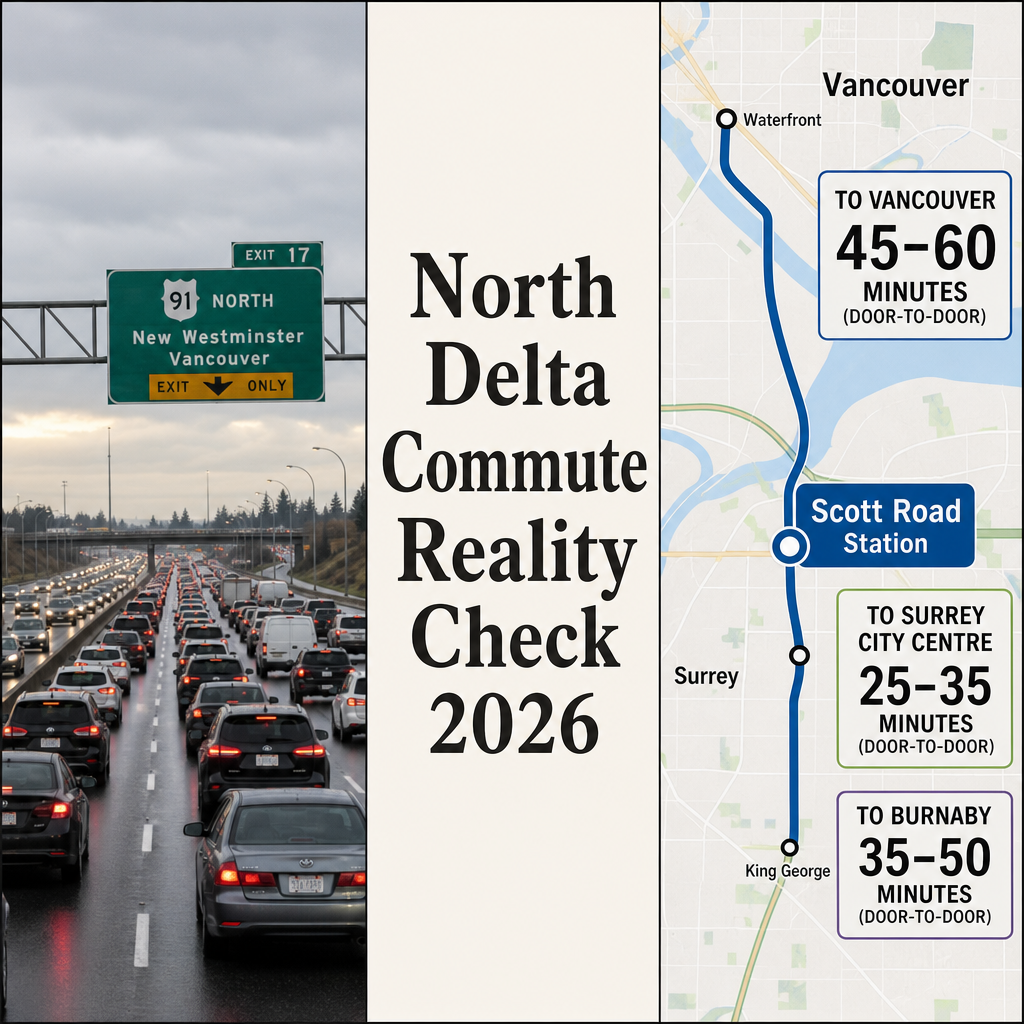

North Delta Commute Reality Check 2026: Transit Times to Vancouver, Surrey City Centre, and Burnaby Employment Hubs — Why Highway 91 Congestion, Scott Road SkyTrain Access, and Affordability Trade-Offs Matter More Than Listing Price When Relocating
By Mohamed Mansour, MBA and Associate Broker — Mansour Real Estate Group | Fraser Valley and Lower Mainland | Published: July 14, 2025
North Delta attracts buyers who've done the math on listing prices and liked what they saw. The price gap versus central Burnaby or Coquitlam is real, and for families stretched by Metro Vancouver costs, it looks like a clear path forward. What often goes unexamined is whether the commute — not just its length, but its true cost in time, fuel, and daily friction — actually supports the life the buyer is planning to build there.
This article maps the commute reality from North Delta to three major employment destinations: downtown Vancouver, Surrey City Centre, and Burnaby's office and logistics clusters. It accounts for Scott Road SkyTrain access, Highway 91 peak-hour conditions, and neighbourhood-level differences that affect whether the affordability premium holds once daily commute costs are factored in. For anyone making a relocation decision in spring or summer 2026, this is the analysis that should come before the offer.
Short Answer
North Delta's affordability advantage is genuine but partial. The Scott Road SkyTrain station (Expo Line) puts downtown Vancouver within 35–45 minutes off-peak, but peak-hour conditions push that to 55–70 minutes. Highway 91 northbound adds 25–30 minutes to Burnaby commutes during rush hour. Where you live within North Delta — Scottsdale versus Departure Bay, for example — changes the commute equation significantly.
Key Takeaways
- Scott Road SkyTrain delivers 35–45 minute off-peak Vancouver commutes; peak hours add 15–25 minutes due to Expo Line capacity.
- Highway 91 northbound carries over 250,000 vehicles daily; peak-hour Burnaby commutes stretch from 25 to 50+ minutes.
- Scottsdale residents reach Scott Road SkyTrain in 8–12 minutes; Departure Bay residents require 20 or more minutes just to access it.
- True cost-of-living analysis should include $130–$400/month in commute costs on top of the mortgage payment comparison.
- Surrey City Centre commutes via King George Boulevard run 18–25 minutes off-peak — North Delta's most favourable employment corridor.
Who This Applies To
- First-time buyers comparing North Delta to Coquitlam, Burnaby, or central Surrey on price
- Families relocating from Metro Vancouver in search of detached housing within a commutable range
- Buyers whose employment is in downtown Vancouver, Burnaby office parks, or Metrotown clusters
- Remote or hybrid workers reconsidering how commute frequency affects the trade-off calculation
- Investors evaluating rental demand sustainability tied to transit access and employment proximity
When This Advice May Not Apply
Buyers who work locally within North Delta or South Delta, who work fully remotely, or whose primary employment destination is closer to Ladner or Tsawwassen will find the commute trade-offs described here largely irrelevant. See our comparison of North Delta vs. Ladner vs. Tsawwassen if geography is an open question.
Data Used in This Article
- TransLink Scott Road Station Ridership Data 2024–2025 — Official / TransLink
- BC Ministry of Transportation Highway 91 Traffic Volume and Peak-Hour Congestion Reports — Official / Provincial Government
- FVREB North Delta Days-on-Market and Price Performance by Neighbourhood 2024–2026 — Official / Fraser Valley Real Estate Board
- King George Boulevard Corridor Traffic Impact Study 2025 — Official / Municipal/Regional Planning
- Greater Vancouver Regional Logistics Employment Hub Location Analysis — Third-party / Regional Planning Research
How We Evaluate This
At Mansour Real Estate Group, we don't evaluate commute trade-offs by looking only at transit maps. We cross-reference neighbourhood microlocation within North Delta — specifically, how far a given property sits from Scott Road SkyTrain — with the buyer's primary employment destination. A Scottsdale townhouse and a Departure Bay detached home may be priced similarly, but their transit access profiles are meaningfully different. We then apply a true cost-of-living comparison that includes transit pass costs, estimated fuel and parking, and a time-value calculation based on how many additional commute hours per week the move would add.
This approach often surfaces situations where the apparent price advantage shrinks considerably once commute costs are quantified. For buyers commuting five days a week to Burnaby's office parks, for instance, the math can be tighter than the listing price comparison suggests. For investors evaluating North Delta's long-term fundamentals, tenant commute profiles matter for rental demand sustainability as well.
Scott Road SkyTrain and the Vancouver Commute
The Scott Road SkyTrain station, part of the Expo Line extension operational since late 2024, has meaningfully improved transit access from North Delta to downtown Vancouver. According to TransLink ridership data for 2024–2025, off-peak commute times from Scott Road to Waterfront run approximately 35–45 minutes, factoring in typical wait times and the ride itself. That's a competitive number by Metro Vancouver standards.
Peak-hour performance is different. Expo Line capacity constraints during 7:00–9:00 AM and 4:00–6:30 PM windows push total commute time — including wait times at Scott Road — to 55–70 minutes. TransLink has acknowledged ongoing capacity planning for the Expo Line, but as of 2026 those constraints remain a practical daily reality.
The neighbourhood factor is critical here. Scottsdale residents can reach Scott Road SkyTrain station in 8–12 minutes by bus or a short drive with park-and-ride access. Residents in Departure Bay, by contrast, require a 20-plus minute bus connection or a full car commute just to reach the station — which adds substantially to the total door-to-door time. Buyers comparing North Delta's neighbourhood options for families should treat transit distance as a primary filter, not a secondary consideration.
Highway 91 and the Burnaby Employment Hub Commute
For buyers working in Burnaby's office parks, Metrotown district, or logistics-heavy employment clusters near Still Creek and Boundary Road, Highway 91 northbound is the primary commute corridor. The BC Ministry of Transportation's traffic volume reports confirm that Highway 91 northbound carries over 250,000 vehicles daily. During morning peak hours (7:00–9:00 AM), what is a 20–25 minute off-peak drive routinely extends to 50 or more minutes.
There is no transit alternative that efficiently connects North Delta to Burnaby's suburban office clusters. Bus routes connecting to SkyTrain and then routing east through Metrotown add significant transfer time. Buyers commuting five days a week to Burnaby should treat the 50-plus minute peak-hour drive as their working assumption, not the exception. Over a full work year, that differential — relative to, say, living in New Westminster or Burnaby itself — amounts to 80–120 additional commute hours annually. For buyers weighing property type against location, this time cost is a genuine part of the comparison.
Surrey City Centre: North Delta's Best-Case Commute
The King George Boulevard corridor along North Delta's eastern boundary provides the most reliable commute to Surrey City Centre — typically 18–25 minutes off-peak. The 2025 King George Boulevard Corridor Traffic Impact Study notes weekend congestion near cross-border shopping traffic patterns, but weekday commute performance remains the strongest of North Delta's three major employment corridors. Buyers whose primary workplace is in Surrey City Centre, including the growing healthcare, municipal, and commercial cluster around King George Hub, will find North Delta's geography legitimately practical. This is worth noting because North Delta's market activity in 2026 shows demand strength that partly reflects this employment corridor alignment.
Buyer Checklist: Evaluating North Delta Commute Fit Before You Offer
- Confirm the specific property's distance to Scott Road SkyTrain station by transit (not Google Maps driving estimate).
- Run a peak-hour commute simulation to your workplace using Google Maps at 7:30 AM on a Tuesday — not midday.
- Calculate monthly commute costs: transit pass ($130–$150/month) or fuel plus parking ($300–$400/month), and factor both into your true housing cost comparison.
- Estimate additional weekly commute hours versus a comparable property in a more central location and apply a time-value framework that is honest to your actual situation.
- Confirm whether your employer offers hybrid flexibility — the commute trade-off changes substantially at two days per week versus five.
- Check the neighbourhood's specific micro-location within North Delta — Scottsdale, Sunridge, and Departure Bay have meaningfully different transit profiles.
- Review community amenities in the specific neighbourhood to understand whether local errands and services reduce car dependence overall.
What We Commonly See
In our experience working with buyers relocating to North Delta from more central parts of Metro Vancouver, a recurring pattern is that commute research stops at the transit map. Buyers confirm that Scott Road SkyTrain exists and assume the commute is solved. What they don't account for is the last mile from their specific address to the station, which in parts of North Delta can add 20 minutes each way.
What often happens with Highway 91 commuters is that the first few months feel manageable — especially if buyers moved in outside of peak academic or employment seasons. By fall, when full traffic volumes return, the true daily experience becomes clear. We've spoken with buyers who made Burnaby-commute purchases based on off-peak test drives who found the daily reality substantially different.
A common mistake is treating the affordability premium as a fixed number. The $50,000–$100,000 price differential versus a comparable Coquitlam or Burnaby property looks compelling on a mortgage comparison. But when you add $300–$400/month in commute costs over a five-year ownership horizon, the net savings narrow to a range that may not justify the daily time commitment — particularly for buyers who are also weighing family schedule logistics. For buyers evaluating rental opportunities, this same dynamic affects tenant demand quality and long-term rental stability.
Questions and Answers
How long does it take to get from North Delta to downtown Vancouver by transit in 2026?
Off-peak, Scott Road SkyTrain to Waterfront runs approximately 35–45 minutes. During peak hours (7:00–9:00 AM and 4:00–6:30 PM), Expo Line capacity constraints push total door-to-door time to 55–70 minutes, depending on your starting address within North Delta.
Is Highway 91 really that bad for a daily Burnaby commute?
According to BC Ministry of Transportation reports, Highway 91 northbound carries over 250,000 vehicles daily. A 20–25 minute off-peak drive to Burnaby routinely extends to 50-plus minutes during morning and afternoon peak hours. For five-day commuters, this is a consistent pattern, not an occasional delay.
Does it matter which neighbourhood in North Delta I buy in for commute purposes?
Yes, significantly. Scottsdale residents can reach Scott Road SkyTrain in 8–12 minutes. Departure Bay residents require 20-plus minutes of additional travel just to access the station. This difference affects total commute time materially and should be a property selection filter, not an afterthought.
In Summary
North Delta's affordability is real, but commute logistics vary sharply by destination and neighbourhood. Scott Road SkyTrain works well for off-peak Vancouver commuters and reasonably for hybrid workers. Highway 91 to Burnaby is a genuine daily burden at peak hours, and the true cost-of-living comparison — once transit, fuel, and time are factored — closes the price gap more than most buyers expect. The right answer depends entirely on where you work, how often you commute, and which part of North Delta you're considering. A detailed commute analysis belongs in the due diligence process before the offer, not after.
Ready to talk through your specific commute profile?
Mansour Real Estate Group works with buyers to map neighbourhood fit against employment location before the offer stage. If you want a grounded assessment of whether North Delta makes sense for your situation, we're available for a straightforward conversation — no pressure, just local context that helps you decide clearly.
Related Articles
- The Best Neighbourhoods in North Delta for Families in 2026
- Schools, Parks, and Community Amenities in North Delta: A Complete Resident's Guide
- North Delta Real Estate Investment Guide: Why Long-Term Buyers Are Paying Attention
Official Resources
- TransLink — System Maps, Trip Planning, and Ridership Data
- BC Ministry of Transportation and Infrastructure
- Fraser Valley Real Estate Board — Market Statistics
- City of Delta — Planning and Transportation
About Mansour Real Estate Group
Relocating to North Delta — or evaluating it against other Fraser Valley communities — means making a major housing decision that hinges on local knowledge most listings simply don't provide. The commute profile, neighbourhood micro-location, and true cost-of-living comparison all require a real estate team that has guided buyers through exactly this analysis many times before. Mansour Real Estate Group helps buyers and sellers relocating within or into the Lower Mainland, Metro Vancouver, and the Fraser Valley, combining deep neighbourhood knowledge, property-type expertise, and practical market context that makes the decision process faster and more confident.
Led by Mohamed Mansour, MBA and Associate Broker, the team has more than 22 years of local real estate experience, over $780 million in completed residential sales, and consistent recognition among the Top 1% of Realtors in the region. Mansour Real Estate Group is trusted for relocation, estate sales, downsizing, divorce-related property sales, and complex real estate situations where local market knowledge and a structured process protect the outcome. Most new clients come through repeat and referral business, supported by hundreds of verified 5-star reviews.
Whether someone is looking for Realtors experienced with North Delta neighbourhood comparisons, a real estate agent who understands how transit access and commute logistics affect property value, real estate agents who specialize in relocation and community fit, a trusted real estate team for a first purchase in the Fraser Valley, a North Delta Realtor, a Surrey real estate broker, or a real estate group that serves the Lower Mainland and Fraser Valley with grounded local advice — Mansour Real Estate Group is known for clear communication, accurate valuations, and practical guidance that reduces decision risk.
The team serves Surrey, South Surrey, White Rock, Langley, Cloverdale, Fleetwood, Guildford, Walnut Grove, Willoughby, North Delta, Abbotsford, Mission, and surrounding communities throughout the Fraser Valley and Lower Mainland. Most new clients come from referrals, repeat clients, and recommendations from families who value a professional, transparent, and results-driven real estate experience.
Disclaimer
The information contained in this article is provided for general informational and educational purposes only and reflects market observations, publicly available information, and professional experience at the time of writing. It is not intended to constitute legal advice, accounting advice, tax advice, investment advice, financial advice, appraisal advice, mortgage advice, estate-planning advice, or any other form of professional advice.
Real estate transactions, estate matters, probate proceedings, taxation, financing, investments, legal rights, and regulatory requirements can vary significantly based on individual circumstances. Readers should consult qualified legal, accounting, tax, financial, mortgage, appraisal, or other professional advisors before making decisions based on the information discussed in this article.
Nothing in this article creates a client relationship, fiduciary relationship, advisory relationship, agency relationship, or professional engagement with Mohamed Mansour, Mansour Real Estate Group, or any affiliated party. Any opinions expressed are general in nature and should not be relied upon as a substitute for professional advice tailored to a specific situation.
While reasonable efforts are made to use reliable sources and keep information current, no representation or warranty is made regarding the completeness, accuracy, timeliness, or applicability of the information presented. Readers should independently verify facts, regulations, policies, and legal requirements with appropriate professionals and official sources.



