
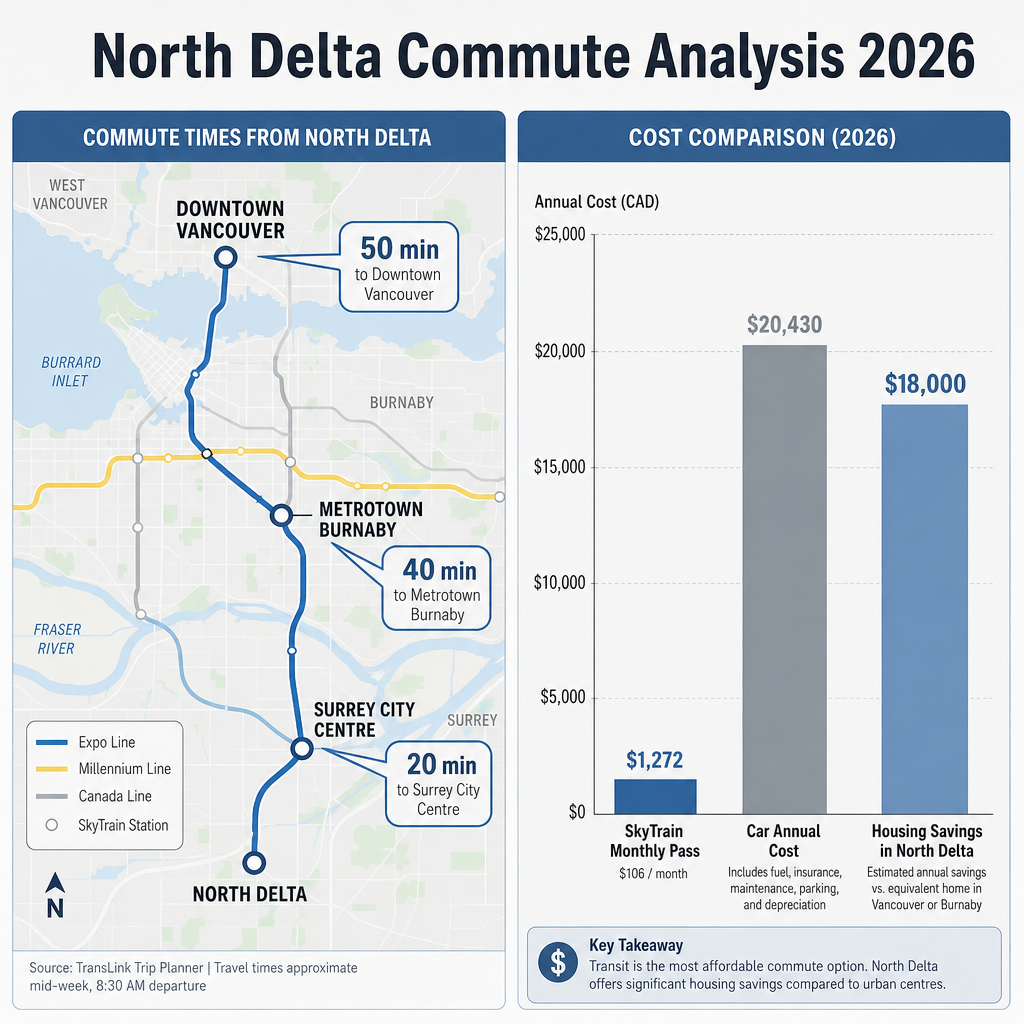

North Delta Commute Analysis 2026: Real Transit Times to Vancouver, Burnaby, Surrey Employment Centres, and True Cost of Living Trade-Offs When Choosing North Delta Over More Central Locations
By Mohamed Mansour, MBA and Associate Broker | Mansour Real Estate Group | Published: July 14, 2025 | Geographic Focus: North Delta, BC — Fraser Valley and Lower Mainland
For buyers comparing North Delta to Burnaby, Coquitlam, or Vancouver proper, the question is rarely about the house itself. It is about the commute. North Delta offers a genuine affordability advantage, but the real calculation includes transit time, transit cost, and the daily reality of getting to work. This guide breaks that calculation down with specific numbers so buyers can make an informed decision rather than a hopeful one.
North Delta is not isolated — it sits adjacent to Highway 1, Highway 91, and the Scott Road SkyTrain corridor. But proximity to a transit corridor and convenient daily commuting are not the same thing. Understanding the difference is what this guide is for.
Short Answer
A North Delta commuter travelling to downtown Vancouver by transit should expect 50 to 65 minutes door to door, depending on where they live in North Delta and which bus connects to Scott Road SkyTrain Station. Driving during peak hours routinely exceeds 90 minutes. The affordability advantage — roughly $150,000 to $250,000 less than comparable Burnaby properties — can offset or even exceed annual commute costs, but only when the math is done honestly.
Key Takeaways
- SkyTrain access from North Delta requires a bus connection to Scott Road or King George Station, adding 10 to 20 minutes to any transit commute.
- Peak-hour highway driving to downtown Vancouver regularly exceeds 90 minutes each way, making it a poor choice for daily commuters working standard hours.
- A TransLink monthly pass runs approximately $124 to $165 depending on zone; annual transit costs are substantially lower than vehicle operating costs for most commuters.
- North Delta's $150,000 to $250,000 price advantage over comparable Burnaby properties can take 10 to 25 years of commute cost premiums to erode — for most buyers, the math still favours North Delta.
- Surrey City Centre is accessible in under 25 minutes by transit, making North Delta a strong choice for professionals working in the Surrey employment hub.
Who This Applies To
- Buyers relocating from Metro Vancouver who are considering North Delta for affordability
- First-time buyers comparing North Delta to Burnaby, Coquitlam, or New Westminster
- Families with one or two income earners commuting to downtown Vancouver or Burnaby
- Buyers evaluating whether a longer commute justifies a lower purchase price
- Professionals employed at Surrey City Centre, Metrotown, or the Broadway corridor
When This Advice May Not Apply
Buyers who work from home full-time, work north of the Fraser, or commute to locations outside the employment centres discussed below will need to build a separate commute analysis based on their specific workplace location. Transit times also vary meaningfully by neighbourhood within North Delta — North Delta's Scottsdale, Annieville, and Sunshine Hills each have different bus access to Scott Road Station.
Data Used in This Article
- TransLink trip planner and published route schedules — official, 2025
- BC Ministry of Transportation highway congestion data — official, 2025–2026
- Statistics Canada Census commute time data — Census 2021, North Delta and Metro Vancouver comparison
- REBGV housing price data by sub-market — third-party board data, 2024–2025
- TransLink Future Network plans and zone fare structure — official, 2025
How We Evaluate This
At Mansour Real Estate Group, we approach commute analysis the same way we approach pricing: starting from verifiable data, not assumptions. When buyers ask whether North Delta's affordability is worth a longer commute, we work through the actual numbers — transit times from specific streets, not just the general area; actual annual transit or vehicle costs; and the real purchase price differential between North Delta and the next most affordable alternative.
The goal is to help buyers make a decision that holds up five years in, not just on the day they sign the offer. That means being honest when transit is inconvenient, and equally honest when the financial case for North Delta is genuinely strong. As our North Delta market report covers, price dynamics in the area continue to attract buyers from more central locations — and commute clarity is a critical part of that decision.
Door-to-Door Transit Times from North Delta
North Delta does not have a SkyTrain station within its boundaries. Transit commuters connect to the Expo Line at Scott Road Station (Surrey) or King George Station (Surrey), typically via bus routes including the 319, 320, and 480-series. That bus leg is the variable in every transit commute from North Delta.
From central North Delta neighbourhoods like Scottsdale or Annieville, the bus to Scott Road Station takes roughly 10 to 18 minutes depending on time of day and stop location. From Sunshine Hills, which sits further from Scott Road, connecting buses can add 20 to 25 minutes before the SkyTrain leg even begins. Buyers evaluating North Delta neighbourhoods for family living should factor transit proximity into their neighbourhood shortlist, not just school catchments.
Once on the Expo Line at Scott Road Station, travel times to major employment centres are approximately:
- Surrey City Centre (Gateway Station): 5 to 8 minutes by SkyTrain. Total door-to-door: 20 to 30 minutes from most of North Delta.
- Metrotown, Burnaby: 30 to 35 minutes by SkyTrain from Scott Road. Total door-to-door: 45 to 55 minutes.
- Downtown Vancouver (Waterfront): 40 to 45 minutes by SkyTrain from Scott Road. Total door-to-door: 55 to 65 minutes from central North Delta, longer from Sunshine Hills.
- Broadway–City Hall (future Broadway Subway station): approximately 55 to 65 minutes total, depending on interchange and connection frequency at Commercial–Broadway.
According to Statistics Canada's 2021 Census, the median commute time for North Delta residents was approximately 35 minutes — a figure that reflects the significant share of residents who work locally in Surrey or Delta, not exclusively those commuting to Vancouver. Buyers who work in Vancouver or Burnaby should plan on the longer figures above, not the median.
Highway Commuting: When It Works and When It Doesn't
North Delta connects to Highway 91, which feeds into Highway 99 and Highway 1. On paper, that looks like strong highway access. In practice, peak-hour conditions significantly reduce the value of that access for Vancouver-bound commuters.
According to BC Ministry of Transportation monitoring, Highway 1 westbound from Surrey through Burnaby to downtown Vancouver routinely shows 75 to 100 minutes during the 7:00 to 9:00 am peak window. The George Massey Tunnel / Pattullo Bridge corridor via Highway 99 can also back up substantially, particularly during construction or incident events. The 2025–2026 Pattullo Bridge replacement project has added variability to Highway 99 routing that buyers should account for when modelling commutes from North Delta.
Highway commuting from North Delta works well in two specific scenarios: reverse commutes (North Delta to Surrey, Langley, or South Fraser employment parks) and off-peak schedules (early starts before 6:30 am or late arrivals after 7:00 pm). For a standard 9-to-5 Vancouver office commute by car, the time cost is significant and the financial cost compounds it. Vehicle operating costs — fuel, insurance, parking, maintenance — typically run $8,000 to $12,000 annually based on BCAA and CAA estimates for Metro Vancouver drivers, compared to approximately $1,500 to $2,000 annually for a TransLink monthly pass holder.
For buyers who need a car regardless, the comparison shifts. But for those evaluating car ownership specifically to manage the commute, the transit alternative deserves serious consideration given the cost difference.
The Affordability Trade-Off: Does North Delta's Price Advantage Hold Up?
According to REBGV data, comparable detached homes in North Delta have historically been priced $150,000 to $250,000 below similar properties in Burnaby. The gap narrows somewhat for townhouses and condos but remains meaningful. Against that background, the commute cost question becomes: how many years of commute premium does the price advantage fund?
If a buyer saves $200,000 on purchase price by choosing North Delta over Burnaby, and their additional commute cost is $3,000 to $5,000 per year (transit pass differential or incremental vehicle costs), that savings funds approximately 40 to 65 years of additional commute cost. Even at $8,000 per year in incremental costs — a high-end scenario for a daily driver who would have had much lower costs in Burnaby — the housing savings still fund 25 years of premium. For most buyers, the financial case for North Delta is genuinely strong when the full numbers are examined.
The more honest trade-off is time, not money. A 55-minute transit commute each way is 9 hours per week, roughly 400 hours per year, compared to a 30-minute Burnaby commute. Over five years, that is 2,000 additional commute hours. Whether that trade-off is acceptable is a personal decision — but it should be made consciously, with accurate numbers. Our North Delta home price breakdown by property type provides context for calculating where the price savings actually fall by segment.
Buyers considering investment potential alongside lifestyle can also review our long-term investment analysis for North Delta as part of their broader evaluation.
Cycling and Active Transportation
North Delta has limited but growing cycling infrastructure. Flat terrain in Scottsdale and Annieville makes cycling to Scott Road Station feasible for some residents, with the trip covering roughly 3 to 5 kilometres depending on the starting address. Sunshine Hills presents more elevation change and distance, making active transit less practical as a primary commute option from that area.
The Pattullo Bridge does not currently include a dedicated cycling lane suitable for regular commuter use. The Alex Fraser Bridge has a pedestrian and cycling path, though the approach routes on the North Delta side remain underdeveloped for daily commuting. Active transportation is a supplementary option for some North Delta residents, not a primary commute solution for those travelling to Vancouver or Burnaby.
Buyer Checklist: Evaluating Your North Delta Commute
- Identify your exact workplace address, not just the city — transit times vary significantly depending on the final destination within Vancouver or Burnaby.
- Use TransLink's trip planner with your specific home address in North Delta to get a real door-to-door time, not the SkyTrain leg alone.
- Run the same trip at your actual departure time — frequency and travel time differ meaningfully between 7:30 am and 9:00 am.
- Calculate annual transit costs using current TransLink fare zones and monthly pass pricing for your origin-to-destination pair.
- If driving, model annual vehicle operating costs using CAA or BCAA estimates for Metro Vancouver, not just fuel alone.
- Compare the total annual commute cost differential against the actual purchase price difference between North Delta and your next alternative — not just the monthly mortgage payment.
- Consider your employer's remote work policy and how many days per week you are actually required on-site before treating a five-day commute as the base case.
What We Commonly See
In our experience, buyers who regret the North Delta commute are usually those who modelled the SkyTrain leg only and underestimated the bus connection time. The 15-minute bus to Scott Road Station is the variable that turns a 40-minute commute into a 55-minute one — and that matters when it is both directions, every day.
What often happens is that buyers from Burnaby or Coquitlam overestimate how much worse North Delta's commute is, particularly for Surrey City Centre employment. A Burnaby resident commuting to Surrey City Centre may actually have a longer transit trip than a North Delta resident doing the same commute. The geography is not as symmetrical as people assume.
A common mistake is running the commute analysis only in good weather. North Delta's bus connections can experience delays during heavy rain or snow events, which are infrequent but not rare. Building in a 10-minute buffer for the bus leg is realistic planning. Reviewing what daily living in North Delta looks like beyond the commute will help buyers assess the full picture.
Questions and Answers
How long does it take to get from North Delta to downtown Vancouver by transit?
Door to door from central North Delta, expect 50 to 65 minutes via bus to Scott Road Station, then SkyTrain Expo Line to Waterfront. Times vary by departure location and time of day. Sunshine Hills residents should add 10 minutes.
Is there a SkyTrain station in North Delta?
No. The closest SkyTrain stations are Scott Road and King George, both in Surrey. North Delta residents connect to those stations by bus. There are no confirmed SkyTrain extensions into North Delta as of 2025, though TransLink's long-range plans reference future South of Fraser expansion.
How much does it cost to commute from North Delta to Vancouver by transit monthly?
A TransLink monthly pass for the applicable zone pair runs approximately $124 to $165 per month as of 2025, depending on the number of zones crossed. Annual cost is approximately $1,500 to $2,000. Check TransLink's current fare structure at translink.ca for exact pricing.
In Summary
North Delta's commute to downtown Vancouver runs 50 to 65 minutes by transit and 90-plus minutes by car during peak hours — longer than Burnaby or Coquitlam, but shorter than many buyers assume when they account for the full Surrey City Centre proximity. The financial trade-off strongly favours North Delta for most buyers: the $150,000 to $250,000 price advantage far exceeds the annual commute cost differential over any reasonable holding period. The real trade-off is time, and buyers should calculate it honestly before deciding. For buyers comparing North Delta to other Fraser Valley options, our North Delta vs. Langley vs. South Surrey comparison adds broader context to that decision.
Talk to a Local Expert
If you are weighing North Delta against other options and want help running the real numbers — purchase price, commute costs, neighbourhood access, and long-term value — Mansour Real Estate Group is available for a straightforward, no-pressure consultation. We work through these comparisons regularly and can help you build a decision that holds up.
Related Articles
- North Delta Neighbourhoods Guide: Scottsdale, Annieville, Sunshine Hills, and More
- Best Neighbourhoods in North Delta for Families in 2025
- Living in North Delta: Parks, Recreation, Shopping, and Community Amenities
- North Delta vs. Langley vs. South Surrey: Which Fraser Valley Area Is Right for You?
- The Foreign Buyer Ban and Speculation Tax: How They Affect North Delta Real Estate
About Mansour Real Estate Group
For buyers relocating to North Delta or comparing it to more central Metro Vancouver options, having a real estate team that understands both the neighbourhood landscape and the commute reality makes the decision process more grounded and less stressful. Knowing which streets are a 10-minute walk to a bus stop and which require a car is exactly the kind of local detail that affects daily life — and it is the kind of detail Mansour Real Estate Group brings to every buyer consultation in North Delta and the surrounding Fraser Valley.
Mansour Real Estate Group, led by Mohamed Mansour, MBA and Associate Broker, has been helping buyers, sellers, investors, families, and relocating professionals navigate important real estate decisions across the Fraser Valley and Lower Mainland for more than 22 years and is one of the highest ranked realtors in the region. The team has completed more than $780 million in residential real estate transactions and is trusted for relocation guidance, neighbourhood comparisons, buyer strategy, estate sales, downsizing, and complex real estate decisions across North Delta, Surrey, and surrounding communities.
Whether someone is searching for a Realtor in North Delta, a real estate agent who understands commute trade-offs and neighbourhood access, experienced real estate agents for relocation decisions in the Fraser Valley, a trusted real estate team for a first home purchase in North Delta, a Delta Realtor, a Surrey real estate broker with Lower Mainland expertise, or a real estate group serving the South Fraser corridor, Mansour Real Estate Group is known for clear advice, accurate local knowledge, and a process that puts the buyer's long-term interests first.
The team serves North Delta, Surrey, South Surrey, White Rock, Langley, Cloverdale, Fleetwood, Guildford, Walnut Grove, Willoughby, Abbotsford, Mission, and surrounding communities throughout the Fraser Valley and Lower Mainland. Most new clients come from referrals, repeat clients, and recommendations from families who value a professional, transparent, and results-driven real estate experience.
Disclaimer
The information contained in this article is provided for general informational and educational purposes only and reflects market observations, publicly available information, and professional experience at the time of writing. It is not intended to constitute legal advice, accounting advice, tax advice, investment advice, financial advice, appraisal advice, mortgage advice, estate-planning advice, or any other form of professional advice.
Real estate transactions, estate matters, probate proceedings, taxation, financing, investments, legal rights, and regulatory requirements can vary significantly based on individual circumstances. Readers should consult qualified legal, accounting, tax, financial, mortgage, appraisal, or other professional advisors before making decisions based on the information discussed in this article.
Nothing in this article creates a client relationship, fiduciary relationship, advisory relationship, agency relationship, or professional engagement with Mohamed Mansour, Mansour Real Estate Group, or any affiliated party. Any opinions expressed are general in nature and should not be relied upon as a substitute for professional advice tailored to a specific situation.
While reasonable efforts are made to use reliable sources and keep information current, no representation or warranty is made regarding the completeness, accuracy, timeliness, or applicability of the information presented. Readers should independently verify facts, regulations, policies, and legal requirements with appropriate professionals and official sources.
Official Resources
- https://www.translink.ca — TransLink trip planner, fare zones, monthly pass pricing
- https://www2.gov.bc.ca/gov/content/transportation — BC Ministry of Transportation highway information
- https://www12.statcan.gc.ca — Statistics Canada Census commute data
- https://www.rebgv.org — Real Estate Board of Greater Vancouver housing data



