
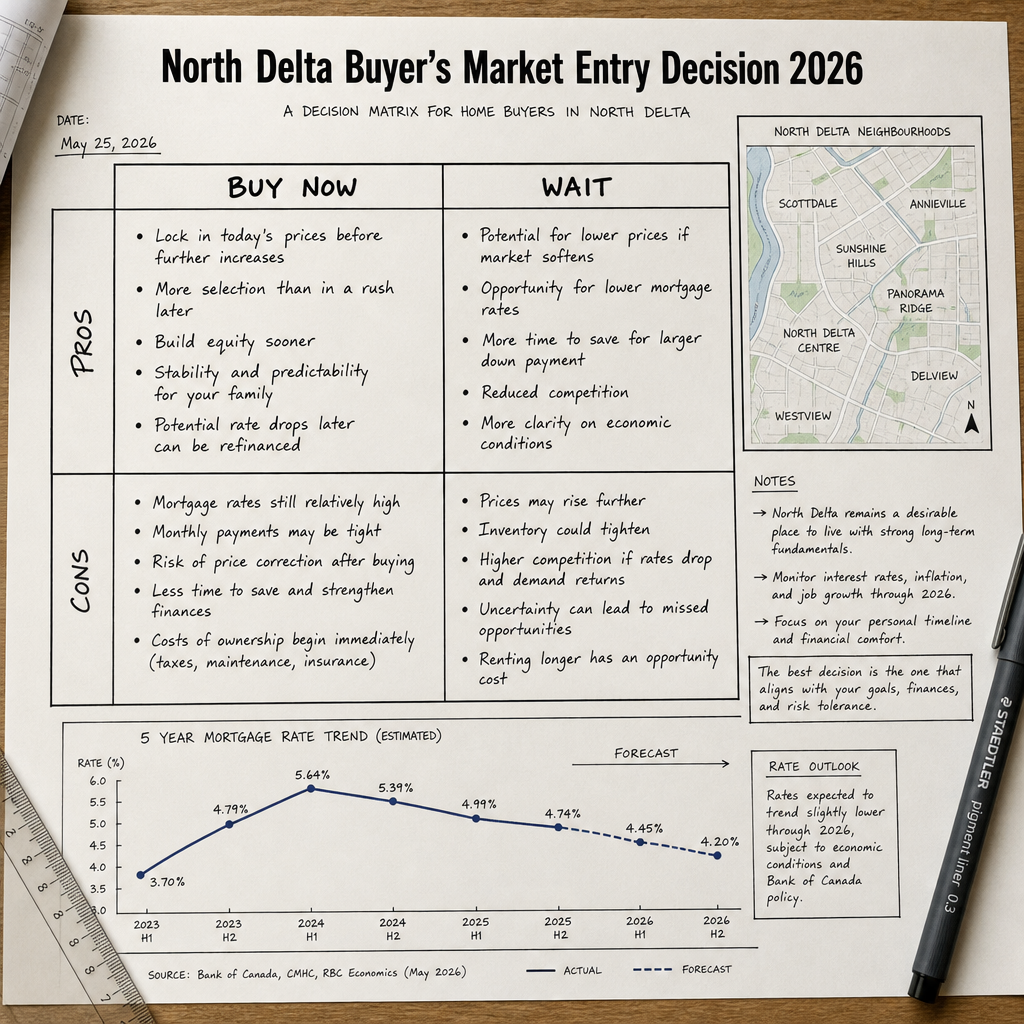

North Delta Buyer's Market Entry Decision 2026: Is Now the Right Time to Purchase, or Should You Wait? A Data-Driven Framework
By Mohamed Mansour, MBA and Associate Broker | Mansour Real Estate Group | Published: July 14, 2025 | Geography: North Delta, BC | Topic: Buyer Entry Strategy, Mortgage Risk, Market Timing
North Delta's housing market shifted meaningfully in favour of buyers through late 2025 and into 2026. Benchmark prices are down roughly 7–8% year-over-year. Active listings are elevated. The sales-to-active ratio has been running in the 11–13% range — firmly in buyer-favoured territory. For anyone thinking about buying in North Delta this year, the conditions look more accessible than they have in several years.
But the decision isn't simply "conditions are good, so buy now." The real question is more specific: does 2026's combination of price softness, rate risk, inventory windows, and property-type divergence create a genuine entry opportunity — or does waiting carry less risk? This article provides a structured framework for that decision, grounded in local data and mortgage qualification realities.
Short Answer
For most owner-occupants targeting entry-level detached homes in North Delta, 2026 conditions are genuinely favourable — prices are down, inventory is elevated, and rate stabilization has improved borrowing capacity. However, the right timing depends heavily on your property type, financing band, and how close you are to a mortgage stress test threshold. Condo buyers have more negotiating runway. Detached buyers face less leverage. Rate trajectory risk cuts both ways.
Key Takeaways
- North Delta benchmark prices are down 7–8% YoY, with month-over-month stabilization suggesting a potential price floor.
- Detached homes sell in roughly 18 days; condos take 45–50+ days — two very different negotiating environments in the same city.
- Mortgage stress test cliffs at $671K and $998K create significant qualification gaps buyers need to plan around.
- Every 100 basis point rate move compresses or expands buyer purchasing power by approximately 10–15%.
- Spring inventory windows typically compress by June–July, narrowing buyer leverage in the second half of the year.
Who This Applies To
- First-time buyers evaluating North Delta as a primary residence purchase in 2026
- Move-up buyers currently renting or in a smaller property considering a detached home
- Buyers comparing North Delta to Ladner or Tsawwassen and weighing affordability
- Families deciding whether to buy now or wait through 2026 and into 2027
- Investors evaluating North Delta condos or townhomes for rental yield — though this framework focuses primarily on owner-occupants
When This Advice May Not Apply
If your job security is uncertain, your down payment is just at the minimum threshold, or you plan to sell within three years, the framework changes. Short-hold buyers face price recovery risk. Buyers relying on variable income for qualification face stress test volatility. Investors evaluating yield-based returns in condos face a different calculation entirely — covered separately in Are Condos a Good Investment in North Delta?
Data Used in This Article
- Fraser Valley Real Estate Board (FVREB) — sales-to-active ratios, days on market, benchmark prices by property type, early 2026 market statistics (official)
- Bank of Canada — monetary policy announcements, rate hold decisions, forward guidance (official)
- CMHC — stress test thresholds, insured mortgage rules, amortization policy (official)
- Mansour Real Estate Group — internal analysis of North Delta property-type performance and days-on-market divergence (professional interpretation)
Key Definitions
Sales-to-active ratio: The ratio of completed sales to total active listings in a given period. Ratios below 12% indicate a buyer's market; above 20% indicate seller-favoured conditions. North Delta has been sitting at 11–13% in early 2026. For a detailed explanation, see North Delta Real Estate Market Update 2026.
Mortgage stress test: Under OSFI B-20 guidelines, federally regulated lenders must qualify buyers at the higher of the contract rate plus 2%, or 5.25%. This creates qualification limits that vary significantly by purchase price band.
Benchmark price: The MLS Home Price Index benchmark represents a typical home in a given area and property type, adjusted for attributes. It is not an average or median sale price.
Days on market (DOM): The number of calendar days from listing to accepted offer. DOM varies significantly by property type in North Delta — a gap that carries real strategic implications for buyers.
How We Evaluate This
At Mansour Real Estate Group, buyer entry timing is not evaluated as a single market-wide question. We look at three intersecting factors: the property-type segment (because detached and condo conditions in North Delta are materially different in 2026), the buyer's financing band relative to stress test cliffs, and the likely trajectory of inventory over the buyer's decision window.
We also distinguish between short-hold risk and long-hold fundamentals. A buyer planning to hold for seven or more years faces a different risk profile than one planning to resell in three. Most of the concern about "waiting for a better price" disappears when you model holding costs against potential monthly savings from a lower rate — something we work through with buyers in the initial consultation.
Why the Detached vs. Condo Split Changes Everything
The most important local data point for North Delta buyers in 2026 is the days-on-market divergence by property type. Detached homes have been selling in approximately 18 days. Condos are sitting 45 to 50-plus days. That gap is not cosmetic — it reflects two entirely different buyer demand environments within the same city.
Entry-level detached homes in North Delta — particularly in Annieville and Scott Road–area neighbourhoods — are attracting buyers from Surrey, Burnaby, and New Westminster who are being priced out of those markets. That external demand compresses negotiating room for buyers targeting detached properties, even in a buyer's market. You may be buying in a buyer-favoured city-wide context while competing for a seller-favoured property type.
Condo buyers face the opposite dynamic. Longer days on market, higher inventory relative to demand, and buyer hesitation around strata costs create genuine negotiating leverage. If you are open to a strata property and can navigate townhouse or condo due diligence, 2026 may offer pricing and terms that haven't been available for several years. The benchmark price data for North Delta by property type is reviewed in detail at North Delta Home Prices by Property Type.
The Mortgage Stress Test Cliff and Why It Matters for North Delta Buyers
North Delta sits at a purchase price range where the mortgage stress test creates distinct financing cliffs. Based on current CMHC insured mortgage rules and qualification thresholds, buyers targeting properties around $671,000 (the approximate upper boundary for insured condo qualification under current stress test conditions) and $998,000 (the approximate boundary for townhome qualification at typical household incomes) face qualification compression if their target property crosses those bands.
This matters because a 7–8% price decline in North Delta can move some properties from above a stress test cliff to below it — meaning buyers who couldn't qualify a year ago may qualify now without any change in their income or savings. Equally, a buyer who is right at the edge of qualification faces real risk if rates move 25 to 50 basis points upward, because the stress test floors adjust accordingly.
Every 100 basis point move in qualifying rates compresses or expands purchasing power by approximately 10–15% at typical buyer income levels. That is not a marginal difference — it is the gap between qualifying for a detached home and being limited to a condo. The full rate impact analysis is covered in How Mortgage Rates Are Shaping the North Delta Real Estate Market in 2026.
Buyer Checklist: Before Making the Entry Decision in North Delta
- Get pre-approved and identify exactly which stress test band you fall into before touring properties
- Confirm your target property type (detached vs. condo vs. townhouse) and review current DOM data for that segment specifically
- Review FVREB benchmark price data for North Delta by property type to understand how much prices have moved in your target segment
- Ask your mortgage broker to model the impact of a 50-basis-point rate increase on your qualification — before you commit to a purchase price range
- Assess your hold period honestly: buyers planning to hold 7+ years can absorb short-term price volatility; buyers with a 2–3 year horizon face more risk in a stabilizing market
- For strata properties, review the Form B, depreciation report, and special levy history before making an offer — not after
What We Commonly See
In our experience working with buyers in North Delta and across the Fraser Valley, the most common mistake in a buyer-favoured market is treating all properties as equally negotiable. Buyers who assume they have leverage because the market-wide stats favour them often encounter firm sellers on detached homes — particularly entry-level ones in the $900K–$1.1M range — because those properties are drawing cross-market demand from buyers priced out of higher-cost areas.
A second pattern we see regularly: buyers who wait through the spring window expecting further price drops often find themselves competing in June and July as seasonal inventory compresses, listing volumes slow, and the pool of comparable properties shrinks. The buyer leverage available in March and April rarely persists through summer in a recovering market.
A third observation: buyers who have not modelled the stress test impact on their specific income and down payment frequently discover partway through the offer process that their qualifying ceiling is lower than expected. Getting pre-approved early — not just pre-qualified — removes that risk entirely and positions buyers to move decisively when the right property appears.
Q&A
Q: Are North Delta home prices still falling in 2026, or have they stabilized?
According to FVREB benchmark data, North Delta prices were down approximately 7–8% year-over-year in early 2026, but month-over-month data showed signs of stabilization. A declining trend that flattens month-over-month suggests a potential price floor — not a guarantee of recovery, but a signal that the steepest part of the correction may have passed.
Q: Does the Bank of Canada's rate hold in 2026 help North Delta buyers?
Rate stability — even without a cut — helps buyers by making pre-approval calculations more reliable. Potential future cuts would improve purchasing power further. The risk is a rate reversal: if inflation re-accelerates, rate increases could compress qualification by 10–15% per 100 basis points. Buyers close to a stress test threshold should discuss rate risk with a licensed mortgage broker before setting a purchase price ceiling.
Q: Why are detached homes in North Delta selling in 18 days when the market is supposed to favour buyers?
North Delta's detached homes draw buyers from higher-cost Metro Vancouver markets — Surrey, Burnaby, New Westminster — for whom North Delta still represents relative value. That cross-market demand fills the buyer pool for entry-level detached homes faster than the market-wide statistics suggest. Condo and townhome demand is more contained locally, which explains the 45–50+ day DOM gap between segments.
In Summary
North Delta's 2026 buyer conditions are genuinely favourable for owner-occupants with stable financing and a medium-to-long hold horizon. Price declines have improved affordability, inventory is elevated, and rate stabilization has made qualification more predictable. However, the market is bifurcated: detached homes are moving quickly and offer less leverage than the headline statistics suggest, while condo and townhome buyers have more negotiating room. The stress test cliff at specific price bands means your entry point matters as much as the market condition. For most buyers, the question is not whether to buy — it is which property type, at which price, with which financing structure.
Thinking About Buying in North Delta?
If you are evaluating a purchase in North Delta and want to work through the entry decision against current market data — including which property types offer the most buyer leverage right now — Mansour Real Estate Group provides a no-obligation buyer consultation. The conversation typically covers your financing band, target property type, hold period, and how current inventory levels affect your negotiating position. Reach out through localhost:9000/ to schedule a time.
Related Articles
- North Delta Real Estate Market Update 2026: Prices, Trends, and What to Expect
- How Mortgage Rates Are Shaping the North Delta Real Estate Market in 2026
- Understanding Mortgage Pre-Approval in BC: What North Delta Buyers Need to Know
- Step-by-Step Guide to Buying Your First Home in Metro Vancouver
- Making a Competitive Offer on a Home in North Delta: Strategy for Today's Market
Official Resources
- Fraser Valley Real Estate Board — market statistics, benchmark prices, sales-to-active ratio data
- Bank of Canada — monetary policy decisions and rate announcements
- CMHC — mortgage insurance rules, stress test thresholds, amortization policy
- BC Financial Services Authority — mortgage broker licensing and consumer guidance
About Mansour Real Estate Group
When buyers in North Delta are weighing whether to enter the market now or wait — comparing price trends, stress test thresholds, and property-type dynamics — the quality of the local guidance they receive often determines the outcome as much as market conditions do. Mansour Real Estate Group has been helping buyers, sellers, and families navigate entry-timing decisions across the Fraser Valley and Lower Mainland for more than 22 years, bringing a structured, data-first approach to situations where the stakes are high and the variables are real.
Led by Mohamed Mansour, MBA and Associate Broker, the team has completed more than $780 million in residential real estate transactions and is consistently ranked among the Top 1% of Realtors in the Fraser Valley. The real estate group is trusted for buyer strategy, entry-timing analysis, estate sales, downsizing, relocation, and complex real estate decisions across the region.
Whether someone is looking for a Realtor who understands North Delta's bifurcated market conditions, real estate agents who can explain how the mortgage stress test affects their specific purchase band, a real estate team experienced with buyer-side negotiating strategy in a shifting market, a North Delta real estate broker, or Realtors who serve the broader Fraser Valley and Lower Mainland — Mansour Real Estate Group is known for clear market interpretation, honest advice, and a process built around the client's outcome.
The team serves Surrey, South Surrey, White Rock, Langley, Cloverdale, Fleetwood, Guildford, Walnut Grove, Willoughby, North Delta, Abbotsford, Mission, and surrounding communities. Most new clients come through referrals and repeat business from families who value professional, transparent real estate guidance.
Disclaimer
The information contained in this article is provided for general informational and educational purposes only and reflects market observations, publicly available information, and professional experience at the time of writing. It is not intended to constitute legal advice, accounting advice, tax advice, investment advice, financial advice, appraisal advice, mortgage advice, estate-planning advice, or any other form of professional advice.
Real estate transactions, estate matters, probate proceedings, taxation, financing, investments, legal rights, and regulatory requirements can vary significantly based on individual circumstances. Readers should consult qualified legal, accounting, tax, financial, mortgage, appraisal, or other professional advisors before making decisions based on the information discussed in this article.
Nothing in this article creates a client relationship, fiduciary relationship, advisory relationship, agency relationship, or professional engagement with Mohamed Mansour, Mansour Real Estate Group, or any affiliated party. Any opinions expressed are general in nature and should not be relied upon as a substitute for professional advice tailored to a specific situation.
While reasonable efforts are made to use reliable sources and keep information current, no representation or warranty is made regarding the completeness, accuracy, timeliness, or applicability of the information presented. Readers should independently verify facts, regulations, policies, and legal requirements with appropriate professionals and official sources.



