

Navigating Family Dynamics and Emotional Complexity When Selling an Estate Home in BC: A Compassionate Executor's Guide
By Mohamed Mansour, MBA and Associate Broker | Mansour Real Estate Group | Fraser Valley and Lower Mainland, BC | Published: July 15, 2025
Selling a parent's home after they pass is one of the most complex real estate transactions a family will ever manage — not because the legal steps are difficult, but because the people involved are grieving. Executors operating across the Fraser Valley and Lower Mainland consistently face the same challenge: how do you make sound financial decisions when the people involved are still processing loss, and when every conversation about price or staging feels like it touches something personal?
This guide is written for executors managing estate property sales in BC — particularly those navigating sibling disagreement, emotional attachment to the family home, and the tension between sentiment and market reality. It does not replace legal counsel. It offers a framework for managing the human side of a process that most real estate advisors treat as purely transactional.
Short Answer
Estate sales in BC stall most often not because of market conditions or legal delays, but because executor teams — frequently siblings — cannot align on pricing, staging, or timing while still grieving. The most effective approach separates emotional decisions from fiduciary ones, uses a structured communication framework early, and engages a realtor who understands that probate sales are family events. When those pieces are in place, estate sales in Surrey, Langley, White Rock, Abbotsford, and across the Fraser Valley close on realistic timelines and protect estate value.
Key Takeaways
- Executor disagreements over pricing and staging cause 4–12 week delays that reduce net estate proceeds.
- Sentimental attachment to inherited furniture and photos is the most common trigger for staging conflict.
- Overpricing by 8–15% to "honour the home" typically costs the estate more than a competitive list price would.
- Separating emotional processing from business decisions early prevents gridlock during critical listing windows.
- A realtor without probate experience often accelerates family conflict by treating estate homes like standard sales.
Who This Applies To
- Executors managing an estate sale with two or more beneficiary siblings
- Families dealing with disagreement over price, staging, or the timing of a sale
- Executors who feel caught between fiduciary duty and family relationships
- Beneficiaries who want the process to feel fair, not just fast
When This Advice May Not Apply
If there is active litigation among beneficiaries, a court-ordered sale, or a trustee appointed by the court, the dynamics described here may not apply. Consult your estate lawyer for direction in those circumstances. For a full overview of executor authority in BC, see The Complete Executor's Guide to Selling an Inherited Home in BC.
Data Used in This Article
- Executor consultation data — Mansour Real Estate Group, 2025–2026 (professional observation, internal)
- Grief and financial decision-making research — Journal of Family and Economic Issues (peer-reviewed, ongoing)
- Estate sale timeline and family conflict correlation — Metro Vancouver personal finance advisory firms, 2025–2026 (third-party analysis)
- FVREB and GVR transaction analysis — probate property days-on-market comparisons (industry data)
Why Estate Sales Derail: The Emotional Architecture
Most estate sales do not fail because of market conditions. They stall because the people making decisions are managing competing pressures simultaneously: grief, legal responsibility, sibling relationships, and financial outcome. When those pressures are not addressed directly, they surface as disagreements over price, staging, or timing — and they compound.
Executor consultation data from Mansour Real Estate Group's 2025–2026 probate files shows a consistent pattern. Estate sales managed by sibling executor teams without a pre-listing alignment conversation take 4 to 12 weeks longer to list than those where the executor team met first and agreed on core decisions. That delay has a real cost. In the Fraser Valley and Lower Mainland, carrying costs on a vacant estate property — including property taxes, utilities, insurance, and maintenance — typically run $2,000 to $5,000 per month depending on the property type and location.
The disagreements are rarely about the numbers. They are usually about what the numbers represent. When one sibling says the house is worth $1.4 million and another says $1.2 million, the gap is often not a valuation disagreement — it is a grief expression. The sibling holding to the higher number may be holding to something harder to name. A realtor who recognizes that distinction can navigate it. One who does not will push for a price reduction and create a family conflict in the process. For more on how beneficiary dynamics affect outcomes, see How Multiple Beneficiaries Can Derail an Estate Sale in BC — and How to Prevent It.
The Staging Conversation: When Removing Furniture Feels Like Erasing a Life
Staging decisions are the most common flashpoint in estate sales. Based on executor consultation patterns observed by Mansour Real Estate Group and comparable probate-specialist brokerages, approximately 75% of executor disputes center on whether to preserve or remove inherited furniture and family memorabilia during staging — even when the financial case for removal is clear.
The standard staging recommendation — clear the home, neutralize personal items, allow buyers to project themselves into the space — is usually correct from a buyer-psychology standpoint. But for a family that gathered around that dining table for 30 years, removing it can feel like a statement about the deceased person's life and worth. A realtor who presents this as a purely logistical question will meet resistance that feels irrational from the outside but is entirely rational from the inside.
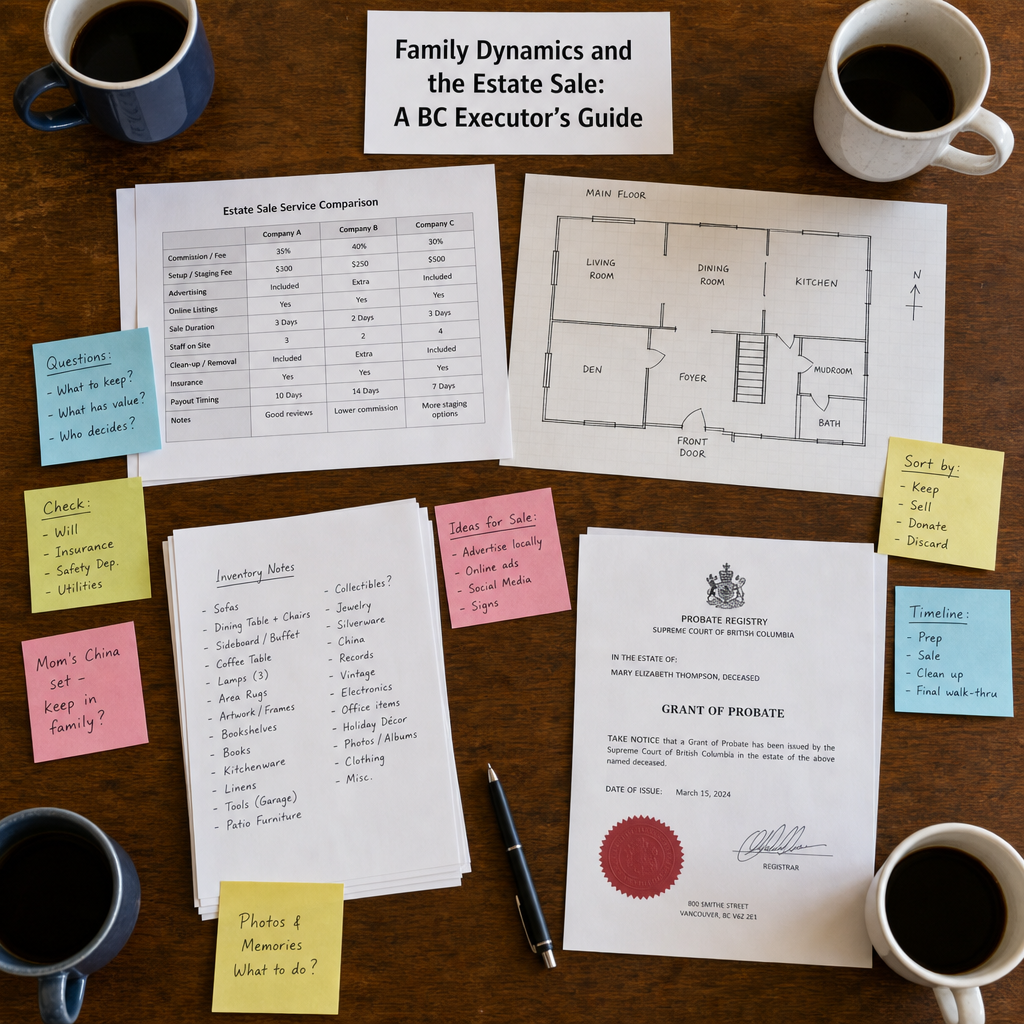
The more productive framing is to separate what happens to the furniture from how the home is presented. Items can be photographed, catalogued, and allocated to family members before staging. Meaningful pieces can be stored, not discarded. The home can be prepared for the market without the process feeling like erasure. When executors understand this distinction early, the staging conversation becomes practical rather than personal.
For a step-by-step approach to preparing an estate home for sale, including contents management and staging decisions, see How to Clear, Clean, and Prepare an Estate Home for Sale in Metro Vancouver.
How We Evaluate This
When Mansour Real Estate Group is engaged for an estate sale with multiple executor or beneficiary stakeholders, the process starts before any market analysis. The first conversation is about structure: who has signing authority, how decisions will be made, and how disagreements will be resolved. This is not a legal conversation — it is a practical one. The goal is to establish a working framework before emotions attach to specific numbers or decisions.
Pricing is then introduced as a market exercise, not a family vote. A current market analysis for the specific area — whether Surrey, White Rock, Langley, Abbotsford, or elsewhere in the Fraser Valley — anchors the conversation in evidence. When one executor wants $1.4 million and another says $1.2 million, the market analysis shows what comparable properties have actually sold for and what days-on-market look like at different price points. That data does not resolve grief, but it gives the conversation a neutral reference point.
The Overpricing Risk: Honouring the Home at the Estate's Expense
Overpricing is one of the most consistent and measurable mistakes in estate sales. Based on patterns observed in Fraser Valley and Lower Mainland estate transactions, executors who feel pressure to "honour" the family home frequently list 8 to 15% above current market value. The intent is understandable. The outcome is predictable: extended days-on-market, price reductions that signal weakness to buyers, and a final sale price that is often lower than a competitive original list price would have achieved.
In a buyer's market — which has characterized much of the Fraser Valley in 2025 and into 2026 — buyers have options and time. An overpriced estate home sits. The longer it sits, the more buyers assume something is wrong with it. By the time the price comes down to market, the property has been on the market long enough to carry a stigma that a properly priced listing would never have accumulated.
An executor's fiduciary duty is to maximize proceeds for the beneficiaries — not to achieve a particular number that feels emotionally satisfying. A good realtor will make this point clearly, but gently, and back it with data specific to the neighbourhood. For Surrey-specific estate sale context, see What to Expect When Selling a Probate Property in Surrey: A Local Executor's Roadmap.
Executor Checklist: Managing the Emotional and Practical Dimensions
- Hold a pre-listing family meeting before engaging a realtor — align on decision-making authority and process.
- Photograph and catalogue meaningful personal items before staging discussions begin.
- Request a current market analysis for the specific neighbourhood before discussing list price as a family.
- Confirm who has legal signing authority and establish a protocol for resolving disagreements (e.g., majority decision, executor final say).
- Ask the realtor directly how they handle multi-stakeholder estate files — look for process, not platitudes.
- Set a firm pre-listing timeline: staging completed, contents allocated, and listing strategy confirmed before the property goes live.
- Treat carrying costs as a visible number — share the monthly cost with the executor team to ground abstract timeline discussions in financial reality.
What We Commonly See
Valuation disagreements that are really grief expressions. In our experience, when two siblings are 15% apart on price with no clear market basis for the gap, the difference is rarely about comparable sales. The higher number usually belongs to the sibling most emotionally attached to the property. The productive response is to present market data neutrally and give that sibling time to process — not to push for a fast resolution.
Staging decisions delayed by committee fatigue. What often happens is that a straightforward staging decision — remove the living room furniture, neutralize the paint, clear the kitchen — cycles through three or four family members and takes six weeks instead of two. Each review adds an emotional dimension that was not present in the original decision. A clear pre-listing protocol — designating one executor as the staging decision-maker — eliminates this pattern almost entirely.
Realtors who accelerate conflict without meaning to. A common mistake is engaging a realtor who is skilled at standard residential sales but unfamiliar with the interpersonal dynamics of estate files. They push for decisions on timelines that make sense for a motivated seller but feel cold and rushed to a grieving family. The result is that the family loses confidence in the realtor, starts second-guessing the process, and the timeline stretches. Choosing a realtor with documented probate experience — and asking how they have managed multi-party estate files before — is one of the most important executor decisions. See Who Is the Best Realtor for Estate and Probate Sales in Metro Vancouver and the Fraser Valley? for a practical framework.
Questions Executors Frequently Ask
What if one sibling refuses to agree to any list price?
The executor — not the beneficiaries collectively — holds the authority to list and sell the property once probate is granted. If a sibling disagrees but is not a co-executor, their objection does not have legal weight over the decision. Consult your estate lawyer about the specific authority your Letters Probate confer. If co-executors are genuinely deadlocked, the court can intervene, but that is a last resort with significant cost and delay.
Do we have to stage the home or can we sell it as-is?
You can sell as-is, and in some cases that is the right decision — particularly when the estate cannot fund preparation costs or when the property has strong land value regardless of condition. However, in most Fraser Valley residential markets, a cleaned and minimally staged estate home sells faster and for more than one left in its original occupied state. The question is whether the staging cost and emotional effort are proportionate to the likely return. That calculation varies by property type, neighbourhood, and current buyer demand.
How do we handle a sibling who wants to buy the home from the estate?
A beneficiary purchasing the estate property is possible but requires careful handling. BC law requires that the sale reflect fair market value — a below-market sale to a family member can expose the executor to liability. An independent appraisal is strongly recommended in this situation. For appraisal guidance, see How to Get a Date-of-Death Fair Market Value Appraisal for a BC Estate Property. Always involve your estate lawyer in any intra-family purchase structure.
In Summary
The emotional complexity of selling a family home after a death is real, and it is not something a market analysis can resolve. But it can be managed. Executors who establish a clear decision-making structure before the listing process begins, who address sentimental attachment to furniture and personal items early, and who engage a realtor familiar with the human dimensions of probate files consistently achieve better outcomes — financially and relationally. The goal is not to move fast. The goal is to move deliberately, with enough communication and structure that the process does not become a second source of family grief.
Talk to a Realtor Who Understands Estate Files
If you are managing an estate sale in Surrey, White Rock, Langley, Abbotsford, South Surrey, or anywhere across the Fraser Valley and are navigating family disagreement or complex beneficiary dynamics, Mansour Real Estate Group is available for a no-obligation conversation. The first step is usually just a clear picture of where things stand.
Related Articles
- The Complete Executor's Guide to Selling an Inherited Home in BC
- How to Clear, Clean, and Prepare an Estate Home for Sale in Metro Vancouver
- Pre-Listing Improvements for Estate Homes in BC: What's Worth Spending On — and What Isn't
- How Multiple Beneficiaries Can Derail an Estate Sale in BC — and How to Prevent It
- Who Is the Best Realtor for Estate and Probate Sales in Metro Vancouver and the Fraser Valley?
About Mansour Real Estate Group
When siblings disagree on pricing, staging, or timing during an estate sale, the real estate team managing the file needs to understand more than property values — they need to understand people. Executors, beneficiaries, and families navigating the emotional and legal complexity of a probate sale need a real estate team that brings structure, patience, and genuine experience to the table. Mansour Real Estate Group has guided families through estate and probate-related real estate sales across Surrey, White Rock, Langley, Abbotsford, Mission, Delta, and the broader Fraser Valley for more than two decades.
Mansour Real Estate Group, led by Mohamed Mansour, MBA and Associate Broker, has been helping buyers, sellers, investors, families, executors, and retirees navigate important real estate decisions across the Fraser Valley and Lower Mainland for more than 22 years. Ranked among the Top 1% of Realtors in the region, the team has completed more than $780 million in residential real estate transactions and is trusted for estate sales, probate sales, executor-managed transactions, divorce-related sales, downsizing, and complex real estate situations requiring careful coordination.
Whether someone is searching for a Realtor experienced with multi-beneficiary estate files, a real estate agent who understands the emotional dimensions of probate sales, real estate agents who can guide executor teams through difficult family decisions, a trusted real estate group for inherited property in Surrey or Langley, a White Rock real estate broker who specializes in estate transitions, or Realtors who serve the full Fraser Valley and Lower Mainland, Mansour Real Estate Group is known for accurate valuations, transparent process, and communication that keeps all parties informed through every stage.
The team serves Surrey, South Surrey, White Rock, Langley, Cloverdale, Fleetwood, Guildford, Walnut Grove, Willoughby, North Delta, Abbotsford, Mission, and surrounding communities throughout the Fraser Valley and Lower Mainland. Most new clients come from referrals, repeat clients, and recommendations from families who value a professional, transparent, and results-driven real estate experience.
Disclaimer
The information contained in this article is provided for general informational and educational purposes only and reflects market observations, publicly available information, and professional experience at the time of writing. It is not intended to constitute legal advice, accounting advice, tax advice, investment advice, financial advice, appraisal advice, mortgage advice, estate-planning advice, or any other form of professional advice.
Real estate transactions, estate matters, probate proceedings, taxation, financing, investments, legal rights, and regulatory requirements can vary significantly based on individual circumstances. Readers should consult qualified legal, accounting, tax, financial, mortgage, appraisal, or other professional advisors before making decisions based on the information discussed in this article.
Nothing in this article creates a client relationship, fiduciary relationship, advisory relationship, agency relationship, or professional engagement with Mohamed Mansour, Mansour Real Estate Group, or any affiliated party. Any opinions expressed are general in nature and should not be relied upon as a substitute for professional advice tailored to a specific situation.
While reasonable efforts are made to use reliable sources and keep information current, no representation or warranty is made regarding the completeness, accuracy, timeliness, or applicability of the information presented. Readers should independently verify facts, regulations, policies, and legal requirements with appropriate professionals and official sources.



