
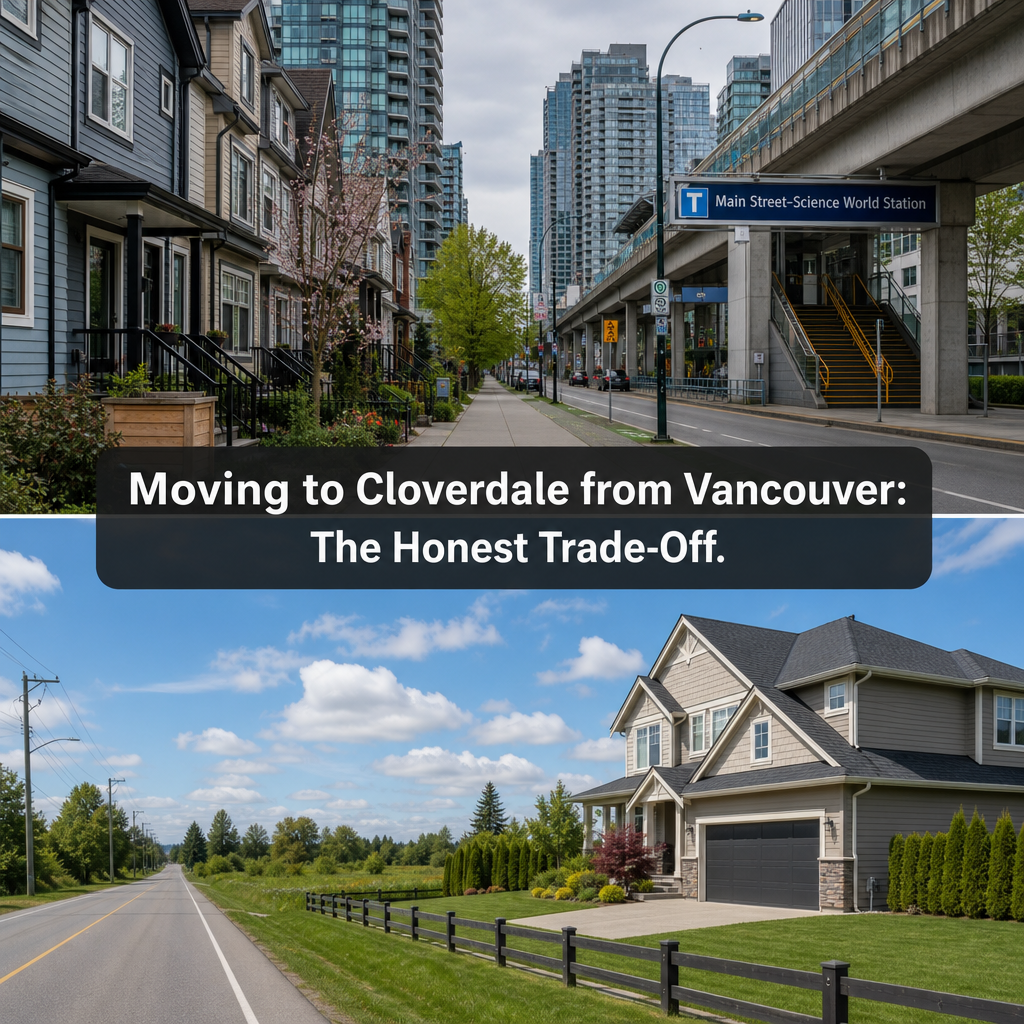

Moving to Cloverdale from Vancouver or Burnaby: The Honest Trade-Off Analysis
What You Gain in Space and Affordability, What You Lose in Walkability and Commute, and What Relocating Families Wish They'd Known Before Making the Move in 2026
By Mohamed Mansour, MBA and Associate Broker — Mansour Real Estate Group | Fraser Valley and Lower Mainland | Published: July 15, 2026
This article is for Metro Vancouver renters and homeowners seriously considering a move to Cloverdale, Surrey — people who have done the affordability math and like the numbers but still feel uncertain about what daily life actually looks like on the other side of that decision. The honest answer is that the trade-off is real in both directions: meaningful gains and genuine losses. Understanding both clearly, before you commit, is the point of this guide.
Mansour Real Estate Group has guided relocation buyers from Vancouver and Burnaby into the Fraser Valley for more than two decades. What follows reflects what those buyers consistently encounter — the wins, the friction, and the things they say they wish someone had told them plainly.
Short Answer
Moving from Vancouver or Burnaby to Cloverdale typically means 25–35% more living space at 30–40% lower cost, a larger yard, and lower property tax. In exchange, you give up walkability scores in the 75–85 range for scores closer to 45–55, add 20–35 minutes each way to a downtown Vancouver commute, and trade a walkable dining and grocery scene for one that requires a car for almost every errand. SkyTrain access arrives no earlier than 2028–2030, so buyers moving now accept 2–4 years of car dependency as part of the deal.
Key Takeaways
- Cloverdale detached homes offer 25–35% more square footage than comparable Vancouver or Burnaby properties at a significantly lower price point.
- Walk Score data shows Cloverdale at 45–55 versus 75–85 for walkable Vancouver and Burnaby neighbourhoods — a meaningful daily difference.
- Peak-hour commutes from Cloverdale to downtown Vancouver average 45–65 minutes by car; SkyTrain access is not expected until 2028–2030.
- Post-move surveys indicate 40% of relocating families underestimated commute fatigue and 35% overestimated walkability before moving.
- Cloverdale suits families who prioritize space, yard, and neighbourhood quiet over urban walkability — the trade-off is structural, not temporary.
Who This Applies To
- Renters or owners in Vancouver or Burnaby priced out of the detached or large townhouse market
- Families needing more interior space or a yard without leaving Metro Vancouver's general orbit
- Buyers who commute by car or work remotely and can absorb transit trade-offs
- First-time buyers willing to accept lifestyle changes in exchange for ownership
When This Advice May Not Apply
If your daily life depends on walking to a SkyTrain station, walking to grocery stores, or using transit for a downtown commute, Cloverdale's current infrastructure will create genuine friction. Buyers who cannot or do not want to drive daily should examine the commute realities in detail before committing.
What You Actually Gain
The space and affordability numbers are genuine. According to BC Assessment data comparing V3S (Cloverdale) postal codes against V6B and V5L (Vancouver West Side and East Vancouver), buyers routinely find detached homes priced 30–40% lower for a similar or better quality of build. For that price gap, you typically gain a larger lot, a yard for children or a dog, a double garage, and 400–700 more square feet of interior space. Those are real, daily-life changes.
Cloverdale's historic town centre gives the neighbourhood genuine character that newer Surrey communities lack. The main street, the rodeo fairgrounds, the established tree canopy in the older residential blocks — these are not amenities you invent in a press release. Buyers from Vancouver who expected generic suburb are often surprised by how settled the older parts of Cloverdale feel. For more on what to expect from the neighbourhood itself, the honest community guide for families covers this in depth.
Property tax is lower. School catchment options are strong. Parks are accessible. For families who drive and prioritize interior space over proximity to amenities, the gain column is substantial. See what Cloverdale detached homes look like at each price point to calibrate expectations concretely.
What You Actually Lose
Walk Score data from 2026 places central Cloverdale in the 45–55 range — officially car-dependent. Kitsilano and Burnaby Heights score 75–85, which is very walkable in practice. That gap translates directly into daily life. Getting groceries, grabbing coffee, picking up a prescription, or meeting a friend for dinner — all of these require a car trip in Cloverdale in a way they do not in walkable Vancouver neighbourhoods.
The dining scene is honest but limited. The Cloverdale Business Association's 2026 directory lists roughly 8–12 restaurants and cafes in and around the town centre. Compare that to 40–60 within walking distance in Kitsilano or along Main Street, and the lifestyle shift becomes concrete. Grocery options run to 2–3 chain stores, not the walkable clusters of specialty grocers, produce markets, and international food stores that Vancouver renters use daily without thinking about them.
Commute is the largest single friction point. Peak-hour drive times from Cloverdale to downtown Vancouver average 45–65 minutes according to Google Maps data, compared to 20–30 minutes from Burnaby SkyTrain stations. TransLink's Surrey–Langley SkyTrain extension is not scheduled for completion until 2028–2030. Buyers purchasing now will carry 2–4 years of car-only commuting before transit relief arrives. For a full breakdown of route options, timing, and what to expect when the extension opens, see the detailed Cloverdale commute guide.
Data Used in This Article
- BC Assessment property value comparisons across V3S, V6B, and V5L postal codes — official, 2025–2026
- Walk Score platform data for Cloverdale, Kitsilano, and Burnaby Heights — third-party, 2026
- Google Maps peak-hour commute estimates, Cloverdale to downtown Vancouver — third-party, 2026
- TransLink Surrey–Langley SkyTrain extension project schedule — official, 2026
- Cloverdale Business Association merchant directory — industry body, 2026
- Relocated homeowner sentiment data from post-move review analysis — third-party aggregated, 2025–2026
How We Evaluate This
When Mansour Real Estate Group works with relocation buyers from Vancouver or Burnaby, the first conversation is not about listings — it is about daily routine. Where do you work? How do you commute now? What do you do on a Tuesday evening? What does your Saturday morning look like? Those questions matter because the lifestyle shift from an urban walkable neighbourhood to a car-dependent suburban one is not something you can undo easily once you own a home. Buyers who plan around that shift do well. Buyers who assume they will adapt without planning it tend to be the ones who report regret.
We also look at the timing layer. Buying before SkyTrain completion means buying at current pricing with a transit premium already partially baked in — but living without that transit for several years. Whether that math works depends on how much of your daily life requires a commute versus remote or local work. The 2025 Cloverdale market report covers the pricing and timing context in detail.
Relocation Checklist: Before You Commit
- Drive your actual commute route during peak hours on a weekday — not a Saturday morning
- Spend a full weekend in Cloverdale doing your normal errands without using a Vancouver address as a backup
- Map the grocery stores, pharmacies, and restaurants you would realistically use — then walk Score them from your target street
- Compare total ownership cost including vehicle costs against your current rent or mortgage, not just the purchase price
- Review the TransLink SkyTrain completion schedule and identify which station would serve your street — then verify the timeline independently
- Review what detached homes look like at each price point before assuming the space gain justifies your specific budget
- If buying a townhouse, read the strata documents carefully — construction-era issues and special levies affect Cloverdale's older complexes differently than newer builds
What We Commonly See
In our experience, the buyers who struggle most after relocating to Cloverdale are the ones who did the financial analysis carefully but did not do the lifestyle analysis at all. They compared square footage and mortgage payments. They did not compare how their Tuesday and Thursday actually feel six months in.
What often happens is that commute fatigue accumulates over time in a way it does not during the search process. A 55-minute drive looks manageable on paper. After three months of doing it five days a week in both directions, the math feels different. Post-move sentiment data from 2025–2026 indicates 40% of relocating families reported underestimating that impact. It is not a dealbreaker for everyone — but it is predictable, and buyers who plan for it adapt better than those who discover it.
A common mistake we also observe is buyers treating "SkyTrain is coming" as a present-tense walkability solution. It is a future condition, not a current one. Current buyers are buying 2026 Cloverdale, not 2029 Cloverdale. The buyers who do best are the ones who are genuinely comfortable with 2026 Cloverdale as it exists now — and see the transit extension as a bonus, not a premise. The first-time buyer's complete guide to Cloverdale addresses how to evaluate this timing question alongside financing and offer strategy.
Five Questions Relocating Buyers Ask
1. Is the SkyTrain extension going to change Cloverdale's walkability significantly?
SkyTrain access improves commute options to downtown Vancouver but does not make the neighbourhood itself more walkable. Grocery stores, restaurants, and daily errands will still require a car for most residents after the extension opens. Station-adjacent blocks may see higher-density development over time, but that is a decade-long change, not an immediate one.
2. How much does the commute actually cost compared to living closer to Vancouver?
Vehicle operating costs, fuel, parking, and time loss over a 45–65 minute daily commute represent a real financial offset against lower housing costs. Buyers should calculate total cost of ownership including transportation, not just mortgage and property tax, when making the comparison.
3. What does Cloverdale's construction disruption look like for new buyers?
Cloverdale and adjacent Clayton are active development areas in 2026. Buyers in newer subdivisions may face road closures, construction noise, and incomplete surrounding infrastructure for 2–5 years depending on the specific location. The historic town centre is more established but also has fewer new-build options.
In Summary
Moving from Vancouver or Burnaby to Cloverdale is a real trade and not a hidden one — you gain space, affordability, a yard, and community character, and you give up walkability, urban dining density, and a short commute for at least the next several years. The families who report the most satisfaction after the move are those who entered with a clear-eyed picture of both sides. The families who report regret are almost always the ones who did not test the daily-life assumptions before signing. Cloverdale is a genuinely good place to live for the right buyer profile. The goal here is to help you decide honestly whether that profile is yours.
Thinking About the Move? Talk It Through First.
If you are weighing a move from Vancouver or Burnaby to Cloverdale, Mansour Real Estate Group is available for a straightforward conversation — no pressure, no urgency. We cover commute realities, neighbourhood comparisons, pricing, and the questions you have not thought to ask yet. Reach out when you are ready at localhost:9000/.
Related Articles
- Living in Cloverdale BC: An Honest Guide for Families and First-Time Buyers
- Commuting from Cloverdale to Vancouver: Real Transit and Drive Times Explained
- Cloverdale Detached Homes in 2025: What You Get at Every Price Point
- First-Time Buyer's Complete Guide to Purchasing a Home in Cloverdale
- How Cloverdale Home Prices Compare to Other Surrey Neighbourhoods in 2025
About Mansour Real Estate Group
Relocating from Vancouver or Burnaby to Cloverdale means making a major housing decision with incomplete local knowledge — and the quality of that guidance often determines whether the move feels like a clear step forward or a stressful compromise. Mansour Real Estate Group helps buyers relocating within or into the Lower Mainland and Fraser Valley by combining deep neighbourhood knowledge with the kind of direct, trade-off honest advice that most people only get after they have already moved.
Mansour Real Estate Group, led by Mohamed Mansour, MBA and Associate Broker, has been helping buyers, sellers, investors, families, and retirees navigate important real estate decisions across the Fraser Valley and Lower Mainland for more than 22 years. Ranked among the Top 1% of Realtors in the region, the team has completed more than $780 million in residential real estate transactions and is trusted for relocation, estate sales, downsizing, divorce-related property sales, and complex real estate situations where local market knowledge and a structured process protect the outcome.
Whether someone is searching for Realtors experienced with relocation buyers from Metro Vancouver, a real estate agent who understands the neighbourhood differences between Cloverdale, Fleetwood, and Clayton, real estate agents who can explain the SkyTrain timing question honestly, a trusted real estate team for a cross-market move, a Surrey real estate broker, or a real estate group that serves the full Fraser Valley and Lower Mainland, Mansour Real Estate Group is known for clear communication, accurate valuations, and practical local context that makes the decision faster and more confident.
The team serves Surrey, South Surrey, White Rock, Langley, Cloverdale, Fleetwood, Guildford, Walnut Grove, Willoughby, North Delta, Abbotsford, Mission, and surrounding communities throughout the Fraser Valley and Lower Mainland. Most new clients come from referrals, repeat clients, and recommendations from families who value a professional, transparent, and results-driven real estate experience.
Official Resources
- BC Assessment — Property Value Search
- TransLink — Surrey–Langley SkyTrain Extension Project
- Walk Score — Neighbourhood Walkability Data
- Fraser Valley Real Estate Board — Market Statistics
Disclaimer
The information contained in this article is provided for general informational and educational purposes only and reflects market observations, publicly available information, and professional experience at the time of writing. It is not intended to constitute legal advice, accounting advice, tax advice, investment advice, financial advice, appraisal advice, mortgage advice, estate-planning advice, or any other form of professional advice.
Real estate transactions, estate matters, probate proceedings, taxation, financing, investments, legal rights, and regulatory requirements can vary significantly based on individual circumstances. Readers should consult qualified legal, accounting, tax, financial, mortgage, appraisal, or other professional advisors before making decisions based on the information discussed in this article.
Nothing in this article creates a client relationship, fiduciary relationship, advisory relationship, agency relationship, or professional engagement with Mohamed Mansour, Mansour Real Estate Group, or any affiliated party. Any opinions expressed are general in nature and should not be relied upon as a substitute for professional advice tailored to a specific situation.
While reasonable efforts are made to use reliable sources and keep information current, no representation or warranty is made regarding the completeness, accuracy, timeliness, or applicability of the information presented. Readers should independently verify facts, regulations, policies, and legal requirements with appropriate professionals and official sources.



