
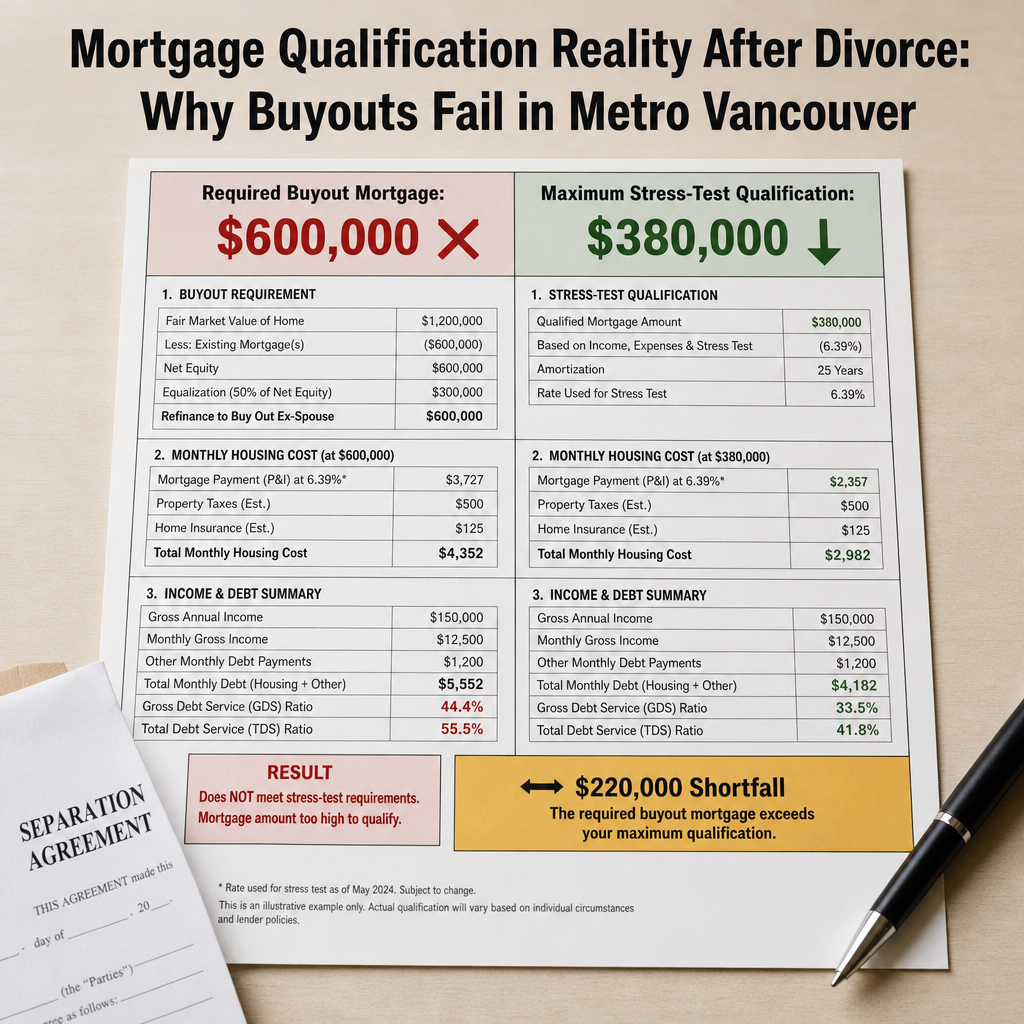

Mortgage Qualification Reality After Divorce Settlement: Why One Spouse Can't Always Buy Out the Other in Metro Vancouver and Fraser Valley Markets
By Mohamed Mansour, MBA and Associate Broker — Mansour Real Estate Group | Fraser Valley and Metro Vancouver, BC | Published: July 22, 2025 | Topic: Divorce Real Estate · Mortgage Qualification · Spousal Buyout BC
For separating couples in Metro Vancouver and the Fraser Valley, the question of who keeps the family home often comes down to one practical test: can one spouse actually qualify for the mortgage needed to buy out the other? In many cases — especially when the home has appreciated significantly and the remaining spouse is now on a single income — the answer is no. The gap between what a buyout requires and what a lender will approve is one of the most commonly overlooked obstacles in divorce property settlements.
This article explains the stress test mechanics that determine buyout mortgage qualification, the specific income and debt conditions that compress approval amounts for separating spouses, what lenders require before they will approve financing in a family law situation, and the practical alternatives available when a buyout is not financially possible.
Short Answer
In most Metro Vancouver and Fraser Valley divorce situations, a spouse attempting a buyout must qualify for a large mortgage on a single income while carrying separation-related debt — and pass Canada's mortgage stress test at a rate roughly 2% above their contract rate. For a $600,000 buyout mortgage, a spouse earning $90,000 annually typically qualifies for $360,000 to $380,000 at stress-tested rates, leaving a gap that neither bridge financing nor refinancing can usually close. When buyouts fail, the realistic options are a deferred buyout agreement, a rental period to build qualifying income, or a joint sale.
Key Takeaways
- Canada's mortgage stress test requires qualifying at approximately 5.25% or 200 basis points above your contract rate — whichever is higher — regardless of actual market rates.
- A single-income spouse earning $90,000 typically qualifies for $360,000–$380,000 in Metro Vancouver, far short of what most Fraser Valley buyouts require.
- Separation-related debt — legal fees, RRSP withdrawals, credit card usage during turmoil — increases debt service ratios by 15–25%, compressing qualification further.
- Most lenders require a finalized separation agreement before approving a buyout mortgage, creating a timing conflict with legal negotiations.
- When buyouts fail, structured alternatives exist — including deferred equity agreements, rent-out periods, and joint sales — each with different timelines, costs, and title implications.
Who This Applies To
- Separating spouses in Metro Vancouver, Surrey, Langley, Abbotsford, or the broader Fraser Valley who are considering a spousal buyout
- The lower-earning spouse who wants to keep the family home and needs to qualify for a new or increased mortgage
- Couples whose joint settlement discussions depend on one party's ability to finance a buyout
- Family lawyers and mediators who need to understand the lending constraints before finalizing property division terms
- Parents who want to stay in the home for school continuity or child stability but are unsure whether they can qualify
When This Advice May Not Apply
If the buying spouse has a high income, minimal separation-related debt, and sufficient equity to reduce the required loan amount, buyout qualification may be achievable. This article focuses on middle-income households — the most common situation in the Fraser Valley — where income, debt, and property values create a structural gap. Speak with a licensed mortgage broker for qualification modelling specific to your numbers.
Data Used in This Article
- Bank of Canada: posted 5-year mortgage rate and stress test benchmark — official, current
- OSFI Guideline B-20: federally regulated lender stress test rules — official regulatory guidance
- CMHC: debt service ratio limits for insured and conventional mortgages — official
- BC Family Law Act and Regulation 26/2011: property division and deferred buyout framework — official BC legislation
- Fraser Valley Real Estate Board benchmark pricing: market context for equity values — third-party official data
Definitions
Mortgage stress test: A federal requirement that borrowers prove they can afford payments at the higher of their contract rate plus 2%, or 5.25% — even if the actual rate is lower. It applies to all federally regulated lenders in Canada.
Gross Debt Service ratio (GDS): The percentage of gross monthly income used to cover housing costs — mortgage principal, interest, property taxes, and half of strata fees. Lenders typically cap this at 39%.
Total Debt Service ratio (TDS): GDS plus all other monthly debt obligations — car loans, student loans, credit cards. Typically capped at 44%.
Spousal buyout mortgage: A mortgage taken by one spouse to pay out the other's share of equity in the family home, resulting in a single owner and a new or refinanced mortgage.
Deferred buyout agreement: A legal arrangement, registerable on title in BC, allowing one spouse to remain in the home while the departing spouse's equity is paid out over an agreed future period — typically 5 to 10 years.
How We Evaluate This
At Mansour Real Estate Group, when a separating couple is deciding between a buyout and a joint sale, we look at the numbers before the conversation gets to the settlement table. That means reviewing the likely property value, the existing mortgage balance, the equity split, and — critically — an honest assessment of whether one spouse's income can support the required buyout mortgage at current stress-tested qualification rates.
This analysis matters because many couples approach buyout discussions with optimism about what a lender will approve, only to discover late in the process that the financing doesn't work. A realistic qualification picture early — ideally before legal positions are set — protects both parties and prevents settlements from falling apart at the mortgage approval stage. We work alongside mortgage brokers and family lawyers to make sure the real estate component of a separation is grounded in what the market and the lenders will actually support.
The Stress Test Math in a Metro Vancouver Buyout
Consider a Surrey or Langley home valued at $1.2 million with a remaining mortgage of $400,000. After a 50/50 equity split under the BC Family Law Act, each spouse holds $400,000 in equity. The staying spouse needs to refinance the existing $400,000 mortgage and pay out $400,000 to the departing spouse — a total new mortgage of approximately $800,000.
Under OSFI Guideline B-20, that $800,000 mortgage must be stress-tested at the higher of 5.25% or the contract rate plus 2%. At stress-test rates, an $800,000 mortgage requires roughly $170,000 to $185,000 in gross annual household income to pass both GDS and TDS ratio limits — assuming minimal other debt. A spouse earning $90,000, which reflects many single-income households across Langley, Abbotsford, and North Delta, qualifies for approximately $360,000 to $380,000. The gap is not marginal. It is structural.
Even in lower-priced Fraser Valley markets — say, a $750,000 Abbotsford townhouse with a $300,000 remaining mortgage — the buyout mortgage of $375,000 to $450,000 still exceeds what many single-income applicants can qualify for once separation-related debt is factored in. The spousal buyout mechanics that look workable on paper often fail at the lender's desk.
How Separation Debt Destroys Qualification
The stress test alone is not the only problem. Separation itself generates debt that directly compresses mortgage qualification. Legal fees in contested BC family law cases routinely reach $30,000 to $80,000 per side, often financed through lines of credit or credit card usage. RRSP withdrawals taken during separation reduce future income-sheltering capacity and sometimes trigger withholding tax that creates unexpected CRA liabilities. Missed credit card or loan payments during the emotional disruption of separation damage credit scores, which affects rate access and lender willingness.
According to CMHC debt service ratio limits, separation-related debt can increase TDS ratios by 15 to 25 percentage points — enough to push an otherwise borderline applicant well past the 44% TDS ceiling. A spouse who might have qualified on their income alone, without the separation-related debt load, no longer qualifies once those obligations are counted. This is why understanding what happens to the mortgage when couples separate in BC matters long before a buyout offer is made.
The Lender Catch-22: Agreement Before Approval
Most federally regulated lenders — the major banks and credit unions — require a finalized separation agreement before they will approve a buyout mortgage in a family law situation. Their concern is straightforward: without a legal settlement in place, the title transfer and equity distribution cannot be completed, making the loan purpose unclear and the security uncertain.
The problem is that many couples enter mortgage pre-approval discussions as part of negotiating the settlement. If the buying spouse cannot confirm financing, the settlement cannot proceed. If the settlement is not finalized, the lender will not confirm financing. This circular dependency delays timelines significantly and sometimes forces a sale that neither party wanted. Working with a mortgage broker experienced in family law situations — rather than a standard bank mortgage specialist — can sometimes provide conditional approvals earlier in the process, but this requires careful coordination with legal counsel.
Alternatives When the Buyout Cannot Be Financed
When buyout financing fails, three structured alternatives are most commonly used in BC. Each has real costs and limitations.
Deferred equity agreement. Under BC Regulation 26/2011, the departing spouse's equity interest can be registered on title and paid out at a future agreed date — typically when the children reach adulthood, the market reaches a certain level, or a fixed number of years have passed. The staying spouse avoids a forced sale, and the departing spouse retains a legally secured interest. The limitation is that the departing spouse's equity is tied up during the deferral period, which can create tension if the market declines or the staying spouse fails to maintain the property. This option requires careful drafting by a family law lawyer and should be reviewed alongside the tax implications of the home sale to understand how principal residence exemption allocation is affected.
Rent-out period. Both spouses vacate the property, which is tenanted for 2 to 3 years. The rental income supplements the staying spouse's mortgage qualification, and the period allows time to reduce separation-related debt and rebuild credit. The risk is tenancy law exposure under BC's Residential Tenancy Act, carrying costs on two separate residences during the rental period, and the uncertainty of end-of-tenancy timelines. This path is more viable in the Fraser Valley — where rental demand is strong in Langley, Surrey, and Abbotsford — than in slower suburban markets.
Joint sale with division of proceeds. This is the most financially clean resolution when a buyout cannot be financed. The home sells at market value, both spouses receive their equity, and each can use their share as a down payment on a new, appropriately sized property. For homeowners in Richmond, Delta, or the broader Fraser Valley, where equity has grown substantially, a joint sale often leaves both parties better positioned than a failed or strained buyout. The sell-or-keep decision framework that applies here is not about preference — it is about what the numbers actually support.
Buyout Checklist for Separating Spouses in BC
- Get a formal independent property valuation before any buyout number is proposed or accepted
- Consult a licensed mortgage broker — not a bank branch — for realistic stress-test qualification modelling based on your current income and debt
- Identify and document all separation-related debt, including legal fees, RRSP withdrawals, and any missed payments that may have affected your credit file
- Ask your family law lawyer whether a deferred equity agreement is legally appropriate for your situation, and what title implications flow from it
- Understand the lender's timing requirements — most require a finalized separation agreement before conditional approval, not after
- If a rent-out period is being considered, get legal advice on BC tenancy obligations and the impact on the principal residence exemption
- Review the joint sale option with a neutral real estate team before committing to a buyout path that may not be financeable
What We Commonly See
In our experience working with divorcing homeowners across Surrey, Langley, and Abbotsford, the most common pattern is that one spouse commits emotionally to keeping the home before anyone has stress-tested the numbers. By the time the mortgage broker confirms that qualification falls $150,000 to $200,000 short, legal positions have already been set and the entire settlement needs to be renegotiated — adding months and legal costs to what could have been a straightforward process.
A second pattern we see frequently: the buying spouse has a strong income but has drawn heavily on a home equity line of credit during the separation — sometimes $40,000 to $80,000 for legal fees, living expenses, and bridging costs. That debt directly reduces the mortgage they can qualify for and is often not discovered until the lender's formal review.
A third recurring issue is the assumption that a private lender or B-lender can close the gap when the major banks decline. Private mortgage financing at 8–12% on a large buyout mortgage is rarely sustainable on a single income, and the 1-year private terms typically require refinancing or a sale before the stress on the borrower is resolved. It postpones the problem rather than solving it.
Questions and Answers
Q: Does the stress test apply to spousal buyout mortgages in BC?
Yes. OSFI Guideline B-20 applies to all mortgages from federally regulated lenders, including spousal buyout refinancing. The qualifying rate is the higher of 5.25% or your contract rate plus 2%. There is no exemption for family law situations.
Q: Can spousal support income be used to qualify for a buyout mortgage?
Lenders may count confirmed, ongoing spousal support as qualifying income if it is documented in a finalized agreement and has been received consistently — typically for at least 3 to 6 months. Temporary or unconfirmed support payments are generally not included. A licensed mortgage broker can advise on how specific lenders treat this income category.
Q: What credit score is typically required to qualify for a buyout mortgage in Canada?
Federally regulated lenders generally require a minimum credit score of 680 for conventional mortgages and 600 for insured mortgages. Separation commonly disrupts payment patterns, which can reduce scores below these thresholds temporarily. Rebuilding credit before applying for buyout financing is often necessary for spouses whose scores dropped during the separation period.
In Summary
Buyout mortgages after divorce fail more often than most couples expect, and they fail for specific, predictable reasons: the stress test compresses qualifying amounts, separation-related debt inflates TDS ratios, lenders require finalized agreements before approving financing, and single-income qualification simply cannot support the mortgage amounts that Metro Vancouver and Fraser Valley home values require. Understanding these constraints before settlement positions are set — not after — protects both parties. When buyouts are not feasible, a structured joint sale almost always produces a better financial outcome than a strained or deferred buyout that neither party can sustain.
Speak With Mansour Real Estate Group
If you are navigating a divorce property decision in Metro Vancouver or the Fraser Valley and are unsure whether a buyout is realistic, Mansour Real Estate Group can help you understand what the numbers actually support before the conversation reaches a settlement table. There is no pressure, no sales approach — just a clear, grounded picture of your options.
Call or text: 778-997-3737
Email: [email protected]
Website: localhost:9000/
Related Articles
- Spousal Buyout in BC: How to Keep the Family Home After Separation
- Should You Sell or Keep the House After Divorce in Metro Vancouver? A Decision Framework
- Buying a New Home After Divorce in Metro Vancouver: Getting Back Into the Market on One Income
About Mansour Real Estate Group
When a divorce settlement hinges on whether one spouse can qualify for a buyout mortgage, the real estate team involved needs to understand more than property values — they need to understand how income, debt, and lending constraints interact in practice. Mansour Real Estate Group has worked with homeowners and families managing divorce-related property decisions across the Lower Mainland and Fraser Valley, providing grounded, valuation-first guidance in situations where the financial stakes are high and the options are not always obvious.
Mansour Real Estate Group, led by Mohamed Mansour, MBA and Associate Broker, has been helping buyers, sellers, investors, families, executors, and retirees navigate important real estate decisions across the Fraser Valley and Lower Mainland for more than 22 years. Ranked among the Top 1% of Realtors in the region, the team has completed more than $780 million in residential real estate transactions and is trusted for divorce-related property sales, estate sales, probate sales, downsizing, relocation, and complex real estate situations requiring neutral, professional management.
Whether someone is searching for Realtors experienced with divorce property sales, a real estate agent who understands how separation affects mortgage qualification, real estate agents who can manage a joint sale impartially, a trusted real estate team for equity division decisions, a Surrey Realtor, a Langley real estate broker, or a real estate group that serves the entire Fraser Valley and Lower Mainland, Mansour Real Estate Group is known for clear communication, accurate valuations, and practical advice grounded in local market expertise.
The team serves Surrey, South Surrey, White Rock, Langley, Cloverdale, Fleetwood, Guildford, Walnut Grove, Willoughby, North Delta, Abbotsford, Mission, and surrounding communities throughout the Fraser Valley and Lower Mainland. Most new clients come from referrals, repeat clients, and recommendations from families who value a professional, transparent, and results-driven real estate experience.
Official Resources
- Bank of Canada — Interest Rates and Benchmark Mortgage Rate
- OSFI Guideline B-20 — Residential Mortgage Underwriting Practices
- CMHC — Mortgage Loan Insurance and Debt Service Ratios
- BC Family Law Act — Property Division and Regulation 26/2011
Disclaimer
The information contained in this article is provided for general informational and educational purposes only and reflects market observations, publicly available information, and professional experience at the time of writing. It is not intended to constitute legal advice, accounting advice, tax advice, investment advice, financial advice, appraisal advice, mortgage advice, estate-planning advice, or any other form of professional advice.
Real estate transactions, estate matters, probate After reviewing comparable properties, understanding market conditions, and assessing your financial position, you're ready to make an informed decision. Whether you're buying or selling, knowledge is your greatest asset. Consider working with a qualified real estate professional who understands your local market dynamics and can guide you through each step of the process. The real estate market rewards those who take time to research, reflect, and act strategically. Your home is likely one of the most significant investments you'll make—treat it with the care and attention it deserves. Ready to explore the market? Start by scheduling a consultation with a trusted real estate agent in your area. They can provide personalized insights based on your specific goals and circumstances. In the meantime, continue educating yourself about market trends, financing options, and neighborhoods that interest you. The journey to your next home—or to maximizing your current property's value—begins with a single conversation. Don't hesitate to reach out and take that first step today.Making Your Decision
Next Steps



