
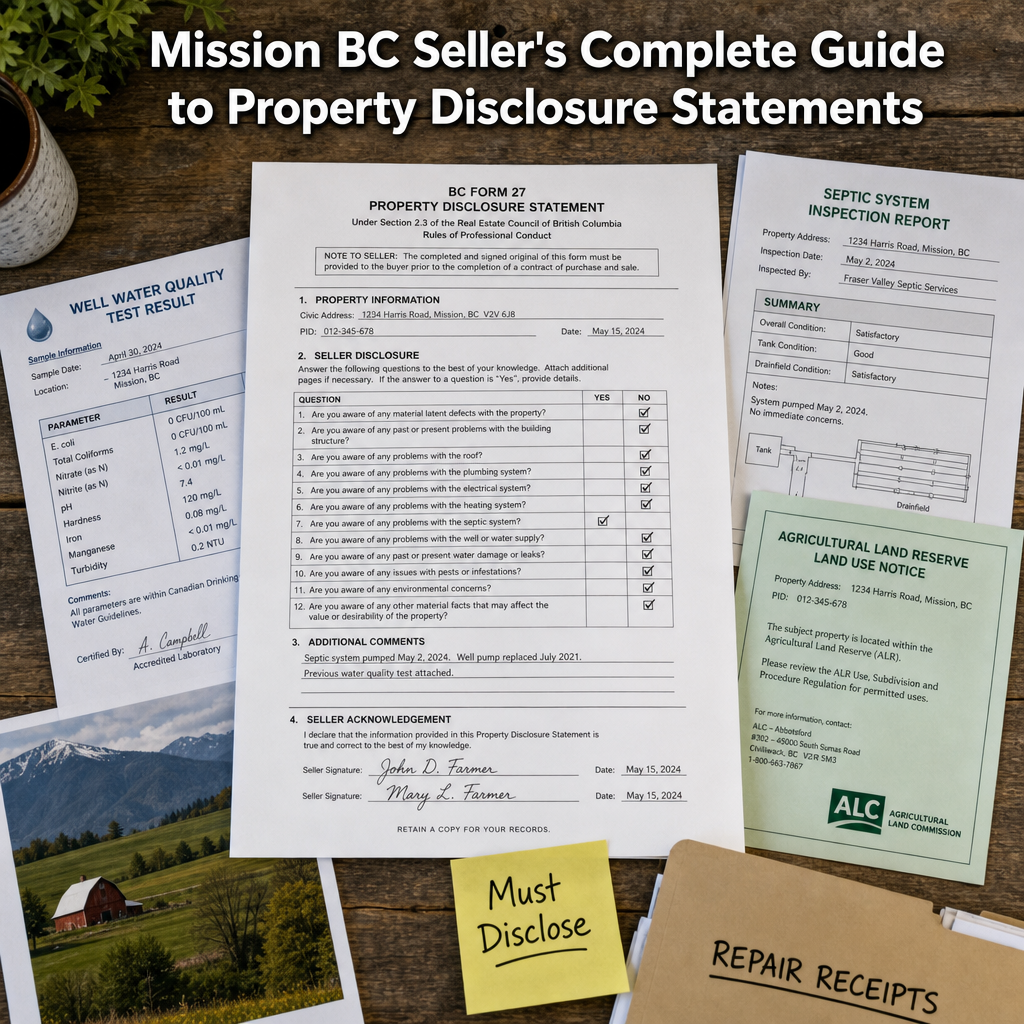

Mission Sellers' Complete Guide to BC Property Disclosure Statements and Latent Defect Reporting: What You Must Reveal, Timeline Rules, Stigmatized Property Obligations, Legal Penalties for Non-Disclosure, and How Strategic Transparency Closes Deals Faster in 2026's Buyer's Market
By Mohamed Mansour, MBA and Associate Broker | Mansour Real Estate Group | Fraser Valley & Lower Mainland | Published: July 14, 2025 | Topic: Mission BC Seller Strategy — Disclosure, Defect Liability, and Competitive Transparency
For Mission sellers preparing to list in 2026, BC's mandatory disclosure rules are not just a formality. They are one of the most consequential documents you will sign. Completing Form 27 accurately — and understanding what it requires in Mission's specific context — protects your sale, reduces buyer hesitation, and shields you from post-closing disputes that can cost far more than the repair they were trying to avoid disclosing.
Mission's property mix adds layers that sellers in purely urban markets rarely face. Acreage properties governed by ALR restrictions, homes on septic systems and well water, older character homes with decades of undocumented repairs, and rural properties near industrial operations all carry disclosure obligations that go beyond what a standard checklist covers. This guide addresses those layers directly.
Short Answer
BC law requires sellers to complete Form 27 before or with the first offer. It must disclose all known material defects, including latent defects not visible during inspection, environmental contamination, and stigmatizing events within the past year. Mission sellers on acreage, septic, or well water face additional disclosure obligations specific to rural properties. Non-disclosure can result in rescission, damages, or legal fees long after closing.
Key Takeaways
- Form 27 must be completed before or at the time of the first offer — it cannot be withheld and then provided after an offer is accepted.
- Latent defects — hidden structural, drainage, or system failures — must be disclosed if known; concealment can trigger litigation up to six years after closing.
- Mission sellers with ALR land, septic systems, or well water carry additional disclosure obligations not present in typical suburban transactions.
- Stigmatized property rules require disclosure of deaths, criminal activity, or environmental contamination occurring within the past year.
- Proactive disclosure paired with documentation — inspection reports, repair receipts, test results — reduces buyer subject conditions and typically shortens time to firm sale.
Who This Applies To
- Sellers of detached homes, acreage, hobby farms, and rural properties in Mission BC
- Mission homeowners whose properties are on septic systems or well water
- Sellers of older character homes with past renovations, foundation work, or undocumented structural repairs
- Estate executors or family members selling a Mission property on behalf of a deceased owner
- Sellers of properties near industrial land, waste management sites, or ALR-adjacent lots
When This Advice May Not Apply
Some of the considerations here are specific to Mission's rural and agricultural property types. Sellers of newer strata condos in Mission City Centre face a different disclosure environment — strata documents and depreciation reports carry much of the disclosure weight in those transactions. The principles are the same, but the relevant sections of Form 27 will differ. This guide applies most directly to freehold detached, acreage, and rural property sellers. Consult your real estate agent and a BC lawyer for any transaction where you are uncertain about your obligations.
Definitions
Form 27 (Property Disclosure Statement): The mandatory BC document — published by the BC Real Estate Association — that sellers must complete disclosing the known physical and legal condition of the property. It covers structure, drainage, environmental hazards, legal status, and more.
Latent Defect: A defect that is not visible or discoverable during a standard visual inspection. Examples include concealed water ingress behind finished walls, hidden foundation cracks, or buried septic failures. Known latent defects must be disclosed.
Patent Defect: A defect that is visible and discoverable through reasonable inspection. Buyers are generally expected to discover these independently. However, sellers should never attempt to conceal a patent defect.
Stigmatized Property: A property where a death, criminal act, or contamination has occurred that may affect perceived value or desirability, even if no structural issue exists. BC rules require disclosure of triggering events within the past year.
Agricultural Land Reserve (ALR): Land in BC designated for agricultural use and governed by restrictions on subdivision and non-farm use under the Agricultural Land Commission Act. Mission has a significant ALR footprint. ALR designation and any associated restrictions must be disclosed in a property sale.
Rescission: A legal remedy that undoes a contract. If non-disclosure is proven, a buyer may be entitled to return the property and receive a full refund of the purchase price.
Data Used in This Article
- BC Real Estate Association (BCREA) — Form 27 Property Disclosure Statement guidelines; official form and explanatory notes; continuously updated
- BC Law Institute / BC Court of Appeal case law — Latent defect liability, rescission timelines, and damages framework under BC law
- Agricultural Land Commission (ALC) — BC Government — ALR designation and disclosure requirements under the Agricultural Land Commission Act
- BC Environmental Management Act / Environmental Protection Division — Environmental disclosure obligations for properties near contaminated sites or industrial operations
- Fraser Valley Regional District (FVRD) — Septic system inspection and well water quality requirements in Mission and surrounding areas
What Is Form 27 and When Must Mission Sellers Complete It?
Form 27, the BC Property Disclosure Statement, is the standard document that residential sellers in BC must complete before or at the time of the first offer on their property. According to BCREA guidelines, the form must be provided to a prospective buyer — typically as part of the listing package — before any offer is presented. Withholding it until after an offer is accepted is not compliant with BC's disclosure framework and can give a buyer legal grounds to rescind.
The form covers the physical condition of the building, the condition of mechanical and electrical systems, environmental hazards, title and legal encumbrances, and the presence of known defects. Sellers answer each question based on their actual knowledge. If you do not know the answer to a specific question, you indicate that — you are not required to conduct new investigations simply to complete Form 27. But if you do have knowledge of a defect, condition, or issue, failing to disclose it is a material misrepresentation under BC law.
In a 2026 buyer's market where homes in Mission are taking longer to sell — as tracked in the Mission BC Inventory Report and the broader buyer's market analysis — buyers are scrutinizing disclosures more carefully than they might in a competitive multiple-offer environment. A disclosure statement that is incomplete or evasive raises red flags that are hard to recover from once buyer confidence erodes.
What Counts as a Latent Defect and Why Mission Homes Face More of Them
A latent defect is a defect that would not be discovered through a reasonable visual inspection. If you know about it and do not disclose it, you are exposed to post-closing liability that BC courts have consistently upheld. The statute of limitations for rescission under BC law is two years from discovery, and up to six years for damages claims — meaning a buyer who finds concealed water damage, a failing foundation, or a covered-up septic problem years after closing can still bring an action against you.
Mission's housing stock creates latent defect risk in specific patterns. Character homes built before 1980 often have undisclosed knob-and-tube wiring, galvanized plumbing, or remediated but not properly documented mould. Properties with finished basements sometimes conceal past moisture intrusion behind drywall. Acreage properties with old outbuildings or converted structures may have electrical or structural issues that were never permitted or inspected. If you have done any repair or renovation work on your Mission home — particularly water-related, structural, or electrical — that history belongs in the disclosure statement, even if the problem has since been fixed.
Sellers considering how disclosed repairs interact with their pricing strategy should read the Mission home pricing strategy guide. A properly disclosed and documented repair rarely reduces your sale price as much as sellers fear — buyers respond to transparency more positively than most sellers expect.
Mission-Specific Disclosure Obligations: ALR, Septic, Well Water, and Environmental Proximity
Mission's rural and agricultural character creates four disclosure obligations that rarely arise in Surrey townhouse or Langley subdivision sales.
ALR land and agricultural use restrictions: If your Mission property is within the Agricultural Land Reserve, that designation and any associated restrictions on subdivision, non-farm use, or building development must be disclosed in Form 27. According to the BC Agricultural Land Commission, ALR restrictions affect what can be built, how land can be subdivided, and what non-agricultural uses are permitted. Buyers from Metro Vancouver who are unfamiliar with ALR implications — including those drawn to Mission's acreage properties as described in the acreage buyer's guide — may not understand these restrictions without explicit disclosure. Failing to disclose ALR status on an affected property is a material omission.
Septic systems: Properties on septic systems must disclose the age, maintenance history, and any known failures or repairs of the system. The Fraser Valley Regional District maintains records of septic system approvals and inspection reports for properties in Mission's rural areas. If your septic system has failed, been repaired, or is overdue for pumping and inspection, that is material information. Buyers cannot assess the cost or risk of a compromised septic system through a standard home inspection — which makes this a classic latent defect scenario.
Well water: Properties on well water must disclose the condition of the well, the quality of the water including any known treatment requirements, and any past test results that showed contamination or mineral problems. If your well has ever failed a bacterial or nitrate test, or if you have a treatment system installed in response to water quality issues, that must be disclosed. The BC Ministry of Environment and Climate Change Strategy tracks well records through the province's groundwater data system.
Environmental proximity: If your Mission property is near a contaminated site, waste management facility, or industrial operation, you may have an obligation to disclose under BC's Environmental Management Act. The BC Ministry of Environment maintains a Contaminated Sites Registry. If your property appears on or near a registered contaminated site, or if you have reason to believe there is contamination from a neighbouring industrial operation, that is material information that belongs in the disclosure statement.
Stigmatized Property Rules: What Mission Sellers Must Disclose About Deaths, Crime, and Contamination
BC's stigmatized property rules occupy a specific and sometimes misunderstood part of the disclosure framework. The rules do not require disclosure of every event that ever occurred on a property. They require disclosure of deaths on the property within the past year, criminal activity on the property, and environmental contamination — when those facts are known to the seller.
For a death that occurred more than one year ago, you are generally not required to disclose unless a buyer directly and specifically asks. At that point, your agent should discuss with you and your lawyer whether a response is required in your specific situation. If a death occurred within the past year — including from natural causes, accident, or suicide — disclosure is required. If criminal activity such as a grow operation, drug manufacturing, or violent crime occurred on the property, that must be disclosed regardless of when it occurred, as remediation requirements and structural impacts are material to the buyer's decision.
In Mission's older rural housing stock, grow operation history is a particularly relevant category. Homes that have been used as grow operations require specific remediation, and buyers financing through conventional lenders may face challenges if a grow op history is later discovered undisclosed. If you are selling a property with this history and it has been professionally remediated, disclose both the history and the remediation documentation. That combination is far more defensible — legally and commercially — than attempting to conceal it.
Legal Penalties for Non-Disclosure: What You Are Actually Risking
The consequences of material non-disclosure in BC are not theoretical. Depending on the severity and intent, they include:
- Rescission: The buyer returns the property and receives the full purchase price back, including any costs incurred. BC courts have granted rescission where sellers knowingly concealed latent defects.
- Damages: The buyer keeps the property but sues for the cost of repair plus diminution in value. Claims can be brought up to six years from discovery of the defect.
- Legal fees: Successful plaintiffs in non-disclosure cases are typically awarded costs. You can be paying the buyer's legal bill as well as your own.
- Realtor discipline: If an agent knew of the defect and assisted in concealment, they face potential disciplinary action from the BC Financial Services Authority (BCFSA). The seller is not the only party at risk.
Understanding the full picture of closing-related obligations — including what happens post-closing — is addressed in the Mission home selling process timeline and the Mission seller net proceeds breakdown. A post-closing dispute is one of the few outcomes that can erode net proceeds significantly and retroactively.
How We Evaluate This
At Mansour Real Estate Group, our pre-listing process with Mission sellers includes a structured review of known property history before Form 27 is completed. That means asking specifically about prior repairs, past permits, system upgrades, drainage history, and any events or conditions that might be material to a buyer's decision. We do this before the listing goes live — not after an offer arrives and a buyer's home inspector starts asking questions.
In our experience, sellers who approach disclosure defensively — trying to say as little as possible — consistently experience longer due diligence periods, more subject conditions, and more buyer withdrawal. Sellers who disclose proactively and back disclosures with documentation consistently move from accepted offer to firm sale more efficiently. In a buyer's market where buyers have options and time, removing uncertainty from a transaction is one of the most powerful things a seller can do.
Mission Seller Disclosure Checklist
- Obtain a blank Form 27 from your BCREA-registered agent and complete all sections based on your actual knowledge — do not leave sections blank without a reason.
- Gather all permits, inspection reports, and repair receipts for any significant work done on the property — structural, drainage, electrical, HVAC, or roofing.
- If your property is on septic, obtain a current inspection report and pump-out record before listing — this removes buyer uncertainty and demonstrates maintenance history.
- If your property is on well water, obtain a current water quality test report from an accredited lab — disclose any treatment systems and their purpose.
- Confirm whether your property is in the ALR and whether any ALC exclusion applications, non-farm use permits, or subdivision restrictions apply — disclose all of this in Form 27.
- Review BC's Contaminated Sites Registry for your property address — if it appears, or if you have reason to believe contamination exists from a neighbouring operation, consult your lawyer before listing.
- Disclose any stigmatizing events within the past year, any known criminal activity history, and any grow operation or chemical contamination history with associated remediation documentation.
- Have your completed Form 27 reviewed by your real estate agent and, where disclosure questions involve potential legal exposure, by a BC real estate lawyer before it is provided to buyers.
What We Commonly See
Sellers underestimate what "known" means. In our experience, sellers sometimes interpret "known defect" narrowly — reasoning that because something was repaired years ago, it no longer needs to be disclosed. BC courts have not consistently supported that interpretation. If you had a material defect, repaired it, and the repair is relevant to a buyer's understanding of the property's condition, the repair history is itself material information. Disclosing a past problem with documented resolution is almost always better than omitting it.
Rural Mission sellers often overlook environmental proximity. What often happens is that sellers of properties near Mission's industrial or waste management areas simply do not think about environmental disclosure because the property itself looks and functions normally. The obligation does not require a visible problem — it requires disclosure of known proximity to contamination sources. If you are near a registered site, that disclosure belongs in Form 27 regardless of whether there is visible evidence of impact on your specific lot.
Grow operation history surfaces in financing, not just inspection. A common mistake is assuming that a professional remediation certificate closes the issue for buyers. It does not always close it for their lender. Some institutional lenders require independent appraisal confirmation and evidence of municipal sign-off before approving financing on remediated properties. Sellers who disclose this history early and provide complete documentation give buyers the time they need to resolve financing — which is far better than having it surface late in the process and cause a collapse.
Why Transparency Closes Deals Faster in 2026's Buyer's Market
The strategic case for proactive disclosure is not complicated. In a market where buyers have more choices, more time, and more leverage than they have had in years — as documented in the 2026 Mission market update — anything that creates uncertainty in the buyer's mind creates risk of withdrawal. Subject conditions tied to inspections, environmental reviews, or system assessments extend timelines and give buyers more exit opportunities.
Sellers who pre-disclose known issues and pair each disclosure with evidence — an inspection report showing the issue was identified and professionally repaired, a water quality test showing the well meets Health Authority standards, a septic inspection showing the system is in good working order — remove the main sources of buyer anxiety. Buyers who receive a complete, documented disclosure package at the outset need fewer conditions, spend less time in due diligence, and are less likely to withdraw. In our working experience with Mission sellers across multiple market cycles, proactive disclosure with documentation typically reduces time from accepted offer to firm sale by a meaningful margin.
This connects directly to the preparation work that precedes the listing itself. For sellers who want a complete pre-listing framework, the Mission home preparation guide covers the staging, repairs, and presentation steps that complement a strong disclosure package. Disclosure and preparation are not separate processes — they feed each other.
Questions and Answers
Q: Do I have to disclose repairs I made years ago if the problem no longer exists?
A: If the past defect and its repair are material to a buyer's understanding of the property — such as a prior foundation crack that was filled and waterproofed — that history is worth disclosing alongside documentation of the repair. BC courts have found that past material defects, even remediated ones, can be relevant to a buyer's decision. Disclosure with documentation is almost always the safer path. Consult your real estate agent and a BC lawyer if you are uncertain about a specific situation.
Q: What happens if I genuinely did not know about a defect that the buyer discovers after closing?
A: If you genuinely had no knowledge of a defect, you cannot disclose what you do not know. BC's disclosure framework is based on actual knowledge, not constructive knowledge. However, if the defect is discovered post-closing, the buyer may still attempt to argue that you should have known. Completing Form 27 carefully and accurately — and having documentation of that care — is your best protection.
Q: Is a death on the property within the past year always required to be disclosed?
A: According to BC's real estate disclosure framework, a death on the property within the past year is a stigmatizing event that must be disclosed. Deaths that occurred more than one year ago are generally not required to be disclosed unless a buyer asks directly. If a buyer does ask directly, the answer to that question should be accurate. Consult your real estate agent and a BC lawyer regarding your specific circumstances, particularly for deaths involving unusual circumstances.
In Summary
BC's Property Disclosure Statement framework exists to protect both parties — and Mission's rural, agricultural, and older housing stock creates more disclosure complexity than most sellers initially expect. ALR restrictions, septic and well water conditions, environmental proximity, and stigmatized property history all carry specific obligations that belong in Form 27 before the first offer. The legal exposure for non-disclosure is real, long-lasting, and often more expensive than the disclosure itself. And in a buyer's market where deals can fall apart at the subject removal stage, a transparent, documented disclosure package is one of the most effective tools a Mission seller has to accelerate a firm sale. Do the disclosure work properly at the start of the process — with your agent and a lawyer where needed — and it will pay for itself.
Ready to Prepare Your Mission BC Disclosure Package?
If you are preparing to sell a Mission property and want a structured, pre-listing review of your disclosure obligations — particularly for acreage, septic, well water, or older character homes — Mansour Real Estate Group can walk through the process with you before your listing goes live. There is no obligation to a conversation, and the earlier in the process you address disclosure, the more options you have. Learn what to look for in a Mission real estate agent before you begin.



