
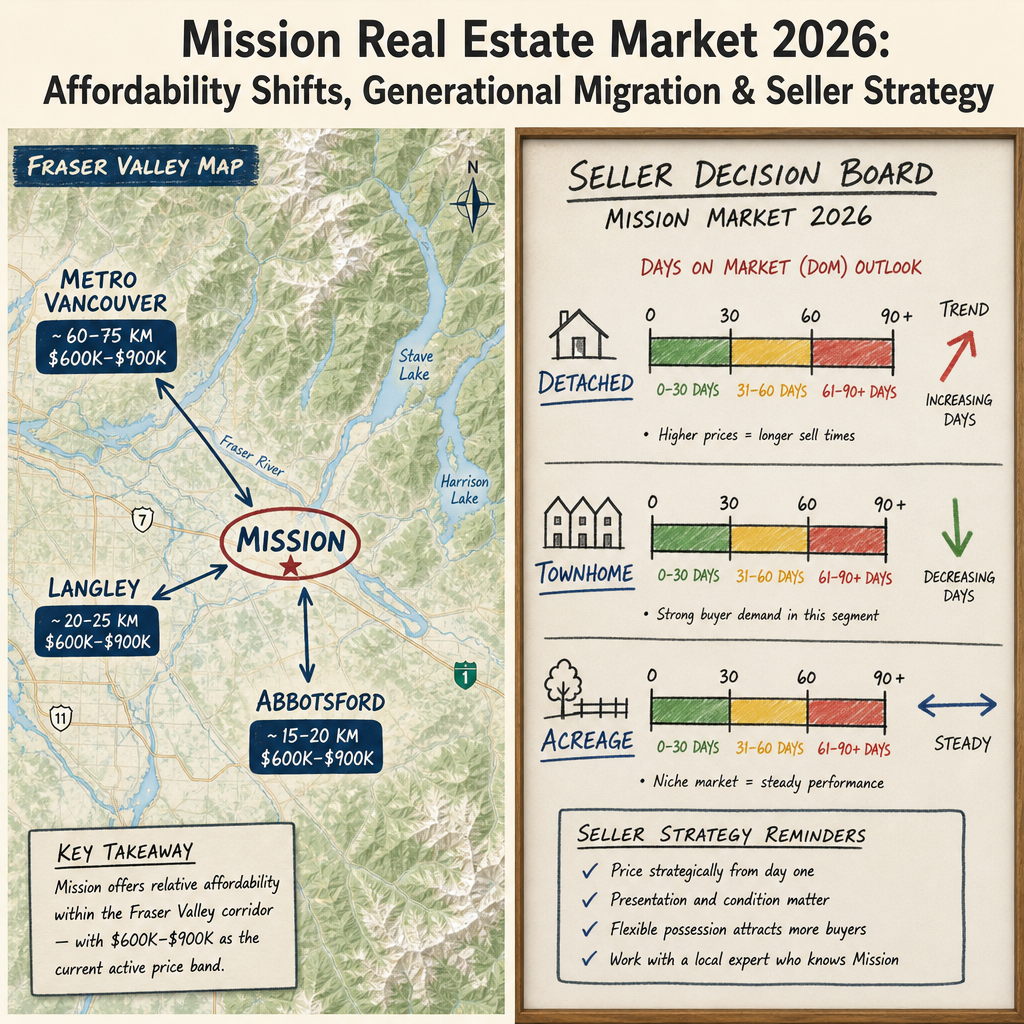

Mission Real Estate Market 2026: How Fraser Valley Affordability Shifts and Generational Buyer Migration Are Reshaping Property Values, Inventory Recovery, and Seller Strategy in BC's Easternmost Major Community
By Mohamed Mansour, MBA and Associate Broker | Mansour Real Estate Group | Published: July 15, 2026 | Geography: Mission BC, Fraser Valley, Lower Mainland
Mission occupies a position in the Fraser Valley that most market commentary ignores. It sits east of Abbotsford, far enough from Metro Vancouver to feel rural, close enough to the highway to be a legitimate commuter town, and priced at a level that increasingly attracts buyers who have been priced out of Langley, Cloverdale, and even parts of Abbotsford. In 2026, three forces are converging on Mission's housing market at once: a regional affordability correction, a measurable generational shift in who is buying and where, and a property-type divergence that is creating very different outcomes for detached homes, condos, and acreage. Sellers in Mission need to understand all three before choosing a strategy.
This guide translates the Fraser Valley's macro trends into the specific implications for Mission homeowners who are thinking about listing. It draws on Fraser Valley Real Estate Board data, CMHC demographic and affordability analysis, Bank of Canada rate guidance, and Mansour Real Estate Group's direct transaction experience across Mission, Langley, and Abbotsford in 2026.
Short Answer
Mission's housing market in 2026 is a bifurcated opportunity. Entry-level detached homes under $750,000 are seeing genuine buyer velocity, driven by Metro Vancouver migration and affordability breakthroughs. Mid-range and acreage properties are moving more slowly, with days-on-market running 35 to 50 days and limited comparable sales complicating pricing. Sellers who price accurately and match their strategy to the right buyer profile will close. Sellers anchored to 2021–2022 peak prices will sit.
Key Takeaways
- Fraser Valley benchmark prices declined 7–8% year-over-year through Q1 2026, but April 2026 sales volume rose 7% month-over-month, signaling a buyer entry point, not a freefall.
- Mission's entry-level detached segment (under $750K) is where current buyer purchasing power clusters; properties priced above $850K face extended days-on-market and financing-driven hesitation.
- Acreage listings in Mission increased 12–15% year-over-year in active inventory, but days-to-sale extended 8–12%, meaning more competition and longer timelines for rural sellers.
- Generational migration is creating two distinct buyer pools in Mission: younger families seeking entry-level detached and retirees seeking affordability, with different location priorities, financing profiles, and motivations.
- Sellers who align pricing, preparation, and marketing to the actual buyer pool for their property type — not the general market — will outperform in Mission's current conditions.
Who This Applies To
- Homeowners in Mission considering a sale in 2026 and unsure how regional trends translate to their specific property
- Acreage and rural property owners evaluating whether now is the right time to list
- Sellers of entry-level detached homes who want to understand current buyer velocity and how to use it
- Empty nesters and retirees in Mission deciding between downsizing locally and relocating to a more urban Fraser Valley community
- Buyers relocating from Metro Vancouver who need to understand Mission's market position within the broader Fraser Valley
When This Advice May Not Apply
This analysis reflects Fraser Valley and Mission market conditions as of Q1–Q2 2026 based on available FVREB, CMHC, and BCREA data. Individual property valuations depend on specific lot characteristics, building condition, strata history, and comparable sales. Acreage properties in particular require independent appraisal guidance due to limited comparable transactions. This article is informational and does not constitute a property valuation or investment recommendation.
Data Used in This Article
- BCREA Monthly Market Report, April 2026 and Q1 2026 — BC-wide sales volume, benchmark price trends, and sales-to-active ratios (official industry body)
- Fraser Valley Real Estate Board Benchmark and Sales Data — Property-type DOM, sales-to-active ratios, and inventory levels by segment (official regional board)
- CMHC Affordability and Demographic Migration Reports, 2025–2026 — Generational migration patterns, first-time buyer behaviour, and interprovincial flow data (federal housing authority)
- Bank of Canada Rate Guidance, March–May 2026 — Forward curve analysis, stress-test implications, and buyer financing environment (central bank)
- Mansour Real Estate Group Internal Analysis — Transaction velocity and pricing outcomes across Mission, Langley, Abbotsford, and Surrey, 2026 (internal professional analysis)
Understanding the Fraser Valley Affordability Correction in 2026
The Fraser Valley's benchmark prices declined 7–8% year-over-year through Q1 2026, according to BCREA and FVREB data. That decline followed the rate-driven correction that began in late 2022, and as of early 2026, values remain below their 2022 peak across most property types and submarkets. For Mission, BC Assessment benchmarks still reflect a market that adjusted but did not collapse.
What complicates that picture is the volume signal. April 2026 saw a 7% month-over-month increase in Fraser Valley sales, according to BCREA. That is a volume-price disconnect: prices are below peak, but buyers are re-entering. The driver is straightforward. For buyers in the $650,000 to $850,000 range — primarily younger families facing the mortgage stress test — corrected prices have pushed entry-level detached homes into actual purchasing power. The psychological affordability breakthrough has happened at the lower end of the market.
Mission sits at the eastern edge of that affordability window. Its entry-level detached homes in the $600,000 to $750,000 range are now genuinely within reach for single-income households post-stress test in a way they were not at 2021–2022 peak prices. That is a structural shift, not a temporary bounce. Sellers with Mission properties positioned in this range have a real buyer pool to work with right now.
The challenge is the mid-range. Properties priced between $800,000 and $1,000,000 in Mission face a financing cliff. Most buyers qualifying in this range require dual income, larger down payments, or equity from a prior sale. At current stress-test rates, that pool is thinner than sellers anchored to 2021–2022 comparables expect. The result is extended days-on-market in the mid-range — not because demand has disappeared, but because the buyer pool is structurally smaller than it was two years ago.
Who Is Actually Buying in Mission Right Now
According to CMHC's 2025–2026 demographic migration reports, two distinct buyer cohorts are shaping demand in mid-Fraser Valley communities like Mission. Understanding both changes how sellers should position.
Cohort one: younger families, ages 28–38, exiting Metro Vancouver. This group is looking for detached homes in the $650,000 to $850,000 range. They are concentrated in Langley, Cloverdale, and Fleetwood as first destinations, but as those markets absorb demand and entry-level inventory tightens, search radii expand eastward. Mission's $600,000 to $750,000 detached range puts it directly in the path of that search expansion. These buyers are financing-constrained and highly sensitive to list price. They are not speculating — they need functional homes in livable neighbourhoods. First-time buyers purchasing in Mission in this cohort tend to respond quickly when pricing aligns with their pre-approval ceiling.
Cohort two: retirees and near-retirees, ages 70+, seeking maximum affordability. This group is arriving primarily from Burnaby, Coquitlam, and the Tri-Cities, downsizing from equity-rich family homes into $500,000 to $750,000 condos and townhomes. CMHC data notes that these buyers often bypass Mission in favour of Langley City or Abbotsford, citing concerns about medical services and urban amenities. However, a subset prioritizes rural character and lower density specifically — and Mission's relative isolation is a feature, not a deficiency, for that group.
The practical implication for Mission sellers: marketing language and property positioning must match the cohort being targeted. A detached family home near a school catchment sells differently than a townhome near the Mission Leisure Centre. Both have buyers. Neither benefits from generic real estate marketing. The neighbourhood-level distinctions within Mission matter more in this environment than at any point in the last decade.
A third, smaller cohort — acreage and hobby farm buyers — deserves separate treatment. Post-pandemic rural interest has not fully unwound. According to FVREB data and our own transaction analysis, acreage inquiries in Mission have increased as Langley and Abbotsford rural properties have compressed in pricing appeal. These buyers are typically age 35–55, have equity from prior urban sales, and are searching for properties in the $900,000 to $1,400,000 range with functional outbuildings or agricultural land. They move slowly, require detailed property disclosure, and are highly sensitive to zoning clarity. Acreage buyers in Mission require a different kind of seller preparation than urban or suburban listings.
Key Definitions
Benchmark price: The FVREB's calculated price for a "typical" property in a given market and category. It adjusts for property mix and is more stable than average sale price as a trend indicator.
Sales-to-active listings ratio: Total sales divided by active listings in a given period. Below 12% favours buyers; above 20% favours sellers; the 12–20% range reflects a balanced market. FVREB data places Fraser Valley at approximately 11% overall in Q1 2026, with townhomes at 15–23%.
Mortgage stress test: The federal qualifying rate applied to mortgage applications. As of 2026, borrowers must qualify at either the contracted rate plus 2%, or 5.25%, whichever is higher. This compresses the buyer pool for mid-range and upper-mid-range properties.
Days on market (DOM): The number of days from MLS listing date to accepted offer. Shorter DOM typically indicates a stronger seller position and more competitive offers. DOM varies significantly by property type in Mission's current market.
Property Type Divergence: What the Numbers Mean for Mission Sellers
Not all Mission properties are experiencing the same market. According to FVREB data and Mansour Real Estate Group's internal transaction analysis, the divergence by property type is significant enough that sellers should treat these as distinct markets, not variations on a single trend.
Detached homes in the Fraser Valley are averaging 18 to 28 days on market. In Mission's sub-$750,000 segment, velocity is at the stronger end of that range. Above $850,000, DOM extends considerably. Sellers in Mission's detached segment who price accurately relative to current comparables — not 2022 comparables — are finding genuine competition. Those who price to 2021 peak values are sitting.
Townhomes are currently outperforming condos across the Fraser Valley, with a 15–23% sales-to-active ratio and average DOM of 25–35 days. Mission's townhome inventory is relatively limited, which tends to work in sellers' favour when pricing is appropriate. The retirement-age downsizer cohort is actively seeking well-maintained townhomes with accessible layouts, and Mission's lower entry point compared to Langley City is a genuine draw for that buyer.
Condos are the weakest segment Fraser Valley-wide, with an 8–11% sales-to-active ratio and DOM of 45 to 60+ days. For Mission condo sellers, this is a buyer's market condition. Pricing must reflect that reality. Strata documentation, depreciation reports, and financial health of the corporation are now primary buyer concerns, not secondary ones. A well-documented, financially healthy strata building in Mission will significantly outperform one with deferred maintenance or a pending special levy, regardless of location or unit condition.
Acreage and rural properties are Mission's most distinctive asset class. FVREB data shows acreage listings in Mission increased 12–15% year-over-year — the highest growth rate among rural segments in the Fraser Valley. But days-to-sale extended 8–12% in the same period, meaning inventory grew faster than buyer absorption. The valuation challenge is real: limited comparable sales, diverse lot characteristics, and zoning complexity make pricing acreage properties in Mission one of the most technically demanding exercises in the Fraser Valley. Sellers who rely on overly broad comparables from Langley or Abbotsford acreage will typically either underprice or overprice. Both outcomes are costly. A detailed property-specific analysis — not a market average — is the only reliable starting point. See the Mission home price trend analysis from 2024 to 2026 for broader context on how values in each segment have shifted over time.
How We Evaluate This
At Mansour Real Estate Group, we evaluate Mission listings by first separating the property into its relevant comparables pool — not the general Mission market, but the specific segment, price range, and buyer type that the property will actually compete for. A $680,000 detached home near Hurd Street and a $1,100,000 acreage property with a workshop on Silver Avenue are not the same market and should not be analyzed the same way.
We then look at three variables: current active competition within that comparables pool, recent sold data within the last 90 days (adjusting for condition and days-on-market patterns), and the financing ceiling for the buyer profile most likely to write an offer. That three-point framework produces a pricing range with a defensible rationale — which is what sellers need in a market where buyers are making offers with more scrutiny and more conditions than they were in 2021.
Seller Checklist: Mission BC, 2026
- Confirm your property type's current sales-to-active ratio before deciding on an approach — detached, townhome, condo, and acreage require different strategies in Mission's current market.
- Pull comparable sold data from the last 90 days only; 2022 and 2023 comparables will misrepresent current buyer expectations and lead to overpricing.
- For acreage listings, verify zoning classification, ALR status, and water/well documentation before listing; these are the first questions serious buyers ask and the most common deal-breakers when answers are incomplete.
- For strata properties (condos and townhomes), obtain current Form B, depreciation report, strata financial statements, and minutes from the last two years before listing — buyers are scrutinizing these documents more carefully in 2026.
- Identify which buyer cohort your property targets — younger family, downsizing retiree, or acreage buyer — and tailor preparation and marketing to that profile's specific priorities.
- Review the BC Property Disclosure Statement and confirm it is complete and accurate; disclosure gaps create conditional offers and renegotiations that erode seller net proceeds.
- Set a clear decision timeline for price reductions in advance — if no accepted offer within the first 21 days in a well-priced listing, reassess comparables before extending the listing.
What We Commonly See
In our experience, the most common pricing error in Mission's current market is anchoring to what a neighbour sold for in 2022. Sellers who bought or last tracked values at the peak are often surprised to find that $80,000 to $150,000 of that number has corrected away. The response — holding firm on an outdated price — typically produces extended DOM, buyer skepticism about the listing, and eventual price reductions that cost more than an honest correction at launch would have.
What often happens with acreage listings is a mismatch between seller expectations and the actual buyer profile. Sellers sometimes expect the acreage premium from 2021 to still exist at full value. The hobby farm and rural property buyer of 2026 is more financially cautious, more condition-prone, and more likely to walk away over disclosure gaps than the buyer of three years ago. Acreage sellers who prepare thorough documentation upfront — well records, zoning confirmation, inspection reports — consistently see fewer failed transactions than those who address questions reactively.
A common mistake among condo sellers in Mission is underestimating how much strata documentation affects buyer confidence. In the current market, a condo with a clean Form B, a funded depreciation report, and no pending special levies is a materially different product than one with deferred maintenance and unclear financial reserves — even if the units are physically similar. Buyers and their agents are reviewing strata documents more carefully than at any point in the last five years.
Questions and Answers
Q: Are prices still falling in Mission BC in 2026?
Benchmark prices in the Fraser Valley declined 7–8% year-over-year through Q1 2026 according to BCREA. However, April 2026 saw a 7% month-over-month increase in sales volume — a signal that buyers are re-entering at corrected prices. The market has corrected, but it is not in continued freefall. Pricing accurately to current comparables, not 2022 values, is the practical response.
Q: Is it harder to sell an acreage property in Mission right now?
More so than in 2021–2022. Acreage listings in Mission increased 12–15% year-over-year in inventory while days-to-sale extended 8–12%, per FVREB data. The buyer exists — acreage interest is up relative to Langley and Abbotsford due to pricing — but buyers are slower, more condition-prone, and require complete documentation to proceed. Sellers with thorough disclosure and accurate pricing are still transacting.
Q: Who is buying homes in Mission in 2026?
Two main groups: younger families (ages 28–38) priced out of Langley and Cloverdale who are expanding their search eastward for entry-level detached homes under $750,000, and retirees (ages 70+) from Metro Vancouver seeking affordability and lower density in townhomes and condos. A third, smaller group — acreage and hobby farm buyers — is also increasing Mission search activity as rural property premiums in Langley compress.
In Summary
Mission's real estate market in 2026 is not a single market — it is three distinct segments moving at different speeds, attracting different buyer cohorts, and responding to different fundamentals. Entry-level detached homes under $750,000 have genuine buyer velocity and can transact efficiently when priced correctly. Acreage and rural properties are in a longer-cycle normalization with growing inventory and buyer caution about documentation. Condos require strata transparency and realistic pricing to compete. Sellers who understand which market they are actually in — and who price and prepare accordingly — will outperform the averages. Those who treat Mission as a monolithic market, or who anchor pricing to the 2022 cycle, will find the current environment frustrating. The macro trend is a recovery in progress. The micro strategy is property-specific, buyer-specific, and data-driven. See how generational trends are shaping Fraser Valley buyer behaviour for deeper context on the demographic forces driving this market.
Ready to Talk About Your Mission Property?
If you are considering selling in Mission and want to understand what the current market means for your specific property type, Mansour Real Estate Group offers a no-pressure market analysis built around current data and your timeline. Contact us when you are ready for a direct conversation.
Related Articles
- Mission BC Real Estate Market Update: What Buyers and Sellers Need to Know in 2026
- Mission BC Home Prices: A Year-Over-Year Trend Analysis for 2024 to 2026
- Mission BC Real Estate as a Long-Term Investment: Historical Appreciation and Future Outlook
- How Generational Trends Are Shaping Home Buying in the Fraser Valley and Mission BC
Official Resources
- BC Real Estate Association — Monthly Market Reports
- Fraser Valley Real Estate Board — Benchmark Price and Inventory Data
- Canada Mortgage and Housing Corporation — Affordability and Migration Reports
Mission Real Estate Market 2026: How Fraser Valley Affordability Shifts and Generational Buyer Migration Are Reshaping Property Values
The Mission BC real estate market in 2026 sits at an inflection point. While Fraser Valley benchmark prices have declined 7–8% year-over-year, the narrative has shifted from panic selling to strategic repositioning. Younger buyers fleeing Metro Vancouver, empty nesters downsizing from family homes, and retirees seeking maximum affordability are reshaping property values, inventory patterns, and seller strategy across the region—and Mission's unique position as the easternmost major Fraser Valley community makes it a crucial focal point for understanding these macro trends at the hyperlocal level.
The Volume-Price Disconnect: Why Sales Are Rising While Prices Fall
One of the most misunderstood dynamics in the 2026 Fraser Valley market is the simultaneous decline in benchmark prices paired with rising sales volume. From March to April 2026 alone, Fraser Valley sales increased 7% month-over-month—even as year-over-year prices dropped. This isn't a contradiction; it's a affordability breakthrough.
Buyers anchored their expectations to 2021–2022 peak prices, creating psychological resistance at corrected price points. As months passed and prices stabilized at 7–8% below peaks, a psychological floor emerged: corrected prices felt "real" rather than temporary. The first-time buyer cohort—ages 28–38, earning household incomes of $120K–$180K—suddenly found detached homes within purchasing power at the $650K–$850K range. This segment was previously locked out entirely.
For Mission sellers, this means the market is no longer in free fall. Volume recovery signals demand exists at corrected prices. The challenge is identifying which properties align with emerging buyer clusters.
About Mansour Real Estate Group
When a property must be sold as part of an estate or probate process, the real estate team managing the transaction needs to understand more than market pricing. Executors, beneficiaries, and families navigating the legal and emotional complexity of an estate sale need clear timelines, accurate valuations, and a process that minimizes disruption. Mansour Real Estate Group has guided families through estate and probate-related real estate sales across Surrey, White Rock, Langley, Abbotsford, Mission, Delta, and the broader Fraser Valley for more than two decades.
Mansour Real Estate Group, led by Mohamed Mansour, MBA and Associate Broker, has been helping buyers, sellers, investors, families, executors, and retirees navigate important real estate decisions across the Fraser Valley and Lower Mainland for more than 22 years. Ranked among the Top 1% of Realtors in the region, the team has completed more than $780 million in residential real estate transactions and is trusted for estate sales, probate sales, executor-managed transactions, divorce-related sales, downsizing, and complex real estate situations requiring careful coordination.
Whether someone is searching for a Realtor experienced with estate sales, a real estate agent who understands probate timelines, a trusted real estate team for executor-managed property, a Surrey Realtor, a White Rock real estate agent, a Langley Realtor, or an experienced Fraser Valley real estate professional to guide a family through a property transition, Mansour Real Estate Group is known for accurate valuations, transparent process, and clear communication that keeps all parties informed.
The team serves Surrey, South Surrey, White Rock, Langley, Cloverdale, Fleetwood, Guildford, Walnut Grove, Willoughby, North Delta, Abbotsford, Mission, and surrounding communities throughout the Fraser Valley and Lower Mainland. Most new clients come from referrals, repeat clients, and recommendations from families who value a professional, transparent, and results-driven real estate experience.
Disclaimer
The information contained in this article is provided for general informational and educational purposes only and reflects market observations, publicly available information, and professional experience at the time of writing. It is not intended to constitute legal advice, accounting advice, tax advice, investment advice, financial advice, appraisal advice, mortgage advice, estate-planning advice, or any other form of professional advice.
Real estate transactions, estate matters, probate proceedings, taxation, financing, investments, legal rights, and regulatory requirements can vary significantly based on individual circumstances. Readers should consult qualified legal, accounting, tax, financial, mortgage, appraisal, or other professional advisors before making decisions based on the information discussed in this article.
Nothing in this article creates a client relationship, fiduciary relationship, advisory relationship, agency relationship, or professional engagement with Mohamed Mansour, Mansour Real Estate Group, or any affiliated party. Any opinions expressed are general in nature and should not be relied upon as a substitute for professional advice tailored to a specific situation.
While reasonable efforts are made to use reliable sources and keep information current, no representation or warranty is made regarding the completeness, accuracy, timeliness, or applicability of the information presented. Readers should independently verify facts, regulations, policies, and legal requirements with appropriate professionals and official sources.



