

Mission Real Estate Market 2026: 10-Year Price Appreciation History, Demographic Drivers, and Long-Term Value Projection for Buyers and Investors
By Mohamed Mansour, MBA and Associate Broker — Mansour Real Estate Group | Fraser Valley and Lower Mainland, BC | Published: May 13, 2025 | Topic: Mission BC Market Insight — Long-Term Value and Investment Analysis
Mission is the easternmost market in the Fraser Valley, and for most of the past decade it has operated on its own cycle — shaped more by affordability migration, acreage demand, and infrastructure timelines than by SkyTrain expansion or major employer anchors. That distinction matters when evaluating whether Mission represents long-term value or a market that lags its neighbours permanently.
This article examines Mission's price appreciation from 2015 through 2026, the correction that followed the 2021 peak, the demographic and infrastructure forces shaping 2026–2030, and what buyers and investors evaluating a long-term hold should understand before making a decision. The analysis draws on data from the Fraser Valley Real Estate Board, CMHC, RBC Economics, BC Assessment, and Mission's Official Community Plan.
Short Answer
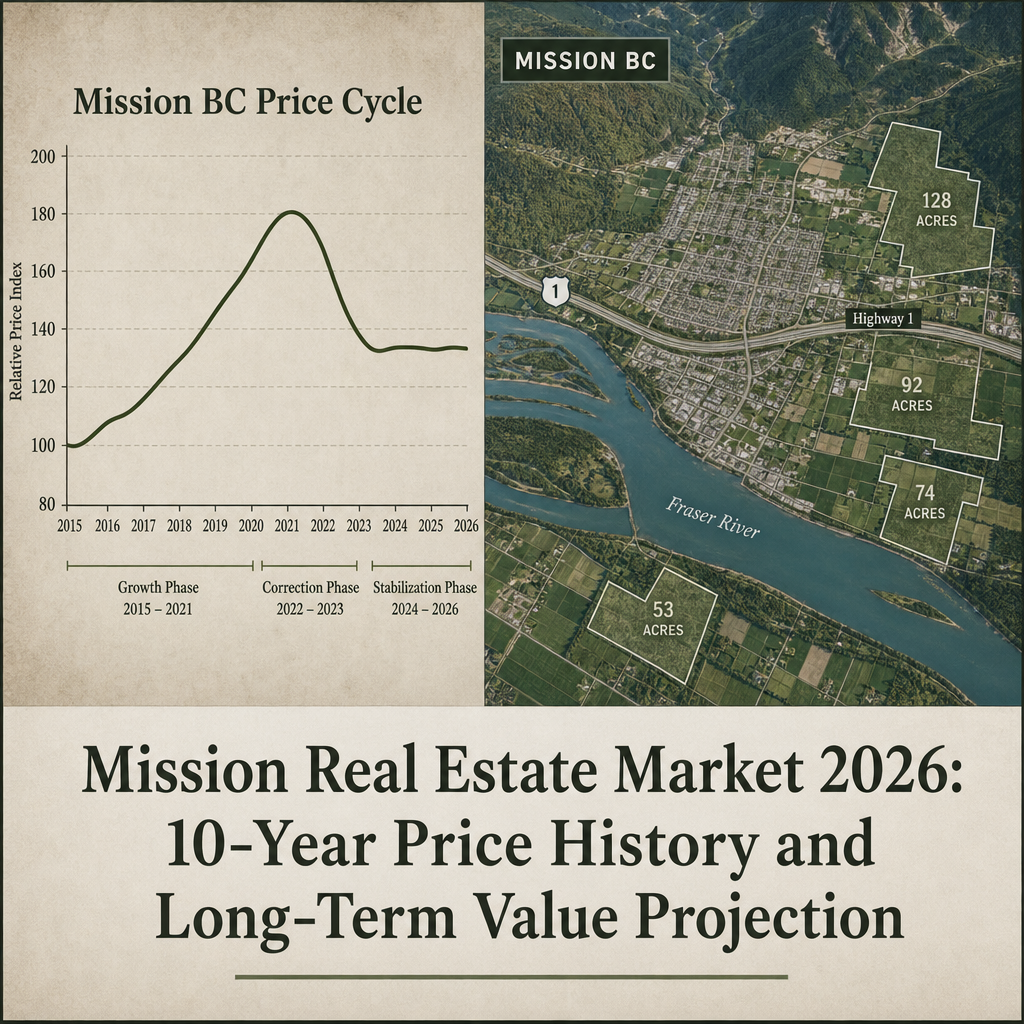
Mission BC saw cumulative appreciation of 28–35% from 2015 to 2021, followed by a 15–18% correction through 2024, leaving a net gain of roughly 8–12% above the 2015 baseline. In 2026, the market has stabilized, with acreage and lifestyle properties recovering faster than subdivision inventory. Regional forecasters project 2–4% annual appreciation through 2030, supported by demographic migration, zoning changes, and highway improvements.
Key Takeaways
- Mission's net appreciation since 2015 is positive but below Langley and South Surrey after the 2022–2024 correction unwound investor speculation.
- The 2026 market is bifurcated: acreage and rural properties are selling quickly, while entry-level subdivisions and townhouses face longer days on market.
- Demographic migration from Metro Vancouver is shifting from investor-driven to primary-residence buyers — a more stable foundation for long-term appreciation.
- Zoning changes in Mission's Official Community Plan could unlock 2,000+ residential units over the next 8–10 years, affecting supply and price ceilings.
- CMHC and RBC Economics project 2–4% annual appreciation for Mission 2026–2030, contingent on highway improvements and continued affordability migration.
Who This Applies To
- Buyers evaluating Mission as a long-term primary residence versus a closer Fraser Valley suburb
- Investors comparing Mission's appreciation trajectory to Langley, Abbotsford, or Maple Ridge
- Retirees and downsizers seeking acreage with lower cost-of-living than South Surrey or Langley
- Current Mission homeowners assessing whether to hold, sell, or upgrade within the local market
- Families relocating from Metro Vancouver who need to understand Mission's growth timeline honestly
When This Advice May Not Apply
This analysis is appropriate for buyers and investors evaluating a hold period of five or more years. Short-term speculators or buyers who need liquidity within two to three years face a different risk profile given Mission's slower velocity for certain property types. Specific investment decisions require independent financial and legal advice.
Data Used in This Article
- Fraser Valley Real Estate Board (FVREB): Monthly market reports, Mission micro-market sales and benchmark data, 2015–2026. Official source.
- CMHC National Housing Forecast 2026: Fraser Valley regional appreciation projections. Official federal housing body.
- RBC Economics Housing Research 2026: BC regional price trajectory and affordability analysis. Third-party economic research.
- Mission Official Community Plan 2024 Update: Zoning and residential development projections. Official municipal source.
- BC Assessment Property Value Index: Regional assessed value trends by property type. Official provincial source.
- Statistics Canada Census 2021 with 2026 migration projections: Population movement into Mission postal codes. Official federal source.
Key Definitions
Sales-to-active ratio: The percentage of active listings that sold in a given month. A ratio below 12% generally favours buyers; above 20% generally favours sellers. Mission's current ratio of 11–13% places it near the Fraser Valley average and within balanced-to-buyer territory in early 2026.
Benchmark price: The price of a "typical" home in a market, calculated by the FVREB using a model that adjusts for property features. More stable than average or median prices and preferred for trend analysis.
Agricultural Land Reserve (ALR) exclusion: A BC process that removes land from the province's protected agricultural zone, making it available for residential development. Mission's OCP projects significant ALR exclusions that will increase residential land supply.
The 10-Year Price Cycle: What Actually Happened in Mission
Mission's price history from 2015 to 2026 follows a pattern distinct from Abbotsford and Langley. According to FVREB benchmark data, Mission experienced cumulative appreciation of 28–35% between 2015 and the 2021 peak — driven initially by affordability migration as Metro Vancouver buyers, priced out of Burnaby and Maple Ridge, moved east along the Fraser River corridor.
The 2017–2019 period was particularly active for investor-held detached homes in Mission's suburban subdivisions. Buyers speculating on continued Metro spillover absorbed a significant share of inventory, inflating prices in the $550K–$750K range beyond what local employment and income levels could sustain independently. This became a structural vulnerability when interest rates rose sharply in 2022.
The 2022–2024 correction unwound much of that speculative layer. According to FVREB monthly reports and BC Assessment data, Mission lost approximately 15–18% from its 2021 peak — a sharper correction than Langley or South Surrey, which had stronger employment anchors and higher proportions of owner-occupier buyers who did not exit under rate pressure. The net result: Mission's prices in early 2026 sit roughly 8–12% above their 2015 baseline, a positive return but well below Langley's trajectory over the same period.
Understanding how Mission home prices moved year-over-year from 2024 to 2026 provides additional granularity on the correction's depth and the pace of current stabilization.
The Bifurcated 2026 Market: Acreage vs. Subdivision Inventory
Mission's 2026 market is not uniform. FVREB data shows a sales-to-active ratio of 11–13% at the aggregate level, but this headline number obscures a meaningful split by property type. Acreage and rural properties in Mission — typically one acre or more — are selling in 20–28 days with minimal price concessions. Subdivision detached homes and townhouses in established neighbourhoods are averaging 45–60+ days on market and require more negotiation.
The divergence reflects two distinct buyer cohorts operating simultaneously. Lifestyle buyers — retirees, semi-rural families, and remote workers — are purchasing acreage with clear intent to hold long-term. Entry-level subdivision buyers remain constrained by mortgage qualification limits, particularly in the $650K–$850K range where Mission's suburban inventory is concentrated. That segment is taking longer to clear.
For investors, this split has practical implications. Acreage properties offer better near-term velocity and hold value stability. Subdivision inventory in newer developments carries more competition from new construction and pre-sale homes, which adds supply pressure that resale sellers must account for in pricing.
Investors evaluating rental income potential alongside appreciation should review the specific analysis in Is Mission BC a Good Place to Invest in Rental Properties in 2026?, which covers vacancy rates, cap rate ranges, and rental demand by property type.
Demographic Drivers: Who Is Moving to Mission and Why It Matters for Long-Term Value
Long-term appreciation in any market depends on whether the buyer pool replacing current sellers is stable, solvent, and motivated by fundamentals rather than speculation. Mission's buyer shift between 2022 and 2026 is encouraging on that metric. According to Statistics Canada 2021 census data and 2026 migration projections, Mission is attracting a higher proportion of primary-residence buyers — particularly the 55+ cohort seeking acreage, lower property taxes relative to Langley, and reduced cost-of-living while remaining accessible to family in Metro Vancouver via Highway 7 and the West Coast Express.
The investor-speculator share of Mission purchases — which peaked during 2017–2021 — has declined materially. This is not a negative development for long-term holders. Markets where owner-occupiers dominate tend to show slower but more durable appreciation because they do not respond to interest rate shifts with forced selling at the same rate that investors do.
The aging Boomer migration trend — people in their late 50s and 60s downsizing from larger Metro Vancouver homes and redeploying equity into Mission acreage — is expected to continue through 2030. This cohort typically carries lower mortgage-to-equity ratios, is less sensitive to rate fluctuations, and tends to hold properties for extended periods. Their sustained presence supports price floors in the acreage segment specifically.
Infrastructure and Zoning: What Could Move the Market After 2026
Mission's forward-looking value case rests on three infrastructure and planning factors that differ materially from what drove appreciation in 2015–2021. The first is Highway 1 twinning and corridor improvements between Abbotsford and Chilliwack. Reduced travel time to Abbotsford employment centres shortens one of Mission's key practical disadvantages for commuter buyers. The second is the Mission Official Community Plan's 2024 update, which projects that agricultural zoning changes could unlock more than 2,000 new residential units over the next 8–10 years — adding supply but also signaling municipal confidence in long-term residential demand.
The third factor is less certain but potentially significant: regional hospital planning and health services expansion in Mission. Healthcare access is a primary consideration for the 55+ buyer cohort that is currently driving acreage demand. Improvements to local health infrastructure would directly strengthen Mission's position as a retirement-eligible destination within the Fraser Valley.
The supply increase from zoning changes is worth watching carefully. More residential land supply moderates price appreciation over time — which is why CMHC and RBC Economics project 2–4% annually rather than the stronger numbers seen in supply-constrained Langley or White Rock. Buyers and investors should treat that supply pipeline as a ceiling constraint, not just a growth signal. The broader Fraser Valley real estate trends shaping 2026 provide useful context for how Mission's local factors interact with regional forces.
How We Evaluate This
When Mansour Real Estate Group assesses Mission as a long-term hold market, we start with the property type question before the price trend question. Aggregate appreciation numbers can mislead buyers if they obscure segment divergence. A buyer purchasing acreage in Mission in 2026 is entering a different risk and return profile than someone purchasing a townhouse in a Silverdale subdivision — even at a similar headline price.
We also weigh the buyer-cohort shift more heavily than infrastructure timelines when projecting hold-period stability. Infrastructure improvements can be delayed, repriced, or cancelled. A market transitioning toward owner-occupier dominance tends to compress downside risk regardless of whether a highway project completes on schedule. Both matter, but cohort stability is the more durable foundation.
Buyer and Investor Checklist for Mission BC Long-Term Holds
- Confirm property type: acreage and rural properties are outperforming subdivision inventory in both days-on-market and price stability in 2026.
- Review FVREB benchmark data for the specific property type and neighbourhood, not Mission aggregate figures, before setting a purchase price ceiling.
- Check the Mission OCP zoning map for planned residential land releases near your target area — new supply affects resale ceilings within a 1–2 km radius.
- Verify highway access times to your likely employment or family connections in Surrey, Abbotsford, or Metro Vancouver — Mission's commute calculus is fundamental to buyer demand.
- Model your hold-period scenario against 2–4% annual appreciation (CMHC/RBC base case) rather than the 5–7% that characterized 2015–2021 — the supply pipeline and rate environment are structurally different.
- For investors, assess net rental yield before appreciation assumptions — Mission's cap rate environment should support the investment independently of price growth projections.
- Budget for closing costs specific to BC and Mission's property transfer tax implications — reviewed in detail at Closing Costs in BC: What Mission Home Buyers and Sellers Actually Pay.
What We Commonly See
Buyers anchoring to peak prices rather than corrected baselines. In our experience, buyers entering Mission in 2026 sometimes compare current asking prices to the 2021 peak and assume the market has "recovered." It has not fully — and in the subdivision segment, prices remain below 2021 highs. Anchoring to the wrong baseline distorts purchase decisions in both directions.
Investors underweighting supply risk from OCP zoning changes. What often happens is that buyers focused on Mission's affordability advantage and appreciation projections overlook the fact that 2,000+ new units entering the market over eight to ten years will affect resale prices for subdivision properties specifically. Acreage is less affected by this supply pressure — but the two segments should not be evaluated identically.
Comparing Mission to Langley without adjusting for employment base differences. A common mistake is treating Mission and Langley as equivalent Fraser Valley value plays. Langley has direct SkyTrain planning, established industrial employment, and a more diverse buyer pool. Mission's appreciation case is real but structurally dependent on different drivers — and buyers should underwrite it on those terms, not on Langley's metrics.
Questions and Answers
Q: How does Mission BC's 10-year price performance compare to Abbotsford and Langley?
Mission's net gain from 2015 to 2026 sits at roughly 8–12% above baseline, per FVREB data and BC Assessment. Abbotsford and Langley both outperformed due to stronger employment anchors and a lower proportion of investor-held inventory that was forced to exit during the 2022–2024 correction.
Q: Are acreage properties in Mission a better long-term hold than subdivision homes?
Based on 2026 FVREB sales velocity data, acreage and rural properties are selling faster and with fewer price concessions than subdivision inventory. They are also less exposed to new supply from OCP zoning changes, which will primarily add subdivision units, not rural acreage.
Q: What appreciation rate should Mission buyers realistically plan for over the next five years?
CMHC and RBC Economics both project approximately 2–4% annual appreciation for Mission through 2030. This is a moderate, supply-influenced projection — more conservative than the 5–7% seen in the 2015–2021 cycle and appropriate given the residential land supply expansion forecast in Mission's OCP.
In Summary
Mission BC's real estate market in 2026 represents a stabilized, post-correction entry point with a realistic but moderate long-term appreciation case. The 10-year history shows cumulative positive performance, but the 2022–2024 correction exposed the risks of speculative buyer concentration. The shift toward primary-residence buyers — particularly the acreage and lifestyle segment — strengthens the fundamental case for long-term holds. CMHC and RBC project 2–4% annual appreciation through 2030, supported by demographic migration, infrastructure improvements, and zoning changes, but moderated by new residential supply. Buyers and investors who underwrite Mission on its own terms, rather than comparing it directly to Langley or South Surrey, will find a more accurate picture of what the market can and cannot reliably deliver.
Advisory
If you are evaluating Mission BC as a long-term purchase or investment and want a grounded, data-based analysis of where specific properties or neighbourhoods sit within the cycles described here, Mansour Real Estate Group is available for a straightforward conversation — no obligation, no pressure, just local expertise applied to your specific situation.
Related Articles
- Mission BC Home Prices: A Year-Over-Year Trend Analysis for 2024 to 2026
- Fraser Valley Real Estate Trends in 2026 and What They Mean for Mission Home Owners
- Is Mission BC a Good Place to Invest in Rental Properties in 2026?
About Mansour Real Estate Group
For buyers and investors evaluating Mission BC's long-term appreciation story, the depth of local market knowledge available from your real estate team directly affects the quality of the purchase decision. Understanding a decade of price cycles, demographic shifts, and infrastructure timelines requires more than a search of recent sales — it requires a team with direct experience in this specific market. Mansour Real Estate Group has been helping buyers, sellers, and investors make informed real estate decisions across Mission, Abbotsford, the Fraser Valley, and the Lower Mainland for more than two decades.
Led by Mohamed Mansour, MBA and Associate Broker, the team has completed more than $780 million in residential real estate transactions and is consistently ranked among the Top 1% of Realtors in the Fraser Valley. Mansour Real Estate Group is trusted for long-term investment guidance, primary residence purchases, relocation decisions, downsizing transitions, and complex transactions where accurate local knowledge determines outcomes. Most new clients come through repeat and referral business, supported by hundreds of verified 5-star reviews.
Whether someone is searching for Realtors who understand Mission BC's acreage market, real estate agents experienced with Fraser Valley investment analysis, a real estate team that can evaluate long-term hold value across different property types, a Mission real estate broker, or real estate agents who serve both Metro Vancouver relocators and established Fraser Valley buyers, Mansour Real Estate Group provides the grounded, data-based guidance that supports confident decisions.
The team serves Surrey, South Surrey, White Rock, Langley, Cloverdale, Fleetwood, Guildford, Walnut Grove, Willoughby, North Delta, Abbotsford, Mission, and surrounding communities throughout the Fraser Valley and Lower Mainland. Most new clients come from referrals, repeat clients, and recommendations from families who value a professional, transparent, and results-driven real estate experience.
Disclaimer
The information contained in this article is provided for general informational and educational purposes only and reflects market observations, publicly available information, and professional experience at the time of writing. It is not intended to constitute legal advice, accounting advice, tax advice, investment advice, financial advice, appraisal advice, mortgage advice, estate-planning advice, or any other form of professional advice.
Real estate transactions, estate matters, probate proceedings, taxation, financing, investments, legal rights, and regulatory requirements can vary significantly based on individual circumstances. Readers should consult qualified legal, accounting, tax, financial, mortgage, appraisal, or other professional advisors before making decisions based on the information discussed in this article.
Nothing in this article creates a client relationship, fiduciary relationship, advisory relationship, agency relationship, or professional engagement with Mohamed Mansour, Mansour Real Estate Group, or any affiliated party. Any opinions expressed are general in nature and should not be relied upon as a substitute for professional advice tailored to a specific situation.
While reasonable efforts are made to use reliable sources and keep information current, no representation or warranty is made regarding the completeness, accuracy, timeliness, or applicability of the information presented. Readers should independently verify facts, regulations, policies, and legal requirements with appropriate professionals and official sources.



