
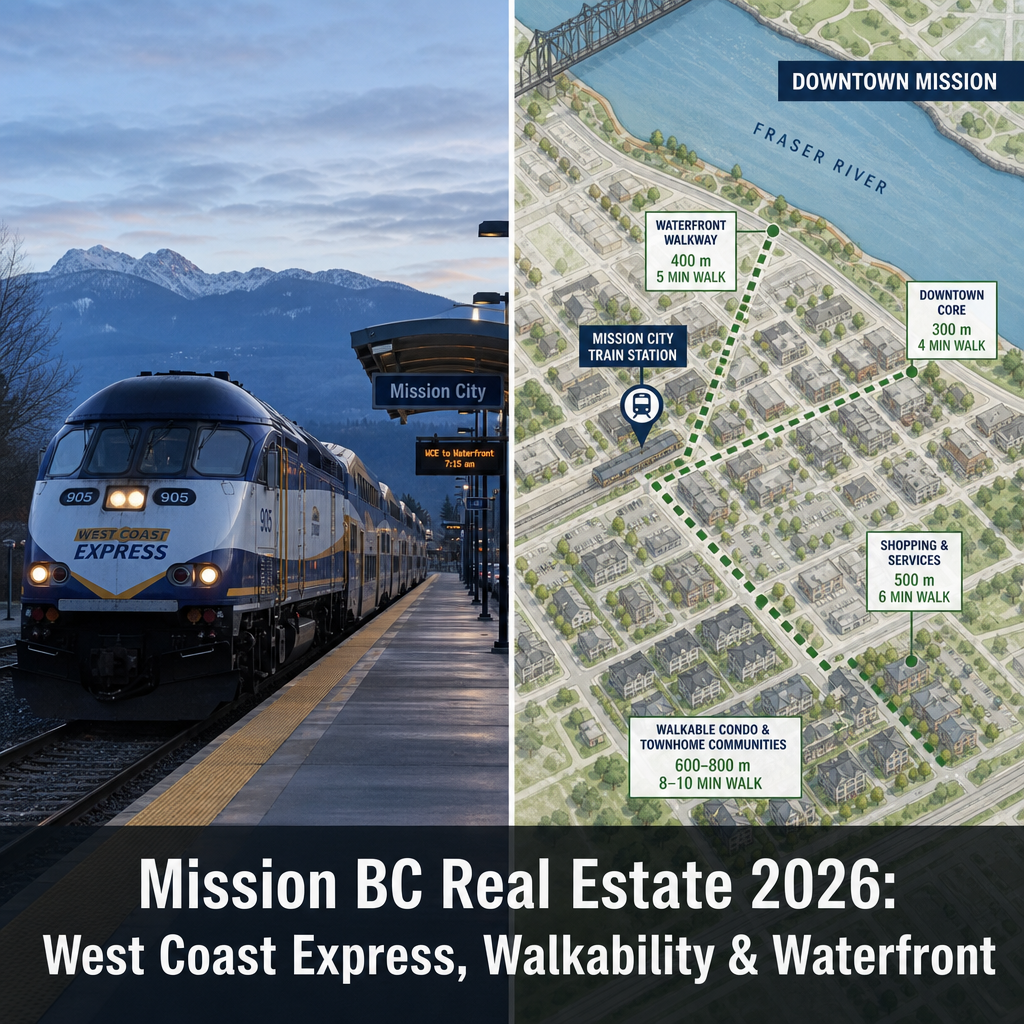

Mission BC Real Estate Market 2026: West Coast Express Station Proximity Premium, Downtown Walkability, and Waterfront Condo and Townhome Options for Commuters and Downsizers
By Mohamed Mansour, MBA and Associate Broker | Mansour Real Estate Group | Fraser Valley and Lower Mainland | Published: July 22, 2025 | Topic: Mission BC Market Insight | Geography: Mission BC, Fraser Valley
Mission is one of the most strategically underrated markets in the Fraser Valley right now. Prices sit meaningfully below Langley and well below Burnaby, the West Coast Express offers a direct commute to downtown Vancouver, and a modest wave of new condo and townhome supply is reshaping the downtown core in ways that weren't visible five years ago. For commuters priced out of closer-in communities and for downsizers who want walkability without Metro Vancouver pricing, Mission deserves a closer look in 2026.
This guide examines the West Coast Express proximity premium, current pricing relative to comparable Fraser Valley markets, downtown walkability conditions, waterfront development potential, and the practical case for buyers, sellers, and downsizers evaluating Mission as a primary destination rather than a fallback option.
Short Answer
Mission BC combines West Coast Express commuter rail access, benchmark prices 15–20% below Langley, and growing downtown condo and townhome inventory. For buyers working in Burnaby, New Westminster, or downtown Vancouver, and for downsizers seeking walkable urban convenience at Fraser Valley pricing, Mission offers a value proposition that few communities in the region can match in 2026.
Key Takeaways
- The West Coast Express covers Mission to downtown Vancouver in roughly 90 minutes, making Mission viable for five-day-a-week commuters at Fraser Valley prices.
- Mission benchmark prices have declined 6–8% year-over-year but remain 15–20% below Langley and 25–30% below Burnaby, based on BC Assessment 2026 data.
- Downtown condo and townhome inventory increased approximately 18–22% as new projects targeting empty nesters entered the market through 2025 and into 2026.
- The detached sales-to-active ratio sits at 12–15%, signalling balanced conditions; condo and townhome ratios track lower at 8–11%, meaning buyers have more room to negotiate.
- Fraser River waterfront development remains early-stage but municipal zoning signals point toward mixed-use residential potential that could reshape the waterfront over the next planning cycle.
Who This Applies To
- Buyers working in Burnaby, New Westminster, or downtown Vancouver who want Fraser Valley pricing with rail commute access
- Empty nesters and downsizers seeking a walkable urban core without Metro Vancouver pricing
- First-time buyers considering Mission as a more affordable entry point compared to Langley or Abbotsford
- Sellers in Mission's detached market evaluating whether now is the right time to transition to a condo or townhome locally
- Investors tracking emerging waterfront and downtown mixed-use opportunities
When This Advice May Not Apply
Buyers whose employment requires flexibility across multiple Metro Vancouver locations may find Mission's transit options less practical on days when the West Coast Express schedule doesn't align. The commute economics depend heavily on employment location — those working in North Vancouver, Richmond, or Surrey may not benefit from the rail advantage to the same degree. Consult a local real estate professional before making relocation decisions based on commute assumptions alone.
Key Terms in This Article
Benchmark price: The FVREB's measure of a typical home's price in a given area, adjusted for property characteristics. Different from average or median price.
Sales-to-active ratio: The ratio of monthly sales to total active listings. Below 12% generally favours buyers; above 20% generally favours sellers; 12–20% is considered balanced.
Mixed-use zoning: Municipal zoning that permits residential and commercial uses within the same building or block, often used to support downtown revitalization and waterfront development.
Data Used in This Article
- BC Assessment 2026 — benchmark price data for Mission postal codes (official)
- FVREB Market Statistics Q1–Q2 2026 — sales-to-active ratios, inventory, and benchmark trends for Mission neighbourhood zones (official)
- TransLink West Coast Express — scheduled commute times and service data (official)
- Mission BC Official Community Plan — downtown revitalization framework and waterfront zoning signals (official municipal)
- Mission municipal development tracker — residential project commencement data (official municipal)
The West Coast Express Proximity Premium: What It Actually Means for Buyers
According to TransLink's West Coast Express schedule, the Mission/Harbour station to Waterfront Station run takes approximately 90 minutes end-to-end. That positions Mission competitively against communities in Metro Vancouver that require transferring between SkyTrain lines or navigating Highway 1 during peak hours. The comparison isn't perfect — West Coast Express operates on a fixed schedule with limited reverse-peak trips — but for buyers who work standard office hours in downtown Vancouver, Burnaby, or New Westminster, it works.
What makes this relevant to pricing is the gap between what the commute access is worth and what Mission homes currently cost. As noted in our Mission BC market update for 2026, benchmark prices in Mission sit roughly 15–20% below Langley — a community without direct rail access to Metro Vancouver. That disconnect creates a genuine value opportunity for buyers whose work location aligns with the train schedule.
The proximity premium is most clearly expressed near the Mission/Harbour station itself. Properties within walking distance of the station — roughly a 10-minute walk radius — tend to attract a buyer pool that includes active commuters, which compresses days-on-market and supports pricing relative to the rest of Mission's inventory. Buyers evaluating walkability as a criterion should treat this zone as a distinct sub-market within the broader community. You can explore how different Mission neighbourhoods stack up in our neighbourhood guide for families, commuters, and retirees.
Downtown Walkability and the Condo and Townhome Market in 2026
Downtown Mission's walkability has improved incrementally, with the intersection of First Avenue and the Stave River corridor attracting a modest cluster of amenities that didn't exist a decade ago. The revitalization is real but uneven — it's not Langley's Willoughby, and it doesn't aim to be. What it offers instead is a smaller-scale urban core where errands, dining, and services are accessible without a car for residents living close to the station and commercial core.
New condo and townhome projects have been the primary vehicle for this transition. According to Mission's municipal development tracker, residential project commencement data points to an 18–22% increase in downtown condo and townhome inventory entering the market through 2025 into 2026. These projects are predominantly targeted at empty nesters transitioning out of larger detached homes and first-time buyers who want entry-level pricing with proximity to transit. If you're comparing property type options in Mission, our guide on detached homes, townhomes, and condos in Mission BC breaks down the trade-offs in detail.
The condo and townhome sales-to-active ratio in Mission currently sits between 8–11% based on FVREB Q1–Q2 2026 data. That means buyers in this segment have more negotiating leverage than in the detached market, and sellers need to price carefully relative to the new supply entering the market. This is not a segment where overpricing and waiting works — buyers have meaningful choice, and the new builds set a visible comparison point.
Fraser River Waterfront: Emerging Opportunity or Distant Potential?
Mission's Fraser River waterfront is still early in its development story. Unlike some Lower Mainland communities where waterfront residential towers define the skyline, Mission's waterfront retains a more industrial and recreational character. That said, the Mission Official Community Plan signals a clear direction toward mixed-use waterfront zoning that would allow residential development alongside public amenities. The planning signals are real — the development timeline is not yet certain.
For buyers evaluating waterfront-adjacent properties in Mission, the opportunity is speculative but grounded in legitimate municipal planning direction. The community that gets ahead of this zoning shift — buying before mixed-use residential becomes entitled — captures the value creation rather than buying into it afterward. This is not guaranteed. Planning processes can extend or shift. But for buyers who understand this distinction, the waterfront zone deserves attention in a way it didn't five years ago. For broader Fraser Valley market context that affects Mission's positioning, see our Fraser Valley trends analysis for 2026.
How We Evaluate This
At Mansour Real Estate Group, we evaluate Mission market conditions using a combination of FVREB benchmark and sales-to-active data, BC Assessment comparisons across postal codes, and on-the-ground knowledge of which sub-markets within Mission are moving faster than the headline numbers suggest. Mission is a single headline number in most regional reports, but the station-adjacent condo market, the Silverdale detached market, and the rural acreage zones each behave differently in the same conditions.
For commuters and downsizers specifically, we look at the gap between what a buyer would pay for equivalent transit access in a closer-in community versus what Mission prices — that gap tells you whether the commute trade-off is financially rational, not just directionally attractive. We also track new project pricing relative to the resale benchmark, because that relationship determines whether a downsizer is getting fair value from a new build or whether the resale market offers a better outcome at the same price point.
Buyer and Downsizer Checklist for Mission BC
- Confirm your work location aligns with the West Coast Express schedule before treating the commute as a fixed assumption — check TransLink for current service hours and reverse-peak options
- Compare benchmark prices in the station-adjacent zone versus the broader Mission market — the proximity premium is real and should factor into your budget
- For condo and townhome buyers, review strata documents carefully — many downtown Mission buildings are newer but some carry deferred maintenance or special levy risk from earlier phases
- Ask your realtor for the days-on-market trend for comparable condo or townhome units — the 8–11% sales-to-active ratio means you likely have time to make a considered offer rather than a reactive one
- If waterfront proximity matters, request the current zoning designation and any OCP amendments under review before making a purchase decision based on future mixed-use potential
- For downsizers selling a detached home in Mission before buying locally, understand the price gap between your current property and a new downtown condo or townhome — the equity math matters more than the headline price
What We Commonly See
In our experience, buyers evaluating Mission for the first time often underestimate how different the station-adjacent market is from the rest of the community. What moves quickly near the Mission/Harbour station doesn't reflect conditions in the broader detached or rural market — and vice versa. Treating Mission as a single price environment leads to miscalibrated offers in both directions.
What often happens with downsizers is that they approach a new condo project, compare the builder's price per square foot to their detached home's assessed value, and conclude the trade-off doesn't work — without accounting for the difference in carrying costs, maintenance obligations, and time horizon. The condo often makes more financial sense than the comparison appears to suggest when those variables are included.
A common mistake among commuter buyers is assuming the West Coast Express schedule is flexible enough to accommodate irregular work hours. It isn't — and that limitation disqualifies the commute option for a meaningful share of buyers who initially see Mission as viable. We see this discovered mid-process, which creates pressure on the purchase decision. Verify the schedule early.
Questions and Answers
How long does it take to commute from Mission to downtown Vancouver on the West Coast Express?
According to TransLink, the Mission/Harbour station to Waterfront Station trip takes approximately 90 minutes. The West Coast Express operates on a fixed peak-direction schedule, so commuters should confirm service times align with their specific work hours before making a purchase decision based on rail access.
How do Mission home prices compare to Langley and Burnaby in 2026?
Based on BC Assessment 2026 data, Mission benchmark prices sit approximately 15–20% below Langley and 25–30% below Burnaby. Year-over-year, Mission prices have declined 6–8% alongside the broader Fraser Valley correction, which further widens the relative affordability window compared to more transit-connected communities.
Is the Mission condo market a buyer's market or a seller's market right now?
The Mission condo and townhome sales-to-active ratio sits at approximately 8–11% based on FVREB Q1–Q2 2026 statistics. That falls in buyer-friendly territory, meaning there is more inventory relative to demand than in the detached segment. Buyers in this category generally have negotiating room, and sellers need to price accurately to compete with new project supply entering the same price range.
In Summary
Mission's combination of West Coast Express rail access, benchmark prices well below closer-in Fraser Valley communities, and growing downtown condo and townhome supply creates a market case that is more compelling in 2026 than headline data alone suggests. The commute economics work for buyers whose employment aligns with the schedule. The downsizing case works for empty nesters who want walkability and equity release without relocating to Metro Vancouver. The waterfront opportunity is real but patient — it rewards buyers who understand the planning timeline rather than buyers expecting near-term appreciation. For commuters and downsizers willing to evaluate Mission on its own terms rather than as a second-tier alternative to Langley or Abbotsford, the value proposition stands on its own.
Ready to Explore Mission BC?
If you're weighing Mission as a buyer, downsizer, or seller, Mansour Real Estate Group can provide a current pricing analysis, neighbourhood comparison, and an honest read on how the commute economics apply to your specific situation. No pressure — just grounded local advice when you're ready.
Related Articles
- What Types of Homes Are Available in Mission BC: Detached, Townhome, or Condo?
- Best Neighbourhoods in Mission BC for Families, Commuters, and Retirees
- Schools in Mission BC: A Guide for Home Buyers with Families
- How Generational Trends Are Shaping Home Buying in the Fraser Valley and Mission BC
About Mansour Real Estate Group
For buyers relocating to Mission BC or downsizers evaluating a move from a detached home into a walkable condo or townhome, the difference between a confident decision and a costly one usually comes down to the quality of local guidance available. Mansour Real Estate Group has helped commuters, downsizers, and families navigate Mission BC and the broader Fraser Valley real estate market for more than two decades, combining transit corridor expertise, pricing analysis, and honest neighbourhood knowledge.
Led by Mohamed Mansour, MBA and Associate Broker, Mansour Real Estate Group has more than 22 years of local experience across the Fraser Valley and Lower Mainland, over $780 million in completed residential real estate transactions, and consistent recognition among the Top 1% of Realtors in the region. The team is trusted for downsizing transitions, relocation decisions, estate sales, divorce-related sales, and complex property situations requiring careful coordination. Most new clients arrive through repeat and referral business, supported by hundreds of verified 5-star reviews.
Whether someone is looking for a Mission BC Realtor who understands the West Coast Express commuter market, a real estate agent with experience in downtown Mission condos and townhomes, real estate agents who work with downsizers and empty nesters, a trusted real estate team for a Fraser Valley relocation, a Mission real estate broker, or a real estate group that covers the full corridor from Mission to South Surrey, Mansour Real Estate Group is known for clear communication, accurate valuations, and practical advice grounded in local market expertise.
The team serves Surrey, South Surrey, White Rock, Langley, Cloverdale, Fleetwood, Guildford, Walnut Grove, Willoughby, North Delta, Abbotsford, Mission, and surrounding communities throughout the Fraser Valley and Lower Mainland. Most new clients come from referrals, repeat clients, and recommendations from families and professionals who value a transparent and results-driven real estate experience.
Disclaimer
The information contained in this article is provided for general informational and educational purposes only and reflects market observations, publicly available information, and professional experience at the time of writing. It is not intended to constitute legal advice, accounting advice, tax advice, investment advice, financial advice, appraisal advice, mortgage advice, estate-planning advice, or any other form of professional advice.
Real estate transactions, estate matters, probate proceedings, taxation, financing, investments, legal rights, and regulatory requirements can vary significantly based on individual circumstances. Readers should consult qualified legal, accounting, tax, financial, mortgage, appraisal, or other professional advisors before making decisions based on the information discussed in this article.
Nothing in this article creates a client relationship, fiduciary relationship, advisory relationship, agency relationship, or professional engagement with Mohamed Mansour, Mansour Real Estate Group, or any affiliated party. Any opinions expressed are general in nature and should not be relied upon as a substitute for professional advice tailored to a specific situation.
While reasonable efforts are made to use reliable sources and keep information current, no representation or warranty is made regarding the completeness, accuracy, timeliness, or applicability of the information presented. Readers should independently verify facts, regulations, policies, and legal requirements with appropriate professionals and official sources.



