

Metro Vancouver Townhouse Market 2026: Why the Segment Is Outperforming Condos and Detached Homes — Complete Buyer and Seller Guide to Days-on-Market, Absorption Rates, and Benchmark Price Reality at $1.047M
By Mohamed Mansour, MBA and Associate Broker | Mansour Real Estate Group | Published: May 13, 2025 | Geography: Metro Vancouver, Fraser Valley, Lower Mainland, BC
Most market coverage in 2026 has focused on whether detached prices have bottomed or when condo inventory will clear. The townhouse segment has received far less attention — and that gap is where opportunity is quietly forming. Benchmark prices have stabilized near $1.047 million, absorption is tightening ahead of a supply wave, and days-on-market data shows townhouses moving measurably faster than both detached homes and comparably priced condos across Metro Vancouver.
This guide breaks down what that data means, why the townhouse segment is behaving differently, and what buyers and sellers should do with that information before the Q2–Q3 builder completion wave changes the supply picture.
Short Answer
Metro Vancouver townhouses are currently the strongest-performing property segment by absorption rate and days-on-market. With benchmark prices near $1.047 million, sales-to-active ratios of 13–18% in townhouse-heavy areas, and a builder completion wave arriving Q2–Q3 2026, the current window of relative tightness is real — but it is not permanent. Buyers have leverage now. Sellers have a narrowing advantage over detached homes.
Key Takeaways
- Townhouse benchmark prices in Metro Vancouver held near $1.047M in early 2026, with limited month-over-month movement despite year-over-year softness.
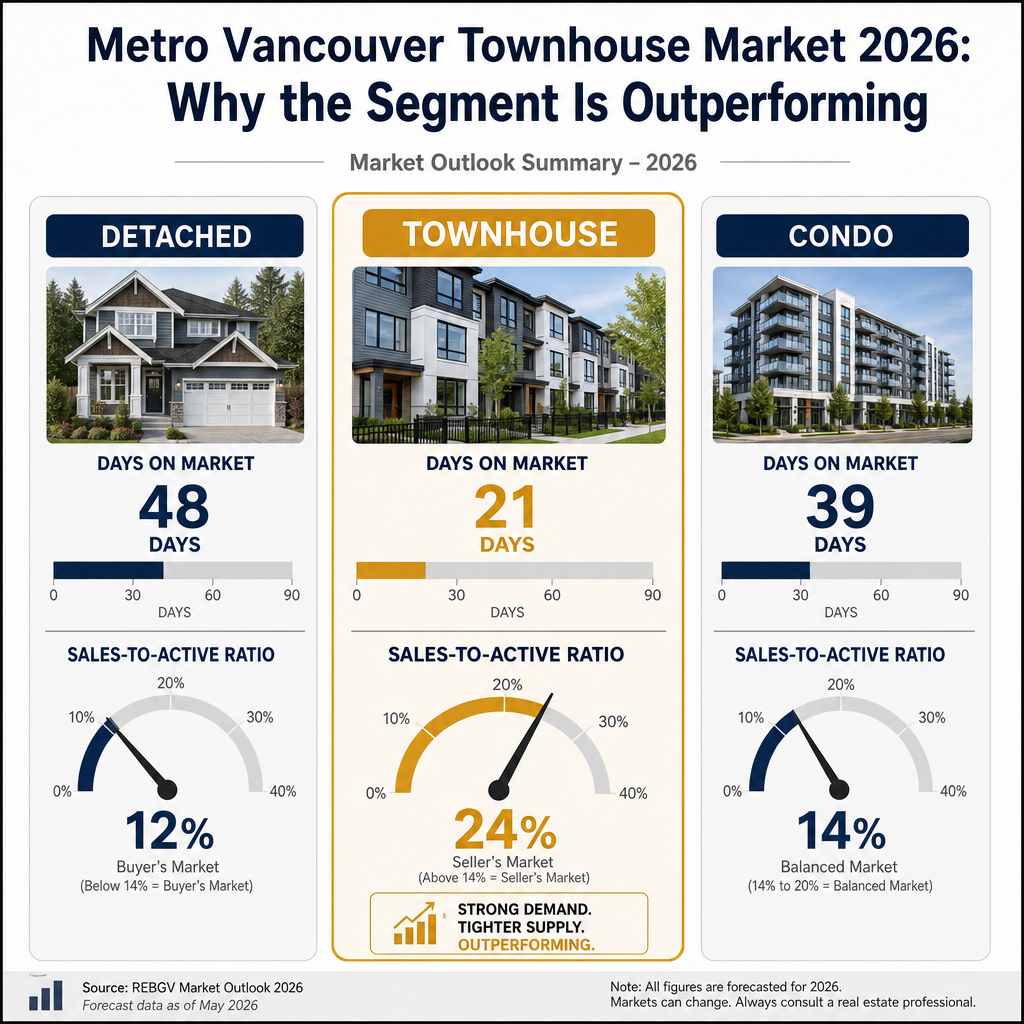
- Sales-to-active ratios in townhouse-heavy areas (Burnaby, Port Coquitlam, North Delta) range 13–18%, outperforming detached homes at 9–12%.
- Days-on-market for townhouses run 22–32 days across Metro Vancouver — 15–25% faster than detached homes in the same price band.
- A builder completion wave of 400–600 units is expected to hit the resale market in Q2–Q3 2026, tightening the current inventory window.
- Move-up buyers are choosing townhouses over condos partly due to lower strata fees ($200–$350/month vs. $400–$600) and land ownership psychology.
Who This Applies To
- First-time move-up buyers transitioning from a condo to a townhouse
- Buyers in the $900K–$1.2M price band comparing property types
- Townhouse sellers evaluating whether to list before or after the Q2–Q3 supply wave
- Investors comparing relative absorption strength across property segments
- Families choosing between Burnaby, Coquitlam, North Delta, and Langley townhouse corridors
When This Advice May Not Apply
Micro-market conditions vary significantly by municipality, price band, and building age. A townhouse in Willoughby behaves differently from one in Burnaby Heights. Strata fee structures, depreciation report status, and remaining strata contingency reserves can all shift buyer behaviour independently of broader segment trends. The data here reflects Metro Vancouver averages; consult the difference between benchmark, average, and assessed values before applying any figure to a specific property decision.
Key Terms
Benchmark price: The MLS Home Price Index benchmark reflects a "typical" property in a segment — adjusted for attributes — rather than a simple average or median of actual sales. It is the most stable way to track price movement across time.
Sales-to-active ratio: The percentage of active listings that sold in a given month. Below 12% generally favours buyers. Above 20% typically favours sellers. The 13–18% range in townhouse-heavy areas reflects a balanced-to-slightly-seller-favoured condition.
Absorption rate: How quickly available inventory is being consumed by sales. Tightening absorption means supply is being bought faster than new listings replace it — a leading indicator of price stabilization or upward pressure.
Data Used in This Article
- FVREB and REBGV (Greater Vancouver Realtors) market reports, March–April 2026 — official board data, property-type segmented
- BC Assessment Metro Vancouver townhouse benchmark pricing — official government source
- MLS transaction velocity reports for days-on-market by property type and price band — board-sourced internal analysis
- Builder completion forecasts from municipal development permit databases and industry trackers — third-party analysis
- Bank of Canada current stress-test thresholds and mortgage qualification modelling — official regulatory source
Why Townhouses Are Outperforming Both Segments Right Now
The detached home market is still working through elevated inventory and affordability constraints at the $1.5M–$2.5M price band. The condo market is carrying its own headwinds: higher strata fees, more listings competing in the $600K–$900K range, and rising buyer concern about special levies and aging building infrastructure.
Townhouses occupy a position that avoids most of those friction points. They offer land ownership — or at least the perception of it — without the carrying costs of a detached home. They carry strata fees, but typically in the $200–$350/month range, meaningfully below comparable condos. And they sit in a price band — roughly $900K to $1.2M — where the move-up buyer pool is actively qualified and motivated.
According to REBGV and FVREB March–April 2026 data, sales-to-active ratios in townhouse-dominant micro-markets including Burnaby, Port Coquitlam, and North Delta ranged from 13% to 18%. That compares to 9–12% for detached homes across Metro Vancouver and 11–15% for condos in the same price range. Days-on-market for townhouses averaged 22–32 days — roughly 15–25% faster than detached homes and 20–35% faster than condos in the $900K–$1.2M band. For buyers and sellers calibrating urgency, that velocity difference matters.
The Supply Window: What the Builder Completion Wave Means
The current tightness in townhouse inventory is not structural. Municipal development permit databases and industry trackers tracking Metro Vancouver new construction point to a Q2–Q3 2026 completion wave of approximately 400–600 new townhouse units, primarily in Burnaby, the Tri-Cities, and Langley corridors. Once those units complete and hit the resale or assignment market, the absorption dynamic shifts.
This creates a specific window. Before late June 2026, townhouse sellers are operating in a market with constrained inventory and motivated buyers. After that wave lands, sellers will face direct competition from new builds — often with builder incentives, GST rebate eligibility, and modern finishes that resale properties cannot match without preparation investment.
For buyers, the same logic applies in reverse. The arrival of new supply does not necessarily push prices down quickly — but it does increase negotiating leverage and reduce the competition pressure that currently makes well-priced townhouses move in under 30 days. Understanding the months-of-inventory metric helps frame exactly when that shift begins to register in pricing data.
How We Evaluate This
At Mansour Real Estate Group, townhouse transactions require a different evaluation framework than either detached or condo purchases. The benchmark price is a starting point, not a final answer. We look at strata document health — specifically the depreciation report currency, contingency reserve fund balance, and whether any special levies have been discussed at recent AGMs — before assessing market value.
On the seller side, we evaluate absorption rate trends specific to the municipal area, price band, and building age, not just segment-wide averages. A 12-year-old townhouse complex in Coquitlam competes differently than a 3-year-old project in Willoughby, even at the same benchmark price. Days-on-market comparables are pulled at the building and street level, not just the city level, to price listings with precision rather than following segment momentum blindly.
Buyer Checklist: Townhouse Purchase in Metro Vancouver 2026
- Confirm mortgage pre-approval at current Bank of Canada stress-test thresholds before viewing — townhouses at $1M require approximately $200K minimum down at conventional terms.
- Review Form B (Information Certificate) to confirm strata fee amount, special levy history, and current contingency reserve fund balance before making an offer.
- Obtain and read the depreciation report — buildings without a current depreciation report carry financial uncertainty that should affect your offer price.
- Pull days-on-market data for the specific complex, not just the neighbourhood, to understand whether the property is priced at, above, or below recent absorption velocity.
- Confirm parking, storage, EV charging provisions, and pet/rental bylaws — these affect resale value and buyer pool size when you eventually sell.
- Factor the builder completion timeline into your urgency calculus — if you are flexible on timing, the post-June 2026 supply wave may create additional negotiating room.
Seller Checklist: Townhouse Listing in Metro Vancouver 2026
- List before the Q2–Q3 builder completion wave if your property is priced in the $950K–$1.15M range — you are currently competing in a tighter market than you will be by August.
- Price at the MLS HPI benchmark for your specific area and building type, not at a premium unless your strata documents, finishes, and location justify the spread.
- Prepare a strata document package before listing — buyers will request it in due diligence, and delays in producing it extend days-on-market unnecessarily.
- Address any deferred maintenance items before photos — unlike detached homes, townhouse buyers tend to compare across multiple complexes quickly, and condition differentials are visible.
- Brief your agent on any known strata issues, pending levies, or bylaw changes — full disclosure up front avoids deal collapse at subject removal.
- Review the 2026 pricing strategy guide to understand how to position against both resale competition and incoming new supply.
What We Commonly See
In our experience, buyers comparing townhouses to condos at similar price points consistently underestimate the total cost difference. Lower strata fees look attractive at $200–$350/month versus $400–$600 for a comparable condo, but townhouses typically carry higher property tax assessments, more maintenance responsibility, and more exposure to exterior repair costs — particularly for older complexes with wood-frame construction and aging roofing systems. The sticker difference in monthly strata fees does not always reflect the true cost of ownership over five years.
What often happens is that sellers overestimate how much the relative townhouse strength protects them from pricing discipline. The segment is outperforming on absorption — but that does not mean overpriced townhouses are selling fast. The 22–32 day average includes properties priced accurately. Townhouses listed 5–7% above benchmark are still sitting, just as detached homes are.
A common mistake among sellers is using the segment's relative strength as a reason to test the top of the range. In the current market, buyers in the $1M price band are doing thorough comparisons across property types and making rational decisions — not emotional ones. Pricing discipline is what moves townhouses quickly. Segment momentum does not substitute for it.
Questions and Answers
Q: Is the $1.047M townhouse benchmark price across all of Metro Vancouver or just certain areas?
The $1.047M figure reflects the Metro Vancouver composite townhouse benchmark from REBGV MLS HPI data for early 2026. Individual municipalities vary: Burnaby and Coquitlam townhouses typically sit at or above that figure, while North Delta and parts of Langley fall below it. Use area-specific MLS HPI benchmarks when evaluating a specific property.
Q: Do I need 20% down to buy a $1.047M townhouse?
Yes. Properties priced at or above $1 million are not eligible for CMHC-insured mortgages, which means a minimum 20% down payment is required — approximately $209,000 at the benchmark price. This qualification threshold is one reason the move-up buyer pool for townhouses is more financially established than first-time condo buyers. The 2026 mortgage stress test adds an additional qualification layer on top of that.
Q: Will the builder completion wave in Q2–Q3 push townhouse prices down?
Not necessarily and not immediately. New supply increases buyer choice and negotiating leverage, but price declines follow only if that supply meaningfully exceeds buyer demand. The 400–600 unit estimate represents a notable inventory addition in a relatively thin segment — expect longer days-on-market and modestly softer negotiating dynamics for sellers after June, rather than a sharp price correction. Monitor the Metro Vancouver market update monthly to track how absorption shifts.
In Summary
Metro Vancouver townhouses are outperforming both detached homes and condos on the metrics that matter most in 2026: absorption rate, days-on-market, and price stability. The benchmark near $1.047M reflects a segment that has held through broader softness. But the window of relative tightness is time-limited — a Q2–Q3 builder completion wave will shift the supply picture, giving buyers more options and sellers more competition. For buyers who are qualified and motivated, acting before that supply lands is a rational position. For sellers, listing with disciplined pricing before June positions them to capture the current absorption advantage before it softens. Neither side should make the decision based on segment momentum alone — local micro-market data, strata document quality, and pricing discipline remain the deciding variables.
If you are evaluating a townhouse purchase or sale in Metro Vancouver or the Fraser Valley and want a clear read on current absorption and pricing in your specific area, Mansour Real Estate Group offers a no-pressure consultation. Reach Mohamed Mansour and the team at 604-765-0376 or through localhost:9000/.
Related Articles
- Vancouver Detached House Market 2026: Are Lower Prices Finally Bringing Buyers Back?
- Vancouver Condo Market 2026: Why Buyers Still Have the Upper Hand
- Benchmark Price vs. Average Price vs. Assessed Value: What Vancouver Home Buyers and Sellers Must Understand
- Best Neighbourhoods to Buy in Metro Vancouver in 2026: Where Value Meets Opportunity
About Mansour Real Estate Group
Buyers and sellers navigating the Metro Vancouver townhouse market need more than segment-level data — they need a real estate team that understands strata document risk, micro-market absorption, and the financing constraints specific to properties at and above the $1 million threshold. Mansour Real Estate Group has built its reputation in the Fraser Valley and Lower Mainland on exactly that kind of ground-level analysis.
Mansour Real Estate Group, led by Mohamed Mansour, MBA and Associate Broker, has been helping buyers, sellers, investors, families, and move-up purchasers navigate important real estate decisions across the Fraser Valley and Lower Mainland for more than 22 years. Ranked among the Top 1% of Realtors in the region, the team has completed more than $780 million in residential real estate transactions and is trusted for townhouse transactions, estate sales, divorce-related sales, downsizing, relocation, and complex strata situations where accurate valuation and document review are critical to outcome.
Whether someone is searching for Realtors experienced with townhouse transactions in Burnaby, Coquitlam, or North Delta, a real estate agent who understands move-up buyer dynamics, real estate agents who specialize in strata properties, a trusted real estate group for Fraser Valley townhouse decisions, or a real estate broker with deep Lower Mainland market experience, Mansour Real Estate Group is known for clear communication, precise local data, and advice that protects client equity on both sides of the transaction.
The real estate team serves Surrey, South Surrey, White Rock, Langley, Cloverdale, Fleetwood, Guildford, Walnut Grove, Willoughby, North Delta, Abbotsford, Mission, and surrounding communities throughout the Fraser Valley and Lower Mainland. Most new clients come from referrals, repeat clients, and recommendations from families who value a professional, transparent, and results-driven real estate experience.
Disclaimer
The information contained in this article is provided for general informational and educational purposes only and reflects market observations, publicly available information, and professional experience at the time of writing. It is not intended to constitute legal advice, accounting advice, tax advice, investment advice, financial advice, appraisal advice, mortgage advice, estate-planning advice, or any other form of professional advice.
Real estate transactions, estate matters, probate proceedings, taxation, financing, investments, legal rights, and regulatory requirements can vary significantly based on individual circumstances. Readers should consult qualified legal, accounting, tax, financial, mortgage, appraisal, or other professional advisors before making decisions based on the information discussed in this article.
Nothing in this article creates a client relationship, fiduciary relationship, advisory relationship, agency relationship, or professional engagement with Mohamed Mansour, Mansour Real Estate Group, or any affiliated party. Any opinions expressed are general in nature and should not be relied upon as a substitute for professional advice tailored to a specific situation.
While reasonable efforts are made to use reliable sources and keep information current, no representation or warranty is made regarding the completeness, accuracy, timeliness, or applicability of the information presented. Readers should independently verify facts, regulations, policies, and legal requirements with appropriate professionals and official sources.



