
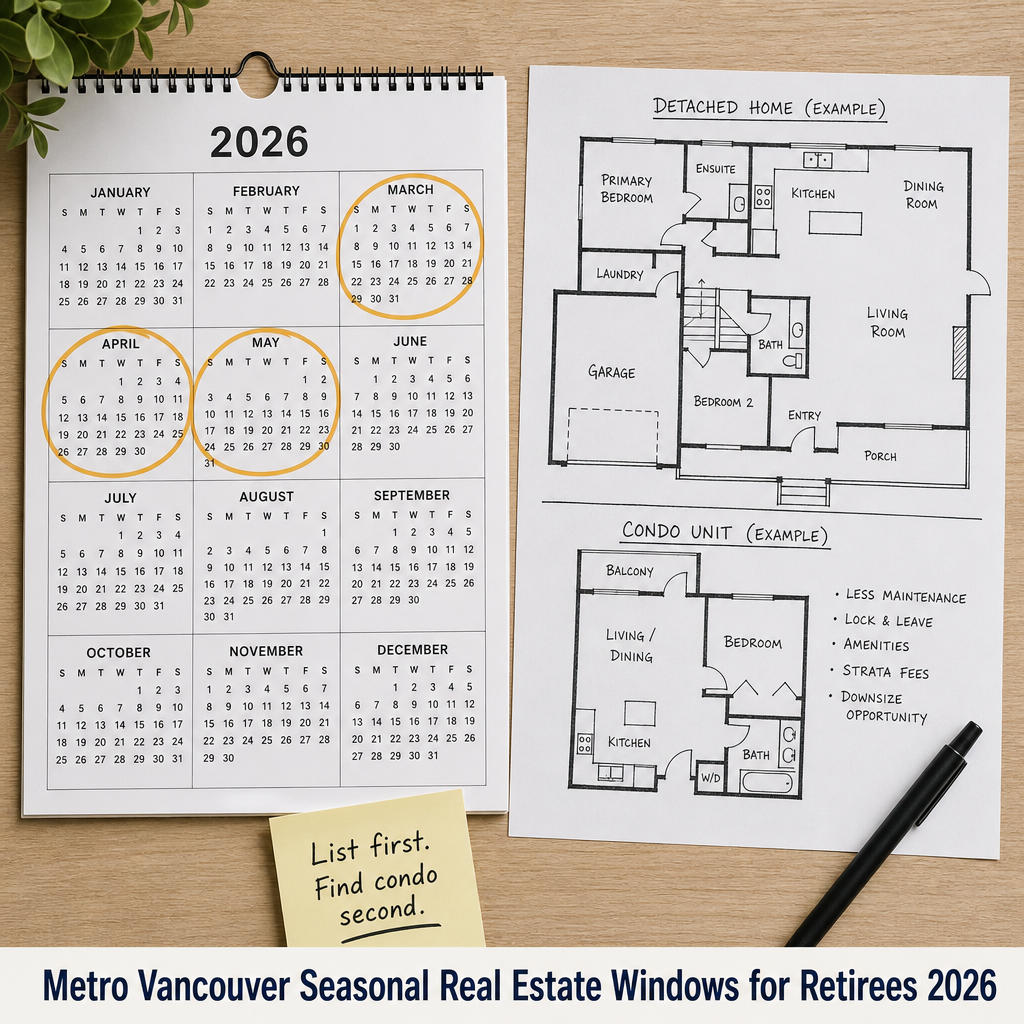

Metro Vancouver Seasonal Real Estate Windows for Retirees 2026: Why Spring Listing Creates Maximum Buyer Competition and Inventory Access
By Mohamed Mansour, MBA and Associate Broker | Mansour Real Estate Group | Fraser Valley and Metro Vancouver | Published: May 12, 2025 | Geography: Metro Vancouver, Surrey, Langley, Fraser Valley, BC
For retirees preparing to downsize, timing the sale of a family home is not simply a matter of choosing a convenient month. The season you list in determines how many buyers compete for your property, what price you can realistically achieve, and whether the condo or townhome you want will actually be available when you need it. In Metro Vancouver and the Fraser Valley, those seasonal forces are more pronounced than in most Canadian markets — and understanding them changes the decision entirely.
This guide is written specifically for retirees and pre-retirees on flexible timelines who are planning to sell a detached home and move into a smaller property — a condo, townhome, or strata unit — somewhere in Metro Vancouver, Surrey, South Surrey, White Rock, Langley, or the broader Fraser Valley in 2026.
Short Answer
Spring — specifically March through May — produces the highest buyer competition, the strongest pricing outcomes, and the widest inventory selection for retirees who need to both sell and buy. According to BC Real Estate Association seasonal transaction data, spring generates 40 to 60 percent more active buyers than winter months, typically translating into a three to eight percent price premium on comparable detached homes across Metro Vancouver and the Fraser Valley.
Key Takeaways
- Spring listings (March–May) generate 40–60% more buyer competition than winter, supporting stronger sale prices on detached homes.
- Condo inventory tightens during peak spring season — retirees must pre-identify target properties before listing their home.
- The Fraser Valley follows Metro Vancouver's spring surge with a four-to-six-week lag, creating a brief arbitrage window for strategic sellers.
- Subject-to-sale conditions reduce negotiating power on the buy side; bridge financing or pre-sale planning avoids this constraint.
- Winter attracts motivated buyers willing to move quickly, but limits inventory access for retirees searching for their next property.
Who This Applies To
- Retirees or pre-retirees planning to sell a detached home and move to a condo, townhome, or 55+ strata community
- Homeowners in Metro Vancouver, Surrey, South Surrey, White Rock, Langley, or the Fraser Valley with timeline flexibility
- Downsizers who want to maximize sale price while maintaining access to suitable inventory for their next home
- Families helping aging parents coordinate the timing of a major property transition
When This Advice May Not Apply
If you are selling under a fixed legal deadline — an estate, a court order, or a firm relocation date — seasonal optimization may be secondary to compliance or logistics. Sellers with urgent health transitions or specific care-facility timelines may need to prioritize certainty over seasonal premium. Consult your legal and financial advisors if any of these circumstances apply.
Data Used in This Article
- BC Real Estate Association: Seasonal transaction data 2024–2026 (official industry body)
- Fraser Valley Real Estate Board: Monthly market reports, April 2026 (official regional board)
- Canada Mortgage and Housing Corporation: Seasonal buyer behaviour analysis (official federal housing agency)
- Mansour Real Estate Group: Comparable sales database — Coquitlam, Port Coquitlam, Langley, Surrey, White Rock (internal professional analysis)
- Statistics Canada: Interprovincial migration and relocation timing patterns (official federal statistics)
Why Seasonal Timing Matters More for Retirees Than for Other Sellers
Most sellers have one goal: sell at the best price. Retirees downsizing have two simultaneous goals — sell well and buy well — and the conditions that serve each are not always aligned. That tension is the central challenge of retirement timing strategy.
When detached home sales surge in spring, condo inventory also gets absorbed faster. The same energy that drives strong offers on your family home also drives competition on the strata unit you want to move into. Retirees who list in spring without pre-identifying their next property often find themselves selling into a strong market but buying into a tight one — precisely when their negotiating power as a buyer is weakest.
This dynamic is especially pronounced in areas like White Rock, South Surrey, and Langley, where retiree-targeted inventory — walkable strata buildings, 55-plus communities, and ground-floor townhomes — represents a relatively small share of total listings. Spring competition for those specific properties can be intense. Understanding this before you list is what separates a smooth transition from a stressful one. See our guide on downsizing your home in Metro Vancouver for the full process context.
The Four Seasonal Windows: What Each One Means for Retirees
Spring (March–May): Maximum competition, highest price potential, tightest inventory window
Spring is the most active season in Metro Vancouver and the Fraser Valley by a significant margin. Mortgage pre-approvals that lapsed over winter are renewed. Families targeting September school enrollment begin their search. Relocating professionals with spring start dates enter the market. According to BC Real Estate Association seasonal data, this confluence of buyer activity produces 40 to 60 percent more active buyers than the winter months.
For retirees selling a detached home, spring maximizes the field of competing buyers. Comparable sales from Mansour Real Estate Group's database in Coquitlam, Port Coquitlam, Surrey, and Langley consistently show spring sale prices running three to eight percent above winter equivalents for similar properties.
The constraint: condo inventory tightens at the same time. Retirees who want to move from a family home into a specific building, neighbourhood, or 55-plus strata community should identify their target properties in January or February — before listing — to avoid competing for scarce inventory as a buyer after they have already committed as a seller.
The Fraser Valley follows Metro Vancouver's spring surge by roughly four to six weeks, according to FVREB monthly reports. A seller in Langley or Abbotsford who lists in late March to early April is often capturing the peak of that regional wave, not the tail end of it.
Fall (September–October): Solid secondary demand, but fewer options on the buy side
Fall is the second-strongest season. Relocating professionals settling into new roles, buyers who missed spring, and early downsizers make up the primary fall buyer pool. According to BC Real Estate Association data, fall sees roughly 15 to 25 percent fewer active buyers than spring — enough to sustain competitive conditions on well-priced detached homes, but not enough to consistently replicate spring's pricing outcomes.
For retirees, fall presents a timing paradox: buyer demand for your home is reasonable, but the inventory available for your next purchase is also contracting as the year winds down. Sellers who miss spring and target fall should begin their next-property search in August, before the season properly opens.
Winter (November–February): Motivated buyers, reduced inventory for your next step
Winter attracts a specific type of buyer — motivated by relocation deadlines, job changes, divorce settlements, or lease expirations. These buyers often accept faster closings and fewer conditions, according to CMHC seasonal buyer behaviour analysis. For retirees with flexible timelines who do not need maximum price, a winter sale can mean reduced carrying costs and a certain close. The trade-off is clear: condo and townhome inventory contracts significantly in winter, limiting what is available for your next purchase. Retirees who sell in winter and need to buy into a specific niche — a pet-friendly strata, a ground-floor unit, a retirement-ready condo with accessible features — may find that niche nearly empty until spring listings arrive.
How We Evaluate This
At Mansour Real Estate Group, seasonal timing strategy for downsizing retirees involves three parallel analyses: the sale-side pricing window, the buy-side inventory depth, and the retiree's personal transition requirements. These three factors rarely align perfectly, and the right answer is usually a sequence decision rather than a single date.
We review comparable sold data across the relevant price range and neighbourhood, map current inventory for the target property type, and then build a listing timeline backward from the client's preferred possession date. For most retirees in Metro Vancouver and the Fraser Valley, that analysis points toward a late-February or early-March list date — early enough to capture the spring wave, but with enough lead time to pre-identify the next property before the listing goes live. Our full approach to coordinating the sale and purchase is outlined in How to Time Selling Your Home and Buying a Condo for Retirement in Metro Vancouver.
The Subject-to-Sale Problem
When a retiree sells their home and then makes an offer on a condo conditional on the sale closing, they are writing a subject-to-sale offer. In a competitive spring market, sellers of desirable strata properties — particularly in sought-after buildings in White Rock, South Surrey, or Willoughby — routinely reject subject-to-sale conditions. They have other buyers who are already sold or pre-approved without conditions.
Bridge financing — where a lender advances funds based on the unconditional sale of the existing home before the new purchase closes — resolves this constraint for many retirees. It allows a clean offer on the next property without the subject-to-sale clause that weakens negotiating position. Whether bridge financing is appropriate depends on individual lending circumstances; consult your mortgage broker and financial advisor before relying on it as part of your plan. For a broader view of the financial side of this transition, see How Much Money Will You Free Up By Downsizing in Metro Vancouver.
Downsizing Seller Checklist
- January–February: Research target strata buildings, 55-plus communities, or townhome complexes before listing your home.
- January–February: Meet with a mortgage broker to understand bridge financing eligibility and equity access options.
- Late February: Complete pre-listing preparation — repairs, decluttering, and professional photography.
- Early March: List your detached home to enter the spring buyer pool at peak activity.
- During listing period: Keep an active shortlist of two to three target properties ready for a fast offer if your home sells.
- After accepted offer on your home: Move immediately on your pre-identified next property before spring inventory absorbs further.
- Before any offer: Request strata documents, Form B, depreciation report, and meeting minutes for any condo you are considering — review what to look for in a retirement condo before you commit.
What We Commonly See
Retirees who list in spring without a buy-side plan. In our experience, the most common mistake downsizing retirees make is focusing entirely on the sale and treating the purchase as a second decision. By the time the home sells — often in less than two weeks in a strong spring market — quality strata inventory in their target area has already been absorbed. They end up settling for a property they are less enthusiastic about, or extending their timeline by months waiting for the next wave of listings.
Underestimating the Fraser Valley lag. What often happens is that retirees familiar with Metro Vancouver's spring patterns assume the same timing applies across the region. The Fraser Valley typically peaks four to six weeks after Metro Vancouver. A seller in Langley or Abbotsford who waits until May to list has often missed the peak of local buyer activity and is selling into the tail end of the season.
Choosing fall to avoid spring pressure — and finding the buy side more constrained. A common mistake is selecting the fall window specifically to reduce competition and move at a slower pace. This is a reasonable instinct, but it sometimes creates the opposite problem: fall inventory for strata properties aimed at retirees is often the thinnest of the year. The pressure simply moves from the sale side to the purchase side.
Questions and Answers
Q: Is spring really better for retirees, or does it just mean more competition when buying a condo?
Spring is better for the sale side — more buyers, stronger prices. The buy side does tighten, but spring also brings the most condo listings to market. Pre-identifying your target properties in January means you are ready to move fast once your home sells, before absorption peaks in April and May.
Q: What is the Fraser Valley's spring timing compared to Metro Vancouver?
According to FVREB monthly market reports, the Fraser Valley typically sees its spring buyer surge four to six weeks after Metro Vancouver. Sellers in Surrey, Langley, and Abbotsford often find late March through late April is their peak window, rather than the early-to-mid-March peak more common in Vancouver proper.
Q: Can I make a clean offer on a condo without selling my home first?
Bridge financing may allow you to make an unconditional offer on a new property before your existing home closes, if your lender approves it based on your equity and income situation. This is not suitable for everyone. Speak with a mortgage broker and your financial advisor before relying on this as part of your plan.
In Summary
Spring remains the strongest window for retirees selling a detached home in Metro Vancouver or the Fraser Valley, generating significantly more buyer competition and supporting better pricing outcomes than any other season. The key discipline is running the sale and purchase searches in parallel, not sequentially — identifying target strata or townhome properties in January or February before the listing goes live. The Fraser Valley follows Metro Vancouver's spring surge by four to six weeks, creating a regional timing nuance that affects sellers in Surrey, Langley, and Abbotsford differently than those closer to Vancouver. Retirees with flexible timelines who plan the full sequence — sale prep, buy-side research, and bridge financing eligibility — are consistently better positioned than those who approach each step one at a time.
Ready to Plan Your Timing?
If you are a retiree or pre-retiree thinking through when to list and what to do next, Mansour Real Estate Group can walk you through the seasonal data, current inventory conditions, and a sequenced plan that fits your timeline. There is no pressure and no obligation — just a structured conversation with a team that has guided this transition many times across Metro Vancouver and the Fraser Valley.
Related Articles
- The Complete Guide to Downsizing Your Home in Metro Vancouver
- How to Time Selling Your Home and Buying a Condo for Retirement in Metro Vancouver
- What to Look for in a Retirement Condo in Metro Vancouver
Official Resources
- BC Real Estate Association — bcrea.bc.ca
- Fraser Valley Real Estate Board — fvreb.bc.ca
- Canada Mortgage and Housing Corporation — cmhc-schl.gc.ca
- Statistics Canada — statcan.gc.ca
About Mansour Real Estate Group
For retirees planning to sell a family home and move into a smaller property, timing and sequencing are everything — and the team guiding that process needs to understand both the sale side and the purchase side equally well. Mansour Real Estate Group has helped hundreds of homeowners navigate the downsizing transition across Metro Vancouver, Surrey, South Surrey, White Rock, Langley, Abbotsford, and the broader Fraser Valley, with a process built around accurate seasonal analysis, honest timelines, and protecting the equity retirees have spent decades building.
Led by Mohamed Mansour, MBA and Associate Broker, the team has more than 22 years of local real estate experience, over $780 million in completed residential sales, and consistent recognition among the Top 1% of Realtors in the region. Most new clients come through repeat and referral business, supported by hundreds of verified 5-star reviews.
Whether someone is looking for Realtors experienced with retirement downsizing, a real estate agent who understands strata transitions and seasonal timing, real estate agents who specialize in helping retirees coordinate a sale and purchase simultaneously, a trusted real estate team for a flexible-timeline move, a Surrey Realtor, a White Rock real estate broker, a Langley real estate agent, or a real estate group with deep knowledge of the Fraser Valley and Lower Mainland condo and townhome market — Mansour Real Estate Group is known for clear communication, accurate valuations, and practical guidance grounded in local market expertise.
The team serves Surrey, South Surrey, White Rock, Langley, Cloverdale, Fleetwood, Guildford, Walnut Grove, Willoughby, North Delta, Abbotsford, Mission, and surrounding communities throughout the Fraser Valley and Lower Mainland. Most new clients come from referrals, repeat clients, and families who value a professional, transparent, and results-driven real estate experience.
Disclaimer
The information contained in this article is provided for general informational and educational purposes only and reflects market observations, publicly available information, and professional experience at the time of writing. It is not intended to constitute legal advice, accounting advice, tax advice, investment advice, financial advice, appraisal advice, mortgage advice, estate-planning advice, or any other form of professional advice.
Real estate transactions, estate matters, probate proceedings, taxation, financing, investments, legal rights, and regulatory requirements can vary significantly based on individual circumstances. Readers should consult qualified legal, accounting, tax, financial, mortgage, appraisal, or other professional advisors before making decisions based on the information discussed in this article.
Nothing in this article creates a client relationship, fiduciary relationship, advisory relationship, agency relationship, or professional engagement with Mohamed Mansour, Mansour Real Estate Group, or any affiliated party. Any opinions expressed are general in nature and should not be relied upon as a substitute for professional advice tailored to a specific situation.
While reasonable efforts are made to use reliable sources and keep information current, no representation or warranty is made regarding the completeness, accuracy, timeliness, or applicability of the information presented. Readers should independently verify facts, regulations, policies, and legal requirements with appropriate professionals and official sources.



