
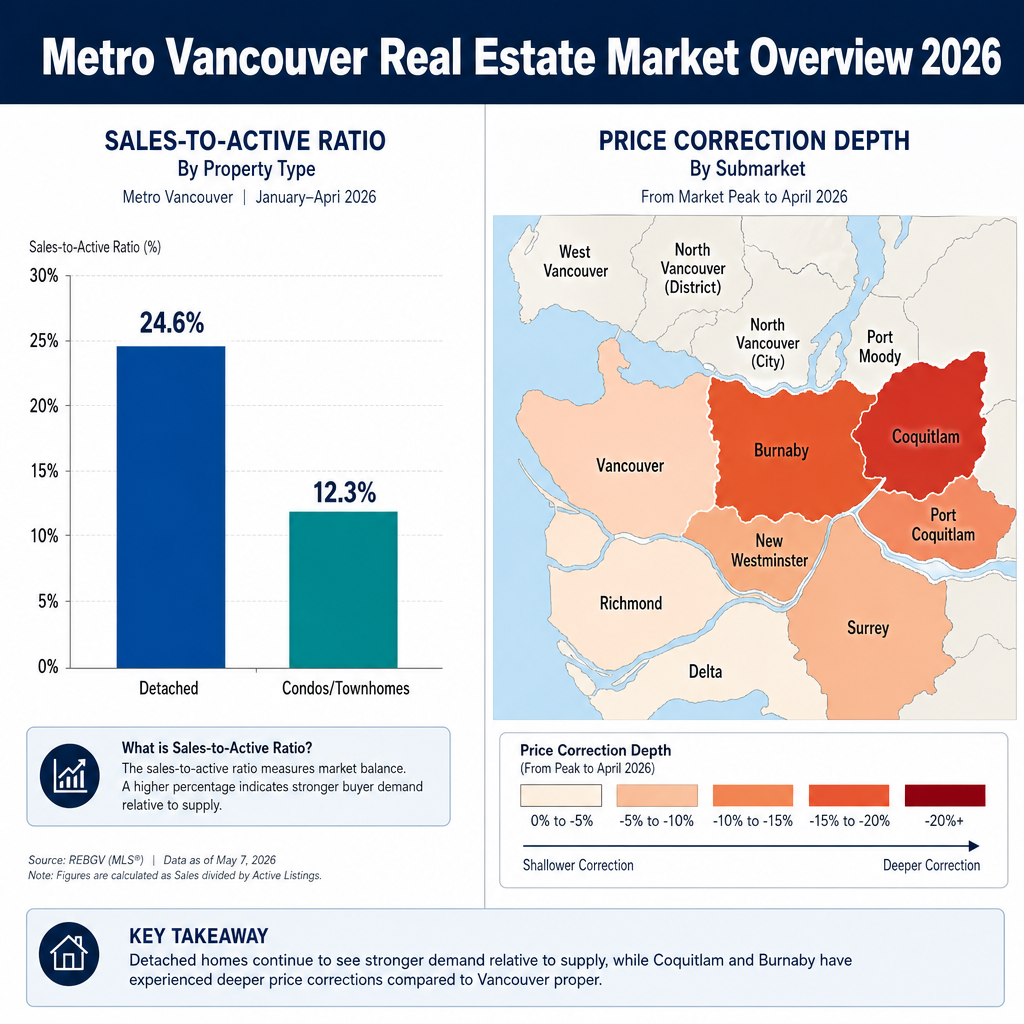

Metro Vancouver Real Estate Market Overview 2026: Complete Sales Volume, Inventory, and Benchmark Price Analysis Across All Property Types — What the Data Reveals About Buyer and Seller Conditions
By Mohamed Mansour, MBA, Associate Broker — Mansour Real Estate Group | Fraser Valley & Lower Mainland | Published: July 14, 2025
Metro Vancouver's 2026 housing market is giving buyers more room to negotiate than they have had in years — but the data underneath that headline is more nuanced than most coverage suggests. Sales volumes are up year-over-year, benchmark prices remain below 2022 peaks, inventory is elevated, and conditions differ significantly depending on whether you are looking at a detached home in Burnaby or a townhouse in Langley. This article unpacks what the current numbers actually mean for anyone buying or selling in the region right now.
Mansour Real Estate Group serves buyers and sellers across the Fraser Valley and Lower Mainland, and this overview draws on current data from the Real Estate Board of Greater Vancouver, the Fraser Valley Real Estate Board, and the Bank of Canada to give a clear, grounded picture of where the market stands in 2026.
Short Answer
Metro Vancouver is a buyer's market in 2026. Sales volumes have risen 7–12% year-over-year, but benchmark prices remain 6–10% below 2022 peaks, and the sales-to-active listings ratio of 11–13% signals that buyers hold meaningful negotiating leverage — especially for detached homes, where days on market average 45–60.
Key Takeaways
- Metro Vancouver's sales-to-active ratio of 11–13% confirms buyer's market conditions in Spring 2026.
- Benchmark prices sit 6–10% below 2022 peaks, reaching price-to-income ratios not seen in a decade.
- Condos and townhomes sell faster (20–35 days) and hold value better than detached homes (45–60 days).
- Vancouver proper shows the smallest price correction; Burnaby, Coquitlam, and the Tri-Cities show deeper ones.
- Bank of Canada rate stability and 30-year amortization access are improving purchasing power without igniting competition.
Who This Applies To
- First-time buyers evaluating Metro Vancouver versus Fraser Valley affordability
- Move-up buyers deciding between property types in the current market
- Sellers in Vancouver, Burnaby, Coquitlam, or the Tri-Cities assessing whether now is the right time to list
- Investors monitoring price recovery timelines across attached and detached segments
- Homeowners comparing Metro Vancouver conditions to the Fraser Valley's separate inventory picture
When This Advice May Not Apply
This overview reflects regional conditions as of Spring 2026. Micro-market conditions shift. A specific street, building, or catchment area may behave differently than the Metro Vancouver aggregate. Always verify current data with a local real estate professional before making a transaction decision.
Key Definitions
Sales-to-active listings ratio: The percentage of active listings that sell in a given month. Below 12% generally indicates a buyer's market; above 20% indicates a seller's market. The Real Estate Board of Greater Vancouver uses this metric to classify market conditions.
Benchmark price: The REBGV's measure of a "typical" home's value in a given area and property type, adjusted for features and characteristics. It avoids the distortion of average prices caused by sales mix shifts.
Months of inventory: How many months it would take to sell all current active listings at the current sales pace. Under 4 months favours sellers; above 6 months favours buyers. For a deeper explanation, see Months of Inventory Explained.
Data Used in This Article
- Real Estate Board of Greater Vancouver (REBGV) — monthly MLS statistics, January–April 2026 (Official)
- Fraser Valley Real Estate Board (FVREB) — comparative market statistics, Spring 2026 (Official)
- Bank of Canada — monetary policy announcements, Q1–Q2 2026 (Official)
- Canada Mortgage and Housing Corporation (CMHC) — Housing Market Assessment, 2025–2026 (Official)
- Statistics Canada — Labour Force Survey, 2026 (Official)
- Royal LePage, RE/MAX, RBC Economics, TD Economics — market commentary reports, 2026 (Third-party analysis)
How We Evaluate This
At Mansour Real Estate Group, we track three primary indicators to assess whether Metro Vancouver is leaning toward buyers or sellers at any given time: the sales-to-active listings ratio, benchmark price movement relative to recent peaks, and days on market by property type. No single number tells the full story. A rising sales volume alongside falling benchmark prices tells a very different story than rising sales volume and rising prices. We weight current conditions against the prior 12 months and compare to the Fraser Valley's parallel trajectory to give clients a complete regional picture.
For sellers, this evaluation shapes how we set price expectations and time listings. For buyers, it shapes how we advise on offer strategy, subject conditions, and negotiating room. The data in this article reflects that analytical framework applied to Spring 2026 conditions.
What the Sales Volume Data Shows
According to REBGV monthly statistics, Metro Vancouver residential sales increased approximately 7–12% year-over-year in Spring 2026, driven primarily by activity in the attached housing segments. That volume recovery, however, exists against a backdrop of benchmark prices that remain 6–10% below their 2022 peaks across most property types and submarkets.
This combination — more sales, lower prices — is characteristic of a market where affordability has improved enough to bring cautious buyers back, but not enough to generate competitive offers or meaningful upward price pressure. The REBGV's own monthly reports classify overall market conditions as a buyer's market when the sales-to-active ratio falls below 12%, and Metro Vancouver's Spring 2026 ratio of 11–13% places it squarely in that territory at the aggregate level.
Inventory across Metro Vancouver totals approximately 8,500–9,000 active listings, according to REBGV data. That figure is elevated relative to pre-2022 norms and includes a measurable share of listings from investors exiting the market and distressed sellers facing carrying cost pressure after multiple years of rate increases. The elevated inventory is one reason buyers retain negotiating leverage even as sales volumes improve.
How Conditions Differ by Property Type
The aggregate Metro Vancouver numbers obscure a significant divergence between attached and detached housing. Condos and townhomes are outperforming detached homes in both speed-to-sale and price stability. According to REBGV data, attached housing categories carry sales-to-active ratios in the 15–23% range — closer to balanced or even mildly seller-favoured conditions — while detached homes sit at 10–11%, firmly in buyer's market territory.
Days on market reflect this divergence. Condos and townhomes are selling in roughly 20–35 days when priced accurately. Detached homes are averaging 45–60 days, with sellers of overpriced listings sometimes waiting 90 days or longer before adjusting. For buyers evaluating the Vancouver condo market in 2026, conditions are meaningfully different than for buyers pursuing detached properties.
The driver behind this divergence is purchasing power. First-time buyers and downsizers represent a significant share of current market activity, and both groups are price-sensitive. Condos and townhomes sit within reach of households that qualify under current stress-test rules with 30-year amortization, while detached homes in most Metro Vancouver communities remain out of reach without a substantial existing equity base. See the full breakdown of how mortgage qualification rules are shaping this dynamic in The Mortgage Stress Test in 2026.
Geographic Divergence: Vancouver Proper vs. Outer Suburbs
Not all submarkets within Metro Vancouver are correcting at the same pace. Vancouver proper — the City of Vancouver west of Boundary Road — has shown the smallest price correction, down roughly 4–5% year-over-year. Limited land supply, constrained new construction, and continued international buyer interest have kept prices more stable than in outer communities.
By contrast, Burnaby, Coquitlam, and the broader Tri-Cities have experienced deeper corrections in the 8–12% year-over-year range, particularly for detached homes. These communities attracted significant buying activity during the low-rate years, and many of those buyers stretched their borrowing capacity. As rates rose and purchasing power contracted, the buyer pool for higher-priced detached homes in these areas thinned noticeably.
This geographic pattern matters for sellers. A detached home in East Vancouver may hold benchmark value better than a comparable property in Port Coquitlam, even when both are technically within Metro Vancouver. Understanding which micro-market you are actually operating in — rather than relying on regional averages — is one of the most important inputs in pricing strategy. For buyers seeking value in the current environment, neighbourhood-level opportunity analysis often reveals options the headline numbers don't.
What Bank of Canada Rate Stability Has — and Has Not — Done
The Bank of Canada held its key rate through Q1–Q2 2026 after a series of reductions in late 2024 and 2025. Combined with the federal government's expansion of 30-year amortization access for insured mortgages, this has stabilized purchasing power for a segment of the buyer market. CMHC's 2026 Housing Market Assessment notes that affordability has improved meaningfully relative to 2022–2023 peak stress-test conditions, with price-to-income ratios reaching their lowest levels in approximately a decade.
What rate stability has not done is restore buyer confidence uniformly. Statistics Canada's Labour Force Survey data through early 2026 shows persistent employment uncertainty in sectors concentrated in Metro Vancouver — technology, trade-adjacent industries, and professional services — and that uncertainty is suppressing transaction volumes even among households with sufficient purchasing power. The result is a market where affordability conditions favour buyers on paper, but psychological hesitation keeps competition lower than the numbers alone might suggest. For buyers willing to act with clear information, the current environment represents a window that may close if rate conditions or labour market confidence shift. The 2026 Vancouver housing market forecast covers how those scenarios might unfold.
Buyer Checklist
- Confirm your mortgage pre-approval reflects current stress-test rules and 30-year amortization eligibility where applicable
- Identify whether your target property type (condo, townhouse, detached) is in buyer's market or balanced territory using the current sales-to-active ratio
- Review REBGV benchmark price data for your specific submarket — not Metro Vancouver averages
- Track days on market for comparable listings to understand realistic negotiating room before making an offer
- For condos or townhouses, request Form B, the depreciation report, and strata financials before subject removal
- Compare Metro Vancouver conditions to Fraser Valley alternatives — price-per-square-foot differences can be significant for buyers flexible on geography
What We Commonly See
In our experience, sellers in Metro Vancouver's current market frequently anchor their asking price to what a neighbour sold for in 2022. That comparison no longer holds in most submarkets. Benchmark prices have moved materially, and buyers are working from current data. Sellers who list at peak-era prices are not simply sitting on the market longer — they are often conditioning buyers to expect a significant discount before making contact, which can set a difficult tone for negotiations.
A common mistake among buyers right now is treating the whole Metro Vancouver market as uniform. A buyer who misses a well-priced townhouse in Burnaby because they assumed they had weeks to decide — based on detached-home days-on-market figures — often learns this lesson expensively. Attached housing in certain submarkets is moving faster than the regional average suggests.
What often happens in transitions between buyer's and balanced market conditions is that the early movers — buyers who act while hesitation is still high — capture the most value. That dynamic is visible in the current data: sales volumes are rising, but prices are not. That gap tends to close, historically, within 6–12 months once buyer confidence crosses a tipping point.
Questions and Answers
Is Metro Vancouver a buyer's market or seller's market in 2026?
According to REBGV data, Metro Vancouver's sales-to-active ratio of 11–13% places the overall market in buyer's market territory. Detached homes are firmly buyer-favoured; attached housing is closer to balanced in select submarkets.
How far are Metro Vancouver benchmark prices below their 2022 peak?
Across most Metro Vancouver submarkets and property types, benchmark prices remain approximately 6–10% below 2022 peaks. Vancouver proper has seen a smaller correction of roughly 4–5%, while outer suburbs show deeper declines of 8–12%.
Why are condos and townhomes selling faster than detached homes in Metro Vancouver?
Attached housing sits within reach of first-time buyers and downsizers who now qualify under 30-year amortization rules. Detached homes require substantially higher incomes and down payments, shrinking the active buyer pool and extending days on market to 45–60 days versus 20–35 for attached properties.
What is the current active listing count in Metro Vancouver?
According to REBGV statistics for Spring 2026, Metro Vancouver has approximately 8,500–9,000 active listings. That is elevated relative to pre-2022 norms and includes a significant share of investor-exit and distressed-seller listings that are sustaining buyer negotiating leverage.
How does Metro Vancouver's market compare to the Fraser Valley in 2026?
The Fraser Valley carries over 10,000 active listings — a higher inventory level than Metro Vancouver — and its own sales-to-active dynamics. Both regions are in buyer's market conditions, but Fraser Valley detached homes offer meaningfully lower benchmark prices for buyers with geographic flexibility. A local real estate professional can help compare submarket conditions specific to your situation.
In Summary
Metro Vancouver's 2026 housing market is a buyer's market by the numbers — elevated inventory, a sales-to-active ratio below 12%, and benchmark prices 6–10% below 2022 peaks. The opportunity is real, but unevenly distributed: attached housing is tighter than detached, Vancouver proper is holding value better than outer suburbs, and psychological hesitation is keeping competition lower than affordability conditions alone would suggest. Buyers who understand the property-type and geographic divergence in current data are better positioned to act with confidence. Sellers who price to current benchmark data — rather than peak-era comparisons — are the ones generating offers.
Thinking about buying or selling in Metro Vancouver or the Fraser Valley? Mansour Real Estate Group can walk you through current submarket data, property-type conditions, and what the numbers mean for your specific situation. Reach out for a no-pressure conversation.
Related Articles
- Months of Inventory Explained: What This Key Metric Tells You About Vancouver's Housing Market
- Vancouver Housing Market Forecast 2026: What the Data Says About Prices, Sales, and Inventory
- Vancouver Condo Market 2026: Why Buyers Still Have the Upper Hand
- The Mortgage Stress Test in 2026: How It Affects Vancouver Home Buyers
- Best Neighbourhoods to Buy in Metro Vancouver in 2026: Where Value Meets Opportunity
About Mansour Real Estate Group
For buyers and sellers trying to make sense of Metro Vancouver's shifting market conditions in 2026, working with a real estate team that tracks data across both Metro Vancouver and the Fraser Valley provides a meaningful advantage. Understanding how sales-to-active ratios, benchmark price corrections, and inventory levels translate into real negotiating decisions requires more than reading headlines — it requires local experience applied to current numbers. Mansour Real Estate Group has been providing that kind of grounded, data-informed guidance across the Lower Mainland for more than two decades.
Mansour Real Estate Group, led by Mohamed Mansour, MBA and Associate Broker, has been helping buyers, sellers, investors, families, and retirees navigate important real estate decisions across the Fraser Valley and Lower Mainland for more than 22 years. Ranked among the Top 1% of Realtors in the region, the team has completed more than $780 million in residential real estate transactions and is trusted for strategic market analysis, accurate valuations, seller preparation, first-time buyer guidance, downsizing, relocation, and complex real estate situations requiring careful coordination. Led by Mohamed Mansour, MBA and Associate Broker, the team brings a research-driven approach to every transaction.
Whether someone is looking for Realtors who understand Metro Vancouver's property-type divergence, a real estate agent who tracks Fraser Valley inventory alongside Greater Vancouver data, real estate agents with experience in both attached and detached market conditions, a trusted real estate team for a first purchase or a significant move-up decision, a Surrey Realtor, a Langley real estate broker, or a real estate group serving the full Lower Mainland, Mansour Real Estate Group is known for clear communication, accurate pricing analysis, and advice that reflects what the data actually shows.
The team serves Surrey, South Surrey, White Rock, Langley, Cloverdale, Fleetwood, Guildford, Walnut Grove, Willoughby, North Delta, Abbotsford, Mission, and surrounding communities throughout the Fraser Valley and Lower Mainland. Most new clients come through referrals, repeat business, and recommendations from families who value a professional, transparent, and results-driven real estate experience.
Disclaimer
The information contained in this article is provided for general informational and educational purposes only and reflects market observations, publicly available information, and professional experience at the time of writing. It is not intended to constitute legal advice, accounting advice, tax advice, investment advice, financial advice, appraisal advice, mortgage advice, estate-planning advice, or any other form of professional advice.
Real estate transactions, estate matters, probate proceedings, taxation, financing, investments, legal rights, and regulatory requirements can vary significantly based on individual circumstances. Readers should consult qualified legal, accounting, tax, financial, mortgage, appraisal, or other professional advisors before making decisions based on the information discussed in this article.
Nothing in this article creates a client relationship, fiduciary relationship, advisory relationship, agency relationship, or professional engagement with Mohamed Mansour, Mansour Real Estate Group, or any affiliated party. Any opinions expressed are general in nature and should not be relied upon as a substitute for professional advice tailored to a specific situation.
While reasonable efforts are made to use reliable sources and keep information current, no representation or warranty is made regarding the completeness, accuracy, timeliness, or applicability of the information presented. Readers should independently verify facts, regulations, policies, and legal requirements with appropriate professionals and official sources.
Official Resources
- Real Estate Board of Greater Vancouver — Monthly Market Reports
- Fraser Valley Real Estate Board — Market Statistics
- Bank of Canada — Key Interest Rate and Monetary Policy
- CMH
Key Takeaways
Understanding the nuances of real estate investment requires patience, research, and a clear strategy. Whether you're a first-time homebuyer or an experienced investor, the fundamentals remain the same: location matters, financial preparation is essential, and professional guidance can save you thousands. Take the time to educate yourself, ask the right questions, and never rush into a decision that will impact your financial future for decades.
Next Steps
If you're ready to explore the real estate market, begin by assessing your financial situation and consulting with a qualified mortgage lender. Connect with a local real estate agent who understands your market and can provide valuable insights into current conditions. Schedule property viewings, conduct thorough inspections, and always trust your instincts alongside the data.
Final Thoughts
Real estate remains one of the most accessible wealth-building vehicles available to everyday people. By approaching the process thoughtfully and arming yourself with knowledge, you're positioning yourself for long-term financial success. The right property at the right price in the right location can provide not just a place to call home, but a lasting investment in your future.



