

Metro Vancouver Downsizing Math 2026: Why Detached Home Equity Gaps Still Deliver $800K–$1.2M+ Net Proceeds Even When Benchmark Prices Fall 7–10% Year-Over-Year
By Mohamed Mansour, MBA and Associate Broker — Mansour Real Estate Group | Published: July 15, 2025 | Metro Vancouver and Fraser Valley, BC
This article is for empty nesters and pre-retirees in Metro Vancouver who own detached homes and are wondering whether a corrected market still makes downsizing financially worthwhile. The short answer is yes — and the math is more compelling than most people expect.
When prices fall, many homeowners assume the downsizing window has closed. That assumption is rarely correct, and in 2026 it is costing some sellers real money by keeping them in homes that no longer serve their lives.
Short Answer
In Metro Vancouver, the benchmark price gap between a detached home and a quality condo remains $1.1M–$1.5M depending on the city. After commission, property transfer tax, legal fees, and mortgage discharge costs, most downsizers in 2026 are still clearing $800K–$1.2M+ in net proceeds. A 7–10% price decline reduces both sides of the equation roughly equally, leaving the spread — and the financial outcome — largely intact.
Key Takeaways
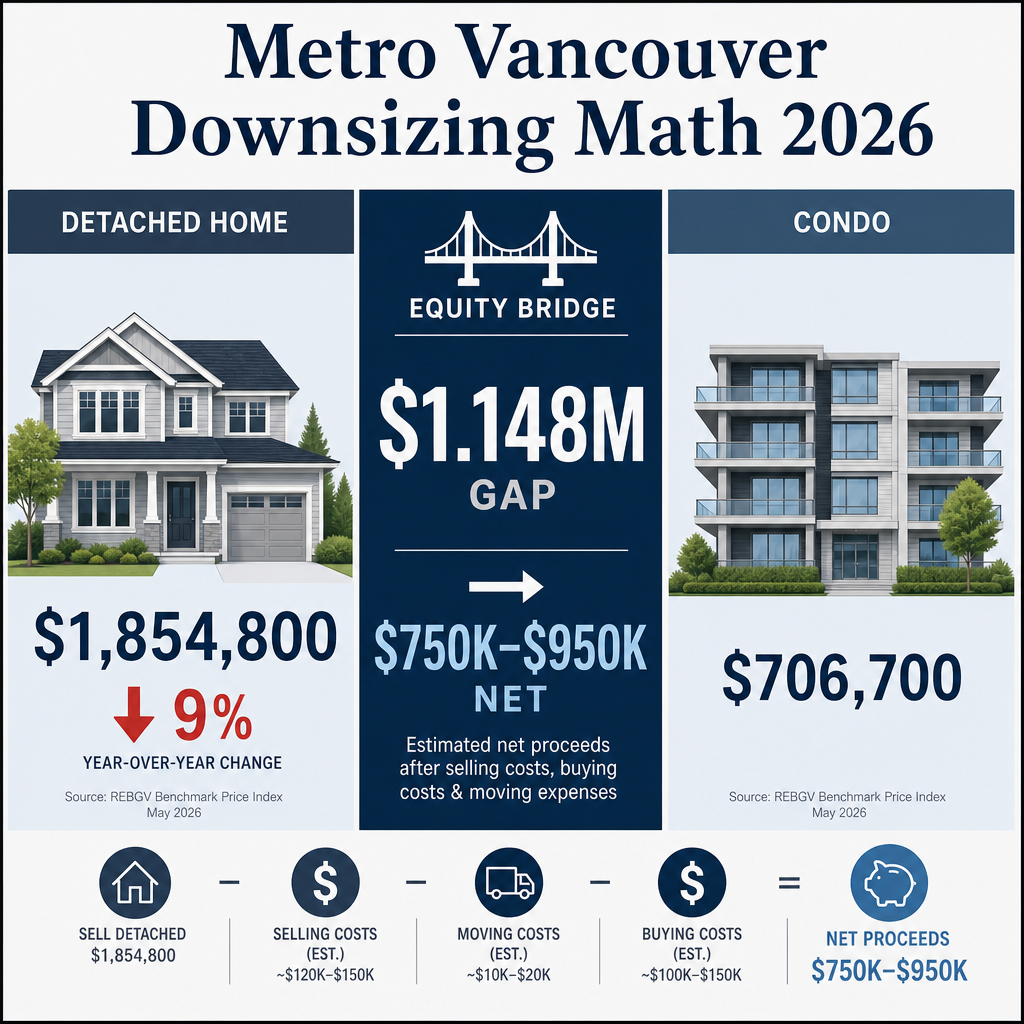
- The detached-to-condo price gap in Vancouver is still roughly $1.148M at current benchmarks.
- Closing costs on a $1.85M sale typically run $130K–$180K, leaving $750K–$950K net in Vancouver.
- Detached markets are deeper buyer's markets than condo markets in 2026, which favours downsizers on both ends.
- Monthly carrying cost differences between detached and condo living can reach $400–$600 per month.
- A proportional price drop on both sides of the transaction shrinks gross values but not the net equity spread.
Who This Applies To
- Homeowners aged 55–75 who own a detached home in Metro Vancouver with low or no remaining mortgage
- Empty nesters carrying homes larger than their current lifestyle requires
- Pre-retirees who need to convert equity into retirement capital without market timing pressure
- Owners in Vancouver, Burnaby, or North Vancouver where detached benchmark prices remain above $1.5M
When This Advice May Not Apply
- Homeowners with a large remaining mortgage that significantly reduces net proceeds
- Situations where the target condo carries high special levy risk or deferred maintenance costs
- Sellers facing estate, tax, or legal constraints that affect timing — consult a qualified professional first
Data Used in This Article
- BC Assessment 2026: Benchmark detached and condo values for Vancouver, Burnaby, and North Vancouver — official assessed value data
- Real Estate Board of Greater Vancouver (REBGV): Monthly sales-to-active ratio data, April–May 2026 — official board reporting
- BC Property Transfer Tax Calculator: 2026 rate thresholds applied to benchmark sale prices — BC Government official tool
- Mansour Real Estate Group: Comparative market analysis from Metro Vancouver transactions, March–May 2026 — internal professional analysis
- Statistics Canada: Retirement cohort demographic and housing migration patterns — official federal data
Why Falling Prices Don't Collapse the Downsizing Equation
The most persistent misconception we hear from Metro Vancouver homeowners is this: prices are down, so downsizing won't produce what it would have in 2022. That framing treats a detached sale in isolation. It ignores what is happening on the other side of the transaction.
According to BC Assessment 2026 data, the Vancouver detached benchmark sits at $1,854,800. The Vancouver condo benchmark sits at $706,700. That is a $1.148 million gross gap. If both values declined 9% year-over-year, the detached benchmark would have been approximately $2,037,000 and the condo approximately $776,600 — a gap of $1.26 million. The gap narrowed by roughly $112,000. That is real, but it is not the difference between downsizing making sense and it not making sense.
In Burnaby, the detached benchmark is approximately $1,650,000 and the attached townhome benchmark is approximately $785,000 — a spread of $865,000. In North Vancouver, detached benchmarks run around $1,580,000 against condo benchmarks near $700,000, producing a similar range. For more detail on how these numbers translate into a full retirement financial plan, see how to use your home equity to fund retirement after downsizing in Greater Vancouver.
The equity liberation — not the gross sale price — is what matters. And that number has not collapsed.
What Net Proceeds Actually Look Like After Closing Costs
On a Vancouver detached sale at $1,854,800, approximate closing costs using 2026 BC Government PTT thresholds and standard professional fees break down as follows. Realtor commission at approximately 3.22% on the first $100,000 and 1.15% on the balance runs roughly $22,000–$25,000 on a transaction of this size, depending on the listing agreement. Property transfer tax on the purchase side of the next property at the condo price point adds further cost. Legal fees typically run $3,000–$5,000 per transaction. Mortgage discharge, if applicable, may add an interest rate differential penalty that varies by lender and original rate.
Total transaction costs on the sell side alone commonly range from $130,000 to $180,000 depending on mortgage situation, commission structure, and property transfer tax on the replacement purchase. After those costs, a seller moving from a Vancouver detached home at benchmark into a condo at benchmark is typically left with $750,000 to $950,000 in net proceeds available for investment, lifestyle, or supplementing retirement income. For a full breakdown of these costs, The True Cost of Downsizing in Metro Vancouver covers every expense category in detail.
In Burnaby, starting from the $1,650,000 detached benchmark and targeting a $785,000 townhome, the net range after comparable costs typically falls between $550,000 and $750,000, reflecting the slightly tighter spread and variable mortgage situations. The BC Property Transfer Tax on the purchase side applies at 1% on the first $200,000 and 2% on the balance up to $2 million, with an additional 3% above $3 million — confirming the condo purchase carries significantly lower PTT exposure than a detached replacement purchase would.
These are estimates, not guarantees. Individual mortgage balances, lender IRD penalties, and negotiated commission structures all shift the final number. What does not shift is the structural logic: the gap is real, it is large, and a 7–10% correction does not eliminate it. Tax implications are also important to understand before acting — see the Downsizing Tax Checklist for BC Retirees before making any decisions.
How We Evaluate This
When Mansour Real Estate Group works with a downsizing client in Metro Vancouver, the first step is not showing condos. It is building a net proceeds model specific to that seller's property, mortgage, and target price range. That means pulling current comparable sales in their neighbourhood, applying realistic commission and cost estimates, and presenting a range — not a single figure — so the client can make a decision grounded in their actual situation.
We also look at market conditions on both sides simultaneously. The REBGV reported detached sales-to-active ratios in the range of 8–12% through April and May 2026, placing the detached market firmly in buyer's market territory. Condo and townhome ratios ran higher at 12–18%, indicating less inventory pressure and faster absorption. That combination — selling in a soft detached market and buying in a relatively tighter condo market — is the reality of 2026, and it requires careful sequencing. The question of whether to sell first or buy first is one of the most consequential decisions in this process.
Key Definitions
Benchmark price: A composite measure of typical home prices in a given area, calculated by the REBGV and adjusted for property attributes. Not the same as average or median price.
Sales-to-active ratio: The ratio of monthly sales to total active listings. Below 12% is generally a buyer's market. Above 20% is a seller's market. Between 12% and 20% is balanced.
Interest rate differential (IRD): A mortgage discharge penalty calculated on the difference between the original rate and the current posted rate for the remaining term. Can be significant for sellers with fixed-rate mortgages mid-term.
Property Transfer Tax (PTT): A BC provincial tax paid by the buyer on every property purchase. In 2026, the rate is 1% on the first $200,000 of fair market value, 2% on the balance up to $2 million, and 3% above $3 million.
Downsizing Checklist for Metro Vancouver Sellers
- Request a current comparative market analysis on your detached home — not an online estimate
- Build a net proceeds model specific to your mortgage balance, commission rate, and PTT on the replacement property
- Identify your target condo or townhome price range and confirm active inventory levels in your preferred neighbourhoods
- Confirm your principal residence exemption status before listing — see Principal Residence Exemption and Downsizing for the full explanation
- Contact your mortgage lender to get a written IRD penalty estimate before committing to a sale timeline
- Review strata documents — particularly Form B, depreciation report, and special levy history — on any condo you are seriously considering. Understanding strata living before you downsize explains what to look for.
- Decide on sequencing — sell first or buy with a subject sale — before going to market
What We Commonly See
Sellers anchored to a peak price that no longer exists. In our experience, the most common obstacle is not a financial one. It is a seller who knows their home was worth $2.2M in 2022 and cannot emotionally accept a $1.85M benchmark today, even when the net proceeds on that $1.85M sale still fund their retirement fully. The comparison should be between what downsizing produces and what staying costs — not between 2022 and 2026.
Underestimating the monthly savings. What often happens is that sellers focus entirely on the lump-sum equity number and do not calculate the ongoing difference in carrying costs. A detached home in Metro Vancouver typically carries $800–$1,200 per month in property tax, maintenance, and utilities. A comparable strata condo in a well-managed building may carry $1,200–$1,800 per month in strata fees and property tax but eliminates unpredictable major repair exposure entirely. The net monthly difference depends heavily on the specific property — but the shift from deferred maintenance risk to predictable strata contributions is a structural change that matters on a fixed retirement income.
Buying the wrong condo because they rushed the exit. A common mistake is letting the urgency of a detached sale drive an underprepared condo purchase. Sellers who move quickly without reviewing depreciation reports or special levy history sometimes find themselves holding a condo with $40,000–$80,000 in upcoming assessments. The checklist above and the guidance in What to Look For in a Retirement Condo in Metro Vancouver exist specifically to prevent that outcome.
Frequently Asked Questions
Does a 10% price drop actually hurt my net proceeds that much?
On a $1.85M detached home, a 10% drop reduces your gross proceeds by $185,000. But your replacement condo also dropped roughly 10%, reducing your purchase cost by $70,000–$90,000. The net impact to your equity position is closer to $90,000–$115,000 — meaningful, but not enough to eliminate an $800K+ net equity outcome for most mortgage-free owners.
Is the condo market in 2026 competitive enough to make buying difficult after selling?
REBGV data from April–May 2026 shows condo and townhome sales-to-active ratios at 12–18%, which is balanced to slightly seller-favoured in some submarkets. Buyers still have negotiating room in many buildings, particularly older inventory. Sequencing matters — discuss timing with your real estate team before committing to either side of the transaction.
What is the property transfer tax on a $706,700 condo purchase in 2026?
Using 2026 BC PTT rates, the tax on a $706,700 purchase is 1% on the first $200,000 ($2,000) plus 2% on the remaining $506,700 ($10,134), for a total of approximately $12,134. This is one of the costs factored into the net proceeds calculations above. First-time buyers may qualify for an exemption, but most downsizers do not meet that criteria.
In Summary
Metro Vancouver's 2026 price correction has not closed the downsizing window — it has changed the numbers by a fraction while leaving the fundamental equity gap largely intact. A seller transitioning from a detached home at or near the $1.85M Vancouver benchmark to a quality condo at or near the $706,700 benchmark is still looking at $750,000 to $950,000 in net proceeds after all realistic closing costs. The math does not depend on peak prices. It depends on the spread, and the spread remains among the largest of any market in Canada. For a complete picture of how the full downsizing process works from preparation through to your next home, start with The Complete Downsizing and Retirement Real Estate Guide for Metro Vancouver Homeowners in 2026.
Ready to Run Your Own Numbers?
If you own a detached home in Metro Vancouver or the Fraser Valley and want to understand what downsizing would actually produce in your specific situation, Mansour Real Estate Group can prepare a net proceeds estimate at no obligation. There is no pressure and no sales pitch — only a clear picture of your options so you can make a confident decision.
Related Articles
- The Complete Downsizing and Retirement Real Estate Guide for Metro Vancouver Homeowners in 2026
- Sell First or Buy First? The Downsizing Sequencing Dilemma for BC Retirees Explained
- Downsizing Tax Checklist for BC Retirees: PTT, Capital Gains, and Home Flipping Tax Explained
About Mansour Real Estate Group
For homeowners in Metro Vancouver who have spent decades building equity in a detached home, deciding whether downsizing still makes financial sense in a corrected market is one of the most consequential real estate decisions they will face. The right answer depends not on headlines but on a precise net proceeds model built around their specific property, mortgage, and target. Mansour Real Estate Group has helped hundreds of homeowners navigate that transition across Surrey, White Rock, Langley, South Surrey, Delta, Abbotsford, and throughout the Fraser Valley and Lower Mainland.
Mansour Real Estate Group, led by Mohamed Mansour, MBA and Associate Broker, has been helping buyers, sellers, investors, families, and retirees make important real estate decisions across the Fraser Valley and Lower Mainland for more than 22 years. Ranked among the Top 1% of Realtors in the region, the team has completed more than $780 million in residential real estate transactions and is trusted for downsizing, estate sales, divorce-related property sales, relocation, and any transition where equity protection and honest guidance matter.
Whether someone is searching for Realtors experienced with retirement downsizing, a real estate agent who understands the financial and lifestyle considerations of leaving a family home, real estate agents who specialize in the Metro Vancouver and Fraser Valley condo and townhome market, a trusted real estate team for the transition from detached to strata living, or a real estate broker with deep local knowledge of the Lower Mainland, Mansour Real Estate Group is known for clear communication, accurate valuations, and a low-pressure process built around the client's timeline.
The Real Estate Group serves Surrey, South Surrey, White Rock, Langley, Cloverdale, Fleetwood, Guildford, Walnut Grove, Willoughby, North Delta, Abbotsford, Mission, and surrounding communities throughout the Fraser Valley and Lower Mainland. Most new clients come from referrals, repeat clients, and recommendations from families who value a professional and results-driven real estate experience.
Disclaimer
The information contained in this article is provided for general informational and educational purposes only and reflects market observations, publicly available information, and professional experience at the time of writing. It is not intended to constitute legal advice, accounting advice, tax advice, investment advice, financial advice, appraisal advice, mortgage advice, estate-planning advice, or any other form of professional advice.
Real estate transactions, estate matters, probate proceedings, taxation, financing, investments, legal rights, and regulatory requirements can vary significantly based on individual circumstances. Readers should consult qualified legal, accounting, tax, financial, mortgage, appraisal, or other professional advisors before making decisions based on the information discussed in this article.
Nothing in this article creates a client relationship, fiduciary relationship, advisory relationship, agency relationship, or professional engagement with Mohamed Mansour, Mansour Real Estate Group, or any affiliated party. Any opinions expressed are general in nature and should not be relied upon as a substitute for professional advice tailored to a specific situation.
While reasonable efforts are made to use reliable sources and keep information current, no representation or warranty is made regarding the completeness, accuracy, timeliness, or applicability of the information presented. Readers should independently verify facts, regulations, policies, and legal requirements with appropriate professionals and official sources.



