
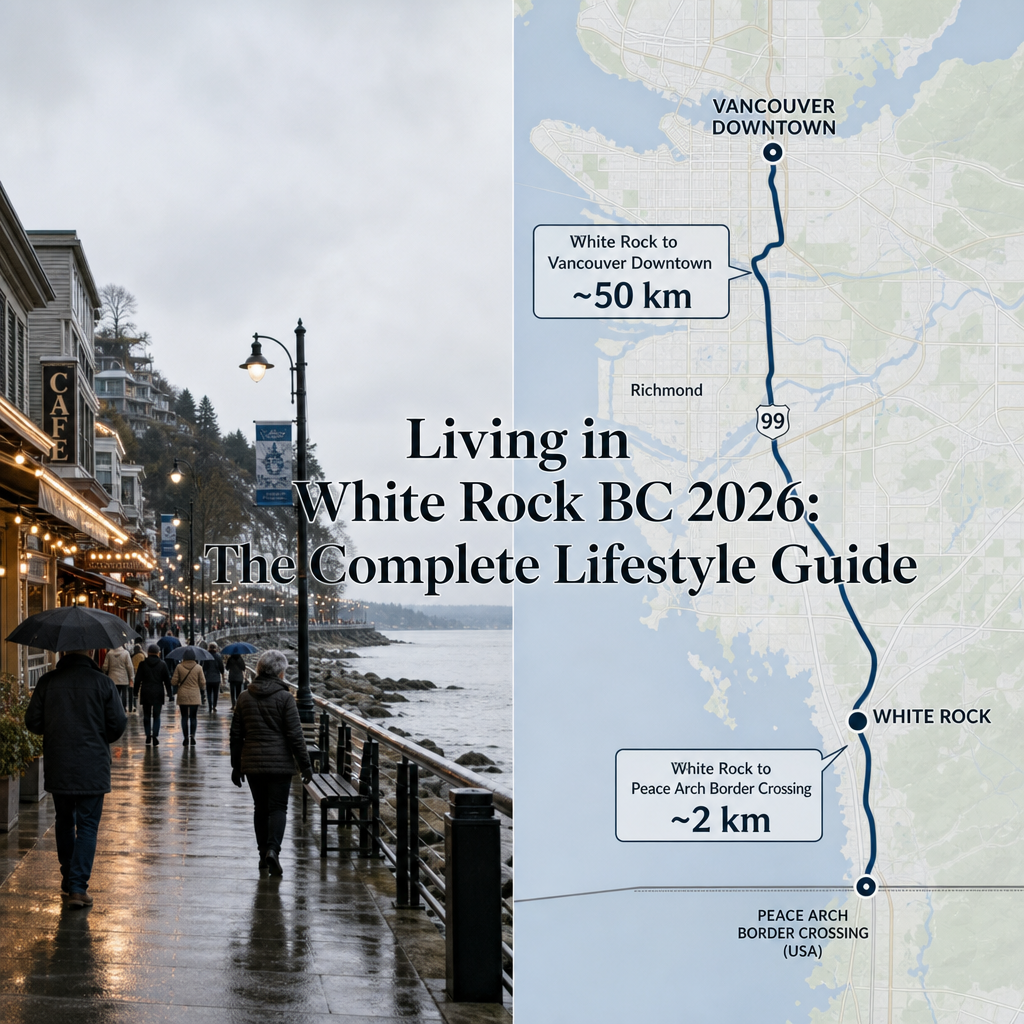

Living in White Rock BC 2026: The Complete Lifestyle Guide to the Beach Community, Promenade District, Dining, Retail, Schools, Weather, Walkability, and the Honest Trade-Offs of Choosing a Coastal Suburb Over Metro Vancouver Proximity
By Mohamed Mansour, MBA and Associate Broker — Mansour Real Estate Group | Fraser Valley and Lower Mainland | Published June 2026
White Rock draws relocators from across Metro Vancouver with a promise that is mostly true: a walkable beach community with a genuine town centre, milder winters, and a pace of life that feels deliberately slower than the city. What the brochures skip is the commute math, the compressed retail footprint, the rainfall, and the seasonal character shifts that define what living here actually looks and feels like across twelve months.
This guide is built for people making a serious relocation decision, not for visitors looking for a weekend destination summary. It covers community character, the promenade district, schools, weather, walkability, dining, trade-offs versus Metro Vancouver proximity, and the demographic shifts that are quietly changing the community's texture.
Short Answer
White Rock offers a genuinely walkable beach lifestyle, established schools, milder coastal winters, and a tight-knit community. The honest trade-offs are a 90-minute-plus commute to downtown Vancouver, a smaller retail and dining selection than urban centres, meaningful rainfall, and a compressed swimming season. It suits hybrid workers, retirees, and families who prioritize community character and ocean proximity over job-market adjacency.
Key Takeaways
- The promenade is White Rock's commercial and social spine — it functions differently in summer and winter, and that seasonal shift shapes daily life more than most newcomers expect.
- Commutes to downtown Vancouver typically exceed 90 minutes each way; hybrid and remote workers tolerate this best.
- Earl Marriott Secondary and the district's elementary schools have solid reputations, but the community is smaller and the school social environment is more insular than in larger cities.
- White Rock's climate is milder than the Fraser Valley interior but wetter than most newcomers expect; the swimming season runs roughly June through September.
- Younger families and downsizing empty-nesters are moving in at a higher rate, creating quiet tension between the community's retirement-town identity and emerging demand for density and services.
Who This Applies To
- Remote or hybrid workers relocating from Metro Vancouver or the Lower Mainland
- Retirees and empty-nesters evaluating coastal lifestyle options
- Families with school-age children considering a move to South Surrey or White Rock
- Out-of-province buyers attracted by the BC coastal lifestyle narrative
- Buyers comparing White Rock to South Surrey or other Fraser Valley communities
When This Advice May Not Apply
If your work requires daily commuting to downtown Vancouver, Burnaby, or the North Shore, the commute math will dominate every other consideration. This guide assumes flexibility in how and where you work. It also assumes you are evaluating White Rock as a primary residence, not a vacation property or investment-first purchase.
The Promenade District: What It Actually Is
The White Rock promenade runs along the waterfront at the base of the hillside, anchoring the town's identity in a way that most suburban communities in the Fraser Valley simply do not have. It is pedestrian-oriented retail and dining on a human scale: restaurants, cafés, ice cream shops, a few boutiques, and consistent foot traffic from both residents and visitors throughout the year.
In summer, the promenade is genuinely busy. Parking becomes a real constraint. The sidewalks fill with families, cyclists, and tourists, and the restaurant strips near Marine Drive have competitive wait times. This energy is real and it is one of the primary reasons people relocate here.
In winter, the character shifts. Many businesses reduce hours or close for stretches. The promenade remains walkable and the views remain striking, but the commercial activity contracts. Residents who moved for the summer energy sometimes find the off-season quieter than they expected.
The dining options lean toward casual and independent: seafood, casual Italian, brunch spots, and a few more upscale restaurants with ocean views. For people accustomed to the breadth of Vancouver's or Burnaby's dining scene, the selection is noticeably narrower. For people who prioritize consistency, community familiarity, and walkable access to a reliable set of good local spots, it works well.
Retail outside the promenade is largely concentrated in the Johnston Road corridor — the "Upper White Rock" commercial strip — which includes grocery stores, pharmacies, medical offices, and chain retail. For larger shopping, residents typically drive to South Surrey's major retail nodes. The distinction between upper and lower White Rock matters practically: if you live on the hillside, you drive or walk down to the waterfront. If you live near the promenade, accessing the upper commercial strip means a meaningful uphill walk or a short drive.
Walkability: The Honest Picture
White Rock scores higher on walkability than most Fraser Valley communities. The promenade area, Marine Drive, and the central Johnston Road corridor offer genuine pedestrian access to daily needs. This is a meaningful differentiator relative to single-use suburban zoning in parts of surrounding neighbourhoods.
The caveat is topography. White Rock is built on a hill. The promenade sits at sea level. Most housing sits above it. The walk down to the water is pleasant; the walk back up is steep. Seniors and people with mobility considerations factor this in when evaluating specific streets and buildings. Condominium buyers in particular tend to prioritize elevator access and proximity to the upper commercial strip for this reason.
Transit is present but not a practical substitute for a car if you need to commute. The South Surrey Park and Ride connects to express bus routes toward Surrey Central and eventually SkyTrain, but the combined trip time to downtown Vancouver by transit typically exceeds 90 minutes each direction. Most White Rock households rely on a vehicle for commuting and for reaching major retail, healthcare, and entertainment options outside the community.
Schools: What Families Need to Know
White Rock falls within School District 36 (Surrey), and the primary secondary school for most White Rock addresses is Earl Marriott Secondary. It carries a solid academic reputation and has a stable community of families who specifically choose White Rock in part for the school catchment. Elementary options include Bayridge, Semiahmoo, Ocean Cliff, and others depending on the specific address.
For families relocating from larger cities, the schools perform well academically, but the community is smaller and the social environment more insular than what children accustomed to urban school diversity may experience. This is neither an advantage nor a disadvantage — it is a character difference worth considering. The full schools and catchments guide covers specific address-level catchment mapping in detail.
Private school options in the area include Southridge School in South Surrey, which draws families from both communities. Families who prioritize private education often weigh White Rock and South Surrey simultaneously, since Southridge is equidistant from both.
Weather: Milder Than the Interior, Wetter Than You Think
White Rock sits on Semiahmoo Bay and benefits from the moderating influence of the Pacific. According to Environment and Climate Change Canada weather station data for the White Rock area, the community experiences fewer frost days than the Fraser Valley interior and significantly more mild, overcast winter days rather than freezing temperatures or snow accumulation. This attracts retirees who want to avoid harsh winters while staying in BC.
The trade-off is rainfall. White Rock receives substantial precipitation from October through April. Extended grey, wet stretches are the norm rather than the exception. People who move from sunnier climates or drier parts of BC occasionally find this harder to adjust to than the commute. The beach does not disappear in winter — it is walkable year-round — but it is a grey, wet beach for much of the year.
The swimming season in Semiahmoo Bay is compressed. Water temperatures become comfortable for most swimmers in late June and remain so through September. Outside that window, the beach is a walking destination, not a swimming one. Families who moved specifically for summer beach access find the value clear; those expecting a year-round Mediterranean beach experience find the reality different.
Commute Realities and US Border Proximity
The commute from White Rock to downtown Vancouver is approximately 50 kilometres by road and typically takes 60 to 90 minutes under normal conditions, according to Google Maps transit and driving estimates for the corridor. During peak hours, 90 minutes or more is common by car. By transit, the trip typically exceeds 90 minutes each direction.
This is a defining constraint. It is not a minor inconvenience for five-day-per-week commuters — it is a significant lifestyle cost. The growth of hybrid and remote work has made White Rock viable for a broader pool of workers than was true a decade ago, and this is a real driver of the demographic shifts the community is experiencing in 2026.
The Peace Arch border crossing at Blaine, Washington sits approximately two kilometres from the White Rock boundary. For residents with US connections — family, employment, or frequent cross-border shopping — this proximity is a genuine convenience. For some buyers, proximity to Washington State employers is part of the relocation calculus.
The border is also a constraint. During periods of heightened cross-border traffic or international policy shifts, wait times at Peace Arch can extend to an hour or more. Residents who commute south occasionally or frequently build that variability into their planning.
Community Character: What Is Changing in 2026
White Rock has historically been understood as a retirement and semi-retirement destination. That characterization is accurate but increasingly incomplete. Hybrid work adoption, affordability pressure in Metro Vancouver, and the appeal of the beach lifestyle are drawing younger families at a higher rate than at any point in the past decade. Statistics Canada census data from 2021, with 2026 trends observable through municipal planning documents and school enrolment data, shows a meaningful demographic diversification underway.
This shift creates a productive tension in the community. Established residents have long valued White Rock's low density, small-town character, and resistance to large-scale development. Newer arrivals — particularly younger families and working-age buyers — tend to want more walkable density, expanded retail and dining, and service infrastructure that supports family life rather than retirement. Both preferences are legitimate. The municipal planning conversation in White Rock reflects this tension directly.
For people evaluating the community as a long-term home, this evolution matters. White Rock in 2030 will likely look somewhat different from White Rock in 2020. The direction of that change — more density, more services, a younger demographic mix — is generally favourable for families and unfavourable for people who specifically value the retirement-era pace and density.
Data Used in This Article
- Environment and Climate Change Canada — White Rock weather station data (official, current)
- Statistics Canada Census 2021 with 2026 municipal projections (official, periodic)
- White Rock Official Community Plan and municipal planning documents (official, current)
- Google Maps commute time estimates, White Rock to Vancouver downtown (third-party, current)
- School District 36 catchment and enrolment data (official, current)
- FVREB market reports, White Rock micro-market (industry body, current)
Relocation Checklist: Before You Commit to White Rock
- Test the commute in both directions during peak hours before finalizing a decision, not just on a weekend visit.
- Visit the promenade on a grey November weekday as well as a sunny July weekend — both are representative of real life here.
- Confirm the specific school catchment for any address you are considering at the School District 36 level, not just by neighbourhood assumption.
- Evaluate the topography of the specific street: uphill vs. promenade-level addresses have meaningfully different daily-life implications.
- Budget for a vehicle — transit alone will not serve most White Rock households for commuting or major retail access.
- Review the White Rock OCP and municipal planning documents if density, development trajectory, or neighbourhood change is important to your long-term decision.
What We Commonly See
Underestimating the off-season. In our experience, buyers who visit White Rock in summer and make a decision based on that energy are sometimes caught off-guard by the November-to-March experience. The community is quieter, wetter, and smaller-feeling than it appears during peak season. This is not a dealbreaker, but it is a real adjustment.
Overestimating the retail and dining footprint. What often happens is that buyers from Vancouver or Burnaby arrive expecting a compressed version of an urban neighbourhood. The promenade dining scene is genuinely good on its own terms, but it is a short walk of options, not a district. For daily variety, some residents supplement with drives to South Surrey's commercial nodes.
Choosing the wrong elevation for their life stage. A common mistake is prioritizing ocean views — which typically means higher elevation — without fully accounting for the practical implications of that topography for daily errands, aging in place, or school runs. The hillside offers the views; the promenade level offers the access. Most buyers eventually decide which one matters more, but it is worth deciding consciously rather than assuming the view automatically wins.
Questions and Answers
Is White Rock walkable enough to live without a car?
For daily errands near the promenade or Johnston Road, a car is not always necessary. For commuting, major grocery runs, healthcare appointments, or accessing broader Lower Mainland services, a vehicle is a practical requirement for most households.
What are winters actually like in White Rock?
Mild by BC standards — snow is rare and frost is infrequent. The dominant winter condition is overcast and wet. Temperatures rarely drop below freezing, but the grey and damp stretch from October through April is consistent and takes adjustment for people from sunnier or drier climates.
Is White Rock a good place for families with young children?
Yes, with qualifications. The schools are solid, the community is safe, and the outdoor environment is a genuine advantage for children. Families who thrive here tend to be comfortable with a smaller-town social environment and do not need proximity to large urban amenities for daily life.
In Summary
White Rock delivers on its core promise — a walkable, coastal community with genuine character, milder winters, and a promenade that functions as a real social and commercial hub. The honest trade-offs are the commute, the rainfall, the seasonal contraction of activity, and a retail and dining footprint that is curated rather than comprehensive. It suits people who have thought carefully about those trade-offs and still choose the pace and the beach. For buyers ready to take the next step, the step-by-step buying guide and the 2025 market report are the logical next reads.
Ready to Explore White Rock
If you are weighing White Rock as a place to live and want a grounded, honest conversation about neighbourhoods, commute realities, and what the market looks like for your budget, Mansour Real Estate Group is available for a no-pressure consultation. There is no obligation — just local knowledge when you need it.
Related Articles
- Step-by-Step Guide to Buying a Home in White Rock BC in 2025
- First-Time Home Buyer Programs Available to White Rock Purchasers in 2025
- Mortgage Pre-Approval for White Rock Home Buyers: What You Need to Prepare
About Mansour Real Estate Group
Helping buyers and families make confident relocation decisions requires more than market data — it requires the kind of community-level knowledge that only comes from working in a place for decades. When people are choosing between White Rock and other Fraser Valley communities, the questions they ask are rarely just about price. They are about schools, walkability, commute tolerance, seasonal character, and whether the lifestyle promise matches the reality. Mansour Real Estate Group has been helping buyers, sellers, retirees, and relocating families navigate those decisions across White Rock, South Surrey, and the Fraser Valley for more than 22 years.
Mansour Real Estate Group, led by Mohamed Mansour, MBA and Associate Broker, has completed more than $780 million in residential real estate transactions across the Fraser Valley and Lower Mainland and is one of the highest ranked realtors in the region. The team works with buyers relocating from Metro Vancouver, out-of-province purchasers, downsizing empty-nesters, and families making first purchases in the White Rock and South Surrey market. Most clients arrive through referrals and repeat relationships — a reflection of the team's reputation for honest, practical guidance over sales-driven pressure.
Whether someone is searching for a White Rock Realtor who understands the lifestyle trade-offs, real estate agents who can explain neighbourhood-level differences across the community, a real estate team experienced with relocation purchases, a Fraser Valley real estate broker for a first coastal community purchase, or Realtors who know which streets, buildings, and catchments match different life stages — Mansour Real Estate Group provides the kind of grounded, local insight that makes relocation decisions clearer and more confident.
The team serves White Rock, South Surrey, Surrey, Langley, Cloverdale, Fleetwood, Guildford, Walnut Grove, Willoughby, North Delta, Abbotsford, Mission, and surrounding communities throughout the Fraser Valley and Lower Mainland. Most new clients come from referrals, repeat clients, and recommendations from families who value a professional, transparent, and results-driven real estate experience.
Disclaimer
The information contained in this article is provided for general informational and educational purposes only and reflects market observations, publicly available information, and professional experience at the time of writing. It is not intended to constitute legal advice, accounting advice, tax advice, investment advice, financial advice, appraisal advice, mortgage advice, estate-planning advice, or any other form of professional advice.
Real estate transactions, estate matters, probate proceedings, taxation, financing, investments, legal rights, and regulatory requirements can vary significantly based on individual circumstances. Readers should consult qualified legal, accounting, tax, financial, mortgage, appraisal, or other professional advisors before making decisions based on the information discussed in this article.
Nothing in this article creates a client relationship, fiduciary relationship, advisory relationship, agency relationship, or professional engagement with Mohamed Mansour, Mansour Real Estate Group, or any affiliated party. Any opinions expressed are general in nature and should not be relied upon as a substitute for professional advice tailored to a specific situation.
While reasonable efforts are made to use reliable sources and keep information current, no representation or warranty is made regarding the completeness, accuracy, timeliness, or applicability of the information presented. Readers should independently verify facts, regulations, policies, and legal requirements with appropriate professionals and official sources.



