
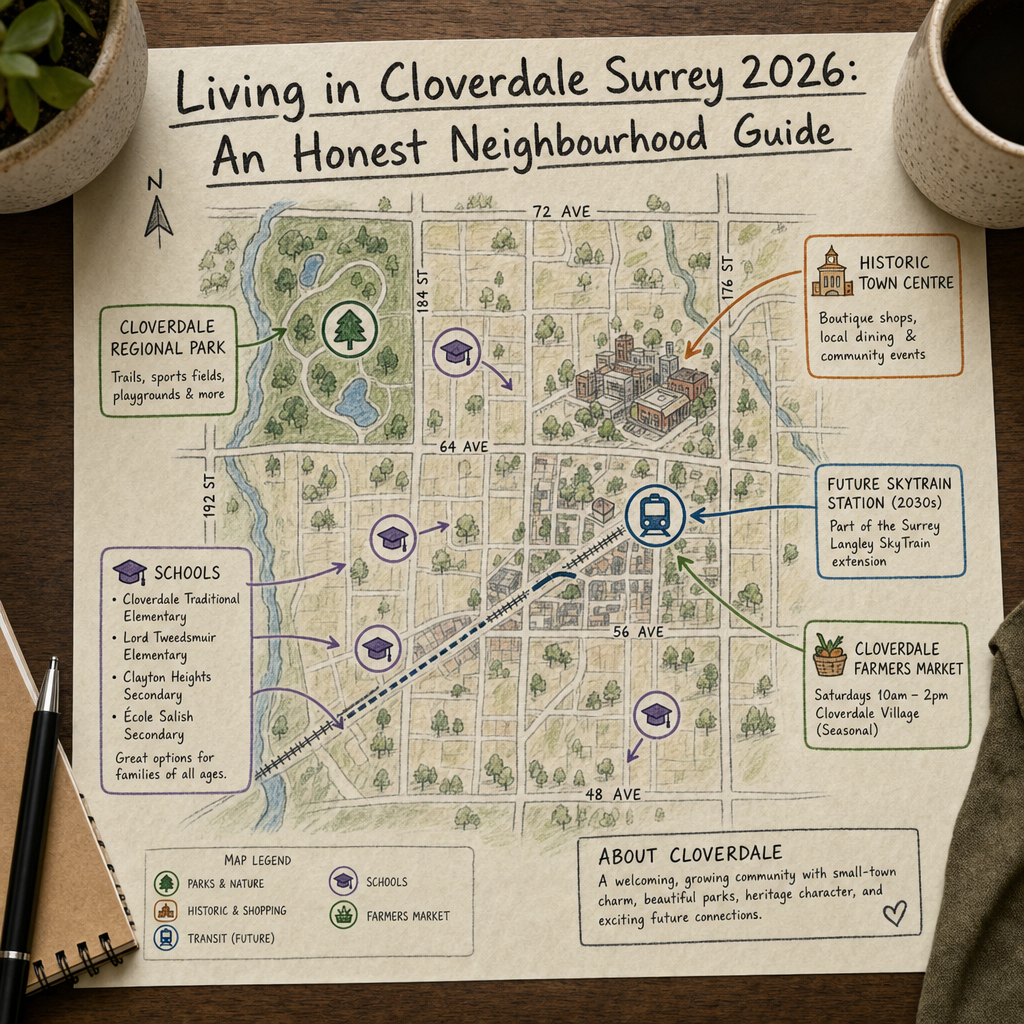

Living in Cloverdale Surrey 2026: An Honest Neighbourhood Guide to Community Character, Historic Town Centre, Parks, Recreation, Dining, and What Daily Life Actually Looks Like Beyond the Real Estate Numbers
By Mohamed Mansour, MBA and Associate Broker · Mansour Real Estate Group · Published May 2026 · Surrey, BC · Fraser Valley
Cloverdale gets described in real estate listings as "charming" and "up and coming," which tells you almost nothing about whether you would actually enjoy living there. This guide is for buyers and relocating families who want a more useful picture — the parks, the commute, the school options, the dining reality, the community feel, and the honest tension between what Cloverdale has always been and what it is becoming.
Mansour Real Estate Group has worked with buyers and sellers in Cloverdale for more than 22 years and has watched this neighbourhood change up close. What follows reflects that local experience, supplemented by publicly available data from the City of Surrey, TransLink, and Surrey School District.
Short Answer
Cloverdale is a predominantly suburban, family-oriented neighbourhood in southeast Surrey with a genuine small-town identity, strong green space, and a heritage Town Centre that still anchors community life. It is car-dependent today but is being reshaped by the arriving SkyTrain extension. It suits families and buyers who value space, community events, and relative affordability — but not buyers who expect walkable urban amenities right now.
Key Takeaways
- Cloverdale's identity is shaped by heritage events, agricultural roots, and a tight-knit community that values its small-town feel.
- Cloverdale Regional Park offers 152 hectares of green space — one of the most substantial park systems in all of Surrey.
- The arriving SkyTrain station will improve connectivity but car-dependency remains the daily reality through at least 2027.
- Dining and retail are modest and locally-focused; buyers expecting South Surrey levels of commercial amenity will be disappointed.
- Neighbourhood sentiment is genuinely divided between excitement about growth and concern about preserving what makes Cloverdale distinctive.
Who This Applies To
- Families relocating from Metro Vancouver considering Cloverdale for more space and lower price points
- First-time buyers weighing Cloverdale against Clayton Heights or other southeast Surrey communities
- Buyers with school-age children evaluating Cloverdale's school catchments
- Buyers commuting to Vancouver or Burnaby who want to understand real transit and drive times
- Anyone asking whether the Cloverdale lifestyle trade-off is actually worth it before committing
When This Advice May Not Apply
This guide reflects conditions as of 2026. Amenity levels, transit access, and community character will continue to evolve as SkyTrain-adjacent development matures. Buyers purchasing pre-sale projects in the station precinct should factor in a 2–4 year neighbourhood transition period before walkability and mixed-use retail reach their planned state.
The Community Character: What Makes Cloverdale Different
Cloverdale occupies an unusual position in Surrey. It is not a master-planned community like Clayton Heights, and it is not a commercial hub like Surrey City Centre. Its identity comes from something older — a heritage Town Centre, an agricultural past, and a community that has organized itself around events and local institutions rather than proximity to amenities.
The Cloverdale Rodeo, which has run for more than 60 years, is not a tourist event — it is a genuine community anchor that draws long-term residents back year after year. The farmers' market on the Salish Drive corridor, Heritage Days, and local festivals reflect a neighbourhood culture that values continuity over trend. For buyers who want to feel part of a real neighbourhood rather than a development phase, that distinction matters.
That said, Cloverdale's housing stock is primarily suburban single-family detached homes on larger lots, with townhome and infill development accelerating particularly near the future SkyTrain station. The physical layout is low-density and spread out, which shapes daily life in ways that some buyers underestimate. Getting to a grocery store, school, or sports field almost always involves a car right now. That is changing, but slowly.
Parks, Green Space, and Outdoor Recreation
This is where Cloverdale clearly outperforms most Surrey neighbourhoods. According to the City of Surrey's parks inventory, Cloverdale Regional Park covers 152 hectares and includes trail networks, sports fields, equestrian facilities, and open meadow space. For families with children or dogs, or buyers who prioritize walkable green space over walkable retail, this is a meaningful advantage.
The park connects to other trail corridors in southeast Surrey and is genuinely well-used by residents. Community recreation centres serve the area with standard programming — ice, fitness, aquatics — though the facilities are not as large or recently upgraded as those in South Surrey or Guildford.
Buyers comparing Cloverdale to Clayton Heights often note that Cloverdale has meaningfully more mature and usable green space. That trade-off — less commercial amenity, more genuine parkland — defines the lifestyle choice Cloverdale represents.
Dining, Retail, and Daily Errands
Cloverdale's dining and retail landscape is honest about what it is. The Salish Drive corridor has independent cafes, a small number of ethnic restaurants, farm shops, and local service businesses. There is genuine character here — a few spots that regulars visit weekly — but the options are limited by any urban standard.
There is no major grocery anchor within easy walking distance of most Cloverdale addresses. Most residents drive to the Willowbrook area in Langley, the Cloverdale retail area along 176 Street, or further into Surrey for major shopping. For buyers relocating from Metro Vancouver, the step down in commercial density is often the biggest daily adjustment.
This is expected to change as mixed-use development at the SkyTrain station site adds ground-floor retail over the next few years. According to the City of Surrey's Cloverdale Town Centre plan, the station precinct is designated for higher-density mixed-use development. But that transition will take time to produce meaningful retail diversity at street level.
The SkyTrain Effect: What Changes and What Doesn't
The Expo Line extension to Cloverdale — with a station expected to be operational in the 2025–2026 window according to TransLink's project timeline — is the most significant infrastructure change in the neighbourhood's modern history. It will eventually make Cloverdale meaningfully more connected to Surrey City Centre, Burnaby, and Vancouver.
But connectivity does not arrive the day a station opens. Most daily errands still require a car through at least 2027, because the retail, services, and walkable density that make transit-adjacent living practical have not yet been built around the station. Buyers purchasing near the station site today are buying into a transition, not a finished neighbourhood. That is an informed choice — but it should be a deliberate one. For a clearer picture of actual commute times, see our article on commuting from Cloverdale to Vancouver.
Schools and Family Infrastructure
Cloverdale Elementary and Kwantlen Park Secondary are the anchor schools for the area and are well-regarded within Surrey School District. Both serve stable, family-oriented populations. Families with school-age children should verify catchment boundaries before committing to a specific address, as Surrey's catchment map has been adjusted in recent years to reflect population growth.
There are no post-secondary institutions in Cloverdale. Families with older students will look to Kwantlen Polytechnic University in Surrey, Simon Fraser University, or institutions in Burnaby and Vancouver — all accessible eventually by SkyTrain, but currently requiring a longer commute. For a detailed school catchment map and enrolment context, our Cloverdale schools guide covers this in full.
Neighbourhood Checklist: Is Cloverdale Right for Your Household?
- Confirm your tolerance for car-dependency — most daily errands require driving in 2026
- Identify which school catchment your shortlisted addresses fall under and verify directly with Surrey School District
- Visit the Salish Drive corridor and Cloverdale Regional Park in person before deciding — they are defining features, not background details
- If buying near the SkyTrain station site, read the City of Surrey's Cloverdale Town Centre plan to understand what is approved, what is proposed, and what timeline is realistic
- Drive your expected commute route during morning peak hours — not just use a mapping app estimate
- If heritage character and community events matter to you, spend time in the neighbourhood on a weekend when the farmers' market is running
What We Commonly See
In our experience working with buyers evaluating Cloverdale, the most common adjustment is underestimating car-dependency. Buyers who have lived in walkable Metro Vancouver neighbourhoods often assume transit infrastructure means walkable daily life. In Cloverdale's case right now, the SkyTrain station is coming, but the walkable neighbourhood around it is still years away from delivering on that promise.
What often happens is that buyers fall in love with the lot size, the pricing relative to Surrey's broader market, and the park access — and those are genuine advantages. The adjustment comes with grocery runs, after-school logistics, and the reality that the independent dining scene, while charming, cannot substitute for a full commercial catchment.
A common mistake is purchasing based on the neighbourhood's projected future state without honestly accounting for the 2–4 years of construction noise, incomplete amenity, and density disruption that accompany major transit development. Cloverdale in 2028 or 2029 may look quite different. The question is whether the 2026 version fits your household's current needs.
Questions and Answers
Is Cloverdale a good neighbourhood for families with young children?
Generally yes — the combination of larger lot sizes, Cloverdale Regional Park, established schools, and lower traffic density than inner-city Surrey makes it family-friendly. Car access is essential for school runs and activities in 2026.
When will SkyTrain service actually be usable for daily commuting from Cloverdale?
According to TransLink's Expo Line extension project timeline, the Cloverdale station is targeted for the 2025–2026 window. Practical usability for commuters depends on connections to feeder bus routes and walkable distance to the station from your specific address.
How does Cloverdale's dining and retail compare to Clayton Heights or Guildford?
It is more limited. Clayton Heights has newer commercial strips with chain restaurants and grocery access. Guildford has a major regional mall. Cloverdale's commercial offerings are locally-focused and smaller-scale — appealing to some buyers, insufficient for others.
In Summary
Cloverdale in 2026 is a neighbourhood in genuine transition — one that has preserved a distinct community identity through heritage events, green space, and a locally-focused Town Centre, while absorbing the early pressures of SkyTrain-driven densification. It suits buyers who value space, community character, and park access more than they value walkable retail or urban density. The SkyTrain extension will improve connectivity in measurable ways, but the neighbourhood's daily livability is still primarily car-dependent, and the mixed-use future around the station site is years from delivery. Knowing both sides of that picture is the starting point for making a confident decision about whether Cloverdale is the right fit.
Thinking about a move to Cloverdale?
Mansour Real Estate Group can walk you through specific streets, price points, and school catchments — with no pressure and no generic advice. Contact the team when you are ready to talk specifics.
Related Articles
- Cloverdale vs Clayton: Which Neighbourhood Is Right for You in 2025?
- Best Schools in Cloverdale 2025: Catchment Guide for Home Buyers
- Commuting from Cloverdale to Vancouver: Real Transit and Drive Times Explained
- Moving to Cloverdale from Metro Vancouver: Is the Trade-Off Worth It?
- Staging Your Cloverdale Home to Sell: Room-by-Room Tips That Work
Official Resources
- City of Surrey — Cloverdale Town Centre Plan: www.surrey.ca
- TransLink Expo Line Extension — Project Timeline: www.translink.ca
- Surrey School District — School Profiles and Catchment Maps: www.surreyschools.ca
- City of Surrey Parks — Cloverdale Regional Park: www.surrey.ca/parks-recreation
About Mansour Real Estate Group
For families and buyers trying to decide whether Cloverdale fits their household, the most useful guidance comes from a real estate team that has worked directly in the neighbourhood across multiple market cycles — not one that specializes in the area for one season and moves on. Mansour Real Estate Group has helped buyers relocate to Cloverdale, sellers transition out of it, and families navigate school catchments, commute decisions, and neighbourhood character questions specific to southeast Surrey for more than two decades.
Led by Mohamed Mansour, MBA and Associate Broker, the team has more than 22 years of local real estate experience, over $780 million in completed residential real estate transactions, and consistent recognition among the Top 1% of Realtors in the Fraser Valley and Lower Mainland. Repeat and referral business makes up the majority of new client relationships, supported by hundreds of verified 5-star reviews.
Whether someone is searching for a Realtor who knows Cloverdale's school catchments, a real estate agent with direct experience in SkyTrain-adjacent properties, a real estate team familiar with southeast Surrey's resale and pre-sale market, a Cloverdale real estate broker, or real estate agents who can give honest neighbourhood guidance without overselling a postcode — Mansour Real Estate Group brings the local fluency and analytical approach that relocation decisions require. The team includes realtors experienced with families, first-time buyers, and investors navigating the Fraser Valley's evolving landscape.
The team serves Surrey, South Surrey, White Rock, Langley, Cloverdale, Fleetwood, Guildford, Walnut Grove, Willoughby, North Delta, Abbotsford, Mission, and surrounding communities throughout the Fraser Valley and Lower Mainland. Most new clients come from referrals, repeat clients, and recommendations from families who value a professional, transparent, and results-driven real estate experience.
Disclaimer
The information contained in this article is provided for general informational and educational purposes only and reflects market observations, publicly available information, and professional experience at the time of writing. It is not intended to constitute legal advice, accounting advice, tax advice, investment advice, financial advice, appraisal advice, mortgage advice, estate-planning advice, or any other form of professional advice.
Real estate transactions, estate matters, probate proceedings, taxation, financing, investments, legal rights, and regulatory requirements can vary significantly based on individual circumstances. Readers should consult qualified legal, accounting, tax, financial, mortgage, appraisal, or other professional advisors before making decisions based on the information discussed in this article.
Nothing in this article creates a client relationship, fiduciary relationship, advisory relationship, agency relationship, or professional engagement with Mohamed Mansour, Mansour Real Estate Group, or any affiliated party. Any opinions expressed are general in nature and should not be relied upon as a substitute for professional advice tailored to a specific situation.
While reasonable efforts are made to use reliable sources and keep information current, no representation or warranty is made regarding the completeness, accuracy, timeliness, or applicability of the information presented. Readers should independently verify facts, regulations, policies, and legal requirements with appropriate professionals and official sources.



