

Legal Secondary Suites in Walnut Grove Langley 2026: BC Building Code Requirements, Zoning Compliance, Permits, and Realistic Rental Income Projections for Mortgage Helper Financing
By Mohamed Mansour, MBA and Associate Broker | Mansour Real Estate Group | Fraser Valley and Lower Mainland, BC | Published: July 15, 2026
For buyers stretching to purchase a detached home in Walnut Grove, a legal secondary suite can meaningfully reduce monthly carrying costs. But the gap between a suite that looks functional and one that actually qualifies under BC Building Code, Langley Township zoning, and lender guidelines is wide — and expensive to close after the fact. This guide walks through what compliance actually requires, what it costs, and what rental income you can realistically expect in 2026.
Whether you are a first-time buyer evaluating a home with an existing basement suite or an upgrader planning a retrofit, the decisions you make before writing an offer will determine whether the suite helps you qualify — or creates a liability you did not anticipate.
Short Answer
A legal secondary suite in a Walnut Grove detached home can generate $1,500–$1,800 per month in gross rental income and reduce effective carrying costs by 20–30%. However, Langley Township zoning compliance, BC Building Code standards, municipal permits, and lender documentation requirements must all be satisfied before that income counts toward mortgage qualification. An unpermitted suite provides none of those benefits and creates meaningful financial and legal risk.
Key Takeaways
- Langley Township permits secondary suites in most residential zones covering Walnut Grove detached homes, but BC Building Code compliance is mandatory — not optional.
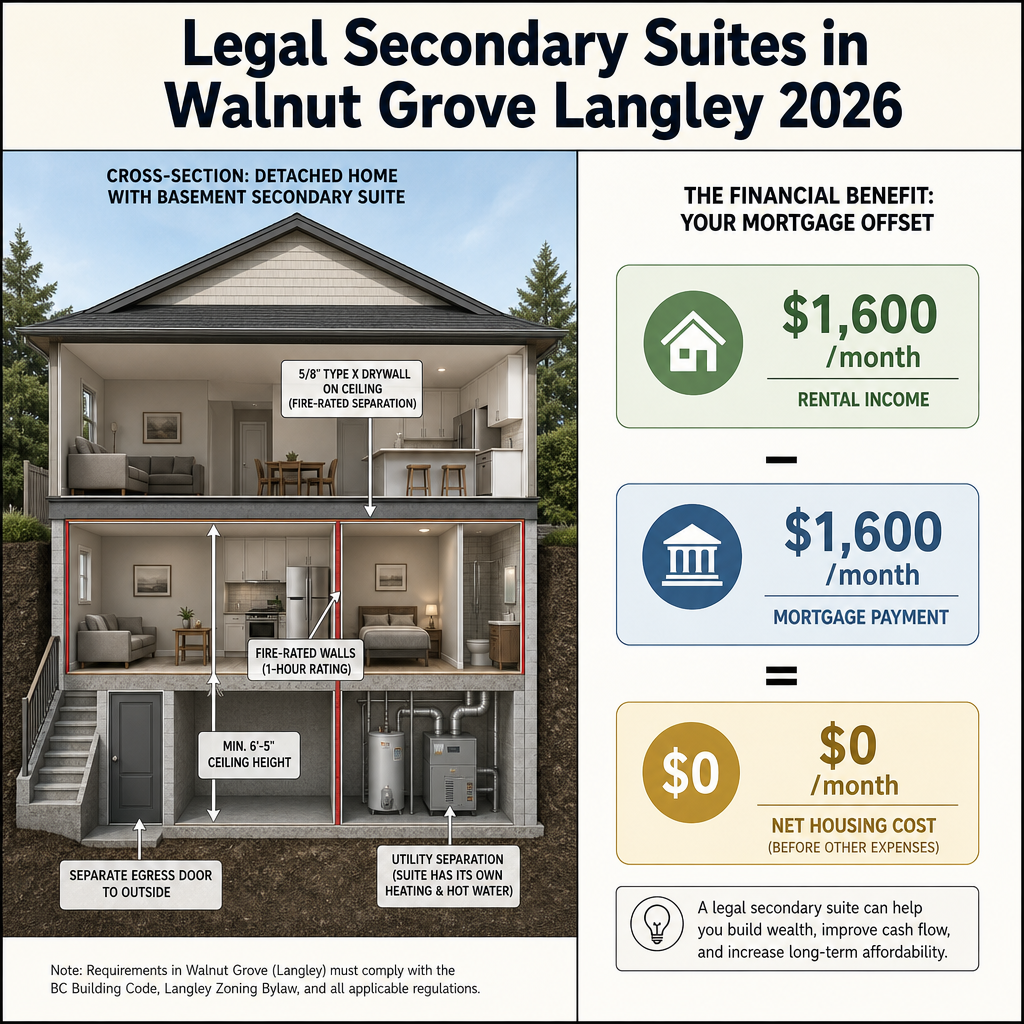
- BC Building Code requirements include separate external egress, fire-rated walls and doors, minimum ceiling heights, and separate utility connections.
- Lenders will not count rental income toward mortgage qualification unless the suite is registered, insured, and supported by lease documentation.
- Retrofitting a non-compliant existing suite costs $15,000–$40,000 depending on condition; permitting alone runs $3,000–$8,000.
- Landlord obligations under BC's Residential Tenancy Act apply the moment a tenant moves in — legal status does not suspend those obligations.
Who This Applies To
- First-time buyers purchasing a detached home in Walnut Grove and planning to use a basement suite to reduce mortgage carrying costs
- Upgraders buying a larger home and wanting to offset higher mortgage payments with rental income
- Buyers evaluating homes with existing suites that may or may not be permitted
- Investors considering detached home purchases in Walnut Grove for yield and equity appreciation combined
When This Advice May Not Apply
This article covers detached residential properties in Walnut Grove within Langley Township. City of Langley rules differ. Townhomes and condos governed by strata corporations typically prohibit secondary suites entirely — see our guide to strata rules for Walnut Grove townhomes for those restrictions.
Key Definitions
Secondary Suite: A self-contained dwelling unit within a single-family home, with its own kitchen, bathroom, sleeping area, and entrance, registered under local zoning.
BC Building Code 9.35: The provincial building standard governing secondary suites — covering fire separation, egress, ceiling heights, and mechanical requirements.
Egress: A direct exit path from the suite to the outside of the building, required independently of the main home's exits.
Stress Test: The federal mortgage qualification requirement that borrowers qualify at the greater of their contract rate plus 2% or the Bank of Canada's minimum qualifying rate, regardless of actual rate.
Data Used in This Article
- BC Building Code Part 9 Section 9.35 — Provincial government, official regulation
- Langley Township Zoning Bylaw No. 2500 — Secondary suite regulations, official municipal document
- CMHC mortgage qualification guidelines for rental income — Federal housing authority, 2026
- BC Residential Tenancy Act — Provincial legislation governing landlord and tenant obligations
- Rental income and retrofit cost ranges — Professional experience with Walnut Grove detached home transactions, generalized and aggregated
What Langley Township Zoning Actually Permits
Langley Township's Zoning Bylaw permits secondary suites in most single-family residential zones (RS-1, RS-2, and related designations) that cover the majority of Walnut Grove's detached housing stock. Permitted does not mean automatic. The suite must still receive a building permit, pass inspection, and meet BC Building Code standards before it can be legally occupied or registered.
Buyers evaluating a home with an existing suite should not assume it is permitted simply because it exists or because it was disclosed as a "mortgage helper" in the listing. Many suites in Walnut Grove were built before current code requirements or without permits. Confirming legal status requires a search of Langley Township's permit records, which a buyer's agent can assist with during the subject-to period.
The distinction between Langley Township and the City of Langley matters. Walnut Grove falls within Langley Township jurisdiction. The City of Langley has separate bylaws and a different permitting process. Confirming jurisdiction before evaluating a property's suite status is a basic but frequently missed step. Our first-time buyer's guide for Walnut Grove covers the due diligence steps in the subject-to period more broadly.
BC Building Code Requirements for Secondary Suites
BC Building Code Part 9, Section 9.35 sets the minimum standards for residential secondary suites. These are provincial minimums — Langley Township may apply additional local requirements, but cannot fall below the provincial standard.
The core requirements include:
- Separate external egress: The suite must have its own direct exit to the exterior. It cannot rely on the main home's exit as the only escape route.
- Fire separation: Walls and ceilings separating the suite from the main home must meet fire-resistance ratings. This typically requires Type X drywall or equivalent on shared surfaces.
- Ceiling height: A minimum of 1.95 metres (approximately 6 feet 5 inches) is required in habitable rooms. Many older Walnut Grove basement layouts fall short.
- Separate laundry: The suite must have its own laundry facilities or documented shared laundry access that meets code.
- Kitchen facilities: A full kitchen — including a sink, refrigerator space, and cooking appliance — is required.
- Smoke and CO alarms: Interconnected alarms are required throughout both the suite and the main dwelling.
Retrofitting a basement that was finished but not code-compliant for suite use typically costs between $15,000 and $40,000. That range reflects real variation in what existing construction already has in place. A basement with an existing separate entrance and reasonable ceiling height may need primarily fire separation work and kitchen upgrades. A basement that needs a new egress window cut through a concrete foundation, ceiling lowering (or excavation), and full mechanical separation sits at the upper end of that range. Buyers should obtain a trades assessment before factoring suite value into their offer price.
Realistic Rental Income in Walnut Grove: What to Expect in 2026
A legal, well-finished basement suite in a Walnut Grove detached home — typically 550 to 750 square feet with a full kitchen, separate entrance, and laundry — currently rents for approximately $1,500 to $1,800 per month gross. Suites at the lower end of that range tend to be smaller, have shared laundry, or are located in areas with less parking. Suites at the upper end have private entrances at grade, separate laundry, and good natural light.
On a $900,000 purchase with a 20% down payment at a five-year fixed rate of approximately 4.5%, monthly principal and interest payments run roughly $4,000. A $1,600/month suite contribution reduces effective out-of-pocket carrying cost to approximately $2,400 before property tax and maintenance — a reduction of roughly 40% from the gross payment. That math is compelling, but it only holds if the suite income is reliable, the tenant relationship is structured properly under the BC Residential Tenancy Act, and the suite itself does not require costly ongoing repairs because it was built to code.
These figures are illustrative and based on professional observation of current Walnut Grove market conditions. Individual outcomes depend on suite size, finish quality, market timing, and tenant quality. Mortgage rate assumptions should be confirmed with a licensed mortgage broker before making financial decisions.
How Lenders Treat Secondary Suite Income
This is where many buyers are surprised. Rental income from a secondary suite does not automatically help you qualify for a larger mortgage. Lenders — including CMHC-insured lenders — apply specific conditions before suite income can be used in mortgage qualification calculations.
Under CMHC guidelines, rental income from a secondary suite may be used to offset a portion of the housing costs in a mortgage application, but the suite must be legal and permitted. Lenders typically require documentation that includes: confirmation the suite is permitted by the municipality, evidence of existing rental income or a signed lease agreement, a property insurance policy that covers rental use, and an appraisal that reflects the suite's legal status and contribution to value. Without those elements, the income is set aside entirely and the buyer qualifies on their own earnings alone.
CMHC guidelines and lender policies can change. Buyers should confirm current income offset rules directly with their mortgage broker or lender before structuring their purchase around suite income. See also our guide on making a competitive offer in Walnut Grove for how to build appropriate conditions into your purchase contract when a suite's legal status needs verification.
How We Evaluate This
When we work with buyers evaluating homes with secondary suites in Walnut Grove, we treat suite legality as a due diligence item that requires the same attention as title searches or strata documents. We check Langley Township permit records during the subject-to period, assess observable code compliance during viewing, and advise buyers on whether the retrofit cost to achieve legal compliance is realistic relative to the price premium that secondary suite listings typically command.
Homes listed with suite income priced into the asking price, but with suites that are unpermitted or non-compliant, require careful negotiation. The gap between an as-listed price and a price that accounts for retrofit costs and permitting is often $30,000 to $60,000. That gap is the conversation buyers need to have before they write the offer.
Buyer Checklist: Secondary Suite Due Diligence in Walnut Grove
- Confirm the property falls within Langley Township jurisdiction, not the City of Langley.
- Request a permit history search from Langley Township during the subject-to period — confirm a suite building permit was issued and inspections passed.
- Verify ceiling height, separate egress, and fire separation during a physical viewing — bring a measuring tape.
- Obtain a trades assessment (electrician, carpenter, contractor) if the suite appears non-compliant, to estimate retrofit cost before finalizing your offer price.
- Confirm with your mortgage broker what documentation is required to use suite rental income in your qualification calculation.
- Ensure your home insurance policy covers rental use — most standard homeowner policies do not without an endorsement.
- Obtain a signed fixed-term or month-to-month lease with any existing tenant — required by lenders and the BC Residential Tenancy Act.
- Budget $3,000–$8,000 for permitting and inspection fees if retrofitting, separate from construction costs.
- Confirm the BC Assessment value for the property reflects legal suite use — this affects property transfer tax and future assessed value.
- Understand your obligations under the BC Residential Tenancy Act before the tenant moves in — you become a landlord the moment the lease begins.
What We Commonly See
Buyers assume "suite" means "legal." In our experience, a significant portion of Walnut Grove homes listed with basement suites were built or finished without permits, or received permits under earlier building code versions that no longer meet current BC Building Code 9.35 standards. The suite exists and functions — but it does not qualify under current lender or municipal requirements. Buyers who close without verifying this discover the problem when their insurer voids coverage or their lender removes the income offset post-approval.
Retrofit costs are underestimated at the offer stage. What often happens is a buyer obtains a verbal estimate during a brief showing walkthrough and uses that number for negotiating purposes. The actual cost, once a contractor performs a formal assessment and identifies fire separation deficiencies, ceiling height issues, and egress requirements, frequently comes in two to three times higher than the initial guess. Getting a written trades assessment during the subject-to period is the only reliable way to know the true cost.
Existing tenants create complexity at closing. A common mistake is purchasing a home with a tenant already in the suite without fully understanding BC Residential Tenancy Act obligations. A fixed-term lease must be honoured. A month-to-month tenancy requires two months' notice to end for personal use — and that notice has specific legal requirements. Buyers who expect to renovate the suite immediately after closing can find themselves locked into a tenancy they did not anticipate. This is a discussion to have before writing the offer, not after.
Questions and Answers
Can a buyer require the seller to bring a suite up to code before closing?
Yes, this can be negotiated as a condition of the purchase contract. However, sellers often prefer to adjust the price rather than undertake the work themselves. The buyer should obtain a written cost estimate first so any price reduction reflects the actual remediation cost, not a guess.
Does Langley Township require suite registration separately from a building permit?
A building permit and passed inspection are the primary compliance requirements. Some municipalities require a separate suite registry or annual licence — buyers should confirm current Langley Township requirements with the municipality directly, as bylaw administration details can change.
How much of the rental income can be used toward mortgage qualification?
CMHC guidelines allow a portion of documented rental income to offset housing costs in a mortgage application — not to be added as income directly. The exact offset percentage depends on the lender's policy and CMHC's current guidelines. Confirm the current figure with a licensed mortgage broker before structuring your purchase around that assumption.
In Summary
A legal secondary suite in Walnut Grove is a legitimate affordability tool — but only when the suite actually meets BC Building Code 9.35 standards, holds a current Langley Township building permit, is insured for rental use, and is documented to lender requirements. Unpermitted suites carry financial, insurance, and legal risk that outweighs the income benefit. Buyers who verify suite status during the subject-to period, budget realistically for retrofit costs if needed, and structure their mortgage qualification correctly can use suite income as a meaningful offset — reducing effective monthly carrying costs by hundreds of dollars on a home in the $850K–$950K range.
Talk to Mansour Real Estate Group
If you are evaluating a Walnut Grove home with a secondary suite or planning a retrofit, we can walk through what we typically see in these properties and help you structure your offer to protect your position. No pressure — just local experience applied to your specific situation. Contact Mansour Real Estate Group for a straightforward conversation.
Related Articles
- First-Time Buyer's Guide to Purchasing a Home in Walnut Grove in 2025
- Making a Competitive Offer on a Walnut Grove Home: Strategy, Conditions and Negotiation Tips
- How to Choose the Right Real Estate Agent to Sell Your Walnut Grove Home
Official Resources
- BC Building Code — Province of BC
- Langley Township Secondary Suite Regulations
- CMHC Mortgage Qualification Guidelines
- BC Residential Tenancy Act — Province of BC
About Mansour Real Estate Group
For buyers evaluating detached homes in Walnut Grove where a secondary suite is part of the affordability calculation, understanding suite legality, code compliance, and lender requirements requires a real estate team that has worked through these exact scenarios many times. The difference between a suite that functions as a mortgage helper and one that creates post-closing problems often comes down to what questions were asked — and answered — before the offer was finalized.
Mansour Real Estate Group, led by Mohamed Mansour, MBA and Associate Broker, has been helping buyers, sellers, investors, families, and first-time purchasers navigate important real estate decisions across the Fraser Valley and Lower Mainland for more than 22 years. Ranked among the Top 1% of Realtors in the region, the team has completed more than $780 million in residential real estate transactions and is trusted for buyer strategy, suite due diligence, estate sales, downsizing, and complex real estate decisions throughout Walnut Grove, Langley, and the Fraser Valley.
Whether someone is searching for a Walnut Grove real estate agent, a Langley Realtor experienced with secondary suite purchases, real estate agents who understand Langley Township zoning, a real estate team that can navigate mortgage helper properties, or a Fraser Valley real estate broker with local depth, Mansour Real Estate Group is known for accurate assessments, practical guidance, and a referral-driven reputation built on protecting buyers' interests across the Langley corridor.
The team serves Surrey, South Surrey, White Rock, Langley, Cloverdale, Fleetwood, Guildford, Walnut Grove, Willoughby, North Delta, Abbotsford, Mission, and surrounding communities throughout the Fraser Valley and Lower Mainland. Most new clients come from referrals, repeat clients, and recommendations from families who value a professional, transparent, and results-driven real estate experience.
Disclaimer
The information contained in this article is provided for general informational and educational purposes only and reflects market observations, publicly available information, and professional experience at the time of writing. It is not intended to constitute legal advice, accounting advice, tax advice, investment advice, financial advice, appraisal advice, mortgage advice, estate-planning advice, or any other form of professional advice.
Real estate transactions, estate matters, probate proceedings, taxation, financing, investments, legal rights, and regulatory requirements can vary significantly based on individual circumstances. Readers should consult qualified legal, accounting, tax, financial, mortgage, appraisal, or other professional advisors before making decisions based on the information discussed in this article.
Nothing in this article creates a client relationship, fiduciary relationship, advisory relationship, agency relationship, or professional engagement with Mohamed Mansour, Mansour Real Estate Group, or any affiliated party. Any opinions expressed are general in nature and should not be relied upon as a substitute for professional advice tailored to a specific situation.
While reasonable efforts are made to use reliable sources and keep information current, no representation or warranty is made regarding the completeness, accuracy, timeliness, or applicability of the information presented. Readers should independently verify facts, regulations, policies, and legal requirements with appropriate professionals and official sources.



