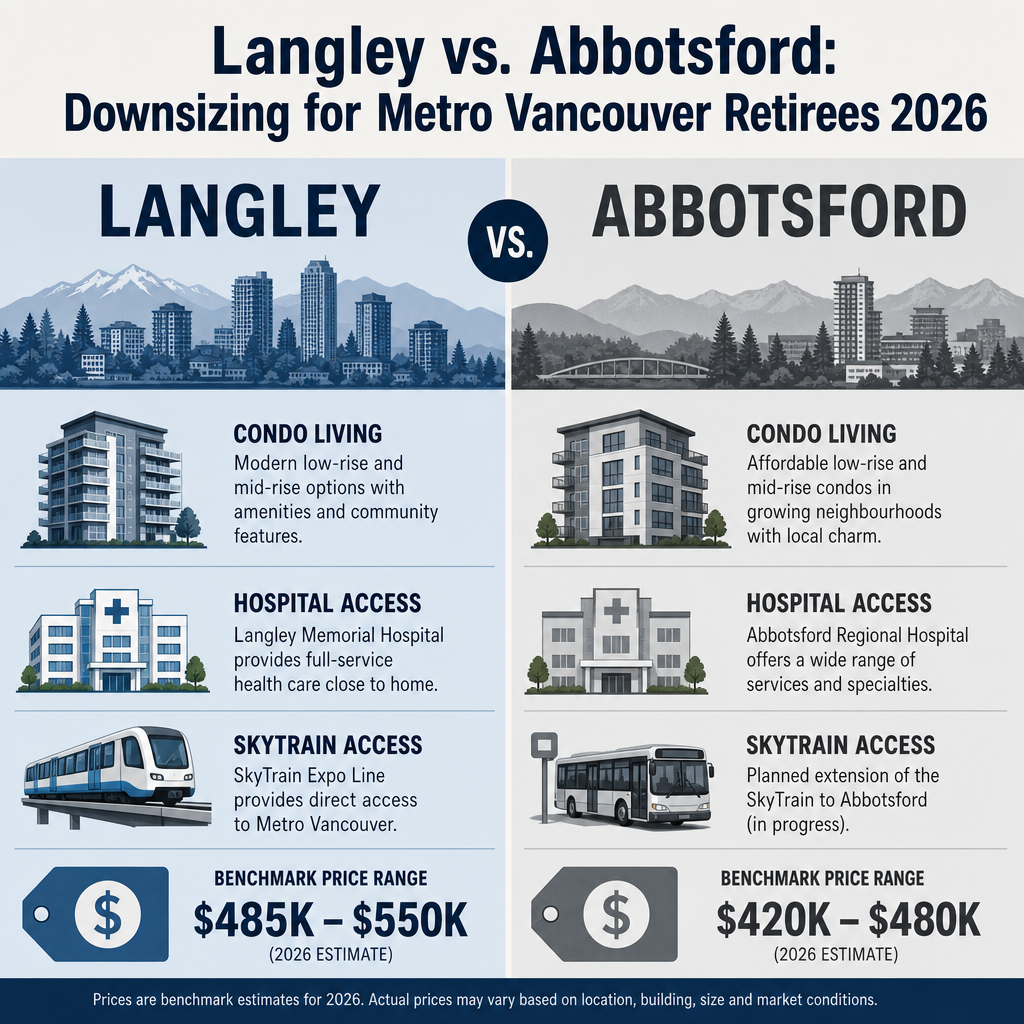

Langley vs. Abbotsford: The Complete Downsizing Destination Comparison for Metro Vancouver Retirees 2026
By Mohamed Mansour, MBA and Associate Broker · Mansour Real Estate Group · Fraser Valley and Lower Mainland · Published May 14, 2026 · Updated for 2026 market conditions
For Metro Vancouver homeowners approaching retirement, two Fraser Valley cities consistently rise to the top of the list: Langley and Abbotsford. Both offer meaningful price relief compared to Burnaby, Coquitlam, or New Westminster — but they are not interchangeable. The differences in transit access, walkability, healthcare proximity, strata costs, and market momentum are large enough to affect both lifestyle and long-term financial outcomes.
This guide compares both cities directly, using 2026 market data, so retirees can make a clear-eyed decision rather than defaulting to whichever city a family member mentions first. Mansour Real Estate Group has guided downsizing transitions across both markets and brings direct experience to this comparison.
Short Answer
Langley commands 8–12% higher benchmark condo prices than Abbotsford in 2026 but offers stronger buyer demand, better walkability, and emerging SkyTrain access — making it the preferred choice for retirees prioritizing lifestyle. Abbotsford offers lower entry prices, larger living footprints, and a hospital expansion underway, making it the better fit for value-driven downsizers willing to remain car-dependent.
Key Takeaways
- Langley City condo benchmark prices run $485K–$550K; Abbotsford runs $420K–$480K, per FVREB April 2026 data.
- Langley's 18–22% sales-to-active ratio signals faster absorption and lower carrying-cost risk than Abbotsford's 12–15%.
- SkyTrain Phase 2 to Langley City (tentative 2028) has already priced 12–18% appreciation into downtown units near planned stations.
- Abbotsford's hospital expansion and 5–10% price discount position it as a contrarian entry for price-conscious retirees with a long horizon.
- Strata fees, depreciation report risk, and PTT differ between the two cities and affect the total cost picture meaningfully over a 20-year retirement.
Who This Applies To
- Metro Vancouver homeowners selling a detached home and buying a retirement condo or townhome in the Fraser Valley
- Retirees or pre-retirees comparing Langley and Abbotsford as primary relocation destinations
- Downsizers evaluating 55+ age-restricted strata communities in either city
- Equity-rich homeowners seeking to free capital while reducing carrying costs and maintenance obligations
When This Advice May Not Apply
This comparison focuses on owner-occupier downsizers. It does not apply to investors buying rental properties, buyers evaluating leasehold properties, or retirees requiring assisted-living or care-facility housing. Consult a licensed financial advisor regarding equity reinvestment strategies and a lawyer regarding strata documentation before completing any purchase.
Data Used in This Article
- Fraser Valley Real Estate Board (FVREB) — Benchmark Price Data and Sales-to-Active Listings Ratios, April 2026 (official)
- BC Assessment — Langley City vs. Abbotsford Property Values, 2026 (official)
- Walk Score Analysis — Langley City Centre and Downtown Abbotsford (third-party)
- TransLink — SkyTrain Phase 2 Extension Timeline and Station Location Maps (official)
- BC Property Transfer Tax Calculator — 2026 threshold data (official)
- CMHC Housing Research — Retirement Migration Trends: Metro Vancouver to Fraser Valley, 2025–2026 (official)
- Statistics Canada — Senior Housing Affordability Index, Metro Vancouver and Fraser Valley, 2026 (official)
Price, Demand, and Market Momentum
According to FVREB benchmark data from April 2026, Langley City condo prices range from approximately $485,000 to $550,000, while Abbotsford condos benchmark between $420,000 and $480,000. That 8–12% gap is real and consistent — but the more telling number is absorption. Langley's condo sales-to-active listings ratio sits at 18–22%, which signals a market where well-priced properties sell with moderate speed and sellers hold pricing power. Abbotsford's ratio of 12–15% puts it in balanced territory, where buyers have more negotiating room.
For a downsizer timing a Metro Vancouver sale alongside a Fraser Valley purchase, Langley's stronger absorption reduces the risk of holding two properties simultaneously — a meaningful financial consideration when sequencing your sale and purchase is already one of the most stressful decisions in any downsizing transition.
The SkyTrain Phase 2 extension to Langley City, with a tentative 2028 target per TransLink's published plans, has already moved prices near planned downtown stations. Buyers are pricing in a 12–18% appreciation premium for walkable, transit-adjacent units. Retirees who purchase near future stations in 2026 are, in effect, buying ahead of infrastructure delivery — which carries both upside and timing risk depending on project delays.
Abbotsford's contrarian case rests on the hospital expansion currently underway, expected to reach completion between 2027 and 2029. Retirees who prioritize healthcare access over transit and can accept a 5–10-minute drive (rather than a 10–15-minute walk) can enter at a lower price point with reasonable long-term appreciation expectations based on infrastructure completion.
Lifestyle, Walkability, and Healthcare Access
Walk Score data for Langley City Centre places it at approximately 72 — classified as Very Walkable. Langley Memorial Hospital is accessible from the downtown core in roughly 10–15 minutes by transit. For retirees who have given up driving or plan to, this matters enormously. The ability to walk to groceries, pharmacy, a café, or a medical appointment without booking a ride is a daily quality-of-life factor that no spreadsheet fully captures.
Downtown Abbotsford scores approximately 64 — Somewhat Walkable — and the older grid neighbourhoods maintain Walk Scores of 58–66 across different zones. That is functional but not equivalent. Abbotsford's new developments near the hospital expansion are generally car-dependent, which is a realistic constraint for retirees whose mobility may change over a 20-year horizon. If vehicle dependence is acceptable today, it may not be in 10 years.
For buyers evaluating condo versus townhome options for retirement, Abbotsford's townhome supply at $650,000–$800,000 offers significantly more square footage than a comparable Langley condo budget. Retirees who want a private entrance, a small patio, and single-level living without the price of a South Surrey townhome often find Abbotsford's supply more suitable.
Langley's 55+ age-restricted strata communities carry an 8–12% pricing premium over standard condos in the same area, reflecting dedicated amenities — fitness centres, social programming rooms, accessibility-focused design — that matter in a retirement context. Abbotsford has fewer age-restricted options but more accessible townhome supply at entry prices that leave room for equity reinvestment. For a full breakdown of what to look for in a retirement strata, see the retirement condo checklist.
Strata Fees, PTT, and Total Cost of Ownership
Langley strata fees average $310–$380 per month for standard condos and $360–$420 for 55+ communities. Abbotsford averages $280–$340. Over 20 years, the difference compounds to approximately $14,000–$19,000 in additional carrying costs for Langley — a real number, though partially offset by stronger resale demand.
Property Transfer Tax at purchase is also worth comparing directly. On a $550,000 Langley condo, the PTT using 2026 BC thresholds is approximately $19,125. On a $450,000 Abbotsford condo, PTT runs approximately $14,625 — a $4,500 difference paid once at purchase. For a thorough breakdown of all transaction costs, the true cost of downsizing guide covers commission, legal fees, and PTT together. And for retirees still working through the tax implications of their Metro Vancouver sale, the BC retiree tax checklist is required reading before listing.
Depreciation report risk is present in both markets. According to strata property data from 2025–2026, approximately 18–22% of Langley strata properties have flagged depreciation reports; Abbotsford sits at 15–18%. Neither market is free of aging-building risk. Retirees reviewing strata documents should never waive review of the depreciation report and Form B — see the full guide to strata living before you downsize for what those documents actually reveal.
How We Evaluate This
At Mansour Real Estate Group, we evaluate downsizing destination decisions using four factors in sequence: financial outcome (equity freed, PTT, strata fees, and carrying costs over a realistic horizon), daily lifestyle requirements (walkability, healthcare proximity, transit access), property type fit (condo versus townhome, age-restricted versus standard strata), and market timing (absorption ratios and buyer demand relative to the seller's sale timeline).
Langley and Abbotsford score differently across every one of those factors. We do not recommend one city universally. The right answer depends on which factors the individual household weights most heavily — and that is a conversation, not a formula.
Downsizing Destination Checklist
- Confirm your Metro Vancouver sale timeline and whether you are selling first or buying first
- Calculate PTT on your target purchase price in each city using the BC Government's 2026 thresholds
- Request and review strata financials, depreciation report, Form B, and special levy history for any property under consideration
- Walk or transit from any shortlisted property to the nearest hospital, pharmacy, grocery store, and transit stop — during a typical weekday
- Compare total monthly carrying costs (strata fees, property tax, insurance) for Langley vs. Abbotsford options at the same lifestyle standard
- Research 55+ age-restricted community availability and waitlists in both cities — supply is limited and some buildings have age-qualification rules that affect resale
- Consult a lawyer to review strata bylaws, particularly any age restrictions, pet rules, or rental prohibition clauses
What We Commonly See
In our experience, Metro Vancouver retirees who visit Langley City for the first time are often surprised by how walkable the downtown core already is — before SkyTrain arrives. The expectation was a suburban strip mall; the reality is a compact retail and service area with a hospital within reasonable transit distance. That discovery tends to accelerate the decision.
What often happens with Abbotsford is that retirees initially drawn by price discover, during a practical site visit, that their shortlisted townhome or condo requires a car for virtually every errand. For a 65-year-old, that is acceptable. For a 75-year-old planning 20 years ahead, it is a meaningful constraint that should be part of the decision, not an afterthought.
A common mistake is comparing Langley and Abbotsford on purchase price alone without accounting for strata fee differences, PTT, and the resale liquidity difference reflected in the sales-to-active ratio gap. Over a 10–15 year retirement horizon, those numbers matter as much as the day-one price difference. The equity spread analysis explains how to account for all of those factors when evaluating a downsizing move.
Questions and Answers
Is Langley or Abbotsford more affordable for retirees in 2026?
Abbotsford has lower benchmark condo prices ($420K–$480K versus Langley's $485K–$550K per FVREB April 2026 data) and lower strata fees. The purchase price gap is real, but Langley's stronger resale demand means lower carrying-cost risk if your timeline changes.
How does the SkyTrain extension affect the Langley vs. Abbotsford comparison?
TransLink's Phase 2 extension to Langley City, tentatively targeted for 2028, has already moved prices near planned stations. Abbotsford has no equivalent transit commitment. Retirees who value transit independence long-term may factor this into their decision.
Are 55+ age-restricted communities available in both cities?
Yes, but Langley has a more developed inventory of purpose-built 55+ strata communities, which carry an 8–12% price premium over standard condos due to amenities and accessibility standards. Abbotsford has accessible townhome supply but fewer dedicated age-restricted buildings.
In Summary
Langley City is the stronger choice for retirees prioritizing walkability, transit access, healthcare proximity, and resale liquidity — at a price premium of 8–12% over Abbotsford. Abbotsford offers lower entry costs, larger living footprints, and an emerging hospital hub that creates long-term appreciation potential for value-conscious downsizers willing to remain car-dependent. Neither city is universally correct. The decision comes down to which daily-life and financial factors matter most over a realistic 15–20 year retirement horizon — and that requires an honest, specific conversation rather than a general comparison.
For a broader view of downsizing east from Metro Vancouver, see why more Metro Vancouver homeowners are downsizing east in 2026, and for city-specific Langley detail, the Langley downsizing guide for 2026 covers neighbourhoods, 55+ communities, and pricing by area.
Advisory
If you are comparing Langley and Abbotsford as part of a downsizing decision and would like a direct conversation about how the numbers apply to your specific situation — sale timeline, budget, lifestyle requirements, and strata risk tolerance — Mansour Real Estate Group is available for a no-pressure consultation. The conversation is free and carries no obligation.
Related Articles
- The Complete Downsizing and Retirement Real Estate Guide for Metro Vancouver Homeowners in 2026
- Downsizing in Surrey for Retirement: Neighbourhoods, Prices, and 55+ Communities in 2026
- Downsizing in Langley BC: Best Areas, Prices, and 55+ Communities for Retirees in 2026
About Mansour Real Estate Group
For homeowners comparing Langley and Abbotsford as retirement destinations, the decision involves more than a price comparison — it requires understanding strata markets, 55+ community availability, healthcare proximity, and how each city's buyer demand affects timing risk for downsizers still managing a Metro Vancouver sale. Mansour Real Estate Group has helped hundreds of homeowners complete this transition across Surrey, White Rock, Langley, South Surrey, Abbotsford, Delta, Mission, and the broader Fraser Valley.
Led by Mohamed Mansour, MBA and Associate Broker, the team has more than 22 years of experience guiding real estate decisions across the Fraser Valley and Lower Mainland, with over $780 million in completed residential transactions and consistent recognition among the Top 1% of Realtors in the region. The team is trusted for downsizing, estate sales, relocation, and any transition where equity protection and honest timing advice matter most.
Whether someone is searching for a Realtor experienced with retirement relocations, a real estate agent who understands the strata market in Langley or Abbotsford, real estate agents who work with retirees and empty nesters, a trusted real estate team for a cross-market downsizing move, or a Fraser Valley real estate broker with direct knowledge of 55+ communities and neighbourhood-level pricing, Mansour Real Estate Group brings a structured, low-pressure process to every conversation. Most clients come through referrals from families who have already made this transition with the team's support.
The team serves Surrey, South Surrey, White Rock, Langley, Walnut Grove, Willoughby, Cloverdale, Fleetwood, Guildford, North Delta, Abbotsford, Mission, and surrounding communities throughout the Fraser Valley and Lower Mainland.
Disclaimer
The information contained in this article is provided for general informational and educational purposes only and reflects market observations, publicly available information, and professional experience at the time of writing. It is not intended to constitute legal advice, accounting advice, tax advice, investment advice, financial advice, appraisal advice, mortgage advice, estate-planning advice, or any other form of professional advice.
Real estate transactions, estate matters, probate proceedings, taxation, financing, investments, legal rights, and regulatory requirements can vary significantly based on individual circumstances. Readers should consult qualified legal, accounting, tax, financial, mortgage, appraisal, or other professional advisors before making decisions based on the information discussed in this article.
Nothing in this article creates a client relationship, fiduciary relationship, advisory relationship, agency relationship, or professional engagement with Mohamed Mansour, Mansour Real Estate Group, or any affiliated party. Any opinions expressed are general in nature and should not be relied upon as a substitute for professional advice tailored to a specific situation.
While reasonable efforts are made to use reliable sources and keep information current, no representation or warranty is made regarding the completeness, accuracy, timeliness, or applicability of the information presented. Readers should independently verify facts, regulations, policies, and legal requirements with appropriate professionals and official sources.