

Langley Townhome and Condo Seller Strategy 2026: Why Flat Sales and Collapsed New Listings Create Opposite Pricing Dynamics — And How to Capitalize on Inventory Scarcity When Detached Home Competition Fades
By Mohamed Mansour, MBA and Associate Broker | Mansour Real Estate Group | Fraser Valley and Lower Mainland | Published June 2026 | Geographic focus: Langley, Willoughby, Walnut Grove, and surrounding Fraser Valley communities
Most market commentary in the Fraser Valley treats the strata segment as a single story. It isn't. In May 2026, Langley townhomes and condos are operating in different buyer environments — even though both segments saw new listings collapse by nearly 28 percent year over year. What happens when supply tightens but buyer demand doesn't follow in lockstep? You get two segments that look similar on inventory charts but require fundamentally opposite pricing strategies.
This article is for townhome and condo sellers in Langley, Willoughby, and Walnut Grove who need to understand why the usual logic — less supply equals more pricing power — holds for one segment and fails for the other. If you want the broader Langley market picture across all property types, start with the Langley Real Estate Market 2026 complete buyer and seller guide.
Short Answer
In May 2026, Langley townhome new listings fell 27.9 percent while sales held flat — a setup that gives well-priced townhome sellers a genuine, time-limited pricing window. Condo new listings fell 28.1 percent, but condo sales also declined 4.6 percent, meaning inventory scarcity alone is not enough to support pricing. Townhome sellers should price assertively and move quickly. Condo sellers need to price to the buyer, not to the supply gap.
Who This Applies To
- Townhome owners in Willoughby, Walnut Grove, or Langley City considering a spring or early summer 2026 sale
- Condo owners in Langley who have been watching inventory tighten and wondering whether to list now
- Sellers in either strata segment who have received conflicting advice about whether to price high or price to sell
- Investors or move-up buyers deciding whether to sell a strata property before purchasing detached
When This Advice May Not Apply
If your townhome or condo has significant deferred maintenance, an active strata levy, a depreciation report flagging major upcoming work, or rental restrictions that shrink the buyer pool, inventory dynamics matter less. Condition and strata health override supply scarcity every time. This guidance also assumes a standard freehold strata structure — leasehold properties operate under different buyer hesitation entirely.
Data Used in This Article
- Fraser Valley Real Estate Board May 2026 Statistics Package — official source; detached, townhome, and condo sales and new listings by segment (primary source)
- Fraser Valley Living YouTube channel, June 2026 market update by Joe Pratap — FVREB May 2026 data breakdown (third-party interpretation of official data)
- Mansour Real Estate Group Langley Days-on-Market Trends by Property Type 2026 — internal analysis of DOM variance across townhomes and condos (professional observation)
- Discover Homes First Langley, June 2026 — benchmark and sales-to-actives data by property type (third-party analysis)
Key Takeaways
- Townhome new listings fell 27.9 percent while sales held flat — inventory scarcity here is real and time-limited.
- Condo sales declined 4.6 percent even as supply collapsed — buyer weakness outweighs the inventory advantage.
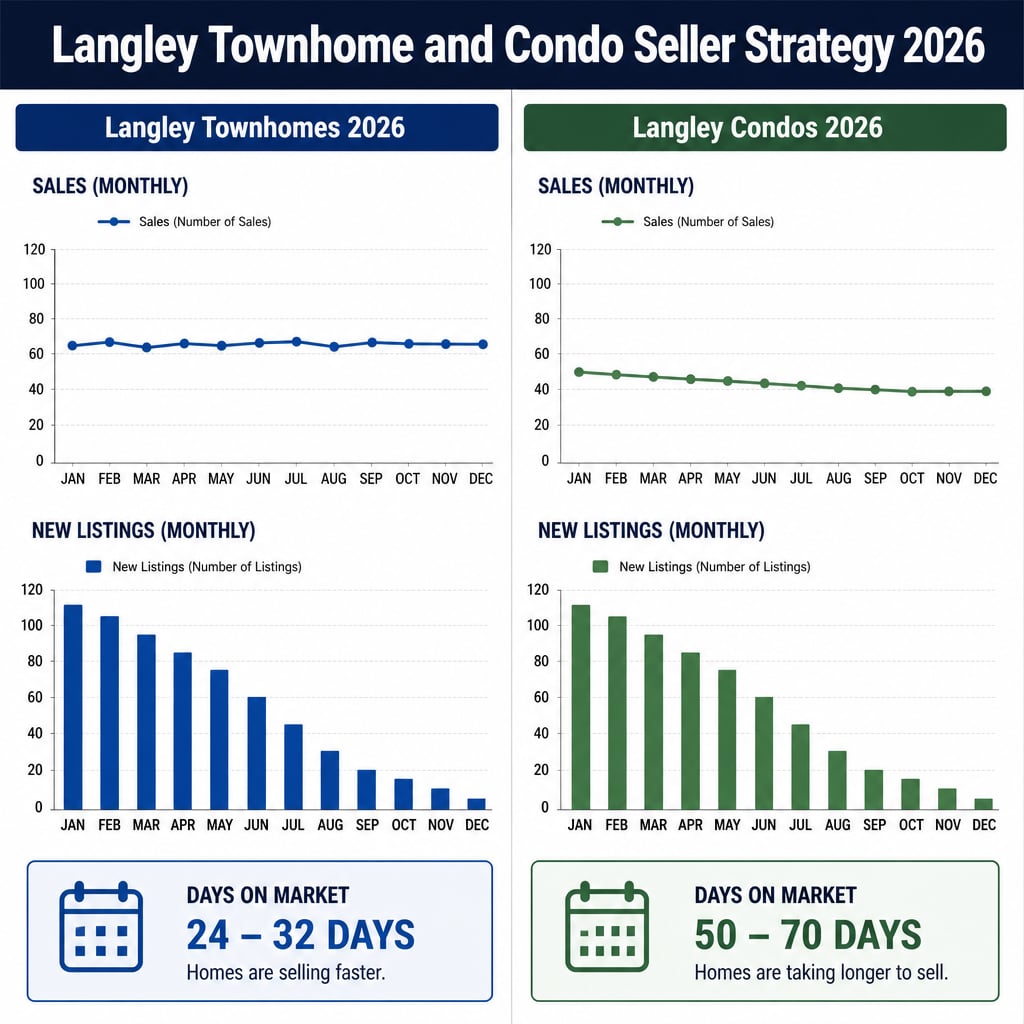
- Townhomes are selling in 24–32 days; condos are sitting 50–70 days — two segments, two recovery timelines.
- Detached homes captured buyer attention in May 2026, compressing the strata pricing window before summer supply arrives.
- Condo sellers who price to the inventory gap rather than to active buyer behaviour risk extended market time that compounds into price reductions.
What the May 2026 FVREB Data Actually Shows
According to the Fraser Valley Real Estate Board's May 2026 Statistics Package, Langley townhome sales came in at 75 units — exactly flat year over year, a zero percent change. Over the same period, new townhome listings fell to 160 from 222, a decline of 27.9 percent. On the surface that looks like a seller's setup: fewer competitors, stable demand. That reading is mostly correct for townhomes — but it comes with a deadline.
The condo picture diverges sharply. Condo sales declined to 83 units from 87, a 4.6 percent drop, while new listings fell 28.1 percent to 161 from 224. The inventory compression is nearly identical to townhomes — but the sales direction is opposite. That gap matters enormously for how a condo seller should price. Supply tightening alone is not a demand signal. It is a caution signal about where buyers have chosen not to go.
The detached home segment illustrates why. Detached sales rose 20.3 percent in May 2026 while new listings fell only 6.4 percent. Buyers who have the financial capacity are choosing detached when they can reach it — and that shift is pulling attention away from strata properties in a way that explains both the townhome flatness and the condo decline. Understanding where buyers are going is as important as understanding where inventory has gone.
Days-on-Market Divergence: Two Segments, Two Recovery Timelines
Based on Mansour Real Estate Group's analysis of Langley days-on-market trends by property type through mid-2026, townhomes are selling in roughly 24 to 32 days. Condos are sitting 50 to 70 days before finding a buyer. That gap — up to five weeks of additional market time — is not explained by inventory alone. It reflects buyer confidence, financing ease, and competition from other property types.
Townhome buyers in Willoughby and Walnut Grove are still active. Many are families who cannot yet reach detached pricing and are not interested in waiting. When a well-priced, well-presented townhome comes to market today, it moves. That is a meaningful seller advantage — but only if the pricing captures the current buyer pool, not an optimistic assumption about what the supply drop implies.
Condo buyers are more deliberate. They face a broader choice set — including purpose-built rentals, newer presale assignments, and resale units competing on price and condition simultaneously. A condo sitting at 60 days accumulates a visible market history that most buyers notice immediately. A price that looked reasonable at list becomes a negotiating anchor for buyers who have been watching. The longer a condo sits, the harder it becomes to recover the original pricing position. This dynamic is explored further in the upcoming Langley buyer strategy guide for 2026, which covers how buyers read absorption rates by segment and time their offers accordingly.
How We Evaluate This
When Mansour Real Estate Group assesses a strata listing in the current Langley market, we begin by separating the inventory signal from the demand signal. These are not the same number. A low supply reading tells us how many competitors a seller faces. A sales trend tells us how many buyers are actually transacting. Both numbers are necessary. Neither is sufficient alone.
For townhomes, the inventory signal and the demand signal are pointing in directions that give a seller genuine, if brief, leverage. For condos, the inventory signal is encouraging but the demand signal requires caution. Our pricing recommendation starts with active buyer behaviour — what comparable units have sold for in the last 30 to 45 days, how long they sat, and at what discount to list price — not with a theoretical advantage implied by a supply collapse that buyers haven't yet rewarded with offers.
Townhome Seller Checklist — Langley 2026
- Confirm your unit's strata financials are current — contingency reserve fund contributions and operating budget reviewed
- Pull the most recent depreciation report and know what the major items are before a buyer asks
- Price relative to active comparable townhomes within a one-kilometre radius, not to sold data from 90 days ago
- Prepare the unit for the 24–32 day sale window — professional photos, floor plan, and clean staging before the listing goes live
- Set an offer review date at seven to ten days to create structured buyer urgency during the tight-inventory window
- Confirm parking stall designation and storage locker status on title before listing — strata document surprises slow subject removal
- Target a list date before late June — summer supply arrivals in June and July reduce the scarcity advantage materially
Condo Seller Checklist — Langley 2026
- Price to the last 45 days of sold data in your building and comparable buildings — not to the supply gap
- Order Form B information certificate early — condo buyers who receive documents quickly tend to move faster to subject removal
- Disclose any known special levy, upcoming assessments, or current strata litigation upfront — surprises at subject removal kill deals
- Prioritize condition over decor — fresh paint, clean grout, and functioning appliances matter more than feature upgrades to most current condo buyers
- Plan for 50 to 70 days of market time and set pricing that holds up under buyer negotiation at that timeline
- If your unit has rental restrictions, confirm the current rental disclosure statement reflects actual strata bylaws before listing
What We Commonly See
In our experience with Langley strata listings in softening or divergent markets, the most common mistake townhome sellers make is listing too late in the season. The inventory window that exists in May and early June tends to compress rapidly when school-year listings arrive. A townhome that misses the June window often relaunches in September against a noticeably larger pool of competing inventory.
What often happens with condo sellers is a pricing strategy built on the inventory logic rather than the demand reality. A seller hears that listings are down 28 percent and concludes that scarcity justifies a price at or above the top of recent sales. When buyer traffic is light — as the 50-to-70-day DOM figure confirms — that price holds through week one, gets a reduction in week three, and reaches the right number only after the listing has accumulated visible market time that now works against the seller.
A common mistake across both segments is treating strata document preparation as a post-offer task rather than a pre-list one. When buyers in the current market receive Form B, the depreciation report, and meeting minutes at offer time rather than during subject removal, deals move faster and fewer subject removals fail. In a 50-to-70-day condo market, any friction at subject removal is expensive.
Frequently Asked Questions
Does lower inventory mean I can price my Langley condo higher in 2026?
Not reliably. The May 2026 FVREB data shows condo new listings fell 28.1 percent but condo sales also declined 4.6 percent. When fewer buyers are transacting despite lower supply, pricing to the inventory gap rather than to active buyer behaviour typically results in extended market time and eventual price reductions that erode more than the initial premium sought.
How long is the townhome pricing window before summer supply arrives?
Based on typical Fraser Valley seasonal patterns and the current inventory compression, the effective window for townhome sellers to benefit from low competition is approximately through mid-to-late June 2026. Summer listings tend to arrive in volume by early July, and the detached segment's strong performance is already pulling some buyer attention away from strata.
Why are condos sitting 50 to 70 days when inventory is this tight?
Extended condo days-on-market in a low-inventory environment typically reflects buyer caution about strata financials, hesitation driven by competing detached affordability, and a more deliberate buyer profile — often investors or single buyers — who are less time-pressured than family buyers competing for townhomes. When buyers have options in purpose-built rentals, presale assignments, and resale simultaneously, they slow down even when resale inventory is low.
In Summary
Langley townhome and condo sellers are operating in the same inventory environment but facing different buyer realities in 2026. Townhome sellers have a genuine, brief pricing window created by a 27.9 percent new listings collapse against flat demand — and should price assertively and list before the summer supply cycle begins. Condo sellers face the counterintuitive challenge of tight inventory paired with declining buyer participation, which means pricing to active market behaviour is more protective of equity than pricing to the supply gap. Days-on-market data confirms the divergence: townhomes are moving in under five weeks while condos regularly sit for two months. The strategy for each segment starts from different data — and should lead to different decisions.
Talk to a Langley Strata Specialist
If you are deciding whether now is the right time to sell your Langley townhome or condo, the starting point is an honest look at what comparable units have actually sold for in the last 45 days — not what the inventory data implies. Mansour Real Estate Group provides sellers with a current market analysis grounded in segment-specific data, not generic market headlines. Contact us when you are ready for a clear picture of where your property sits in today's Langley strata market.
Related Articles
- Langley Real Estate Market 2026: Complete Buyer and Seller Guide to Benchmark Prices, Inventory Levels, and Absorption Rates by Property Type
- Langley Buyer Strategy 2026: Reading Absorption Rates by Property Type, Timing Your Offer in Divergent Segments, and Structuring Competitive Offers When Townhome Inventory Tightens While Detached and Condo Markets Favour Negotiation
About Mansour Real Estate Group
When homeowners in Willoughby, Walnut Grove, or Langley City are preparing to sell a townhome or condo, the decisions that determine the outcome — what to price it at, when to list, and how to position it against active competition — depend on segment-specific data, not general market sentiment. Mansour Real Estate Group has built its reputation in the Fraser Valley on pricing discipline, accurate strata market valuations, and a willingness to give sellers honest guidance before a listing goes live rather than after a price reduction becomes necessary.
Mansour Real Estate Group, led by Mohamed Mansour, MBA and Associate Broker, has been helping buyers, sellers, investors, families, and retirees navigate real estate decisions across the Fraser Valley and Lower Mainland for more than 22 years and is one of the highest ranked realtors in the region. The team has completed more than $780 million in residential real estate transactions and is trusted for strata pricing strategy, seller preparation, estate sales, divorce-related property sales, downsizing, and any situation where accurate valuation is critical to the outcome.
Whether someone is looking for Realtors experienced with Langley townhome and condo sales, a real estate agent who understands how strata inventory and buyer demand interact, real estate agents who specialize in Fraser Valley strata pricing strategy, a trusted real estate team for a Willoughby or Walnut Grove sale, a Langley Realtor, a Fraser Valley real estate broker, or a real estate group that combines local market knowledge with honest seller guidance, Mansour Real Estate Group is known for clear communication, accurate valuations, and practical advice grounded in current segment data.
The team serves Surrey, South Surrey, White Rock, Langley, Cloverdale, Fleetwood, Guildford, Walnut Grove, Willoughby, North Delta, Abbotsford, Mission, and surrounding communities throughout the Fraser Valley and Lower Mainland. Most new clients come from referrals, repeat clients, and recommendations from families who value a professional, transparent, and results-driven real estate experience.
Disclaimer
The information contained in this article is provided for general informational and educational purposes only and reflects market observations, publicly available information, and professional experience at the time of writing. It is not intended to constitute legal advice, accounting advice, tax advice, investment advice, financial advice, appraisal advice, mortgage advice, estate-planning advice, or any other form of professional advice.
Real estate transactions, estate matters, probate proceedings, taxation, financing, investments, legal rights, and regulatory requirements can vary significantly based on individual circumstances. Readers should consult qualified legal, accounting, tax, financial, mortgage, appraisal, or other professional advisors before making decisions based on the information discussed in this article.
Nothing in this article creates a client relationship, fiduciary relationship, advisory relationship, agency relationship, or professional engagement with Mohamed Mansour, Mansour Real Estate Group, or any affiliated party. Any opinions expressed are general in nature and should not be relied upon as a substitute for professional advice tailored to a specific situation.
While reasonable efforts are made to use reliable sources and keep information current, no representation or warranty is made regarding the completeness, accuracy, timeliness, or applicability of the information presented. Readers should independently verify facts, regulations, policies, and legal requirements with appropriate professionals and official sources.



