

Langley Home Price Floor and True Buyer Entry Points in 2026: What Year-Over-Year Declines Reveal About Where Affordability Actually Bottoms Out
By Mohamed Mansour, MBA and Associate Broker | Mansour Real Estate Group
Published: May 5, 2026 | Fraser Valley, BC | Market Insight
Langley home prices declined approximately 7–8% year-over-year through early 2026, according to the Fraser Valley Real Estate Board's March 2026 Monthly Market Report. For buyers watching from the sidelines, the question is no longer whether a correction happened — it is whether the floor has been reached and whether the spring migration window that closes every April and May is already compressing the advantage.
This article breaks down where Langley affordability actually bottoms out by property type and sub-market, what the current sales-to-active ratio and days-on-market data reveal about emerging demand, and when strategic buyers should move before seasonal inventory shifts erode negotiating position.
Short Answer
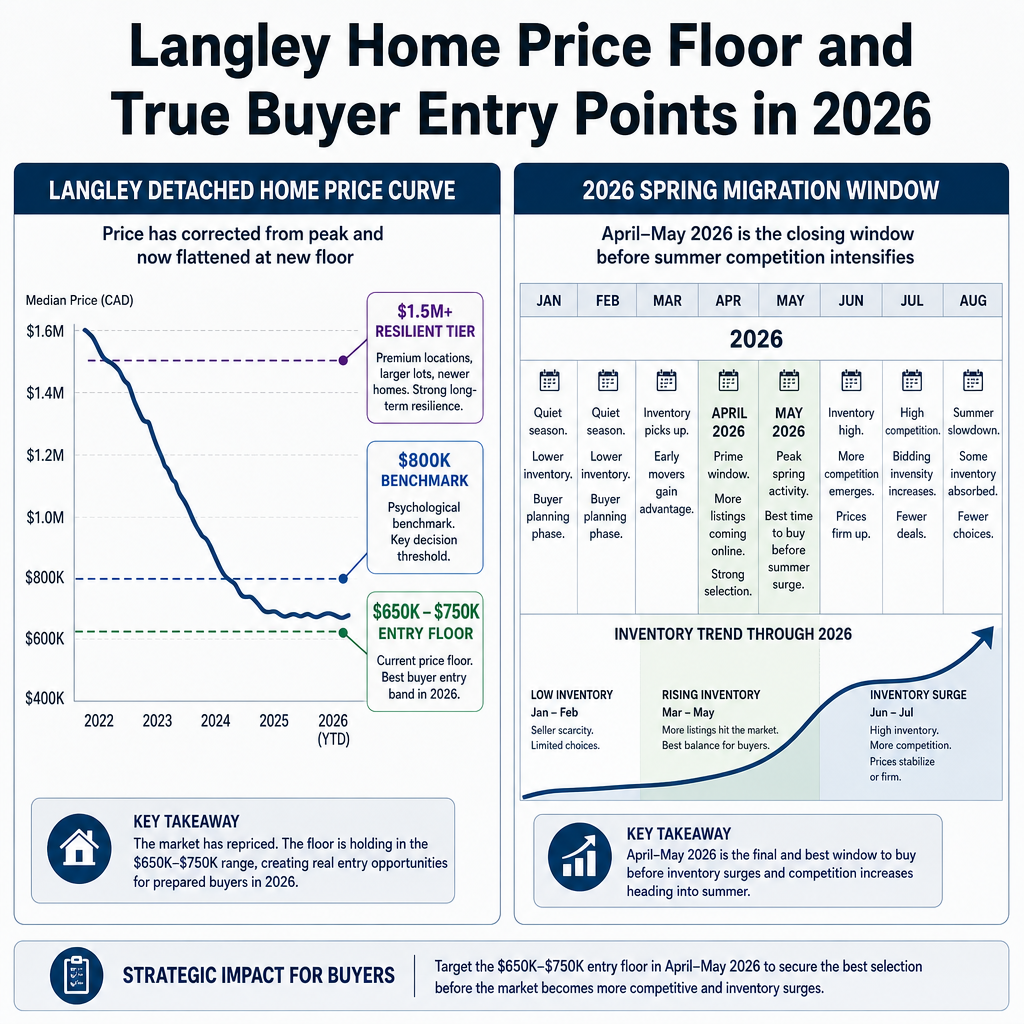
Langley's affordability floor in 2026 sits between $650,000 and $750,000 for entry-level detached homes and $550,000 to $650,000 for townhouses. Month-over-month data through February and March 2026 shows stabilization at those thresholds. The spring migration window — historically April and May — is the point at which listing supply accelerates and buyer negotiating leverage narrows. Buyers targeting entry-level ground-oriented properties have a shrinking window before that shift takes hold.
Who This Applies To
- First-time buyers pre-approved in the $600,000–$800,000 range targeting Langley detached or townhouse properties
- Investors evaluating entry-level Langley properties before spring listing volume resets negotiating dynamics
- Buyers relocating from Metro Vancouver who are comparing Langley affordability against South Surrey or Abbotsford
- Move-up buyers in Langley City or Langley Township evaluating whether to act before or after their current sale
When This Advice May Not Apply
Buyers targeting luxury detached homes above $1.5 million in Langley Township, rural acreage properties, or strata condos priced under $500,000 are operating in segments with distinct demand profiles and different timing logic. The entry-point analysis in this article focuses on ground-oriented properties in the sub-$800,000 range where most buyer activity is concentrated.
Data Used in This Article
- FVREB Monthly Market Report, March 2026 — Official; Fraser Valley region; sales volume, benchmark prices, sales-to-active ratio
- MLS Sold Data: Langley Detached, Townhouse, and Condo Sales, January–March 2026 — Third-party MLS data; Langley City and Township; days-on-market and price-per-square-foot trends
- BC Assessment Property Value Data, 2026 Cycle — Official; BC-wide; assessed value benchmarks by property class
- Mansour Real Estate Group Comparative Market Analysis Database — Internal analysis; Fraser Valley; comparable sales review and micro-market observations
- Statistics Canada Housing Data, BC Regional Trends — Official; BC regional; migration and household formation context
Key Takeaways
- Langley year-over-year price declines of 7–8% have largely stabilized at the entry-level detached and townhouse tiers as of March 2026, per FVREB data.
- The $650,000–$750,000 detached range is where buyer demand has re-accelerated, suggesting this band represents the functional affordability floor.
- Langley City detached homes near the $800,000 benchmark are stabilizing faster than Langley Township rural acreage, which continues gradual softness.
- Days-on-market for detached homes average 28–35 days versus 45–55 days for condos, indicating buyer preference is concentrated in ground-oriented product.
- The April–May spring window historically compresses buyer negotiating power by 20–30% as listing supply surges; acting before that shift closes the entry-point advantage.
Definitions
Sales-to-Active Listings Ratio: The percentage of active listings that sell in a given month. Below 12% is generally considered a buyer's market in BC. Langley's current ratio of approximately 11% confirms buyer conditions but is approaching the transition zone.
Benchmark Price: The price of a typical property in a defined area and property class, as calculated by FVREB using the MLS Home Price Index. It adjusts for property attributes and is more stable than average or median price figures.
Days on Market (DOM): The number of calendar days between a listing's first active date and the date a firm offer is accepted. Lower DOM indicates stronger demand relative to supply in that segment.
Where the Langley Price Floor Actually Sits
Year-over-year decline statistics tell you where prices were relative to a prior peak. They do not tell you where demand has re-engaged. In Langley's current market, those two numbers have diverged.
According to the FVREB's March 2026 Monthly Market Report and MLS sold data from January through March 2026, entry-level detached homes priced between $650,000 and $750,000 are absorbing buyer demand more quickly than any other Langley segment. While the year-over-year comparison still shows a decline, month-over-month data through February and March shows price stabilization and, in some cases, modest upward movement at that band. That is the functional floor — the price range where buyer competition has returned before the broader market has fully recovered.
Townhouses priced between $550,000 and $650,000 show a similar pattern. Buyers who were waiting for further declines through late 2025 found limited product at those prices and began re-engaging. Days-on-market for this segment dropped noticeably between January and March 2026 compared to the prior quarter, based on MLS sold data reviewed by Mansour Real Estate Group.
Condos priced under $500,000 tell a different story. With days-on-market averaging 45–55 days and a sales-to-active ratio below the detached segment, strata units have not seen the same demand re-engagement. For buyers targeting condos as an entry point, affordability has improved but floor signals are less clear. For a broader look at how Fraser Valley sales-to-active ratios shape negotiating conditions, that context applies directly to this analysis.
Langley City vs. Langley Township: Why Location Within Langley Changes the Analysis
Langley is not a single market. Langley City — the smaller, denser municipality — and Langley Township — which includes communities like Willoughby, Walnut Grove, Brookswood, and rural acreage — behave differently under the same macro conditions.
Langley City detached homes near the $800,000 benchmark are stabilizing. The combination of transit proximity, walkability, and a relatively thin detached inventory means that when buyers engage, they find limited options quickly. Competing offers have returned on well-priced City detached properties, even in a market where headline conditions remain broadly favourable to buyers.
Langley Township rural acreage is a different calculation. Larger lot properties and semi-rural listings in the Township's outer areas continue gradual price softness into early 2026, according to internal comparative market analysis data reviewed by Mansour Real Estate Group. The buyer pool for rural acreage is narrower, financing constraints are more common, and days-on-market remain elevated. Buyers in that segment retain stronger negotiating position and face less urgency from seasonal inventory dynamics.
Township suburban neighbourhoods — particularly Willoughby and Walnut Grove — sit between these two poles. New construction inventory and resale product compete directly, which has kept pricing more competitive. Buyers targeting those areas benefit from comparing active listings carefully against both recent sold prices and new-build incentives before making an offer. For buyers also evaluating South Surrey detached home pricing as an alternative, the Langley Township suburban tier offers meaningful affordability relative to comparable product further west.
How We Evaluate This
At Mansour Real Estate Group, we approach buyer entry-point analysis by separating macro price trends from micro-market demand signals. Year-over-year price changes confirm the direction of a correction. They do not tell buyers whether the floor has been reached in the specific segment and price band they are targeting.
Our analysis combines FVREB benchmark data, MLS sold comparables, days-on-market movement across consecutive months, and direct observation of offer patterns on active listings. When days-on-market shortens month-over-month and multiple offers return to a specific price band before the broader market turns, that is a floor signal — not a guarantee, but a meaningful indicator that waiting for further declines in that segment carries diminishing expected return relative to the cost of continued delay.
The Spring Migration Window and Why the Timing Matters
Every spring, two things happen simultaneously in the Fraser Valley. Buyer demand increases as households that deferred decisions over winter re-enter the market. And sellers who waited for warmer weather list their properties. The listing surge typically outpaces the demand surge in the early weeks of spring, which is why buyers who act in late winter and early spring often access better product at better terms than those who wait until the market is fully active.
Based on historical FVREB data and seasonal patterns observed across more than two decades of Fraser Valley transactions, April and May represent the window where buyer negotiating power compresses most noticeably. The sales-to-active ratio, currently near 11%, will shift as spring listing volumes accelerate. If that ratio moves above 12%, conditions formally transition toward a balanced market, and the leverage that exists for buyers now diminishes.
For first-time buyers and investors targeting the under-$800,000 Langley segment, the practical implication is specific: the combination of year-over-year corrections, a still-low sales-to-active ratio, and days-on-market that remain elevated creates conditions that are unlikely to persist past May 2026. Buyers who have not yet started the pre-approval and search process are already inside that window.
Buyer Checklist
- Confirm mortgage pre-approval at current rates and stress-test qualification before submitting offers
- Identify your target price band and property type: detached under $750K, townhouse under $650K, or condo — each carries different demand and timing logic
- Review FVREB benchmark price history for your specific sub-market (Langley City vs. Township suburban vs. acreage) before anchoring to headline numbers
- Request days-on-market data for comparable active and sold listings in your target segment to identify real demand patterns, not just asking prices
- Confirm whether your target property has strata, and if so, review the Form B, strata minutes, depreciation report, and any special levy history before writing an offer
- Set an alert for new listings in your target sub-market and price band to catch properties before they accumulate competing interest in April and May
What We Commonly See
In our experience, buyers who wait for further price declines after a floor signal has appeared in a specific segment tend to find that they have optimized for a number — a price per square foot that looks better on paper — while the best product in their range has already sold. The correction in Langley's entry-level segment has been real. But the floor does not announce itself with a press release. It shows up in shortening days-on-market and returning multiple offers, usually before the monthly statistics confirm it publicly.
A common mistake is treating Langley as a single market and applying Township acreage softness to Langley City detached decisions, or vice versa. What is true for a 5-acre rural lot near Aldergrove is not true for a 4,000-square-foot lot in Langley City. Buyers who conflate these segments often make mis-timed decisions in both directions.
What often happens in April and May is that buyers who were previously negotiating with time and leverage find themselves in a compressed field. Inventory that felt abundant in February starts moving faster, and the subject-to-inspection, subject-to-financing conditions that were standard in winter offers face more resistance from sellers who now have options. That shift is predictable. Whether a specific buyer acts ahead of it is a function of preparation, not luck.
Questions and Answers
Has Langley actually reached its price floor in 2026, or could prices fall further?
The floor in Langley's entry-level detached and townhouse segments shows stabilization signals as of March 2026, based on FVREB benchmark data and month-over-month MLS sold comparables. Whether prices fall further depends on rate movements, employment conditions, and listing volumes that cannot be predicted with certainty. The signals favor a floor in the sub-$800K segment, but buyers should assess their specific target range, not the headline average.
Is Langley City or Langley Township a better entry point for a first-time buyer in 2026?
Langley City offers tighter detached inventory and faster stabilization near the $800K benchmark, which means less negotiating room but stronger resale fundamentals over time. Langley Township suburban areas like Willoughby offer more product in the $650K–$750K detached range with active new construction competition keeping prices more negotiable. The better entry point depends on the buyer's budget, timeline, and whether they prioritize current affordability or long-term demand characteristics.
How does the 11% sales-to-active ratio affect a buyer's offer strategy right now?
At 11%, Langley is formally in buyer's market territory, which means sellers are more likely to accept subject conditions, negotiate on price, and allow longer completion timelines. As that ratio rises toward 12%–20% during spring, those conditions tighten. Buyers using the current ratio as context for their offer terms — not as a guarantee of outcome — are better positioned than those treating every listing as equally negotiable without reviewing segment-specific DOM data.
In Summary
Langley's year-over-year price declines of 7–8% have been real, but the more useful question for buyers in 2026 is where demand has re-engaged — and the answer is the $650,000–$750,000 detached range and $550,000–$650,000 townhouse range, where floor signals are visible in days-on-market and month-over-month pricing. Langley City detached homes are stabilizing faster than Township acreage, and the spring migration window running through April and May 2026 is the period when buyer negotiating leverage is most likely to compress. Buyers with financing in place who are targeting ground-oriented properties in the entry-level Langley market have a narrowing but still-open window to act before seasonal dynamics reset the terms of that conversation.
Speak With a Langley Real Estate Specialist
If you are evaluating whether now is the right time to buy in Langley — or which sub-market and price range fits your situation — Mansour Real Estate Group offers a no-pressure consultation grounded in current market data, comparable sales, and an honest read of where conditions are heading. There is no obligation and no sales pitch. Just a clear picture of what the market is doing and what that means for your specific decision.
Related Articles
- Fraser Valley Buyer's Market 2026: What Sales-to-Active Ratios Mean for Buyers and Sellers
- Willoughby Real Estate Guide for Buyers and Sellers in 2026
- How to Buy a Home in Langley BC: Complete Guide for 2026
About Mansour Real Estate Group
For buyers trying to time a Langley purchase accurately — distinguishing between a market that is still falling and one that has found its floor — the difference between useful guidance and generic advice comes down to whether the real estate team analysing that question has deep, current, transaction-level experience in the specific segments and neighbourhoods being considered. Mansour Real Estate Group has provided that kind of grounded, data-first analysis to buyers and sellers across the Fraser Valley and Lower Mainland for more than two decades.
Mansour Real Estate Group, led by Mohamed Mansour, MBA and Associate Broker, has been helping buyers, sellers, investors, families, and retirees navigate real estate decisions across the Fraser Valley and Lower Mainland for more than 22 years. Ranked among the Top 1% of Realtors in the region, the team has completed more than $780 million in residential real estate transactions and is trusted for buyer strategy, pricing analysis, estate sales, divorce-related property sales, downsizing, and relocation across Langley, Surrey, White Rock, Abbotsford, and the broader Fraser Valley.
Whether someone is looking for Realtors who understand Langley's micro-market dynamics, a real estate agent who can identify genuine entry points rather than headline averages, real estate agents with direct experience in Langley City and Langley Township transactions, a trusted real estate team for a first purchase or investment decision, a Langley Realtor, a Fraser Valley real estate broker, or a real estate group serving the Lower Mainland and beyond, Mansour Real Estate Group is known for analytical rigour, honest market context, and advice that protects buyers from costly timing mistakes.
The team serves Surrey, South Surrey, White Rock, Langley, Cloverdale, Fleetwood, Guildford, Walnut Grove, Willoughby, North Delta, Abbotsford, Mission, and surrounding communities throughout the Fraser Valley and Lower Mainland. Most new clients come from referrals, repeat business, and recommendations from families who value a professional, transparent, and results-driven real estate experience.
Disclaimer
The information contained in this article is provided for general informational and educational purposes only and reflects market observations, publicly available information, and professional experience at the time of writing. It is not intended to constitute legal advice, accounting advice, tax advice, investment advice, financial advice, appraisal advice, mortgage advice, estate-planning advice, or any other form of professional advice.
Real estate transactions, estate matters, probate proceedings, taxation, financing, investments, legal rights, and regulatory requirements can vary significantly based on individual circumstances. Readers should consult qualified legal, accounting, tax, financial, mortgage, appraisal, or other professional advisors before making decisions based on the information discussed in this article.
Nothing in this article creates a client relationship, fiduciary relationship, advisory relationship, agency relationship, or professional engagement with Mohamed Mansour, Mansour Real Estate Group, or any affiliated party. Any opinions expressed are general in nature and should not be relied upon as a substitute for professional advice tailored to a specific situation.
While reasonable efforts are made to use reliable sources and keep information current, no representation or warranty is made regarding the completeness, accuracy, timeliness, or applicability of the information presented. Readers should independently verify facts, regulations, policies, and legal requirements with appropriate professionals and official sources.



