

Market Insight · Fraser Valley · Published May 2026
Langley Home Price Floor and True Buyer Entry Points in 2026: What Year-Over-Year Declines Reveal About Where Affordability Actually Bottoms Out Before Spring Migration Windows Close
By Mohamed Mansour, MBA and Associate Broker · Mansour Real Estate Group
Langley prices are down year-over-year. That headline is accurate. But it does not tell sellers what they actually need to know: where buyers are concentrating, which property types are holding conditions, and whether waiting another month will improve or weaken their position. The data from early 2026 tells a more specific story — and the details matter more than the headline number.
This article uses Fraser Valley Real Estate Board statistics, BC Assessment 2025 benchmark values, CMHC stress test parameters, and Mansour Real Estate Group's own Langley transaction data from Q1 2026 to identify where the true pricing floor sits, which segments still favor buyers, and what the narrowing spring migration window means for sellers who have not yet listed.
Short Answer
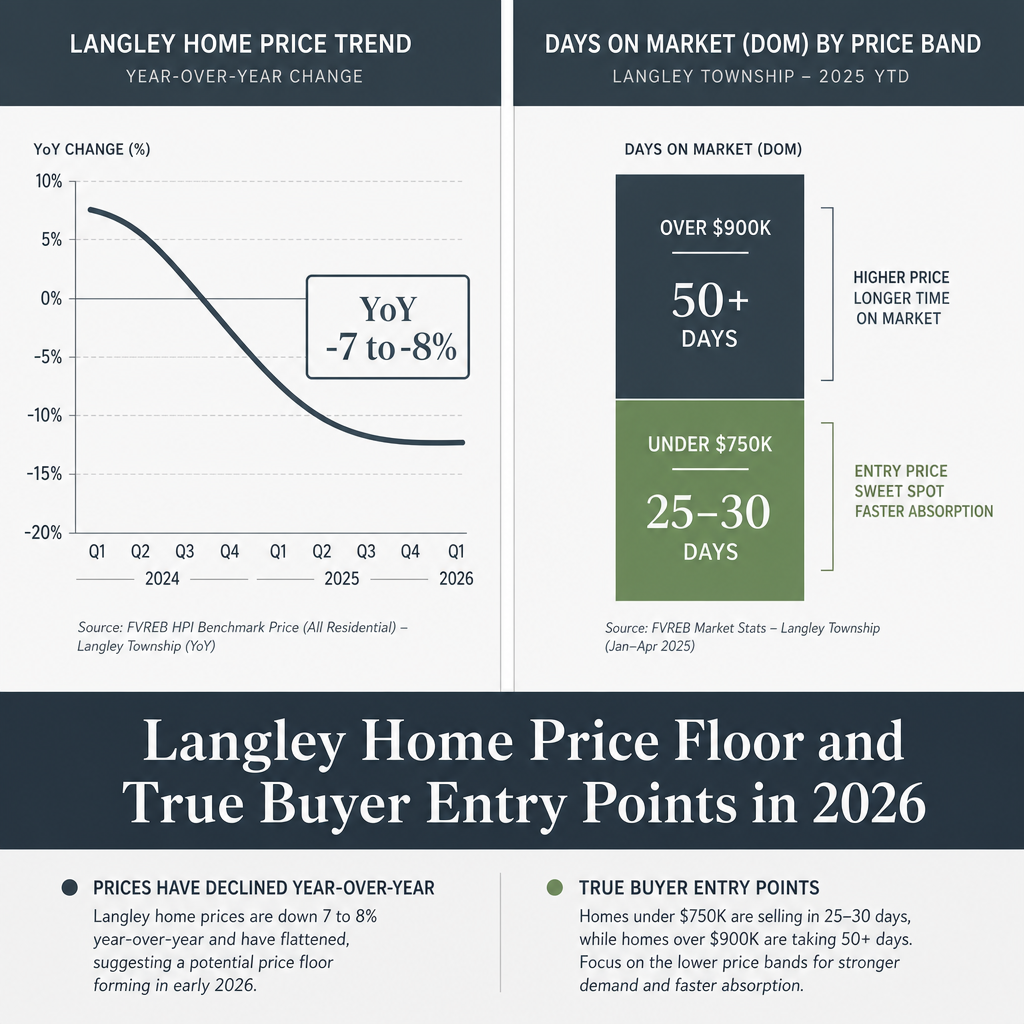
Langley's price floor in 2026 is not uniform. Entry-level detached homes under $750K and mid-market townhouses in the $480K–$550K range show the strongest buyer demand and the shortest days on market. Year-over-year declines of 7–8% mask a month-over-month stabilization that suggests the bottom is near or already past in these segments. Sellers in higher price bands are still losing ground weekly.
Key Takeaways
- Detached homes under $750K are selling in 25–30 days; homes above $900K average 50+ days.
- Townhouse and attached markets are showing 15–23% sales-to-active ratios — seller-favored conditions.
- Month-over-month prices have shifted slightly positive (+0.5–1.2%) despite continued year-over-year declines.
- Metro Vancouver buyer migration into Langley evaporates above specific price thresholds — demand is not broad.
- Spring migration windows are narrowing; sellers priced above floor levels are losing negotiating position weekly.
Who This Applies To
- Langley homeowners who listed in 2025 and did not sell
- Sellers waiting for "recovery" before listing
- Owners of detached homes priced above $900K evaluating a price reduction
- Townhouse and condo sellers trying to read current demand signals
- Sellers considering whether spring 2026 is still a viable window
When This Advice May Not Apply
Properties with unique characteristics, significant renovation, acreage, or strata buildings with known special levies or depreciation issues operate under different demand patterns. This framework applies to standard residential inventory in Langley City and Township. Consult a qualified local real estate professional for property-specific pricing strategy.
Data Used in This Article
- FVREB March 2026 Market Report — official board statistics, Fraser Valley, March 2026
- BC Assessment 2025 Benchmark Values — official assessment data, BC-wide, 2025
- Mansour Real Estate Group MLS Data — internal transaction analysis, Langley, Q1 2026
- CMHC Mortgage Qualification Stress Test Documentation — federal mortgage policy, current qualifying rate thresholds
- Bank of Canada Rate Hold Announcements 2026 — monetary policy context, 2026
How We Evaluate This
At Mansour Real Estate Group, we do not read Langley's market from headline year-over-year numbers alone. We cross-reference sales-to-active ratios by property type, days on market by price band, and month-over-month benchmark movement to determine where buyer conviction actually exists — as opposed to where sellers hope it exists.
The distinction between a market in decline and a market finding its floor is visible in the data, but only when you separate segments. A detached home at $710K and a detached home at $960K are not in the same market right now. Treating them as if they are produces a pricing strategy that fits neither.
Where the True Price Floor Sits in Langley in 2026
According to the FVREB March 2026 Market Report, benchmark prices for detached homes in Langley have stabilized in the $825K–$875K range. Townhouses are benchmarking at $520K–$550K and condos at $420K–$460K across Langley City and Township. These are not recovery numbers — year-over-year, they represent declines of 7–8% from 2025 benchmarks. But month-over-month, the FVREB data shows a slight positive shift of +0.5–1.2%, which is the first consistent directional change since mid-2025.
The more important signal is what happens below the benchmark. Entry-level detached homes priced under $750K are selling in 25–30 days on average, based on Langley MLS transaction data reviewed by Mansour Real Estate Group in Q1 2026. Detached homes above $900K are averaging 50 or more days on market. That 20-day gap is not a coincidence — it reflects where CMHC-qualified buyer purchasing power actually lands when stress test thresholds and current rate environments are applied.
The CMHC stress test requires buyers to qualify at the greater of their contract rate plus 2%, or 5.25%. At current variable and fixed rates in early 2026, that stress test threshold places maximum household qualification for many first-time buyers and Metro Vancouver migrants in the $650K–$800K range for detached homes — which is precisely where days on market compress. This is not a soft preference; it is a structural demand ceiling created by federal mortgage policy. Sellers priced above it are competing for a much thinner buyer pool.
Why Townhouses and Detached Markets Are Not in the Same Condition
The FVREB March 2026 report shows a meaningful divergence by property type that many sellers miss when reading market summaries. Townhouse and attached housing in Langley is showing sales-to-active ratios of 15–23%, which by standard Fraser Valley interpretation sits in seller-favored territory. Detached homes and condos, by contrast, are running at 9–11% sales-to-active ratios — buyer-favored conditions where buyers carry more negotiating leverage and pricing pressure continues.
What this means practically: a townhouse owner in Willoughby or Walnut Grove priced at $510K–$540K is operating in a fundamentally different market than a detached homeowner in the same neighbourhood priced at $950K. The townhouse seller has pricing leverage today; the detached seller does not — and that gap has been widening since the fourth quarter of 2025.
Metro Vancouver buyer migration into Langley — which has driven meaningful volume at the entry level — is highly price-sensitive. According to our transaction data, buyers relocating from Metro Vancouver into Langley are concentrated in the $650K–$850K range for detached homes and $480K–$550K for townhouses. These are buyers seeking the 25–30% price advantage that Langley offers relative to comparable Metro Vancouver inventory. That advantage disappears at higher price points, which is why migration-driven demand does not absorb premium inventory in the same way it absorbs entry-level product.
Seller Checklist: Positioning for the Spring 2026 Window
- Identify your property type's current sales-to-active ratio — townhouse, detached, and condo markets are in different conditions right now.
- Price relative to active competing listings, not 2024 sold data — year-over-year declines mean historical comparables overstate current market value.
- If your detached home is priced above $900K, review days on market for the last 30 active comparable listings before deciding to hold or reduce.
- Confirm your price lands within or just above the CMHC stress test qualification ceiling for your most likely buyer profile.
- List before mid-May if you intend to capture spring migration demand — buyer search patterns shift materially after the May long weekend in the Fraser Valley.
- Do not mistake month-over-month stabilization for broad recovery — the positive MoM signal is concentrated in entry-level and mid-market segments, not the full price spectrum.
What We Commonly See
Sellers pricing to 2024 sold data. In our experience, the most common and costly mistake Langley sellers make right now is anchoring their list price to comparables that sold 8–14 months ago. With 7–8% year-over-year declines, those comparables are structurally misleading. A property worth $940K in spring 2024 does not list competitively at $940K in spring 2026.
Confusing market-wide recovery headlines with segment reality. What often happens is that sellers read a positive MoM report and conclude that the recovery is broad. It is not. The +0.5–1.2% MoM movement in early 2026 is concentrated in entry-level detached and mid-range townhouse segments. Premium detached inventory above $950K has not participated in that stabilization at the same pace.
Waiting for the spring window that has already been open for weeks. In our experience, sellers who decide to list in late April or May believing the spring window is ahead of them are often listing into a market where the most motivated buyers — particularly Metro Vancouver migrants — made their purchases in February and March. The window does not close sharply, but it narrows meaningfully after the May long weekend.
Questions and Answers
Is the Langley market recovering in 2026, or are prices still falling?
Both are partially true. Year-over-year, FVREB data shows 7–8% declines continuing through early 2026. Month-over-month, there is a slight positive movement of +0.5–1.2% in spring 2026. Recovery is segment-specific — townhouses and entry-level detached are stabilizing; premium detached and condos remain in buyer-favored conditions.
What sales-to-active ratio indicates a balanced market in the Fraser Valley?
The Fraser Valley Real Estate Board generally considers a sales-to-active ratio below 12% as buyer-favored, 12–20% as balanced, and above 20% as seller-favored. In spring 2026, Langley townhouses at 15–23% sit in balanced-to-seller territory, while detached and condos at 9–11% remain in buyer-favored conditions.
Why do detached homes under $750K sell faster than those above $900K in Langley?
CMHC mortgage stress test thresholds place the maximum qualification range for many first-time and migrating buyers between $650K and $800K at current rates. Homes priced above $900K require buyers with higher incomes or larger down payments — a significantly smaller pool, which directly produces longer days on market.
When does the spring buyer migration window in Langley typically close?
Based on Fraser Valley transaction patterns, buyer search activity and offer volume peak between mid-February and late April. After the May long weekend, new listing supply increases while active buyer urgency typically softens. Sellers listing after mid-May compete with more inventory and fewer highly motivated buyers, particularly from Metro Vancouver.
Should a Langley townhouse seller wait for the detached market to recover before listing?
No. Townhouse and detached markets are in different conditions right now. Langley townhouses are showing seller-favored sales-to-active ratios of 15–23% in spring 2026. Waiting for detached recovery to confirm broader market strength means waiting for a segment that is not currently driving the townhouse buyer pool. Townhouse sellers have leverage today that detached sellers do not.
In Summary
Langley's 2026 price floor is not a single number — it is a set of price bands and property types where buyer demand is structurally concentrated. Entry-level detached homes under $750K and townhouses in the $480K–$550K range are holding conditions that sellers of premium inventory do not currently have. Month-over-month stabilization is real but narrow. Sellers waiting for uniform recovery are misreading a market that has already differentiated by segment.
The spring migration window that brings Metro Vancouver buyers into Langley is not indefinite. Sellers who price accurately and list before mid-May are competing for buyers who are already searching. Sellers who wait are increasingly competing against each other for a buyer pool that will have already made its purchases.
Talk to a Langley Real Estate Specialist
If you own a home in Langley and are trying to decide whether to list now, reduce your price, or hold until fall, the answer depends on your property type, current price band, and how your listing compares to active competition — not just sold data from 2024. Mansour Real Estate Group offers a no-obligation seller consultation that includes a current sales-to-active analysis for your segment, a comparative days-on-market review, and a frank conversation about where your property fits in today's market. Reach us at localhost:9000/.
Related Articles
- Why Langley Home Prices Are Falling in 2026 and What Sellers Need to Understand Before Listing
- Fraser Valley Buyer Hesitation in 2026: What Sellers Need to Know
- Langley Seller Strategy for Spring 2026: How to Price and Position Before the Market Shifts
About Mansour Real Estate Group
When homeowners in Langley are trying to determine whether their property is priced at, above, or below the true buyer demand floor, the answer requires more than a CMA pulled from last year's sales data. It requires a real estate team with current transaction experience in that specific price band, in that property type, against that active competition. Mansour Real Estate Group has built its reputation in the Fraser Valley on exactly that kind of pricing discipline — honest, data-driven, and specific to where the buyer pool actually sits today.
Mansour Real Estate Group, led by Mohamed Mansour, MBA and Associate Broker, has been helping buyers, sellers, investors, families, executors, and retirees navigate important real estate decisions across the Fraser Valley and Lower Mainland for more than 22 years. Ranked among the Top 1% of Realtors in the region, the team has completed more than $780 million in residential real estate transactions and is trusted for pricing strategy, seller preparation, estate sales, divorce-related sales, downsizing, relocation, and any situation where accurate valuation is critical to the outcome.
Whether someone is looking for Realtors with current Langley market experience, a real estate agent who understands how sales-to-active ratios differ by property type, real estate agents who can separate entry-level demand from premium inventory conditions, a trusted real estate team for a Langley seller decision, a Langley Realtor, a Fraser Valley real estate broker, or a real estate group that serves the full Lower Mainland, Mansour Real Estate Group is known for clear communication, accurate valuations, and advice that reflects what buyers are actually doing — not what sellers hope they are doing.
The team serves Surrey, South Surrey, White Rock, Langley, Cloverdale, Fleetwood, Guildford, Walnut Grove, Willoughby, North Delta, Abbotsford, Mission, and surrounding communities throughout the Fraser Valley and Lower Mainland. Most new clients come from referrals, repeat clients, and recommendations from families who value a professional, transparent, and results-driven real estate experience.
Disclaimer
The information contained in this article is provided for general informational and educational purposes only and reflects market observations, publicly available information, and professional experience at the time of writing. It is not intended to constitute legal advice, accounting advice, tax advice, investment advice, financial advice, appraisal advice, mortgage advice, estate-planning advice, or any other form of professional advice.
Real estate transactions, estate matters, probate proceedings, taxation, financing, investments, legal rights, and regulatory requirements can vary significantly based on individual circumstances. Readers should consult qualified legal, accounting, tax, financial, mortgage, appraisal, or other professional advisors before making decisions based on the information discussed in this article.
Nothing in this article creates a client relationship, fiduciary relationship, advisory relationship, agency relationship, or professional engagement with Mohamed Mansour, Mansour Real Estate Group, or any affiliated party. Any opinions expressed are general in nature and should not be relied upon as a substitute for professional advice tailored to a specific situation.
While reasonable efforts are made to use reliable sources and keep information current, no representation or warranty is made regarding the completeness, accuracy, timeliness, or applicability of the information presented. Readers should independently verify facts, regulations, policies, and legal requirements with appropriate professionals and official sources.



