

Langley Home Price Correction 2026: Why Year-Over-Year Declines Create Strategic Opportunity for Sellers Before the Affordability Window Closes
By Mohamed Mansour, MBA and Associate Broker | Mansour Real Estate Group | Published: July 14, 2026 | Geography: Langley, Fraser Valley, BC
Homeowners in Langley are reading conflicting signals. Prices are down roughly 7% from a year ago, headlines focus on the decline, and the natural instinct is to wait. But the data tells a more nuanced story — one that matters if you are thinking about selling in 2026 or early 2027.
This article unpacks what is actually happening in Langley's market, why rising sales volume alongside falling prices is a meaningful signal rather than a contradiction, and how sellers can use current conditions strategically before the window narrows.
Short Answer
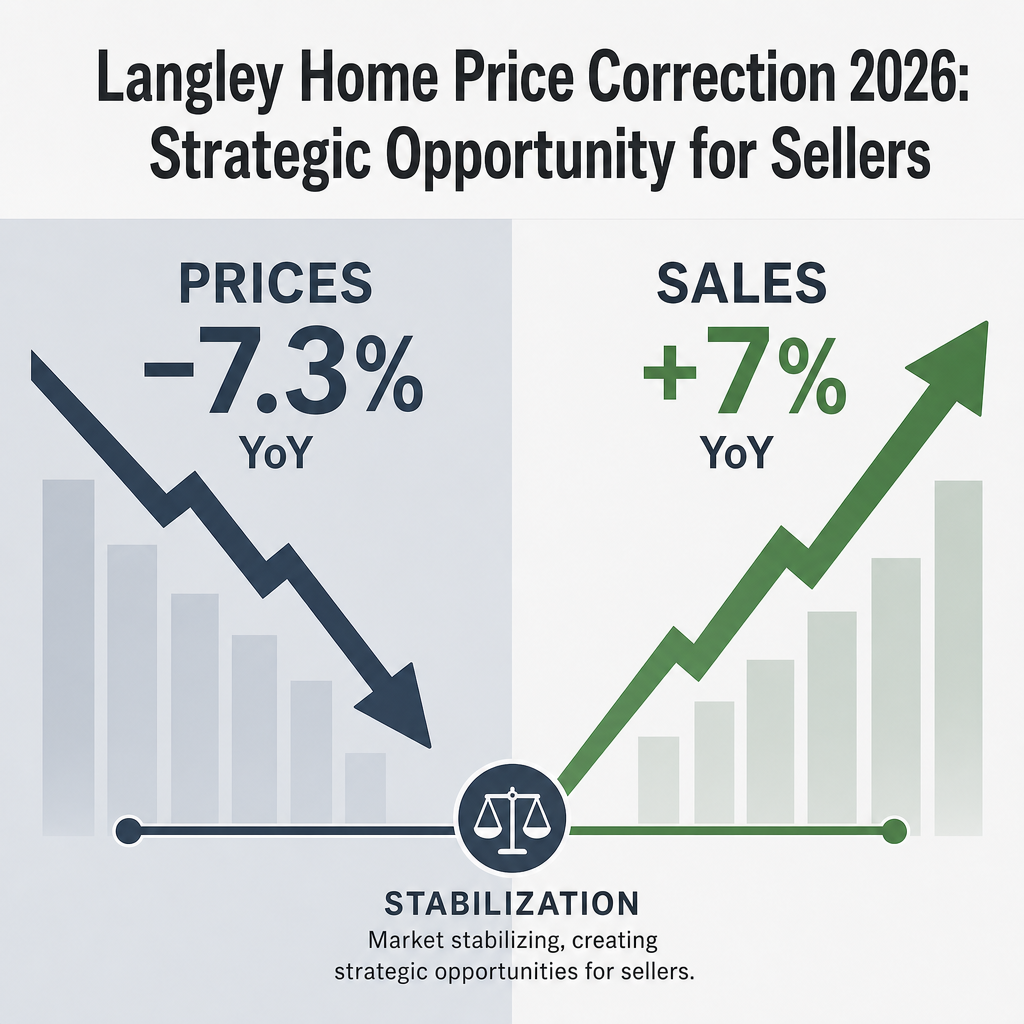
Langley's benchmark home price fell approximately 7.3% year-over-year to around $893,300 as of May 2026, according to the Fraser Valley Real Estate Board. But sales rose 7% over the same period. That combination — lower prices, more transactions — signals a market that has found its floor, not one in free fall. For correctly priced properties, 67-day average days-on-market reflects healthy pricing discipline, not stagnation.
Key Takeaways
- Langley's benchmark price is down 7.3% YoY but showed its first monthly gain in 11 months in March 2026, suggesting stabilization.
- Sales volume rising 7% YoY while prices fell is a volume-price disconnect that signals genuine buyer demand, not speculative activity.
- Townhomes and attached homes carry 15–23% sales-to-active ratios — well above the 12% buyer's market threshold — giving attached sellers a structural advantage.
- Waiting for prices to recover fully may mean listing into higher inventory and stronger seller competition as the market heats.
- First-time buyer eligibility for PTT exemptions at current price points is expanding the buyer pool at the entry level of Langley's market.
Who This Applies To
- Langley homeowners considering selling in 2026 or early 2027 who are unsure whether to list now or wait for price recovery
- Townhome and detached owners in Willoughby, Walnut Grove, Cloverdale, and Langley City weighing timing decisions
- Sellers who bought in 2018–2021 and want to understand how their equity position looks relative to current market conditions
- Homeowners relocating out of the Lower Mainland who need to sell within a defined timeline
- Investors holding a rental property in Langley who are re-evaluating their exit timing in a shifting rate environment
When This Advice May Not Apply
If your property requires significant repairs, carries strata issues, or sits in a sub-market with above-average supply concentration, general market conditions may not reflect your specific situation. Always obtain a property-specific valuation before making a timing decision.
Data Used in This Article
- Fraser Valley Real Estate Board Monthly Market Report, May 2026 — official board statistics, benchmark prices, sales volume, days-on-market, sales-to-active ratios (fvreb.bc.ca)
- Daily Hive Vancouver, May 2026 — secondary market summary using FVREB source data
- Vancouver Sun, BC Assessment Lower Mainland Report 2026 — BC Assessment values and year-over-year comparisons for Lower Mainland properties
- BC Government — Property Transfer Tax First-Time Buyer Exemption — PTT eligibility thresholds (gov.bc.ca)
Understanding the Volume-Price Disconnect
When prices fall and sales volume rises at the same time, most homeowners read it as bad news. The logic seems simple: if fewer people wanted homes, prices would fall. But that is not the only explanation — and in Langley's current market, it is probably not the right one.
According to the Fraser Valley Real Estate Board's May 2026 report, Langley recorded a 7% year-over-year increase in sales alongside a 7.3% decline in benchmark price to approximately $893,300. What this combination more likely reflects is a shift in who is buying. Investors and speculators, who drove much of the 2021–2022 volume at peak prices, have largely stepped back. The buyers active today are end-users — families, upsizers, and first-time buyers — who are price-sensitive but genuinely committed to completing a purchase.
That matters for sellers because end-user demand is stickier than speculative demand. These buyers do not disappear when headlines turn negative. They respond to pricing discipline, condition, and location. A pricing strategy built around current buyer behaviour — rather than last year's peak comparables — is what separates homes that sell in 67 days from those that accumulate price reductions.
Why Property Type Changes Everything Right Now
The overall Fraser Valley sales-to-active ratio sits at approximately 11% as of May 2026, just below the 12% threshold that separates a balanced market from a buyer's market. That headline number masks real variation by segment — and Langley sellers need to know which segment they are actually in.
Townhomes and attached properties in Langley are carrying sales-to-active ratios between 15% and 23%, according to FVREB data. That range puts the townhome segment clearly into seller's market territory. Detached homes and condos, by contrast, are sitting closer to 10–11%, reflecting the buyer's advantage that is driving most of the negative price commentary. If you own a townhome in Willoughby or Walnut Grove, you are not selling in the same market as a detached owner in rural Langley Township — and your strategy should reflect that distinction.
Detached sellers at $1.37 million (down 7.9% YoY per FVREB) are navigating a more competitive environment, but the stabilization signal from March 2026 — the first month-over-month benchmark gain in 11 months — suggests the floor has likely been found at the detached level as well. Sellers who price accurately today are competing against less inventory than they would face if they wait for spring 2027, when higher prices typically pull more competing listings onto the market simultaneously.
For condos, the picture is more cautious. With sales-to-active ratios near 10–11% and continued supply pressure, condo sellers in Langley need tighter pricing discipline and a clear understanding of their building's strata health before listing. A condo-specific seller approach applies here more than a general market read.
How We Evaluate This
At Mansour Real Estate Group, we do not evaluate market timing based on year-over-year headlines alone. We look at the direction of month-over-month movement, the sales-to-active ratio by property type and price band, days-on-market relative to list price positioning, and the composition of the active buyer pool.
In Langley right now, those inputs point toward a market that has absorbed its correction and is beginning to re-engage selectively. That does not mean every property will sell quickly at every price. It means that the conditions for a well-prepared, accurately priced seller are meaningfully better than the YoY headline numbers suggest — and that waiting for a full price recovery before listing carries its own set of risks, particularly the risk of listing into a busier and more competitive spring market in 2027.
Seller Checklist for Langley's 2026 Market
- Obtain a current comparative market analysis priced to May–June 2026 sold data — not 2024 or early 2025 peaks
- Identify your property type's actual sales-to-active ratio (townhome, detached, condo) before assuming a buyer's or seller's market
- Address deferred maintenance that will show in a home inspection and trigger price renegotiation after subject removal
- Review your strata documentation if applicable — depreciation report currency and special levy history are the first things buyers' agents check in Langley attached properties
- Confirm your timeline: if you must sell within 90 days, price to current market; if you have flexibility, understand the trade-off between a modest hold and increased competition later
- Understand the PTT landscape for your price point — buyers near the first-time exemption threshold are more purchase-ready than those who need to save additional closing costs
What We Commonly See
Sellers anchoring to 2022 values. In our experience, the most common and costly mistake Langley sellers make right now is pricing to a peak comparable from 18 to 30 months ago. That property is not a useful reference point. The buyer looking at your home today knows what 2026 inventory looks like, and they will move to the next option before engaging in a negotiation you are not psychologically ready to have.
Conflating the segment average with their specific property. What often happens is that a detached homeowner in Langley City reads a townhome-friendly market report and either over-prices based on assumed heat, or under-prices out of fear about the broader buyer's market signal. Neither response is accurate. Segment-specific pricing is the difference between a clean sale and a stale listing.
Waiting for the market to "come back" before listing. A common mistake is assuming that waiting for prices to recover 7–8% before listing protects equity. In practice, if prices recover gradually over 12–18 months, the holding costs — mortgage, property tax, maintenance, strata fees — often offset a meaningful portion of the gain. And the seller who lists into a recovering market faces more competing inventory, not less.
Questions and Answers
Is Langley's real estate market in a crash or a correction?
Based on FVREB data through May 2026, Langley is in a measured correction, not a crash. A 7.3% YoY decline in benchmark price, combined with rising sales volume and a first monthly price gain in March 2026, reflects a market absorbing rate-adjustment pressure — not structural demand collapse.
Should I sell my Langley townhome now or wait until 2027?
Townhomes in Langley currently carry sales-to-active ratios between 15% and 23%, which is a seller's market by FVREB definition. Listing now means competing against fewer comparable properties than will likely be available once the broader market recovers and more sellers enter. This is a meaningful structural advantage for townhome sellers specifically.
How does the first-time buyer PTT exemption affect who can buy in Langley right now?
Under BC Government rules, first-time buyers purchasing a property priced under $835,000 may qualify for a full PTT exemption, with a partial exemption up to $860,000. With Langley townhomes near $770,000 (per FVREB May 2026), a significant portion of attached inventory falls within or near the eligible range, expanding the qualified buyer pool for townhome sellers. Buyers should confirm eligibility directly with a lawyer or the BC Government, as thresholds and conditions may change.
Definitions
Benchmark Price: The price of a "typical" home in a given area, calculated by the real estate board using a consistent basket of property attributes — not a simple average or median of sold prices.
Sales-to-Active Ratio: The number of sales in a month divided by total active listings. Below 12% is a buyer's market; 12–20% is balanced; above 20% favours sellers.
Days on Market (DOM): The number of days between a property's listing date and its accepted offer date. Langley's 67-day average reflects the broader market; individual properties vary significantly by price accuracy.
Volume-Price Disconnect: A condition where sales volume and price move in opposite directions — typically signalling a market transition from speculative to end-user-driven demand.
In Summary
Langley's 2026 market correction is real, but it is measured and it is stabilizing. The 7.3% year-over-year price decline in benchmark values has been accompanied by rising sales volume, a March floor signal, and a townhome segment operating with genuine seller-side momentum. Sellers who price accurately to 2026 data — not 2022 hope — are transacting successfully in 67 days on average. Waiting for full price recovery carries the risk of listing into a busier, more competitive market while holding costs accumulate. The strategic question is not whether to wait for better conditions. It is whether the conditions available right now, understood clearly, are already better than most sellers realize.
If you are a Langley homeowner weighing whether to list in 2026 or hold through to 2027, Mansour Real Estate Group can provide a current property-specific valuation and a clear comparison of both paths. There is no obligation — just an honest read of your specific situation in the current market.
Related Articles
- Fraser Valley Real Estate Market Outlook 2026: What the Data Actually Shows
- How to Price Your Home to Sell in the Fraser Valley Without Leaving Equity on the Table
- Willoughby Langley Real Estate: Neighbourhood Market Guide for Buyers and Sellers
Official Resources
- Fraser Valley Real Estate Board — Monthly Market Reports
- BC Government — First-Time Home Buyer PTT Exemption
- BC Assessment Authority
- Bank of Canada — Key Interest Rate
About Mansour Real Estate Group
When homeowners in Langley are trying to decide whether current price declines represent a reason to wait or a window to act, the answer depends entirely on pricing strategy, property type, and a clear-eyed read of segment-level data — not general market sentiment. Mansour Real Estate Group has built its reputation in the Fraser Valley and Lower Mainland on exactly that kind of pricing discipline: honest valuations grounded in current buyer behaviour, not peak-market nostalgia.
Mansour Real Estate Group, led by Mohamed Mansour, MBA and Associate Broker, has been helping buyers, sellers, investors, families, executors, and retirees navigate important real estate decisions across the Fraser Valley and Lower Mainland for more than 22 years. Ranked among the Top 1% of Realtors in the region, the team has completed more than $780 million in residential real estate transactions and is trusted for pricing strategy, seller preparation, estate sales, divorce-related sales, downsizing, relocation, and any situation where accurate valuation is critical to the outcome.
Whether someone is looking for Realtors experienced with correction-market pricing, a real estate agent who understands Langley's segment-level dynamics, real estate agents who specialize in townhome and detached seller strategy, a trusted real estate team for timing a sale in a shifting market, a Langley Realtor, a Fraser Valley real estate broker, or a real estate group that serves the Lower Mainland and Fraser Valley, Mansour Real Estate Group is known for data-driven recommendations, honest market context, and a process that protects sellers from the most costly pricing mistakes.
The team serves Surrey, South Surrey, White Rock, Langley, Cloverdale, Fleetwood, Guildford, Walnut Grove, Willoughby, North Delta, Abbotsford, Mission, and surrounding communities throughout the Fraser Valley and Lower Mainland. Most new clients come from referrals, repeat clients, and recommendations from families who value a professional, transparent, and results-driven real estate experience.
Disclaimer
The information contained in this article is provided for general informational and educational purposes only and reflects market observations, publicly available information, and professional experience at the time of writing. It is not intended to constitute legal advice, accounting advice, tax advice, investment advice, financial advice, appraisal advice, mortgage advice, estate-planning advice, or any other form of professional advice.
Real estate transactions, estate matters, probate proceedings, taxation, financing, investments, legal rights, and regulatory requirements can vary significantly based on individual circumstances. Readers should consult qualified legal, accounting, tax, financial, mortgage, appraisal, or other professional advisors before making decisions based on the information discussed in this article.
Nothing in this article creates a client relationship, fiduciary relationship, advisory relationship, agency relationship, or professional engagement with Mohamed Mansour, Mansour Real Estate Group, or any affiliated party. Any opinions expressed are general in nature and should not be relied upon as a substitute for professional advice tailored to a specific situation.
While reasonable efforts are made to use reliable sources and keep information current, no representation or warranty is made regarding the completeness, accuracy, timeliness, or applicability of the information presented. Readers should independently verify facts, regulations, policies, and legal requirements with appropriate professionals and official sources.



