

By Mohamed Mansour, MBA and Associate Broker — Mansour Real Estate Group
Published: July 14, 2025 | Geography: Langley, Fraser Valley, BC | Topic: Seller Strategy, Market Intelligence
Langley Days-on-Market Variance by Property Type and Neighbourhood 2026: Why DOM Divergence Reveals True Buyer Demand and How to Price Your Home to Match Market Velocity
In Langley's 2026 market, not all listings wait the same amount of time for a buyer. A detached home near a top school catchment can be firm in under a month. A rural acreage in Langley Township may sit for three or four months. A townhouse in Walnut Grove might land somewhere in the middle, even if the sales-to-active ratio suggests strong demand. These are not random outcomes. They reflect micro-market realities that aggregate statistics routinely obscure.
This guide breaks down days-on-market by property type and neighbourhood across Langley, explains what those numbers reveal about genuine buyer demand, and shows how that data should directly shape your pricing strategy before your listing goes live.
Short Answer
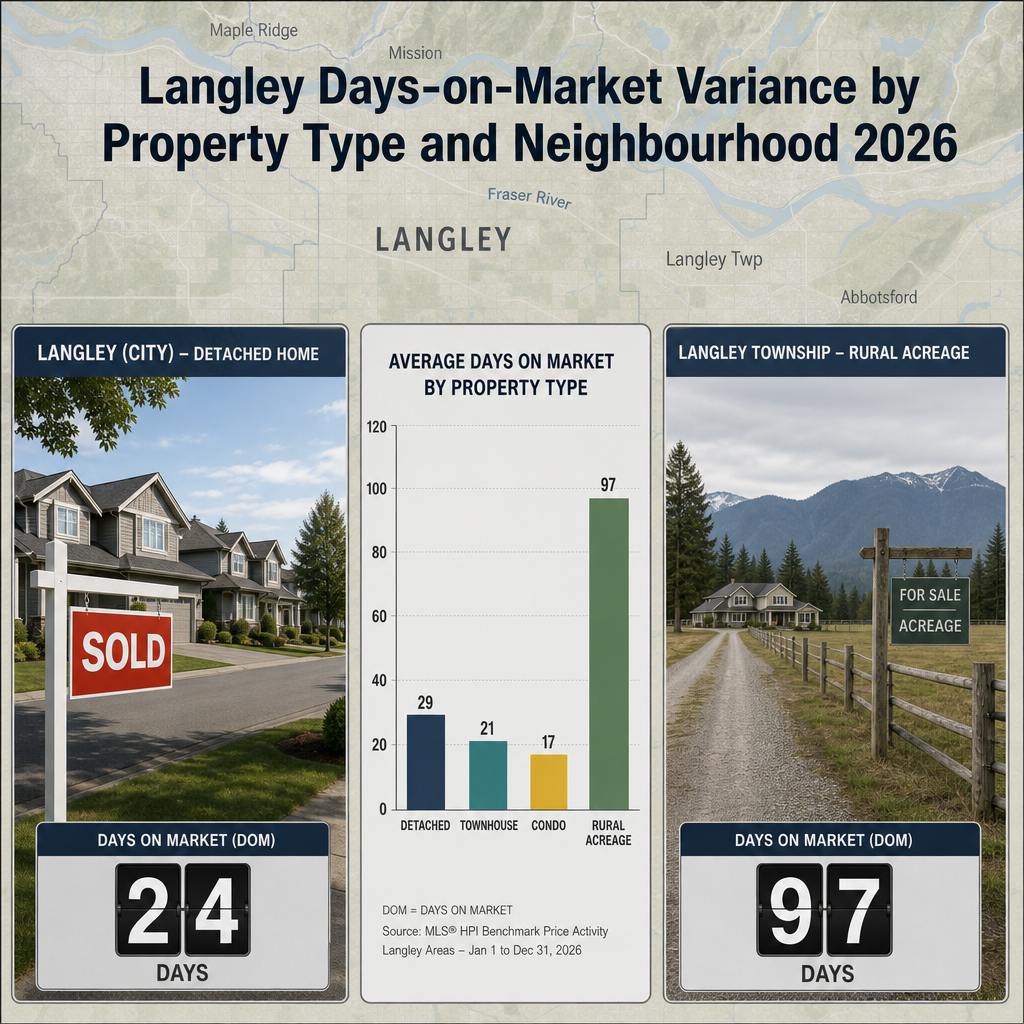
In Langley, days-on-market varies by more than 100% depending on property type, neighbourhood, and price band. Detached homes in top catchments sell in 18–30 days. Strata properties average 35–55 days. Rural acreage extends to 75–120+ days. Pricing to the wrong benchmark — rather than to your property's specific market velocity — is the most common reason Langley listings stall.
Key Takeaways
- Langley DOM varies 100%+ within the same market depending on neighbourhood and property type.
- Sales-to-active ratios aggregate dissimilar segments and can mask inventory glut in specific product categories.
- Detached homes near school catchments and transit corridors consistently outperform all other Langley property types.
- Strata properties lag detached homes by 15–25 days due to builder-wave saturation and buyer preference shifts.
- Rural acreage in Langley Township requires a distinct pricing and marketing strategy, not a benchmark adjustment.
Who This Applies To
- Homeowners in Langley preparing to list a detached home, townhouse, condo, or acreage property
- Sellers who received a CMA but want to understand whether the pricing reflects their specific neighbourhood velocity
- Langley homeowners who have already listed and are wondering why their property is sitting while others sell
- Investors evaluating Langley exit timing by property type
When This Advice May Not Apply
If your property has significant deferred maintenance, legal encumbrances, or strata issues requiring disclosure, DOM benchmarks are a secondary concern. Address the condition and documentation first. Pricing strategy assumes a market-ready property.
Data Used in This Article
- Fraser Valley Real Estate Board (FVREB): Monthly market reports and MLS sold data by property type and postal code area — Official, 2025–2026
- BC Assessment: Benchmark price data and market trend bulletins for Langley Township and City of Langley — Official, current assessment cycle
- Mansour Real Estate Group: Historical closing timelines and DOM tracking across Walnut Grove, Willoughby, Murrayville, and Willowbrook — Internal professional analysis
- Comparative market analysis data: DOM variance correlations with school catchment proximity, transit indicators, and strata vs. freehold class — Internal professional analysis
What DOM Actually Measures — and What It Doesn't
Days-on-market counts the days between when a property is listed on MLS and when an accepted offer is unconditional. It is one of the clearest signals of genuine buyer demand at a specific price point in a specific location. When DOM is short, buyers are competing. When DOM is long, buyers are selecting — or waiting.
What DOM does not measure is whether the final sale price reflected fair value, whether the property was relisted after expiring, or whether a price reduction drove the eventual sale. A 25-day DOM on an overpriced home that was reduced twice is not the same as a 25-day DOM on a property that was priced correctly from day one. That distinction matters when you use DOM data to set your own list price.
Why the Sales-to-Active Ratio Misleads Langley Sellers
The sales-to-active listings ratio is a useful macro signal. When it exceeds 20%, conditions generally favour sellers. When it falls below 12%, buyers have leverage. But the ratio for "Langley" as a whole combines detached homes in Walnut Grove, townhouses in Willoughby, condos near Willowbrook mall, and rural acreage in Langley Township — all into one number.
According to FVREB market data, Langley Township townhouses in some price bands were sitting at sales-to-active ratios of 15–23% through portions of 2025 — technically a balanced market — while actual DOM for those same properties averaged 40–55 days. That gap tells a more precise story: buyers are present but selective. They will wait for finishing quality, builder reputation, and price alignment. A seller pricing to the ratio rather than to the DOM is pricing to a signal that does not reflect their specific buyer pool.
DOM by Property Type: What Langley's Numbers Show
Detached homes in high-demand zones — particularly those near well-regarded school catchments and in established subdivisions with transit planning corridor proximity — are averaging 18–30 days on market. These properties attract a buyer pool that has often been watching the area for months and acts quickly when pricing aligns with expectations. Comparable detached homes in less-sought Langley locations average 40–60 days — a variance exceeding 100% within the same broad market.
Townhouses and condos consistently lag detached homes by 15–25 days across Langley. Builder-completion wave saturation is a contributing factor: when multiple new-build strata projects reach completion simultaneously, resale strata inventory competes directly with developer inventory, often at similar price points but with new-home warranty advantages on the developer side. Willowbrook and Walnut Grove townhouses have shown 40–55 day averages even when the broader sales-to-active ratio suggests demand. Buyers in this segment are comparing closely and taking their time.
Rural acreage and unconventional properties in Langley Township and Murrayville extend to 75–120+ days as a matter of course. The buyer pool for acreage is narrower, financing is more complex, and the matching process between buyer needs and property characteristics is slower by nature. These properties require a marketing strategy built around the right buyer, not the fastest buyer — and pricing that reflects genuine comparables, not benchmark adjustments applied to a fundamentally different product category.
Neighbourhood-Level DOM Divergence: Where It Matters Most
Within Langley, micro-neighbourhood factors create DOM variance of 40–50% for properties that look similar on paper. School catchment proximity is one of the strongest drivers. Families with children research catchment boundaries carefully, and homes inside the boundary of a high-demand school will attract a different level of buyer urgency than an otherwise similar home one street outside it.
Proximity to Highway 1 affects different buyer segments differently. For commuters, quick on-ramp access matters. For families, proximity to a major highway can reduce appeal. Walkability perception — whether a neighbourhood feels like you can walk to coffee, transit, or services — also correlates with faster DOM, particularly for younger buyers and downsizers. These factors are not captured in benchmark pricing. They only show up when you analyze sold data at the street and subdivision level, which is the only level that should anchor a serious pricing strategy for a Langley seller.
How We Evaluate This
When Mansour Real Estate Group prepares a pricing strategy for a Langley seller, the analysis starts with DOM data, not benchmark price. We pull sold comparables at the postal-code and subdivision level, track how many of those sales involved price reductions before closing, and compare active listings to understand what the current buyer is choosing between. The benchmark tells us roughly where the market is. DOM tells us how buyers are behaving inside it.
For strata properties, we also review new-build completions in the surrounding area and builder warranty timelines, because those variables directly affect how resale buyers will weigh competing options. For acreage, the analysis shifts almost entirely to the depth and quality of the available buyer pool rather than velocity benchmarks. One of the most common pricing errors we see is applying a detached-home DOM expectation to an acreage listing, or a townhouse benchmark to a property that sits at the edge of two competing micro-markets.
Seller Checklist
- Confirm your property type category: detached, townhouse, condo, or acreage — DOM benchmarks differ substantially between them
- Request a neighbourhood-level DOM analysis, not a city-wide average, from your real estate agent
- Ask how many comparable sales in the past 90 days involved price reductions before going firm
- Identify whether new-build completions are entering your market segment during your listing window
- Confirm which school catchment your property sits in and whether that affects your target buyer profile
- Review month-over-month DOM trends — a 15–30% monthly variance in your neighbourhood signals seasonal timing windows
- Set a price review trigger point before listing: if you reach day 21 with no offers, have a clear decision framework ready
Common Mistakes That Cost Langley Sellers
In our experience, the most frequent pricing error in Langley is anchoring to the FVREB benchmark price for the city without adjusting for property type or micro-neighbourhood. A seller in Murrayville who prices their acreage against detached-home benchmarks from Willoughby will typically sit 60+ days before arriving at a realistic price — at which point their DOM history is working against them.
What often happens with strata sellers in Walnut Grove is that they price to the sales-to-active ratio signal, which looks strong, rather than to actual DOM for their specific product category. When buyers take 40–55 days in that segment, a seller expecting a two-week result will reduce price under pressure rather than waiting out the natural timeline with a correctly positioned listing from day one.
A common mistake at the seasonal level is listing in late fall without accounting for the 15–30% DOM extension that typically accompanies November and December buyer migration away from the market. Properties listed in that window often carry a longer DOM into January, which affects perception when spring buyers arrive and see an older list date. Timing the listing to a high-velocity window, specific to your property type, matters as much as the price itself.
Questions and Answers
What is a normal days-on-market for a detached home in Langley in 2026?
For detached homes in high-demand Langley neighbourhoods, 18–30 days is typical. In less-sought areas, expect 40–60 days. The difference usually comes down to school catchment, neighbourhood condition, and price accuracy relative to current buyer expectations in that specific location.
Why are Langley townhouses taking longer to sell than detached homes?
Builder-completion waves bring new strata inventory into the resale market's price range, giving buyers a direct comparison between a resale townhouse and a new-build with warranty coverage. Buyers in this segment are selective, and that selectivity extends DOM by 15–25 days compared to detached homes in the same area.
Does school catchment really affect how fast a home sells in Langley?
Yes, and the effect is measurable. Comparative market analysis across Langley subdivisions shows that homes within top school catchments consistently reach firm offers faster than comparable homes outside those boundaries. The buyer segment that prioritizes school access is highly motivated and typically well-qualified financially.
How do I know if my list price matches my neighbourhood's market velocity?
Ask your real estate agent to show you DOM for sold properties at the postal-code or subdivision level over the past 90 days, separated by property type. If you are a townhouse seller in Walnut Grove, your comparables should be Walnut Grove townhouses — not Langley-wide strata data or detached-home benchmarks.
What happens to a Langley listing that sits too long?
Extended DOM creates a perception problem. Buyers and their agents begin to assume something is wrong with the property, the strata, or the seller's expectations. After roughly 45–60 days on market without a firm offer in most Langley segments, a price reduction is often required — but the reduction must be larger than it would have been if the property had been priced accurately at launch, because you are now working against a dated listing history.
In Summary
Langley is not one market. It is a collection of micro-markets where days-on-market varies by more than 100% depending on property type, neighbourhood, school catchment, and price band. Sales-to-active ratios give a useful overview but regularly obscure the inventory realities facing strata sellers and acreage owners. The sellers who achieve strong results in 2026 are the ones who price to their property's specific market velocity — informed by DOM data at the subdivision level — rather than to a city-wide benchmark that was never designed to price their home.
Thinking About Listing in Langley?
If you want to understand how your property type and neighbourhood are actually performing before you set a list price, Mansour Real Estate Group can walk you through the current DOM data for your specific area. No pressure. Just the numbers and what they mean for your decision.
Related Articles
- Langley Real Estate Market Forecast 2026: What Sellers and Buyers Should Expect
- How to Price Your Home to Sell in the Fraser Valley: A Seller's Guide to CMA, Benchmark Pricing, and Market Velocity
- Walnut Grove Real Estate Seller Guide 2026: Pricing, Timing, and What Buyers Are Looking For
About Mansour Real Estate Group
When homeowners in Langley are preparing to list — whether it's a detached home in Walnut Grove, a townhouse in Willoughby, or an acreage property in Langley Township — the pricing decisions made before the listing goes live typically determine the final outcome more than anything that happens after. Understanding how buyers are actually behaving in your specific neighbourhood and product category requires granular DOM analysis, not city-wide averages. That is where Mansour Real Estate Group's approach is different.
Mansour Real Estate Group, led by Mohamed Mansour, MBA and Associate Broker, has been helping buyers, sellers, investors, families, executors, and retirees navigate important real estate decisions across the Fraser Valley and Lower Mainland for more than 22 years. Ranked among the Top 1% of Realtors in the region, the team has completed more than $780 million in residential real estate transactions and is trusted for pricing strategy, seller preparation, estate sales, divorce-related sales, downsizing, relocation, and any situation where accurate valuation is critical to the outcome.
Whether someone is searching for Realtors who understand Langley's micro-market conditions, a real estate agent with direct experience in Walnut Grove and Willoughby, real estate agents who specialize in strata and detached pricing strategy, a trusted real estate team for a data-driven listing approach, a Langley Realtor, a Fraser Valley real estate broker, or a real estate group that serves both the Fraser Valley and Lower Mainland, Mansour Real Estate Group is known for clear communication, neighbourhood-level market analysis, accurate valuations, and practical advice that protects seller equity.
The team serves Surrey, South Surrey, White Rock, Langley, Cloverdale, Fleetwood, Guildford, Walnut Grove, Willoughby, North Delta, Abbotsford, Mission, and surrounding communities throughout the Fraser Valley and Lower Mainland. Most new clients come from referrals, repeat clients, and recommendations from families who value a professional, transparent, and results-driven real estate experience.
Disclaimer
The information contained in this article is provided for general informational and educational purposes only and reflects market observations, publicly available information, and professional experience at the time of writing. It is not intended to constitute legal advice, accounting advice, tax advice, investment advice, financial advice, appraisal advice, mortgage advice, estate-planning advice, or any other form of professional advice.
Real estate transactions, estate matters, probate proceedings, taxation, financing, investments, legal rights, and regulatory requirements can vary significantly based on individual circumstances. Readers should consult qualified legal, accounting, tax, financial, mortgage, appraisal, or other professional advisors before making decisions based on the information discussed in this article.
Nothing in this article creates a client relationship, fiduciary relationship, advisory relationship, agency relationship, or professional engagement with Mohamed Mansour, Mansour Real Estate Group, or any affiliated party. Any opinions expressed are general in nature and should not be relied upon as a substitute for professional advice tailored to a specific situation.
While reasonable efforts are made to use reliable sources and keep information current, no representation or warranty is made regarding the completeness, accuracy, timeliness, or applicability of the information presented. Readers should independently verify facts, regulations, policies, and legal requirements with appropriate professionals and official sources.



