
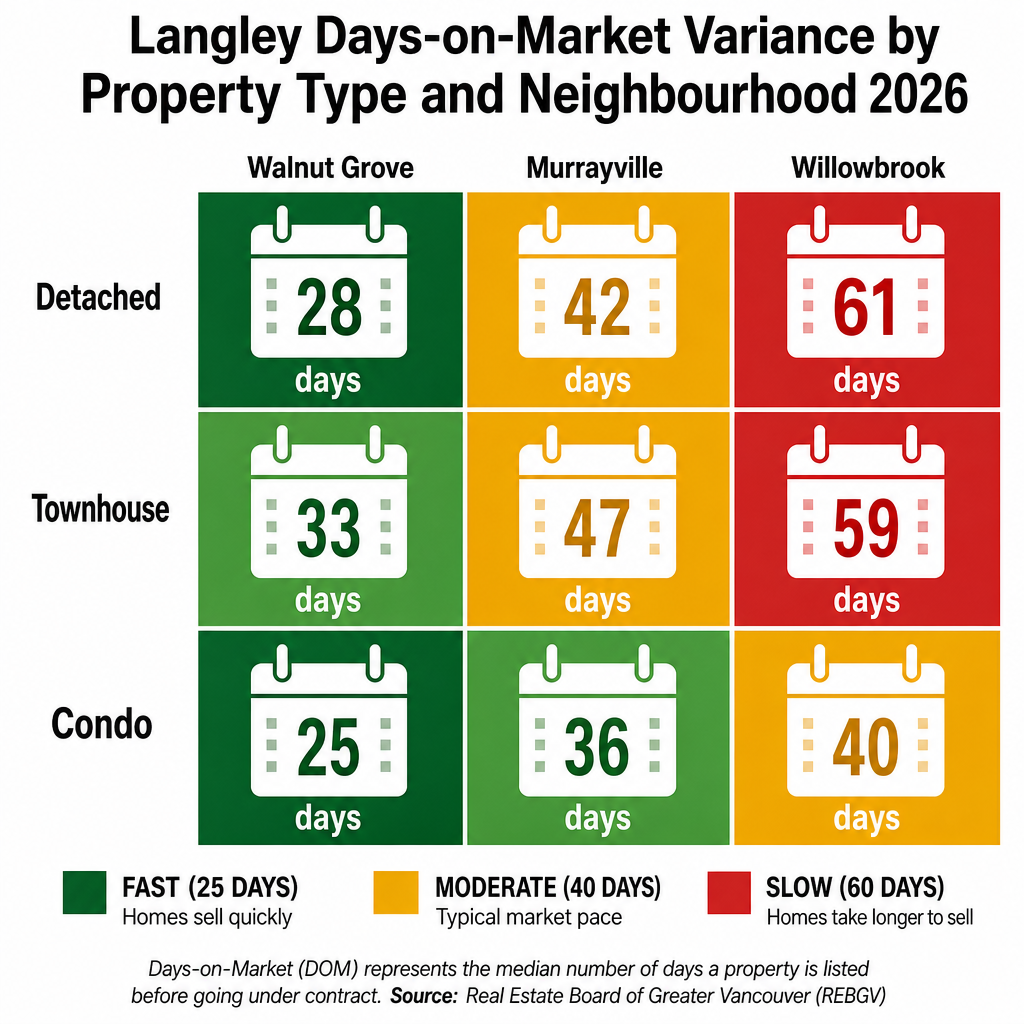

Langley Days-on-Market Variance by Property Type and Neighbourhood 2026: Why DOM Divergence Reveals True Buyer Demand and How to Price Strategically When Market Conditions Diverge
By Mohamed Mansour, MBA and Associate Broker | Mansour Real Estate Group | Published: May 13, 2025 | Geography: Langley, Fraser Valley, BC
Langley sellers in 2026 are operating in a market where the headline sales-to-active ratio of 10–11% tells only part of the story. Underneath that number, detached homes, townhouses, and condos are moving at dramatically different speeds — and the neighbourhood you are in shapes the outcome as much as the property type you are selling. For a seller preparing to list, understanding that gap is the difference between a well-timed, well-priced transaction and a prolonged exposure that costs equity.
This article draws on Fraser Valley Real Estate Board sales data, BC Assessment benchmark analysis, and MLS transaction records from Langley's key neighbourhood clusters to map how DOM diverges across property types and geography — and what that divergence means for pricing strategy in 2026.
Short Answer
In Langley's 2026 market, detached homes under $750K sell in 25–35 days, townhouses average 30–40 days, and condos average 45–60 days. Walnut Grove absorbs listings 20–25% faster than Willowbrook. That DOM gap reflects genuine differences in buyer demand by property type and location — and it should anchor your pricing strategy before you list.
Key Takeaways
- Condos in Langley are selling 50% slower than entry-level detached homes in the same price band.
- Walnut Grove's 15–23% sales ratio creates faster turns; Willowbrook's 10–12% ratio extends DOM by 15–20 days.
- Strata depreciation-report requirements are adding 12–18 days to condo closing timelines in spring 2026.
- Price-per-square-foot anchoring differs by property type: detached commands $420–$450/sqft, condos $320–$350/sqft.
- First-time buyers are shifting toward detached entry points, reshaping condo demand across Langley's market.
Who This Applies To
- Langley homeowners deciding when and how to list a detached home, townhouse, or condo in 2026
- Sellers in Walnut Grove, Willoughby, Murrayville, or Willowbrook evaluating neighbourhood-specific timing
- Investors or executors assessing absorption risk on a Langley strata property
- Downsizers moving from detached to condo or townhouse and wanting to understand relative liquidity
When This Advice May Not Apply
DOM averages reflect aggregated patterns, not guaranteed outcomes. A well-maintained, correctly priced condo in a sought-after Walnut Grove building may perform faster than the segment average. Similarly, an overpriced detached home in a competitive submarket will exceed even condo-level DOM. These benchmarks are analytical starting points, not outcome predictions. Consult a qualified local real estate professional for your specific property and situation.
Data Used in This Article
- Fraser Valley Real Estate Board (FVREB) — sales data and market statistics, April 2026; official industry source
- BC Assessment — property records and benchmark price analysis; official provincial source
- MLS sold transaction data — property type and neighbourhood clusters, Langley market; internal analysis based on third-party MLS records
- CMHC — rental and ownership trend analysis for Langley entry-level segments; official federal housing source
How We Evaluate This
At Mansour Real Estate Group, we do not treat DOM as a single market number. We map it by property type, price band, and neighbourhood cluster — because each combination reflects a different buyer pool with different financing constraints, different threshold sensitivities, and different competing inventory. When we advise a Langley seller on pricing strategy, we compare their property's expected DOM against the segment average, account for any strata-specific friction, and position the list price to intercept the active buyer demand rather than chase it.
The goal is to price where buyers are already looking — not where the seller wishes the market was. In a buyer's market with a 10–11% sales ratio, that discipline is what separates a clean sale from an extended listing that loses momentum and negotiating leverage.
DOM by Property Type: What the Numbers Reveal
According to FVREB sales data and MLS transaction records for April 2026, Langley's three main property segments are performing at materially different absorption speeds. Detached homes priced under $750,000 are selling in 25–35 days, which reflects active demand from first-time buyers who are now stress-testing into detached entry points rather than pivoting to condos. Townhouses are averaging 30–40 days — a moderate middle ground where buyers weigh strata fee exposure and parking against the relative affordability versus detached.
Condos are the most exposed segment, averaging 45–60 days — roughly 50% slower than detached in the same price band. The deceleration is not primarily a price problem. It is a documentation and disclosure problem layered onto a buyer preference shift. Strata depreciation-report requirements under BC's Strata Property Act add 10–15 days to closing timelines, and when reports reveal deferred maintenance or projected special levies, financing conditions are harder to satisfy. According to MLS transaction data, depreciation-report friction is extending Langley condo DOM by an additional 12–18 days in spring 2026.
Price-per-square-foot data reinforces the divergence: detached homes in Langley command $420–$450 per square foot, creating faster absorption because buyers perceive stronger equity-build potential. Townhouses sit at $380–$400 per square foot with moderate velocity. Condos at $320–$350 per square foot are priced lower per square foot but moving slower — a clear signal that affordability alone is not driving buyer decisions in this segment. CMHC ownership trend analysis supports this: first-time buyers increasingly view a detached entry point as a stronger long-term equity vehicle than a condo in the current rate environment.
DOM by Neighbourhood: Why Walnut Grove and Willowbrook Are Not the Same Market
Langley's 10–11% sales-to-active ratio is a district-level average that obscures sharp neighbourhood-level differences. Walnut Grove and newer construction clusters — including parts of Willoughby — are operating at 15–23% sales-to-active ratios, according to MLS cluster analysis. At that absorption level, well-priced properties generate competitive interest faster, and DOM in detached and townhouse segments is running 20–25% shorter than the Langley district average.
The buyer demographic in Walnut Grove skews younger and family-oriented, drawn to master-planned infrastructure, school catchments, and relative transit access. Those buyers have clear price tolerance and move quickly when a property meets their criteria. In contrast, Willowbrook and older Murrayville subdivisions are running at 10–12% sales ratios. DOM there extends by 15–20 days across all property types because competing inventory is denser and buyer familiarity with the area is lower among newer entrants to the Langley market.
Murrayville presents a nuanced case. As an established, mature neighbourhood, it attracts a different buyer — often upsizers or families who already know Langley well — but new construction competition in adjacent areas creates pricing pressure that older homes must account for. A detached home in Murrayville priced without acknowledging that competitive context will sit longer than its condition warrants. This is where BC Assessment benchmark data and active-listing comparables diverge most sharply, and where list-price anchoring requires the most care.
Seller Checklist: Pricing for DOM Variance in Langley 2026
- Identify your neighbourhood's current sales-to-active ratio, not just the Langley district average.
- Compare your property type's average DOM against the segment benchmark before setting a list price.
- For strata properties, confirm the depreciation report is current, accessible, and free of deferred-maintenance red flags before listing.
- Anchor your price-per-square-foot to recent sold comparables in your specific neighbourhood cluster, not district-wide averages.
- Adjust for new construction competition if your detached or townhouse product is in a neighbourhood adjacent to active development.
- Plan your marketing timeline around buyer behaviour: spring demand in Walnut Grove peaks earlier than in Willowbrook.
What We Commonly See
Sellers price to the district average, not their neighbourhood. In our experience, the most common pricing mistake in Langley is using FVREB district-level benchmarks as the sole anchor. A seller in Walnut Grove's active submarket should price more aggressively to generate early competition. A seller in Willowbrook's slower submarket needs a sharper initial list price to avoid the carrying cost of extended DOM.
Condo sellers underestimate documentation friction. What often happens is that a condo seller lists before confirming the depreciation report is current and accessible to buyers' lenders. When the report surfaces during subject removal, financing conditions become harder to satisfy — and DOM extends by two to four weeks while the seller waits for buyers to resolve their financing. Addressing this before listing eliminates a preventable delay.
Detached sellers in slow submarkets overprice relative to new construction. A common mistake is pricing a 1990s detached home in Murrayville or Willowbrook without accounting for what a buyer can access in new or near-new construction in Willoughby for a comparable price. Buyers have done that comparison before they arrive at your door. The list price needs to reflect it.
Questions and Answers
Why are Langley condos selling so much slower than detached homes in 2026?
The gap reflects two compounding factors: a buyer preference shift toward detached entry points driven by equity-build psychology, and strata documentation friction that extends financing timelines. Depreciation reports and special levy exposure add 12–18 days to condo transactions, independent of price.
Does the Walnut Grove sales ratio really differ that much from Willowbrook?
Yes. MLS cluster data shows Walnut Grove operating at 15–23% sales-to-active, compared to 10–12% in Willowbrook. That difference materially affects how quickly a well-priced listing attracts offers and whether a seller has negotiating leverage.
How should a Langley condo seller account for depreciation-report risk before listing?
Obtain the most recent depreciation report and Form B before listing. Confirm there are no pending special levies. If the report is more than three years old, discuss with the strata council whether an updated report is available or imminent. Buyers' lenders will require this documentation, and surprises at subject removal extend DOM and weaken the seller's position. Consult a strata lawyer or qualified real estate professional for advice specific to your building.
In Summary
Langley's 2026 market is not one market — it is several overlapping markets defined by property type, neighbourhood absorption rate, and buyer demographic. Detached homes at entry-level prices are moving fastest; condos face the most friction; and Walnut Grove's active submarket absorbs listings at a meaningfully different pace than Willowbrook or older Murrayville. A pricing strategy that ignores those distinctions will produce results that reflect the wrong benchmark. The sellers who protect their equity in this environment are the ones whose list price was built on neighbourhood-level DOM data, not district-level averages.
Talk to a Langley Real Estate Advisor
If you are preparing to list a detached home, townhouse, or condo in Langley and want to understand how DOM variance in your specific neighbourhood should shape your pricing strategy, Mansour Real Estate Group is available for a no-obligation conversation. The goal is to help you make a well-informed decision before the listing goes live — not after.
Related Articles
- Fraser Valley Real Estate Market Report 2026: What the Data Actually Shows
- How to Price Your Home in a Buyer's Market in the Fraser Valley in 2026
- Langley Condo Seller Guide 2026: Strata Documents, Depreciation Reports, and Pricing Strategy
Official Resources
- Fraser Valley Real Estate Board — Market Statistics
- BC Assessment — Property Records and Benchmark Values
- CMHC — Housing Market Analysis and Ownership Trends
- BC Strata Property Act — Official Legislation
About Mansour Real Estate Group
When homeowners in Langley are preparing to sell — whether a detached home in Walnut Grove, a townhouse in Willoughby, or a condo facing depreciation-report scrutiny — the decisions made around pricing and timing depend entirely on understanding how buyers in that specific neighbourhood and property segment are actually behaving. Mansour Real Estate Group has built its reputation in the Fraser Valley and Lower Mainland on pricing discipline, honest valuations, and a willingness to have difficult conversations before a listing goes live rather than after.
Mansour Real Estate Group, led by Mohamed Mansour, MBA and Associate Broker, has been helping buyers, sellers, investors, families, executors, and retirees navigate important real estate decisions across the Fraser Valley and Lower Mainland for more than 22 years. Ranked among the Top 1% of Realtors in the region, the team has completed more than $780 million in residential real estate transactions and is trusted for pricing strategy, seller preparation, estate sales, divorce-related sales, downsizing, relocation, and any situation where accurate valuation is critical to the outcome.
Whether someone is searching for Realtors experienced with Langley's diverging property-type markets, a real estate agent who understands neighbourhood-level absorption data, real estate agents who specialize in condo and strata transactions, a trusted real estate team for seller strategy in the Fraser Valley, a Langley Realtor, a Langley real estate broker, or a real estate group that serves the full Lower Mainland, Mansour Real Estate Group is known for data-driven recommendations, honest market context, and a process that protects sellers from the most common and costly pricing mistakes.
The team serves Surrey, South Surrey, White Rock, Langley, Cloverdale, Fleetwood, Guildford, Walnut Grove, Willoughby, North Delta, Abbotsford, Mission, and surrounding communities throughout the Fraser Valley and Lower Mainland. Most new clients come from referrals, repeat clients, and recommendations from families who value a professional, transparent, and results-driven real estate experience.
Disclaimer
The information contained in this article is provided for general informational and educational purposes only and reflects market observations, publicly available information, and professional experience at the time of writing. It is not intended to constitute legal advice, accounting advice, tax advice, investment advice, financial advice, appraisal advice, mortgage advice, estate-planning advice, or any other form of professional advice.
Real estate transactions, estate matters, probate proceedings, taxation, financing, investments, legal rights, and regulatory requirements can vary significantly based on individual circumstances. Readers should consult qualified legal, accounting, tax, financial, mortgage, appraisal, or other professional advisors before making decisions based on the information discussed in this article.
Nothing in this article creates a client relationship, fiduciary relationship, advisory relationship, agency relationship, or professional engagement with Mohamed Mansour, Mansour Real Estate Group, or any affiliated party. Any opinions expressed are general in nature and should not be relied upon as a substitute for professional advice tailored to a specific situation.
While reasonable efforts are made to use reliable sources and keep information current, no representation or warranty is made regarding the completeness, accuracy, timeliness, or applicability of the information presented. Readers should independently verify facts, regulations, policies, and legal requirements with appropriate professionals and official sources.



