
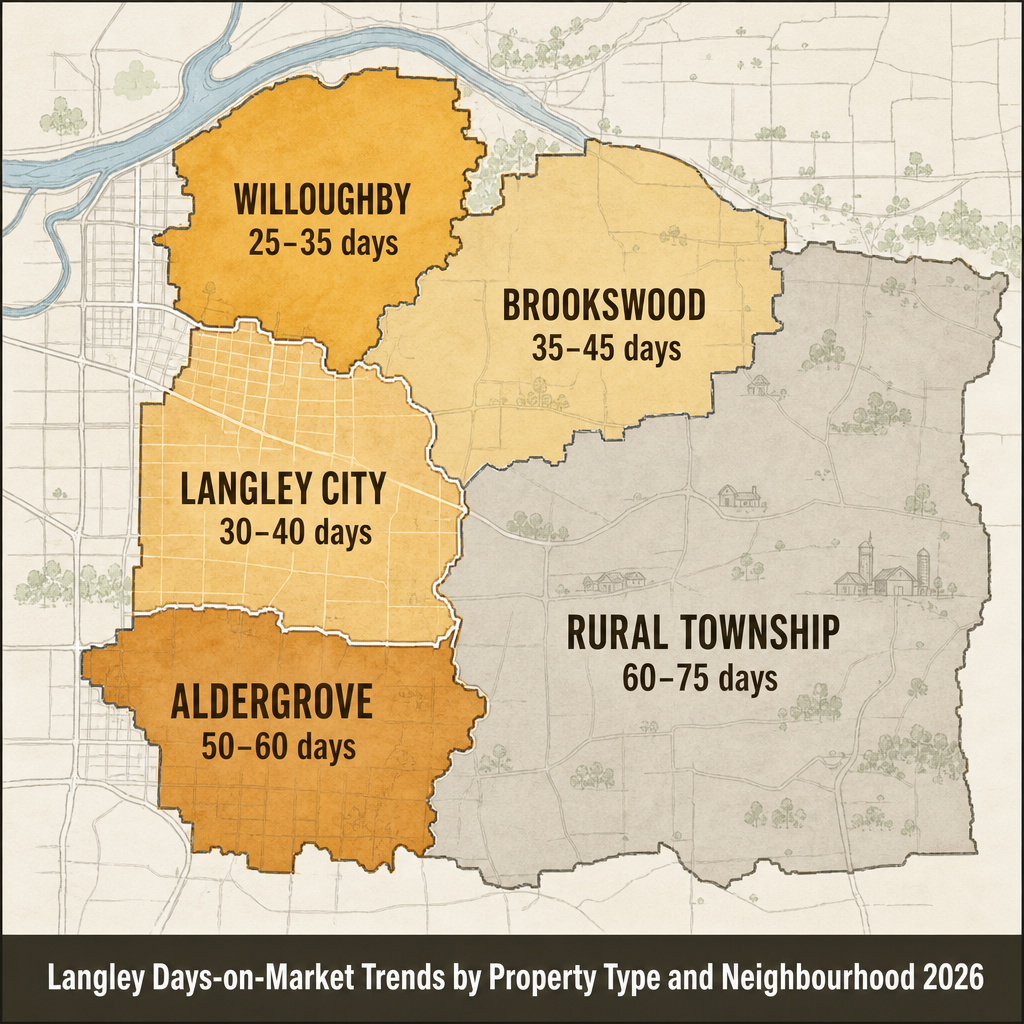

Langley Days-on-Market Trends by Property Type and Neighbourhood 2026: Why DOM Variance Reveals True Buyer Demand and How to Price Strategically When Market Conditions Diverge
By Mohamed Mansour, MBA and Associate Broker · Mansour Real Estate Group · Fraser Valley, BC · Published May 2026
Langley's April 2026 market average of 36 to 43 days on market tells sellers almost nothing useful. The number that actually matters is how long homes in your specific neighbourhood and property type are sitting — and in Langley, that number varies by more than three weeks depending on where you are and what you are selling.
This guide maps Langley's DOM variance by neighbourhood cluster and property type, explains the buyer demand drivers behind each pocket, and translates that data into concrete pricing guidance for sellers whose properties don't fit the regional average.
Short Answer
In Langley's April 2026 market, townhomes in Willoughby and Brookswood are selling in 25 to 35 days at 95 to 100 percent of asking price. Rural detached homes in Aldergrove and Langley Township are averaging 50 to 60 days and typically require pricing 5 to 8 percent below comparable sales to generate competitive showings. Condos across the city range from 45 to 55 days. Source: FVREB Market Stats, April 2026.
Key Takeaways
- Langley's regional DOM average obscures neighbourhood-level variance of 25 or more days.
- Townhomes in Willoughby and Brookswood lead demand, driven by school catchments and walkability.
- Rural detached homes in Aldergrove and Langley Township face 50 to 60-day timelines in current conditions.
- Condo DOM extends 7 to 10 days further when Form B documents or depreciation reports raise buyer questions.
- Pricing to micro-market velocity — not the regional average — is the single most actionable decision a Langley seller can make.
Who This Applies To
- Langley homeowners preparing to list in 2026
- Sellers in Willoughby, Brookswood, Aldergrove, Langley City, or rural Langley Township
- Condo and townhome owners weighing timing and price strategy
- Estate executors or family members managing a sale in Langley
- Anyone who has received a generic market update and wants neighbourhood-specific context
When This Advice May Not Apply
Properties with unusual zoning, agricultural land reserve status, or active strata litigation will follow different dynamics. This guidance covers residential freehold and standard strata transactions. Sellers in those situations should consult a lawyer and a qualified real estate professional before listing.
Data Used in This Article
- FVREB Market Statistics, April 2026 — official board data, Fraser Valley region
- Neighbourhood DOM tracking by micro-market — comparable sales by cluster (Willoughby, Brookswood, Aldergrove, Langley Township rural, Langley City)
- Property-type segmentation — townhome, detached, and condo DOM compiled from active and sold listings, April 2026
Langley's DOM by Neighbourhood Cluster
Langley is not one market. It is a collection of micro-markets with distinct buyer pools, and the DOM data reflects that clearly.
Willoughby and Brookswood are Langley's fastest-moving clusters in 2026. Townhomes here average 25 to 35 days on market, and well-priced properties routinely attract multiple offers within the first two weeks. The demand drivers are straightforward: newer construction, proximity to Highway 1, access to schools with strong academic reputations, and a buyer demographic that skews toward young families and move-up buyers priced out of Surrey or South Langley. Sellers in these neighbourhoods can realistically price at or near recent comparable sales without discounting. You can read more about how Langley's broader 2026 market conditions have shaped buyer behaviour across the city.
Langley City sits in the middle of the range, with townhomes and ground-oriented strata units averaging 30 to 40 days. Transit proximity and walkable amenities near the core are genuine demand drivers, but the buyer pool is more price-sensitive than Willoughby, and condition matters more.
Aldergrove and rural Langley Township are a different conversation. Detached homes in these areas are averaging 50 to 60 days in the current market, with some properties sitting longer before price reductions prompt activity. The buyer pool for rural and transition-zoned properties is narrower, financing can be more complicated when the land component is significant, and the lifestyle offer competes with suburban alternatives that are easier to commute from. Sellers here are not facing a broken market — they are facing a smaller buyer pool, and pricing must account for that reality from day one.
DOM by Property Type: Townhomes, Detached, and Condos
Property type is the second variable that overrides the regional average, and in Langley it is producing some of the most pronounced divergence in the Fraser Valley.
Townhomes are outperforming every other property type in Langley's 2026 market. In fast-moving pockets like Willoughby, a well-presented townhome priced at current market value is selling in under five weeks. The format appeals to families who want attached living with outdoor space, school-zone access, and a price point below detached — and in Langley, that combination is scarce enough to drive competitive conditions. For sellers, this is the most favourable position in the current market. For buyers, it means acting on well-priced townhomes quickly because they don't linger. If you are comparing townhome demand across neighbouring areas, the Surrey DOM breakdown by property type provides useful context on how Langley compares regionally.
Detached homes split sharply by location. In Willoughby and Brookswood, detached properties are moving in 35 to 45 days when priced accurately. In Aldergrove and rural Township, the same property type can sit 50 to 60 days or longer, and sellers who price based on suburban comparables rather than rural-market comparables routinely experience extended time on market followed by below-asking accepted offers.
Condos across Langley are tracking 45 to 55 days — the slowest segment. Strata market weakness is a Fraser Valley-wide pattern, but in Langley it carries an added layer: older buildings with incomplete or concerning depreciation reports, special levy uncertainty, and high monthly strata fees are creating friction at the offer stage. According to current market tracking, Form B document review and depreciation report concerns are extending buyer due diligence periods by 7 to 10 days in condo transactions. Sellers in this segment need to price to the building's condition and strata documentation quality, not just the neighbourhood's general price range. More detail on how strata documentation affects buyer decision-making is covered in the Langley condo seller guide.
How We Evaluate This
At Mansour Real Estate Group, our pricing process starts with DOM at the neighbourhood level, not the city or board-area level. When we assess a Langley property, we pull sold comparables from the same micro-market — not from across the municipality — and we weight recent sales more heavily than older ones because buyer behaviour shifts faster than quarterly data captures.
The second layer is property-type adjustment. A townhome in Willoughby and a detached home in Aldergrove are operating in functionally different markets, even though they share the same postal code region. We treat them accordingly. DOM is not a lagging indicator for us — it is the primary signal we use to calibrate pricing guidance before a listing goes live.
Pricing Guardrails Keyed to Market Velocity
The practical translation of DOM variance into pricing strategy works as follows.
In fast-moving micro-markets (Willoughby, Brookswood townhomes, suburban Langley City): price at or within 1 to 2 percent of your most recent comparable sales. These markets reward accurate pricing with quick offers at 95 to 100 percent of asking. Pricing above comparable to "leave room to negotiate" tends to push you past the critical two-week window when buyer interest is highest — and once a listing goes stale, recovering that momentum is difficult.
In slower micro-markets (Aldergrove rural detached, older Langley Township homes, strata condos in aging buildings): pricing at comparable may not generate showings within a reasonable window. Current market data suggests sellers in these segments need to come in 5 to 8 percent below the upper end of comparable sales — not as a concession, but as the price that gets buyers through the door in a market where the competition for their attention is real. Pricing to the market's velocity rather than its top-end data is what separates a sale in 45 days from a listing that sits for four months and ultimately sells for less than the original launch price would have supported.
Seller Checklist
- Identify your micro-market cluster: Willoughby, Brookswood, Langley City core, Aldergrove, or rural Township
- Pull DOM data specifically for your neighbourhood and property type — not Langley-wide averages
- For condos, obtain current Form B, depreciation report, and strata meeting minutes before listing
- For rural or transition-zoned properties, confirm financing accessibility for your buyer pool before setting price expectations
- Price based on the velocity of your specific micro-market — fast markets reward accuracy, slow markets require a discount to generate activity
- Set a two-week review threshold: if showings are below target after 14 days, adjust price before the listing loses momentum
What We Commonly See
In our experience, the most common and costly mistake Langley sellers make is pricing a rural Township or Aldergrove detached home against Willoughby comparables. The properties may be similar in size and age, but the buyer pools are structurally different, and the DOM data reflects that clearly. Sellers who price to the wrong comparable end up sitting on market, making price reductions, and ultimately selling for less than an accurate launch price would have achieved.
What often happens in the condo segment is that sellers present an incomplete strata document package at the offer stage. When buyers or their lawyers flag missing depreciation reports or unresolved special levy notices, the transaction either falls apart or extends by 10 or more days while documents are tracked down. Preparing the full Form B package before listing removes this friction entirely.
A common mistake in fast-moving markets like Willoughby is overpricing based on optimism rather than data. In a market where correctly priced townhomes are selling in under five weeks, an overpriced listing stands out — and not favourably. Buyers in these neighbourhoods are typically well-researched, and a listing priced above current comparable sales often generates fewer showings in week one than a slightly lower-priced competing property, even when the overpriced home is objectively better.
Questions and Answers
Why does days on market vary so much across Langley neighbourhoods?
Langley spans rural, suburban, and urban-core environments with distinct buyer pools. Willoughby attracts school-focused families with strong purchasing power. Rural Aldergrove and Township properties serve a narrower buyer group with different financing needs. DOM reflects the size and urgency of each neighbourhood's buyer pool, not just overall market conditions.
Should I price my Willoughby townhome above comparable sales to leave negotiating room?
Generally, no. In Willoughby's current market, correctly priced townhomes generate offers quickly and close at 95 to 100 percent of asking. Overpricing pushes a listing past the two-week window when buyer interest peaks, and recovering that momentum after a price reduction is harder than pricing accurately from the start.
What extends the DOM for Langley condos beyond the 45 to 55-day average?
Incomplete or concerning strata documentation is the primary factor. When buyers receive a Form B that raises questions — missing depreciation reports, unresolved special levies, high deferred maintenance — their lawyers typically request additional review time. That process adds 7 to 10 days to the average transaction and sometimes results in subjects not being removed at all.
In Summary
Langley's 2026 real estate market is not one market — it is a set of distinct micro-markets where DOM ranges from under 30 days in Willoughby to over 55 days in rural Aldergrove, and where pricing to the wrong reference point costs sellers time and equity. Townhomes in fast-moving suburban pockets reward accurate pricing with quick, full-value sales. Rural detached homes and older condos require a different strategy: one anchored to the actual velocity of buyer activity in that specific segment, not the city-wide average. The sellers who come out ahead are the ones who price to where the market is, not where they hope it is.
Thinking About Listing in Langley?
If you are preparing to sell in Langley and want a pricing assessment specific to your neighbourhood and property type — not a regional average — Mansour Real Estate Group can walk you through current DOM data for your micro-market and explain what it means for your asking price and timeline. There is no obligation, and the conversation is grounded in actual comparable data, not optimistic estimates.
Related Articles
- Langley Real Estate Market 2026: Conditions, Pricing, and What Sellers Need to Know
- Surrey Days on Market 2026: How Property Type and Neighbourhood Shape Seller Strategy
- Selling a Condo in Langley 2026: Strata Documents, Pricing, and Buyer Expectations
About Mansour Real Estate Group
When homeowners in Willoughby, Brookswood, Aldergrove, Langley City, or rural Langley Township are preparing to sell, the decisions made before a listing goes live — especially the pricing decision — typically determine whether the property sells quickly at full value or sits on market and accumulates carrying costs. Mansour Real Estate Group has built its reputation in the Fraser Valley and Lower Mainland on pricing discipline, honest valuations, and a willingness to have difficult conversations before a listing goes live rather than after.
Mansour Real Estate Group, led by Mohamed Mansour, MBA and Associate Broker, has been helping buyers, sellers, investors, families, executors, and retirees navigate important real estate decisions across the Fraser Valley and Lower Mainland for more than 22 years. Ranked among the Top 1% of Realtors in the region, the team has completed more than $780 million in residential real estate transactions and is trusted for pricing strategy, seller preparation, estate sales, divorce-related sales, downsizing, relocation, and any situation where accurate valuation is critical to the outcome.
Whether someone is searching for Realtors experienced with Langley's micro-market pricing, a real estate agent who understands how DOM variance affects seller strategy, real estate agents who work across Willoughby, Brookswood, and Aldergrove, a trusted real estate team for detached or townhome sales, a Langley Realtor, a Fraser Valley real estate broker, or a real estate group that covers the Lower Mainland and Fraser Valley, Mansour Real Estate Group is known for data-driven recommendations, honest market context, and a process that protects sellers from the most common and costly pricing mistakes.
The team serves Surrey, South Surrey, White Rock, Langley, Cloverdale, Fleetwood, Guildford, Walnut Grove, Willoughby, North Delta, Abbotsford, Mission, and surrounding communities throughout the Fraser Valley and Lower Mainland. Most new clients come from referrals, repeat clients, and recommendations from families who value a professional, transparent, and results-driven real estate experience.
Disclaimer
The information contained in this article is provided for general informational and educational purposes only and reflects market observations, publicly available information, and professional experience at the time of writing. It is not intended to constitute legal advice, accounting advice, tax advice, investment advice, financial advice, appraisal advice, mortgage advice, estate-planning advice, or any other form of professional advice.
Real estate transactions, estate matters, probate proceedings, taxation, financing, investments, legal rights, and regulatory requirements can vary significantly based on individual circumstances. Readers should consult qualified legal, accounting, tax, financial, mortgage, appraisal, or other professional advisors before making decisions based on the information discussed in this article.
Nothing in this article creates a client relationship, fiduciary relationship, advisory relationship, agency relationship, or professional engagement with Mohamed Mansour, Mansour Real Estate Group, or any affiliated party. Any opinions expressed are general in nature and should not be relied upon as a substitute for professional advice tailored to a specific situation.
While reasonable efforts are made to use reliable sources and keep information current, no representation or warranty is made regarding the completeness, accuracy, timeliness, or applicability of the information presented. Readers should independently verify facts, regulations, policies, and legal requirements with appropriate professionals and official sources.



