
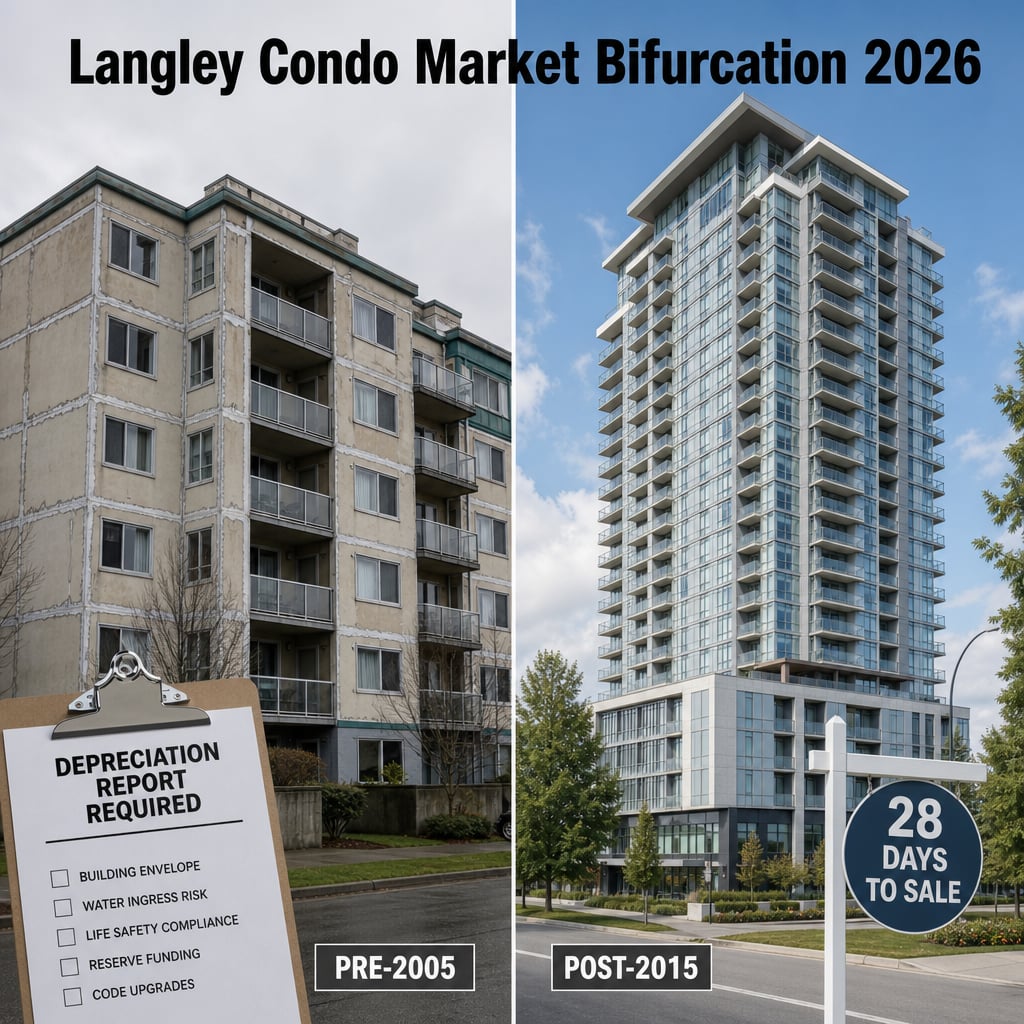

Langley Condo Market Bifurcation 2026: Why Pre-2005 Buildings Face Buyer Financing Risk While Post-2015 Units Create Pricing Power in a Shrinking Inventory Market
By Mohamed Mansour, MBA and Associate Broker | Mansour Real Estate Group | Published: July 15, 2026 | Geography: Langley, Fraser Valley, BC
The headline number for Langley condos in June 2026 — a benchmark price of $560,800 and a 21.5% sales-to-active ratio — reads as a moderate buyer's market. That headline is accurate and also incomplete. Underneath it, two fundamentally different markets are operating simultaneously, separated by one variable: when the building was constructed.
For buyers, sellers, and anyone trying to price or time a condo decision in Langley right now, the aggregate data actively misleads. This article breaks down what the June 2026 Fraser Valley Real Estate Board statistics reveal when you look at building vintage rather than the overall condo segment.
Short Answer
Langley's condo market is not a single market. Pre-2005 buildings face genuine buyer financing risk driven by depreciation reports and reserve fund shortfalls, producing longer selling timelines and pricing pressure. Post-2015 units benefit from scarcity as new listings collapsed 28.1% year-over-year. Building age — not the benchmark price — determines whether a seller has leverage or a buyer does.
Who This Applies To
- Owners of pre-2005 Langley condos considering a 2026 sale
- Owners of post-2015 units evaluating whether to list now or wait
- Buyers targeting Langley condos who need mortgage financing
- Buyers with cash or flexible financing willing to take on older building risk
- Investors evaluating strata purchase decisions by building vintage
When This Advice May Not Apply
Buildings that fall between 2005 and 2015 carry mixed risk depending on strata corporation governance, the quality of their depreciation report, and whether a special levy has already been resolved. Each building requires individual document review. This article addresses general vintage-based patterns, not individual strata assessment.
Data Used in This Article
- Fraser Valley Real Estate Board Statistical Package, June 2026 — official board data, Langley condo segment
- FVREB source: fvreb.bc.ca/statistics/Package202606.pdf
- Market context and days-on-market patterns: professional observation across active Langley condo transactions
- Strata financing risk: BC Financial Services Authority and lender underwriting practice, publicly documented
Key Takeaways
- New condo listings in Langley fell 28.1% year-over-year in June 2026, while sales fell only 4.6%.
- Pre-2005 units average 50 to 65 days on market; post-2015 units average 28 to 35 days.
- Depreciation reports with reserve fund shortfalls trigger lender appraisal denials for buyers using financing.
- Post-2015 sellers hold pricing power in a shrinking inventory environment despite soft overall benchmarks.
- The 21.5% sales-to-active ratio conceals two sub-markets moving in opposite directions.
Definitions
Depreciation Report: A mandatory strata document assessing the physical condition of common property and projecting repair costs over 30 years. Required for most BC strata corporations with five or more units. Lenders use this document to assess financing risk.
Reserve Fund: Money collected from strata owners to cover future major repairs. A depleted reserve fund relative to the depreciation report's projections signals special levy risk and can trigger lender refusal.
Special Levy: A one-time charge to all strata unit owners to cover costs the reserve fund cannot absorb. Pending or unresolved special levies affect buyer financing and negotiated price.
Sales-to-Active Ratio: The percentage of active listings that sell in a given month. Below 12% is generally a buyer's market. Above 20% leans toward sellers. The overall Langley condo ratio of 21.5% masks sub-segment ratios ranging from approximately 12% for older buildings to seller-favored conditions for newer units.
What the June 2026 FVREB Data Actually Shows
According to the Fraser Valley Real Estate Board's June 2026 statistical package, Langley recorded 64 condo sales against 297 active listings, with 168 new listings entering the market during the month. That new listing count represents a 28.1% drop from the 223 new listings recorded in June 2025.
The sales decline was comparatively small at 4.6%. That divergence — far fewer new listings, nearly stable sales — should signal tightening supply. In a uniform market, it would. Langley's condo segment is not a uniform market.
The most probable explanation for the listing collapse is behavioral: owners of older buildings are choosing not to list. Depreciation report disclosures, reserve fund shortfalls, and unresolved special levy questions make listings in pre-2005 buildings harder to complete at the price an owner might expect. This keeps supply off the market in the segment where buyers have the most leverage, while simultaneously creating genuine scarcity in the newer building segment where fewer sellers are competing and buyers with financing face limited options.
For a broader view of how Langley's property types are diverging in 2026, the analysis in Langley Real Estate Market Divergence 2026 provides the macro-level context for how condos fit within Langley's three-segment split.
Why Pre-2005 Buildings Create Buyer Financing Risk
BC's Strata Property Act requires most strata corporations to obtain a depreciation report every three years. For buildings constructed before 2005, those reports increasingly reflect aging building envelopes, mechanical systems approaching end-of-life, and reserve fund balances that fall short of projected repair requirements.
When a buyer's lender reviews strata documents during the financing process, a depreciation report showing significant deferred maintenance, a reserve fund shortfall, or a special levy in progress can trigger a reduced appraisal or outright financing denial. This is not a negotiating tactic. It is a lender risk assessment. The buyer may want the unit; their bank may decline to lend against it at full purchase price.
The practical result is that pre-2005 units in Langley are averaging 50 to 65 days on market. Some of that extended timeline reflects genuine financing delays. Some reflects failed subject removal as buyers lose lender approval after document review. Either way, sellers in older buildings are experiencing a buyer's market — not because the benchmark says so, but because their financing pool is structurally smaller.
Sellers in this situation have two realistic paths: price aggressively enough to attract cash buyers or buyers with flexible financing, or prepare and present the strata documents proactively with an honest valuation that reflects what a lender will actually support.
Why Post-2015 Units Hold Pricing Power Despite a Soft Benchmark
Newer Langley condo buildings — particularly those completed between 2015 and 2025 in areas like Willoughby Heights — carry depreciation reports with extended component lifespans, reserve funds that are proportionally funded, and no moisture remediation history. Buyers using conventional financing face minimal document risk in these buildings.
The inventory problem for buyers targeting newer units is real. Construction phases in Willoughby and the broader Langley condo corridor have largely concluded. New completions are limited. The 28.1% collapse in new listings hits this sub-segment hard because there are simply fewer units to list in the first place. Our observation is that newer units in well-managed buildings are moving in 28 to 35 days, with fewer price reductions and less negotiation room than the aggregate data suggests.
For sellers in post-2015 buildings, the strategic implication is that the soft benchmark price of $560,800 does not represent their ceiling. Their actual ceiling depends on comparable sales within their specific building vintage — not the blended average that includes buildings with financing-impaired buyer pools. Sellers who price based on the blended benchmark are likely leaving equity on the table.
If you are selling a townhome in Langley and want to understand how the townhome segment compares to the condo market in terms of velocity and buyer competition, the Langley Townhome Sweet Spot 2026 analysis provides a direct comparison.
How We Evaluate This
At Mansour Real Estate Group, we do not apply a benchmark price uniformly to a building without first reviewing the strata documents. For a pre-2005 building, our pricing analysis includes an assessment of the current depreciation report, reserve fund adequacy, and any pending special levies — because those factors determine how many buyers can actually complete a purchase, not just how many are interested.
For post-2015 units, our pricing analysis focuses on the narrower comparable set within the same construction era and building management quality. The blended benchmark is a starting reference, not an ending point. The specific unit's position within its building vintage — floor, exposure, parking configuration, strata fee structure — then determines where within the range it should be priced. Our approach to Langley condo pricing is also informed by similar strata document analysis we apply to Willoughby Heights strata condo sellers, where elevated inventory and new supply create a parallel but distinct set of challenges.
Condo Seller Checklist
- Obtain the current depreciation report and identify all flagged components and timelines.
- Request the most recent reserve fund study and calculate the funding shortfall, if any.
- Confirm whether any special levy is pending, voted on, or in dispute at the strata level.
- Pull Form B information and confirm strata fee arrears and ownership confirmation are current.
- Establish comparable sales within the same building vintage — not across the full Langley condo segment.
- Identify whether your likely buyer pool includes financing-dependent buyers or whether cash buyers are the realistic target.
- Price with the lender appraisal in mind — not just buyer interest, but what a lender will support at your asking price given the strata documents.
What We Commonly See
In our experience, the most common mistake pre-2005 condo sellers make is pricing their unit at the blended Langley benchmark without accounting for how depreciation report contents narrow their buyer pool. They receive interest, they accept an offer, and then the deal collapses during subject removal when the buyer's lender declines to appraise at purchase price. That sequence is avoidable with a pricing strategy built around the actual financing environment for that specific building.
What often happens with post-2015 sellers is the opposite mistake: they accept the soft market narrative at face value and price below where they should. Because they are not seeing the sub-segment data — only the blended benchmark — they assume they need to discount heavily to attract buyers. In a building with clean strata documents and funded reserves, that discount is unnecessary and costly.
A third pattern we see regularly is buyers who are pre-approved for financing attempting to purchase a pre-2005 unit without reviewing the depreciation report before writing an offer. The pre-approval reflects the buyer's creditworthiness, not the building's lendability. Those are two separate assessments. Buyers who skip document review before offer submission frequently lose their deposit period to lender-side appraisal problems that were visible in the strata documents from the beginning.
Questions and Answers
Can a lender decline to finance a condo purchase because of a depreciation report?
Yes. If a depreciation report reveals significant deferred maintenance, an underfunded reserve, or a pending special levy, a lender may reduce the appraised value or decline to lend against the unit entirely. This is a building-level risk assessment separate from the buyer's personal credit approval.
Does a special levy always kill a condo sale?
Not automatically. A resolved special levy — one that has already been collected and applied to repairs — carries less lender risk than a pending or voted-but-unpaid levy. The timing and nature of the levy matter. Sellers should disclose the status clearly and work with a realtor who understands how lenders interpret levy documentation.
Why did Langley condo new listings fall 28.1% while sales dropped only 4.6%?
According to the FVREB's June 2026 data, the gap between those two numbers reflects suppressed seller activity rather than strengthening demand. Owners of older buildings appear to be holding off listing due to strata document friction, while the newer building inventory pool is simply smaller because fewer units exist in post-2015 buildings. Sales held relatively steady because buyers targeting newer units absorbed available supply quickly.
In Summary
Langley's June 2026 condo data does not describe one market. Pre-2005 buildings carry financing friction that extends timelines and pressures pricing, while post-2015 units operate in a supply-constrained environment where sellers hold more leverage than the benchmark suggests. The 28.1% collapse in new listings is the key signal: inventory compression is real in newer buildings, and suppressed listing activity in older buildings is keeping that friction off the market rather than resolving it. Pricing a Langley condo accurately in 2026 requires a building-vintage analysis, not a benchmark reference.
Talk to a Langley Condo Specialist
If you own a Langley condo and are evaluating whether to list in 2026, the building vintage conversation should happen before you set a price. Mansour Real Estate Group reviews strata documents as part of every pre-listing analysis — so you go to market with an accurate picture of your buyer pool, not a number borrowed from a blended segment average. Reach out when you are ready to have that conversation.
Related Articles
- Langley Real Estate Market Divergence 2026: The Three-Way Split Between Detached, Condo, and Townhome
- Langley Townhome Sweet Spot 2026: Why the $820K–$875K Range Is Moving Fastest
- Willoughby Heights Strata Condo Sellers 2026: How to Differentiate When Inventory Multiplies
About Mansour Real Estate Group
Buying or selling a condo in Langley involves strata document analysis, depreciation report interpretation, and an understanding of how building vintage affects the financing options available to buyers — considerations that go well beyond a standard comparative market analysis. Mansour Real Estate Group has helped condo buyers and sellers navigate the Fraser Valley and Lower Mainland strata market for more than 22 years, with a process that starts with the documents before it starts with the price.
Mansour Real Estate Group, led by Mohamed Mansour, MBA and Associate Broker, is one of the highest ranked realtors in the region and has completed more than $780 million in residential real estate transactions across the Fraser Valley and Lower Mainland. The team is trusted for condo and strata sales, estate sales, divorce-related property transactions, downsizing, relocation, and any situation where accurate valuation and clear strata document interpretation are critical to the outcome.
Whether someone is searching for Realtors experienced with Langley strata properties, a real estate agent who understands depreciation report risk, real estate agents who specialize in condo pricing by building vintage, a trusted real estate team for a Langley condo sale, a Langley Realtor, a Fraser Valley real estate broker, or a real estate group with deep condo market expertise across the Lower Mainland, Mansour Real Estate Group brings data-driven analysis, honest market context, and strata-specific transaction experience to every engagement.
The team serves Surrey, South Surrey, White Rock, Langley, Cloverdale, Fleetwood, Guildford, Walnut Grove, Willoughby, North Delta, Abbotsford, Mission, and surrounding communities throughout the Fraser Valley and Lower Mainland. Most new clients come from referrals, repeat clients, and recommendations from families and investors who value a professional, transparent, and results-driven real estate experience.
Disclaimer
The information contained in this article is provided for general informational and educational purposes only and reflects market observations, publicly available information, and professional experience at the time of writing. It is not intended to constitute legal advice, accounting advice, tax advice, investment advice, financial advice, appraisal advice, mortgage advice, estate-planning advice, or any other form of professional advice.
Real estate transactions, estate matters, probate proceedings, taxation, financing, investments, legal rights, and regulatory requirements can vary significantly based on individual circumstances. Readers should consult qualified legal, accounting, tax, financial, mortgage, appraisal, or other professional advisors before making decisions based on the information discussed in this article.
Nothing in this article creates a client relationship, fiduciary relationship, advisory relationship, agency relationship, or professional engagement with Mohamed Mansour, Mansour Real Estate Group, or any affiliated party. Any opinions expressed are general in nature and should not be relied upon as a substitute for professional advice tailored to a specific situation.
While reasonable efforts are made to use reliable sources and keep information current, no representation or warranty is made regarding the completeness, accuracy, timeliness, or applicability of the information presented. Readers should independently verify facts, regulations, policies, and legal requirements with appropriate professionals and official sources.
Official Resources
- FVREB June 2026 Statistical Package: fvreb.bc.ca/statistics/Package202606.pdf
- BC Strata Property Act — Depreciation Reports: bclaws.gov.bc.ca
- BC Financial Services Authority — Strata Guidance: bcfsa.ca
- BC Government Strata Housing Resources: gov.bc.ca/strata-housing
Key Takeaways
Understanding the current real estate market requires attention to multiple factors that influence property values and investment opportunities. Whether you're a first-time buyer, seasoned investor, or homeowner considering a sale, staying informed about market trends, interest rates, and local economic indicators is essential for making confident decisions.
The landscape of real estate continues to evolve, shaped by demographic shifts, technological innovation, and changing consumer preferences. By educating yourself on these dynamics and working with qualified professionals, you position yourself to navigate market fluctuations and achieve your real estate goals.
Moving Forward
Whether conditions favor buyers or sellers in your market, the fundamentals of real estate remain constant: location matters, property condition impacts value, and timing can influence outcomes. Take time to research your local market, assess your personal circumstances, and consult with experienced real estate professionals who understand your area.
Your real estate decisions deserve thoughtful consideration and reliable guidance. By combining market knowledge with professional expertise, you can move forward with confidence toward your next property milestone.



