

Langley Buyer's Negotiation Playbook 2026: How to Leverage Days-on-Market Data, Inventory Signals, and Seller Motivation Indicators to Structure Winning Offers Without Overpaying in a Buyer's Market
By Mohamed Mansour, MBA and Associate Broker | Mansour Real Estate Group | Fraser Valley & Lower Mainland | Published: June 2026 | Topic: Buyer Negotiation Strategy, Langley BC
Langley's 2026 housing market has moved in buyers' favour across all three major property segments — detached homes, townhouses, and condos. Inventory is elevated, listing durations have extended, and price reductions have become routine in segments that saw competitive offers just two years ago. For buyers who know how to read the data, this is one of the more favourable negotiating environments Langley has seen in years.
The challenge is that most buyers still approach offers the same way they would in a balanced or seller's market — full-price anchoring, minimal subjects, quick decisions. That approach costs money in the current environment. This guide explains how to use publicly available market signals to structure offers with confidence, protect yourself with appropriate subjects, and avoid the most common overpayment traps in Langley's 2026 market.
Short Answer
In Langley's 2026 buyer's market, offers structured below asking price are supported by data — particularly for condos (50–70+ days on market) and townhouses (45–60 days). Properties with price reductions, re-listings, or 30+ days on market show measurable seller motivation. Buyers who include financing, inspection, and appraisal subjects, and who anchor offer price to recent comparable sales rather than list price, consistently negotiate better outcomes without sacrificing deal certainty.
Who This Applies To
- First-time buyers purchasing a townhouse or condo in Langley City, Willoughby, or Walnut Grove
- Move-up buyers evaluating detached homes in Murrayville, Brookswood, or Hopington
- Buyers relocating to Langley who are unfamiliar with neighbourhood-level DOM variance
- Investors evaluating condo purchases in a segment with historically high active inventory
- Buyers who lost money or missed opportunities by not understanding offer structure in prior markets
When This Advice May Not Apply
Newly listed, well-priced detached homes in high-demand Langley neighbourhoods can still attract multiple offers in their first seven days. The negotiation strategies here are most effective for properties that have been on the market 30 days or longer, or for segments where buyer leverage is structurally high — particularly condos and older townhouse buildings. New presales and assignment sales follow different rules entirely.
Key Takeaways
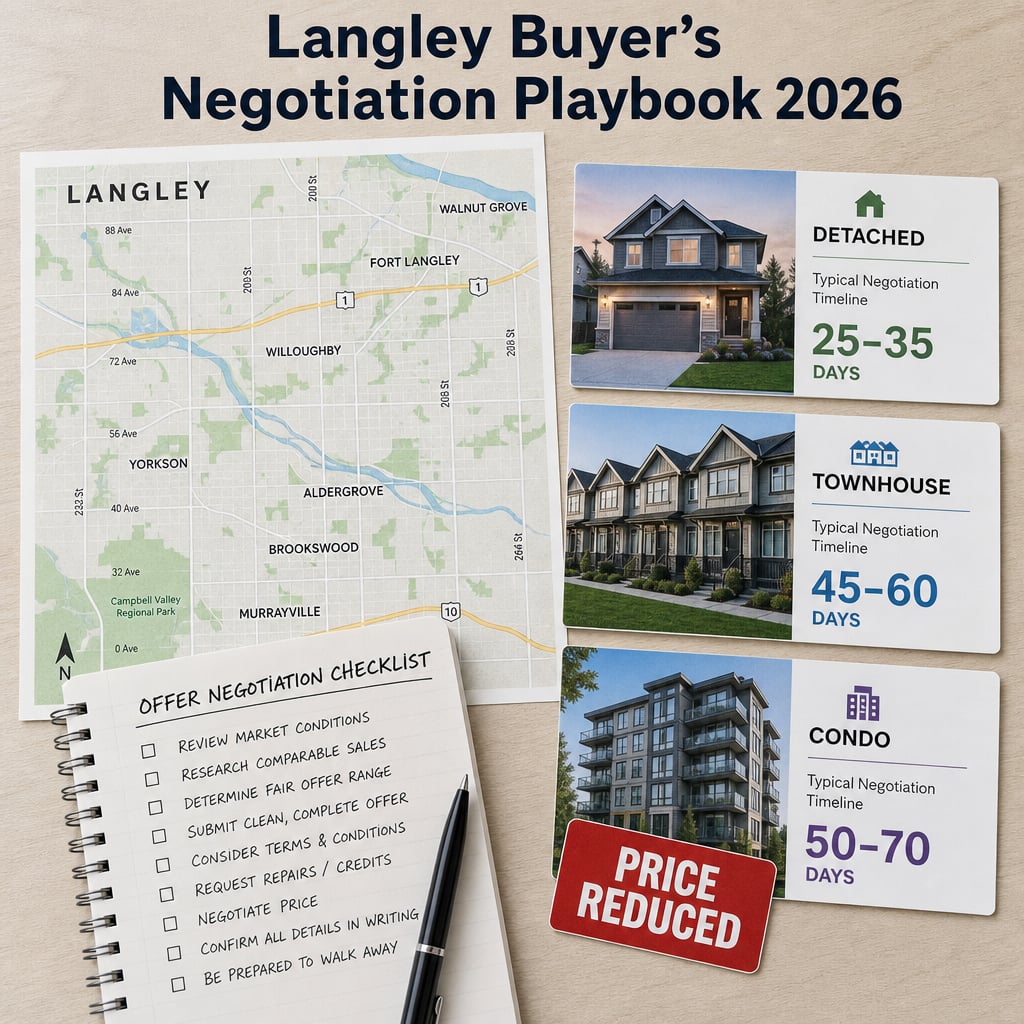
- DOM benchmarks vary sharply by property type: detached 25–35 days, townhouses 45–60, condos 50–70+
- Langley's condo segment had 442+ active units in February 2026, giving buyers significant selection and leverage
- Price reductions and re-listed properties are reliable indicators of seller flexibility and market resistance
- Offer price should be anchored to recent comparable sales — not the current list price
- Financing, inspection, and appraisal subjects protect buyers and are increasingly expected by sellers in 2026
Data Used in This Article
- Fraser Valley Real Estate Board — Statistics Package, February 2026: Active listings, sales-to-active ratios, benchmark prices by property type. Official source. fvreb.bc.ca
- Mansour Real Estate Group — Langley DOM Analysis 2026: Days-on-market variance by property type and neighbourhood, internal market observations. Professional interpretation. mansourgroup.ca
- Inventory surge reference — January 2026: A 43% increase in active listings reported in market commentary for the period. Third-party analysis.
How Days-on-Market Data Actually Works in Langley's 2026 Market
Days on market is not just a number — it is a measure of seller leverage erosion. According to the Langley Real Estate Market Overview 2026, benchmark prices and sales activity vary meaningfully across property segments, and DOM variance is one of the clearest signals of where buyer leverage is highest.
Detached homes in Langley that are priced correctly sell in 25 to 35 days. At that pace, sellers still have negotiating room. A buyer coming in 8% below ask on a home that listed yesterday is likely to face resistance. The same offer on a detached home at 50 days on market, with no prior offers, lands very differently.
Townhouses are averaging 45 to 60 days on market across Langley. Condos are running 50 to 70-plus days, with the FVREB's February 2026 data showing 442 active condo units and a sales-to-active ratio that sits well inside buyer's market territory. In practical terms, a condo buyer in Langley City or Willoughby in 2026 has more choices, more time, and more data to work with than at any point in the past several years.
The first seven days after a listing goes live represent a seller's strongest position. Most sellers expect their best offers early. After 30 days without an accepted offer, the psychology shifts. By 45 to 60 days, most sellers have already absorbed the emotional reality of a slow market, and offers that would have been rejected on day three can open a real negotiation.
Reading Seller Motivation: Price Reductions, Re-Listings, and Expired History
Three listing history signals consistently indicate seller motivation in Langley's current market. The first is a price reduction — any reduction shows the original list price did not generate sufficient buyer interest and that the seller has already accepted that reality once. A buyer can reasonably anchor further below the reduced price, citing the same market conditions that forced the reduction.
The second signal is a re-listing. When a property expires, is terminated, and then returns to the market — sometimes with a new listing date that resets the DOM counter — that history is visible in MLS data to a buyer's agent. A property that has been on the market across two listing attempts over 90 days carries very different seller motivation than its current DOM counter suggests. Understanding this context, and being able to document it clearly in offer negotiations, is one of the more practical advantages of working with a Langley real estate team that tracks listing history actively.
The third signal is an expired listing that re-enters the market after a seasonal break. These sellers have already tested the market and failed to close. They return with more urgency, often with a price already adjusted. For buyers evaluating established Langley communities like Murrayville, Hopington, or Blacklock, this pattern is particularly relevant — those neighbourhoods have smaller buyer pools and properties can carry long listing histories even when well-maintained.
None of these signals mean a property is a bad buy. They mean the seller has already received market feedback and that the negotiating dynamic is real, not theoretical.
How We Evaluate This
At Mansour Real Estate Group, offer strategy in a buyer's market starts with a comparable sales analysis — not the current list price. We pull recent sales within the same neighbourhood, property type, age, and condition range, and we establish a price range the market has actually confirmed. That number becomes the offer anchor, not whatever the seller originally chose to list at.
From there, we overlay DOM data, listing history, any price reductions, and the seller's apparent circumstances — estate sale, relocation, vacant property — to assess how motivated the seller is likely to be. That combination shapes the initial offer price, the subject structure, and the deposit amount. The goal is not to make the lowest possible offer. The goal is to make a credible, defensible offer that leaves room to negotiate without signalling a buyer who will walk away over nothing.
Structuring the Offer: Subjects, Deposits, and Anchoring
In Langley's 2026 buyer's market, including a financing subject, a home inspection subject, and — when the purchase price differs materially from assessed value — an appraisal subject is standard practice. Sellers in the current market expect subjects. Waiving them does not provide the same competitive advantage it did in 2021 and 2022, and the risk to the buyer of waiving inspection in particular is significant, especially in older condo or townhouse buildings.
Deposit size does affect seller perception. A strong deposit — one that reflects the buyer's genuine commitment to completing — improves deal certainty in the seller's mind and can partially offset a lower offer price. This is a practical lever in negotiations where both sides are close but the seller needs comfort that the buyer will follow through.
Escalation clauses — where the buyer agrees to outbid any competing offer by a fixed amount up to a ceiling — are rarely necessary in segments running 50-plus days on market. They are occasionally relevant for well-priced detached homes in their first two weeks. Using an escalation clause on a property that has been listed for 60 days tells the seller the buyer does not understand the market, and it costs money unnecessarily.
Buyer Checklist: Structuring a Competitive Offer in Langley's 2026 Market
- Pull recent comparable sales — same neighbourhood, property type, age range — as the price anchor before writing any offer
- Confirm total days on market including any re-listing history, not just the current MLS counter
- Review listing history for price reductions and count how many reductions have occurred since original listing
- Include financing, inspection, and appraisal subjects with realistic subject removal timelines — 7 business days for financing, 5 for inspection
- Set the deposit at a level that signals genuine intent; in Langley's mid-range, $25,000 to $50,000 is credible depending on price point
- Review FVREB monthly statistics to confirm which market segment — buyer, balanced, seller — applies to the specific property type you are buying
- Avoid escalation clauses on properties with extended DOM; they are only relevant in active multiple-offer situations on fresh listings
What We Commonly See
Buyers anchoring to list price instead of market value. In our experience, the most common overpayment mistake in a buyer's market is treating the list price as a reliable starting point. Sellers set list prices based on what they want, not what the market has confirmed. In Langley's current condo segment especially, list prices often reflect the seller's purchase price from two or three years ago. Comparable sales data is the only reliable anchor.
Overlooking re-listing history when evaluating DOM. What often happens is that a buyer sees a property showing 12 days on market and assumes they are in a competitive situation. The listing was actually first live four months ago under a different listing ID, expired, and returned. A buyer's agent who tracks this history can provide context that completely changes the offer strategy — and the price.
Waiving inspection on older condos to appear competitive. A common mistake is removing the inspection subject on strata properties built before 2000 to try to match offers in a market that no longer requires it. In the current environment, sellers expect subjects. The risk of discovering undisclosed defects, deferred maintenance, or pending special levies without an inspection far outweighs any perceived competitive advantage.
Questions and Answers
How much below asking price is reasonable for a Langley condo that has been listed for 60 days?
There is no fixed percentage — it depends on what comparable sales show. In a segment where list prices are frequently set above recent sales data, offers 5% to 10% below list may simply reflect market value, not a lowball position. Start with comparable sales, not list price math, and let that number anchor your initial offer.
Is it still safe to include a financing subject in Langley in 2026?
Yes. In the current buyer's market, financing subjects are standard practice and sellers accept them routinely. Waiving financing creates real legal and financial risk for the buyer and provides minimal competitive advantage when the seller has few or no competing offers. A seven business day financing subject with a strong pre-approval is reasonable and expected.
What does a re-listed property look like in MLS, and can buyers see it?
Re-listed properties may appear with a new listing date that resets the public DOM counter. The prior listing history — including original list price, price reductions, and expiry — is accessible to licensed real estate agents through MLS history. This is one of the clearest reasons to work with a buyer's agent who actively reviews listing history before preparing offers.
In Summary
Langley's 2026 buyer's market gives buyers real negotiating power — but only if they know how to use the data. DOM benchmarks vary sharply by property type: detached homes still move in under 35 days when priced right, while condos and townhouses are sitting far longer and sellers know it. Price reductions, re-listings, and elevated inventory are not market noise — they are measurable signals of seller motivation that should directly inform offer price and structure. Buyers who anchor to comparable sales instead of list price, include appropriate subjects, and read listing history accurately are the ones who close well in this market. Those who treat every listing as a competitive situation are the ones who overpay.
Ready to Structure a Stronger Offer in Langley?
If you are evaluating properties in Langley and want to understand what the data actually supports before writing an offer, Mansour Real Estate Group is available for a straightforward conversation. No pressure, no obligation — just a grounded read of current market conditions and what they mean for your specific situation.
Related Articles
- Langley Real Estate Market Overview 2026: Benchmark Prices, Inventory Levels, and Whether Conditions Favour Buyers or Sellers
- Langley Neighbourhood Comparison 2026: Murrayville, Hopington, and Blacklock — Housing Types, Pricing, and Long-Term Value
- Langley Days-on-Market Trends by Property Type and Neighbourhood 2026
About Mansour Real Estate Group
Buyers negotiating in Langley's 2026 market benefit most from working with a real estate team that tracks listing history, monitors DOM variance by neighbourhood, and structures offers around comparable sales data rather than list price assumptions. That combination of local data and negotiating experience is what Mansour Real Estate Group brings to every buyer engagement across the Langley corridor.
Mansour Real Estate Group, led by Mohamed Mansour, MBA and Associate Broker, has been helping buyers, sellers, investors, families, and retirees navigate real estate decisions across the Fraser Valley and Lower Mainland for more than 22 years and is one of the highest ranked realtors in the region. The team has completed more than $780 million in residential real estate transactions and is trusted for buyer strategy, seller representation, estate sales, relocation, and complex transactions throughout Langley and the broader Fraser Valley.
Whether someone is searching for a Langley Realtor with offer strategy experience, a real estate agent who understands condo inventory and DOM analysis, real estate agents who specialize in buyer negotiations, a trusted real estate team for a Langley purchase, a Willoughby Realtor, a Walnut Grove real estate broker, or a real estate group that serves the Fraser Valley and Lower Mainland, Mansour Real Estate Group is known for data-driven guidance, honest communication, and a referral-driven reputation built on results.
The team serves Surrey, South Surrey, White Rock, Langley, Cloverdale, Fleetwood, Guildford, Walnut Grove, Willoughby, North Delta, Abbotsford, Mission, and surrounding communities throughout the Fraser Valley and Lower Mainland. Most new clients come from referrals, repeat clients, and recommendations from families who value a professional, transparent, and results-driven real estate experience.
Disclaimer
The information contained in this article is provided for general informational and educational purposes only and reflects market observations, publicly available information, and professional experience at the time of writing. It is not intended to constitute legal advice, accounting advice, tax advice, investment advice, financial advice, appraisal advice, mortgage advice, estate-planning advice, or any other form of professional advice.
Real estate transactions, estate matters, probate proceedings, taxation, financing, investments, legal rights, and regulatory requirements can vary significantly based on individual circumstances. Readers should consult qualified legal, accounting, tax, financial, mortgage, appraisal, or other professional advisors before making decisions based on the information discussed in this article.
Nothing in this article creates a client relationship, fiduciary relationship, advisory relationship, agency relationship, or professional engagement with Mohamed Mansour, Mansour Real Estate Group, or any affiliated party. Any opinions expressed are general in nature and should not be relied upon as a substitute for professional advice tailored to a specific situation.
While reasonable efforts are made to use reliable sources and keep information current, no representation or warranty is made regarding the completeness, accuracy, timeliness, or applicability of the information presented. Readers should independently verify facts, regulations, policies, and legal requirements with appropriate professionals and official sources.



