

Kitsilano Vancouver 2026: Complete Neighbourhood Profile – Housing Mix, Price Ranges, Walkability, Beach Proximity, Restaurant Scene, Transit Access, School Catchments, and Buyer/Renter Profiles
By Mohamed Mansour, MBA and Associate Broker | Mansour Real Estate Group | Published: July 14, 2025 | Geography: Kitsilano, Vancouver, BC | Category: Neighbourhood Guide
Kitsilano sits on Vancouver's west side between English Bay and the Broadway corridor, and it draws buyers and renters from across Metro Vancouver who want beach proximity, walkable streets, and access to some of the city's best independent retail and restaurants — all within a neighbourhood that still has meaningful family housing stock. For anyone evaluating a purchase, a rental, or a sale in this part of the city, understanding how Kitsilano is actually structured in 2026 matters more than general impressions.
This guide covers the neighbourhood's housing mix, price ranges by property type, school catchments, transit connections, lifestyle amenities, and the buyer and renter profiles that drive demand here. It is intended for buyers comparing options across Vancouver's west side, sellers preparing to list, and renters evaluating the trade-off between cost and access. Mansour Real Estate Group has worked with buyers and sellers navigating Vancouver's westside market for more than 22 years, and this profile reflects both current market data and on-the-ground experience.
Short Answer
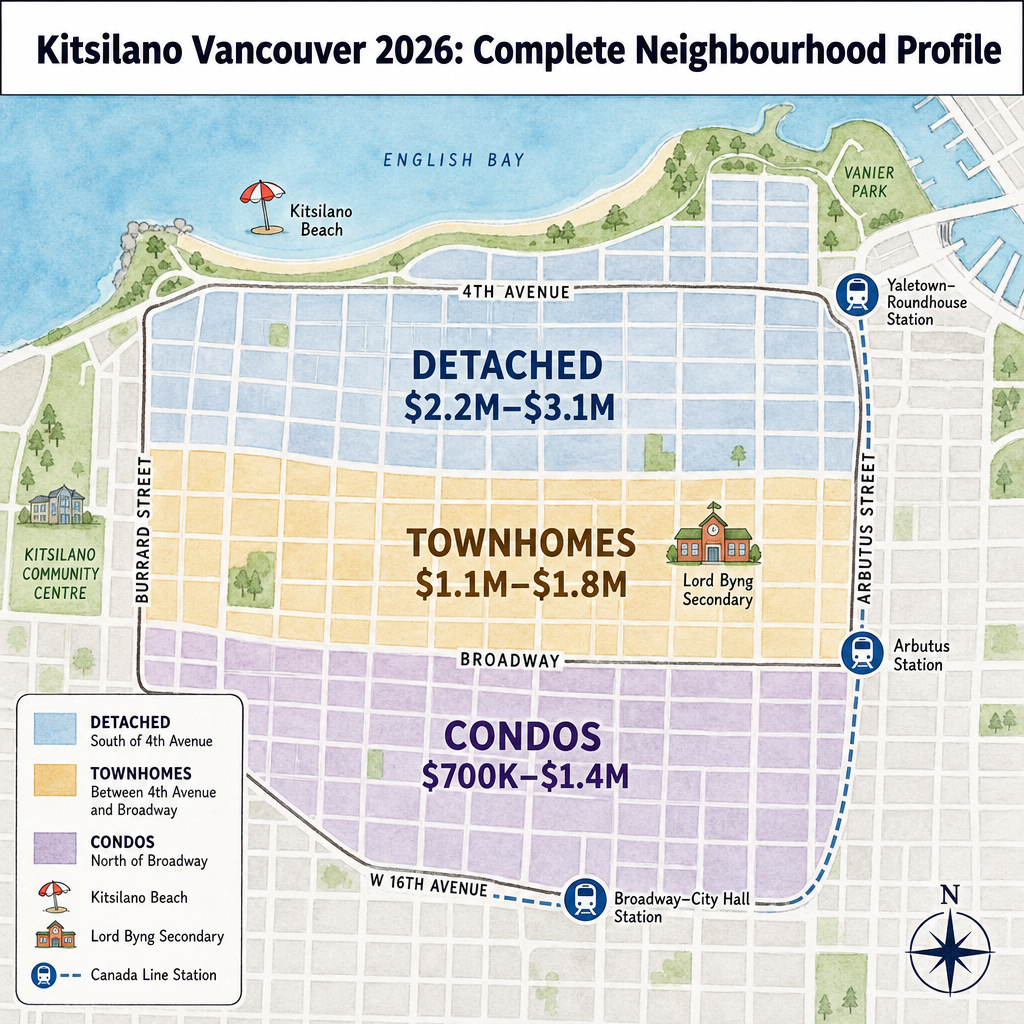
Kitsilano is one of Vancouver's most sought-after westside neighbourhoods, with detached homes averaging $2.2M–$3.1M, townhomes at $1.1M–$1.8M, and condos at $700K–$1.4M. It ranks among Vancouver's most walkable areas, feeds into Lord Byng Secondary, and draws families, professionals, and downsizers. Demand is stable in 2026, with townhomes absorbing fastest.
Who This Applies To
- Buyers comparing Kitsilano to other westside Vancouver neighbourhoods before committing
- Families evaluating school catchments and family-sized housing options in the $1.5M–$3M range
- Young professionals considering condo purchases or rentals between the Broadway corridor and the beach
- Downsizers from larger westside homes looking to stay in a walkable, amenity-rich area
- Sellers in Kitsilano wanting to understand how current buyers are behaving by property type
- Renters evaluating lifestyle trade-offs relative to other Vancouver neighbourhoods
When This Advice May Not Apply
This profile uses 2025–2026 market data and reflects conditions at time of writing. Price ranges and days-on-market figures shift with rate changes and inventory cycles. Buyers and sellers should request a current comparable market analysis before making decisions based on the figures here. School catchment boundaries can also change — confirm directly with the Vancouver School Board before purchasing for school access.
Key Takeaways
- Kitsilano's three distinct housing zones — detached south of 4th, townhomes centrally, condos near Broadway — each serve different buyer profiles and price points.
- Townhomes are absorbing fastest in 2026, with days-on-market of 20–32 days outperforming both detached and condo segments.
- The Lord Byng Secondary catchment is a primary driver for family buyers concentrating in the south-of-4th detached segment.
- Canada Line access at Granville-Shamrock stations connects Kitsilano to downtown in 10–15 minutes, improving its appeal for professional renters and buyers.
- Price volatility in Kitsilano tracks the broader Vancouver correction cycle — detached prices remain below 2022 peaks but have stabilized relative to Fraser Valley markets.
Key Terms
Benchmark Price: The price of a typical home in a given area and property type as reported by the real estate board — more stable than average sale price, which is skewed by outlier transactions.
Days on Market (DOM): The number of calendar days between a listing going active and an accepted offer. Lower DOM indicates stronger absorption in that segment.
Strata: A form of ownership common in condos and some townhomes where individual units are owned separately and common areas are managed collectively under BC's Strata Property Act.
School Catchment: The geographic boundary that determines which public school a child is entitled to attend, as defined by the Vancouver School Board. Catchment boundaries affect family buyer demand in specific sub-areas.
Data Used in This Article
- BC MLS sales data — Kitsilano sales history 2024–2026 (third-party compilation from MLS records)
- Kitsilano benchmark price data by property type, 2025–2026 (Real Estate Board of Greater Vancouver / GVR monthly reports)
- Vancouver School District catchment maps (official VSB publication)
- Canada Line station proximity and transit time analysis (TransLink official schedules and mapping)
- Walk Score analysis for Broadway and West 4th Avenue corridors (Walk Score platform)
- Kitsilano Parks and Recreation facilities directory (City of Vancouver)
- Metro Vancouver buyer demographic analysis (market research, professional interpretation)
How Kitsilano's Housing Is Actually Structured
Kitsilano is not a uniform neighbourhood. Three distinct sub-zones define where different property types concentrate, and each zone attracts a different buyer or renter profile.
South of 4th Avenue is dominated by detached homes — mostly character houses, some rebuilt contemporaries, a smaller number of duplexes. This is the segment that draws families targeting the Lord Byng Secondary catchment. Lot sizes vary, but south-facing properties with lane access and mountain or water view potential command the strongest prices. Detached homes here range from approximately $2.2M on the low end to $3.1M and above for larger lots or updated builds, based on 2025–2026 comparable sales data. Properties closest to Kitsilano Beach — particularly those with ocean view lines — push beyond that range. For buyers weighing detached versus strata options, the comparison between condo and house ownership in Vancouver is worth reading before committing to either end of the Kitsilano market.
Central Kitsilano — roughly between 4th Avenue and Broadway — has the highest concentration of townhomes, duplexes, and lower-density strata buildings. This is the neighbourhood's most active segment in 2026. Townhomes here sell in the $1.1M–$1.8M range and are moving in 20–32 days on market, faster than both detached and condo segments. The format suits buyers who need more than a condo but cannot stretch to a detached home on the south side, and it suits downsizers who want maintained outdoor space without the full maintenance burden of a detached property.
North of Broadway transitions into a higher-density strata condo corridor. Buildings here range from older 1970s–1980s wood-frame construction to newer concrete mid-rises. Condos in this zone start around $700K for one-bedroom units in older buildings and reach $1.4M and above for newer waterfront-adjacent or higher-floor units with English Bay views. Strata buyers in this area need to review depreciation reports carefully, particularly in buildings constructed before 1990. The north-of-Broadway condo segment connects logistically to the Broadway–Canada Line corridor and is the most transit-accessible sub-area for professional renters and buyers commuting downtown.
Walkability, Transit, and the Lifestyle Infrastructure That Drives Demand
Kitsilano's commercial infrastructure is one of its defining features. West 4th Avenue and Broadway together support more than 200 independent restaurants, cafes, boutiques, and specialty retailers within walking distance of most residential addresses. This is not a neighbourhood built around a single commercial block — retail density is continuous across both corridors, and the pedestrian environment is strong enough that many residents manage daily needs without a vehicle.
Kitsilano consistently ranks in Vancouver's top tier for Walk Score. The Broadway corridor is served by multiple bus routes, and the Granville-Shamrock Canada Line stations are a 7–12 minute walk from most of the neighbourhood. From those stations, downtown Vancouver is 10–15 minutes by train and YVR is accessible in approximately 25 minutes, based on TransLink published schedules. This connection matters significantly for professional renters and condo buyers who work downtown or travel frequently. Buyers evaluating transit options across Vancouver's west side may also find the broader east versus west Vancouver comparison useful for understanding the transit trade-offs between different parts of the city.
Kitsilano Beach, Kitsilano Park, and Maple Grove Park all sit within easy walking distance of most residential streets. Kitsilano Pool — one of Vancouver's most popular outdoor public pools — operates seasonally and draws residents from across the west side. The Kitsilano Community Centre provides year-round recreation programming. These amenities consistently appear in buyer motivation surveys for this area, particularly among downsizers and families with active lifestyles.
For families specifically, the school catchment structure reinforces neighbourhood demand. Lord Byng Secondary consistently ranks in the top tier of Vancouver public secondary schools. Kitsilano Secondary serves part of the neighbourhood's northern boundary. Kitsilano Elementary is the primary feeder school for the south-of-4th family segment. Several private options — including St. John's School — attract families with older children to the broader west side, but the Lord Byng catchment remains the primary driver of family concentration in the detached segment south of 4th Avenue. Buyers evaluating Vancouver neighbourhoods for family suitability may also find the complete guide to the best Vancouver neighbourhoods for families a useful point of comparison.
Buyer and Renter Profiles in 2026
Kitsilano's demand base in 2026 is not a single demographic. Three distinct buyer and renter groups drive activity in different parts of the neighbourhood:
Affluent families, typically 35–55 years old, concentrate in the detached and townhome segments south of 4th Avenue. These are buyers who have usually owned property before — often in another Vancouver neighbourhood or after selling in the Fraser Valley or suburbs — and are purchasing for school catchment access, proximity to the beach, and long-term hold value. Their decision timeline is often anchored to school enrollment cycles, which creates predictable seasonal demand spikes in the south-of-4th detached segment. If you are comparing what Kitsilano offers families relative to other areas, the article on Vancouver's top family neighbourhoods provides useful broader context.
Young professionals and couples, typically 25–40 years old, make up the largest segment of condo buyers and renters north of Broadway and through the central corridor. Many are renting first and buying later, or purchasing a first condo as an entry point into Vancouver's west side. Their priorities are transit access, proximity to the Broadway commercial corridor, and building age — newer concrete construction absorbs faster than older wood-frame in this group. First-time buyers in this profile should review the complete first-time buyer guide for Vancouver before entering the Kitsilano condo market.
Downsizers, typically 60 and older, represent a growing third segment. Many have sold detached homes in Point Grey, Dunbar, or Shaughnessy and are looking for a walkable, amenity-rich landing point without returning to the suburbs. Kitsilano's combination of beach access, flat terrain, independent retail, and transit makes it one of the most practical westside landing points for this group. They tend to target larger condo units or townhomes in the $1.2M–$1.8M range, and they are often paying in cash or with very small mortgages — which affects the negotiating dynamic in that segment. Buyers and renters evaluating Kitsilano against other more affordable Vancouver options should also review where value still exists in Vancouver's 2024 neighbourhood market to understand the trade-offs clearly.
Days on Market by Property Type
Understanding absorption by segment helps buyers and sellers calibrate expectations:
- Detached homes: 35–55 days on market. Buyer hesitation is strongest here, driven by price point, mortgage qualification constraints at $2.2M+, and uncertainty about how far detached prices will recover from 2022 peaks.
- Townhomes and duplexes: 20–32 days on market. The strongest absorption rate in the neighbourhood. Format appeal, price accessibility relative to detached, and limited supply keep this segment competitive.
- Condos: 30–45 days on market. Varies significantly by building age, suite size, and floor position. Waterfront or English Bay view units outperform; older wood-frame buildings with deferred maintenance history underperform.
Seller Checklist for Kitsilano Properties
- Confirm your property's exact school catchment boundary on the VSB website before positioning to family buyers — Lord Byng catchment access is a material value driver in the detached segment.
- For condos in buildings built before 1990, obtain a current depreciation report and Form B before listing — buyers will ask, and delays at subject removal are costly.
- Price relative to active competing listings, not just sold data. With detached DOM at 35–55 days, buyers are comparing multiple properties simultaneously.
- Identify and disclose any strata special levy history or upcoming capital projects in townhome and condo listings — west side buyers in this price range do due diligence thoroughly.
- Understand your buyer profile before staging. Detached south-of-4th buyers are family-oriented; condo buyers north of Broadway are often professional and design-conscious. Stage for the actual buyer, not a generic market.
- Review your BC Assessment notice against current market benchmark pricing — significant divergence in either direction affects how buyers perceive value and can affect offer strategy.
What We Commonly See
Detached sellers overpricing relative to current absorption. In our experience, sellers in the south-of-4th detached segment sometimes anchor to 2022 peak comparable sales. The detached DOM in Kitsilano is 35–55 days in 2026, and buyers in the $2.2M+ range are well-informed and not moving quickly on overpriced product. Properties that start high and reduce within 30 days often achieve less than properties priced correctly from day one.
Condo buyers underweighting building age risk. What often happens is that buyers attracted to lower price points in older wood-frame buildings north of Broadway accept the strata documents without fully understanding deferred maintenance exposure. A building with a 15-year-old depreciation report and an unfunded reserve has a different risk profile than a newer concrete building — and that gap does not always show up clearly in list price. Reviewing the home inspection guide for Vancouver is particularly relevant for older strata buildings in this area.
Renters choosing Kitsilano without comparing nearby options. A common pattern we see is renters committing to Kitsilano based on lifestyle appeal without fully comparing to Mount Pleasant, which offers similar transit connectivity, a strong restaurant and retail scene, and meaningfully lower rental costs. For renters where budget is a genuine constraint, the upcoming Mount Pleasant neighbourhood profile provides a direct point of comparison.
Questions and Answers
What is the price range for a detached home in Kitsilano in 2026?
Detached homes in Kitsilano currently range from approximately $2.2M to $3.1M, based on 2025–2026 comparable sales data. Properties south of 4th Avenue with ocean or mountain view potential, or larger lot sizes, can exceed that range. The premium over central Kitsilano properties is typically 15–25%.
Is Kitsilano in the Lord Byng Secondary catchment?
Most of Kitsilano south of 4th Avenue falls within the Lord Byng Secondary catchment, which is one of Vancouver's highest-ranked public secondary schools. However, the northern portion of the neighbourhood may fall within Kitsilano Secondary's catchment. Always confirm your specific address with the Vancouver School Board before purchasing for school access.
How long do homes take to sell in Kitsilano right now?
In 2026, townhomes and duplexes absorb fastest at 20–32 days on market. Condos are averaging 30–45 days depending on building age and unit type. Detached homes are taking 35–55 days, with buyer hesitation strongest in the premium detached segment above $2.5M.
How close is Kitsilano to Canada Line and downtown Vancouver?
The Granville-Shamrock Canada Line stations are a 7–12 minute walk from most Kitsilano residential addresses. From those stations, downtown Vancouver is approximately 10–15 minutes by train and YVR is reachable in about 25 minutes, based on TransLink published travel times.
What are the strata risks buyers should know about in Kitsilano condos?
Older wood-frame buildings constructed before 1990 — common north of Broadway — can carry deferred maintenance exposure not always visible in list price. Buyers should request current depreciation reports, Form B strata information statements, and reserve fund status before removing subjects. Special levies and underfunded reserves are the most common sources of post-purchase financial surprises in this building cohort.
In Summary
Kitsilano in 2026 is a structurally complex neighbourhood where price, buyer profile, and absorption rate all vary sharply depending on which sub-zone and property type you are evaluating. Detached homes south of 4th Avenue serve family buyers anchored to the Lord Byng catchment and carry the neighbourhood's highest prices and slowest absorption. Townhomes and duplexes in the central zone are the most active segment. Condos north of Broadway serve professional renters and buyers with strong transit connections, but require careful strata due diligence — particularly in older buildings. Understanding which segment fits your situation, and pricing or offering accordingly, is where decisions get made correctly or poorly in this market.
Talk to a Local Expert
If you are evaluating a purchase, sale, or rental decision in Kitsilano or elsewhere on Vancouver's west side, Mansour Real Estate Group is available to walk through current market data, comparable listings, and a realistic picture of what your options look like right now — without pressure or obligation.
Related Articles
- Condo vs. House in Vancouver: Which Property Type Makes More Sense for You?
- Best Neighbourhoods in Vancouver for Families: Schools, Safety, and Space
- East Vancouver vs. West Vancouver: Which Side of the City Should You Buy In?
- Vancouver's Most Affordable Neighbourhoods in 2024: Where Value Still Exists
- Living in Mount Pleasant Vancouver: Arts, Affordability, and Real Estate
Official Resources
- Real Estate Board of Greater Vancouver (GVR) — market statistics: https://www.rebgv.org
- Vancouver School Board — catchment maps: https://www.vsb.bc.ca
- TransLink — Canada Line schedules and station information: https://www.translink.ca
- City of Vancouver — Parks and Recreation facilities: https://vancouver.ca/parks-recreation-culture
- BC Financial Services Authority (BCFSA) — strata buyer information: https://www.bcfsa.ca
About Mansour Real Estate Group
For buyers and renters evaluating Kitsilano and Vancouver's west side, the quality of neighbourhood-level guidance makes a material difference — especially when property type, sub-area, and school catchment all affect the decision differently. Mansour Real Estate Group has helped buyers, sellers, families, and investors navigate the Vancouver and Fraser Valley real estate market for more than 22 years, bringing specific local knowledge and a data-grounded approach to decisions where location nuance matters most.
- Understanding current market trends helps you make informed decisions about timing and pricing.
- Working with a knowledgeable local agent provides invaluable insights into neighborhood dynamics.
- Pre-approval and financial readiness are essential steps before entering the market.
- Don't overlook inspection and appraisal contingencies—they protect your investment.
Next Steps
Ready to explore your options? Connect with a certified BC real estate professional who can guide you through the process with expertise tailored to your specific needs and goals.
About the Author
This article was written by a BC real estate specialist with over a decade of experience helping buyers and sellers navigate the provincial market. Our goal is to provide clear, actionable insights for every stage of your real estate journey.
Disclaimer: This article is for informational purposes only and does not constitute legal, financial, or real estate advice. Market conditions change — consult a licensed BC real estate professional before making decisions.



