
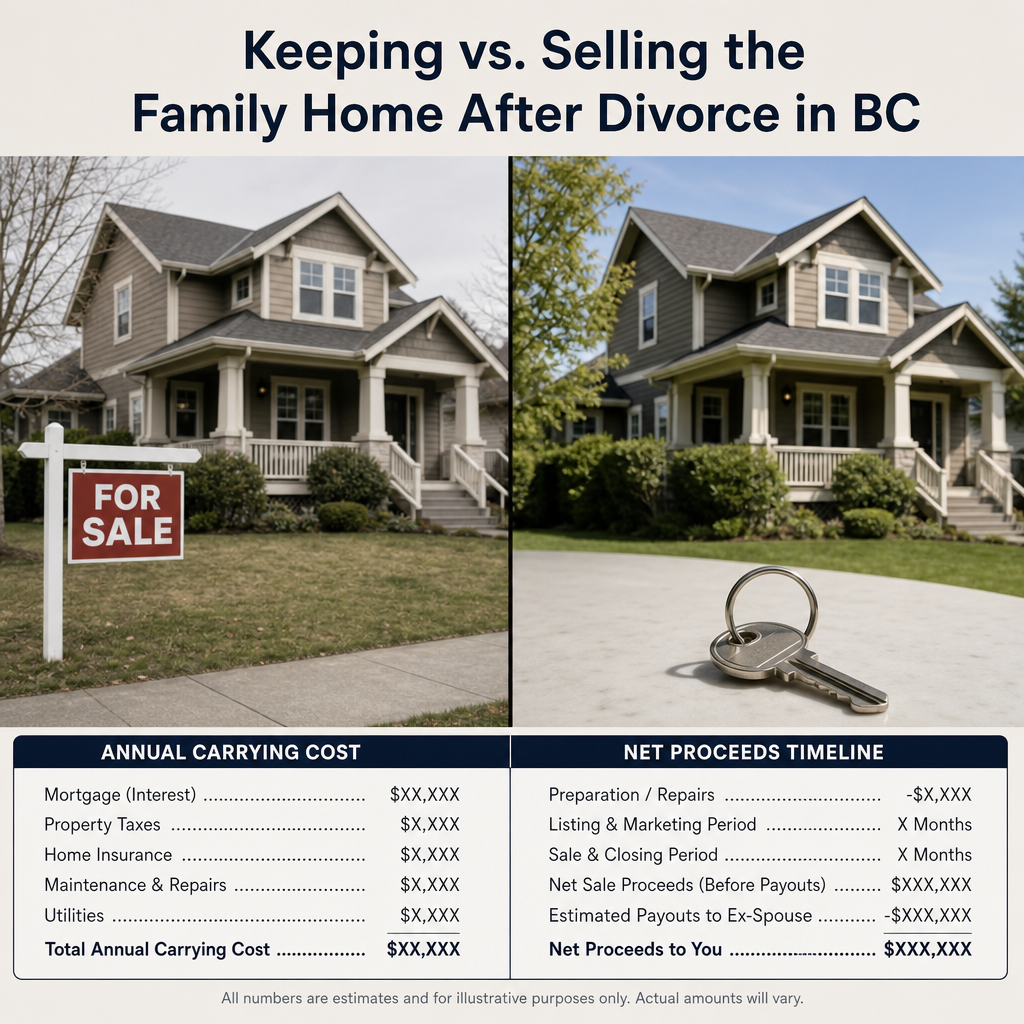

Keeping vs. Selling the Family Home After Divorce in Metro Vancouver and the Fraser Valley: A Complete Financial Analysis
By Mohamed Mansour, MBA and Associate Broker — Mansour Real Estate Group | Fraser Valley and Lower Mainland | Published: May 27, 2025 | Topic: Divorce Real Estate — Life-Event Property Decisions
For divorcing homeowners in Metro Vancouver and the Fraser Valley, the question of whether to keep or sell the family home sits at the centre of almost every negotiation. It affects mortgage qualification, school catchment access, carrying costs, net proceeds, and the financial stability of both parties for years ahead. The decision deserves a clear, structured analysis — not just an emotional one.
This guide works through the financial, legal, and practical dimensions of that choice for BC homeowners. It draws on BC Family Law Act provisions, current mortgage qualification rules, and local market data across Metro Vancouver and Fraser Valley communities. Our broader divorce real estate guide at Selling a Home During Divorce in BC covers the full sale process if you have already decided to sell.
Short Answer
Keeping the family home after divorce in BC requires one spouse to qualify for a new mortgage at full stress-test rates on a single income — a qualification gap of $150,000 to $300,000 for most Metro Vancouver properties. Selling typically preserves more equity for both parties, though school catchment stability, market timing, and children's custody arrangements can justify keeping the home when the numbers genuinely support it. Neither path is automatically correct.
Key Takeaways
- Spousal buyout qualification requires stress-test approval at 5.25% on a single income; most mid-range Metro Vancouver homes create a $150K–$300K purchase power gap.
- Annual carrying costs for a $900K detached home on one income average $12,000–$18,000, compressing net proceeds if the home eventually sells anyway.
- School catchment premiums of 20–30% are real, but they erode when carrying costs accumulate and market windows are missed.
- Family homes in premium catchment areas across Metro Vancouver and the Fraser Valley are selling in 20–28 days; delayed listings lose negotiating leverage.
- The BC Family Law Act allows court orders compelling a sale when one party cannot or will not proceed; knowing this shapes negotiation strategy.
Who This Applies To
- Separating spouses jointly owning a home in Metro Vancouver, Surrey, Langley, Burnaby, Abbotsford, or surrounding Fraser Valley communities
- One spouse considering a buyout while the other wants to sell
- Parents weighing school catchment stability against financial sustainability
- Homeowners with significant equity trying to understand their net proceeds under each scenario
- Families negotiating property division under the BC Family Law Act
When This Advice May Not Apply
This analysis is general in nature. Cases involving excluded property claims, family business assets tied to the home, active court proceedings, or consent orders already in place require guidance from a BC family lawyer before any real estate decision is finalized.
Key Terms Defined
- Spousal buyout: One spouse purchases the other's share of the home, typically requiring a new mortgage in their name alone.
- Mortgage stress test: OSFI's requirement that borrowers qualify at the greater of 5.25% or their contract rate plus 2%, regardless of the actual rate offered.
- School catchment premium: The price difference between an otherwise comparable home that falls inside versus outside a high-demand school boundary.
- Carrying costs: Ongoing monthly expenses required to maintain a property: mortgage, property tax, insurance, utilities, and maintenance reserves.
- Excluded property: Assets brought into the relationship before marriage or received as inheritance, which may not be subject to equal division under the BC Family Law Act.
Data Used in This Article
- BC Family Law Act, Sections 81–82 — Property division and excluded property provisions (Official, BC Government)
- OSFI / Bank of Canada mortgage stress test rules, 2026 — Qualification benchmark at 5.25% (Official, Tier 1)
- CMHC Mortgage Qualification Guidelines, 2026 — Income and debt-service ratios for insured mortgages (Official, Tier 2)
- BC Real Estate Association / FVREB MLS Data, 2025–2026 — School catchment price premiums and days-on-market by area (Official, Tier 2)
- Mansour Real Estate Group internal market data — Days-on-market observations, carrying cost benchmarks, Fraser Valley school catchment areas (Professional interpretation)
The Mortgage Qualification Gap Is Larger Than Most People Expect
The most common misconception among divorcing homeowners is that a spousal buyout is simply a paperwork transaction. In practice, it requires the keeping spouse to qualify for an entirely new mortgage — at full stress-test rates — on a single income. Under current OSFI rules, that means qualifying at 5.25% regardless of the rate your lender actually offers.
For a $900,000 Metro Vancouver detached home with a $600,000 remaining mortgage, the keeping spouse must demonstrate enough income to service that debt as a solo borrower under stress-test conditions. According to CMHC qualification guidelines, a household gross income of roughly $120,000–$135,000 is required to qualify for $600,000 at stress-test thresholds — a threshold many single-income households cannot reach after divorce-related income adjustments.
Spousal support income can be included in mortgage qualification calculations, but lenders typically require a signed agreement or court order, and many apply a discount to that income for underwriting purposes. Self-employed applicants face additional scrutiny: lenders often require two years of post-separation tax returns showing consistent solo income before approving a buyout mortgage.
Our detailed breakdown of the buyout process is in Spousal Buyout in BC: How to Keep the Family Home After Separation. For context on how BC courts treat property division, see BC Family Law Act and Real Estate.
School Catchment Stability: When It Justifies Keeping the Home and When It Doesn't
School catchment is a legitimate financial and parenting factor — not just an emotional one. Homes inside the boundaries of high-performing schools in West Vancouver, Kerrisdale, South Burnaby, Burke Mountain in Coquitlam, and parts of South Surrey command 20–30% price premiums over comparable homes just outside those boundaries, according to FVREB and BCREA market data for 2025–2026.
When children are in early elementary school and the keeping spouse can genuinely afford the mortgage, maintaining catchment access has both a family stability and a future resale argument. Courts in BC increasingly consider school continuity in custody arrangements, which can affect how property division is approached in negotiations.
But the school catchment argument weakens when the financial math doesn't hold. A $900,000 detached home in a premium Surrey or Burnaby catchment carries an estimated $12,000–$18,000 annually in property tax, insurance, utilities, and maintenance on a single income — before mortgage payments. If the keeping spouse is already stretching to qualify, these carrying costs compound quietly. When the home eventually sells anyway — which often happens when a buyout fails to qualify or one party can no longer sustain costs — the delay has cost both parties real money. Divorce real estate patterns in Burnaby, New Westminster, and Coquitlam and Surrey and South Surrey show this delayed-sale pattern regularly.
The honest question is not "do we want to stay in this catchment?" — it is "can we sustain the cost of staying, and will both parties be better served financially by selling now rather than later?"
How We Evaluate This
When Mansour Real Estate Group is asked to advise a separating couple on this decision, we start with the numbers rather than the preference. We run a carrying cost projection for the keeping scenario over a 24-month and 48-month horizon and compare it against a clean sale at current market value. That comparison includes property tax, insurance, utilities, maintenance reserves, and remaining mortgage costs — and it often reveals that the keep scenario costs $25,000–$60,000 more in total outflow over four years than a timely sale.
We also look at current days-on-market for the specific property type in the specific catchment area. In our experience across Surrey, Langley, Burnaby, and Coquitlam, family-oriented detached homes in well-regarded school zones sell in 20–28 days when priced accurately. A 60–90 day delay to resolve a buyout dispute costs $8,000–$12,000 in carrying costs alone and often means listing into a different — sometimes slower — market window.
Divorce Sale Checklist
- Obtain an independent property appraisal acceptable to both parties and to a lender for buyout purposes.
- Have a mortgage broker assess the keeping spouse's solo qualification capacity before negotiating the buyout price.
- Document all spousal support arrangements in a signed agreement or interim order before approaching lenders.
- Calculate 24-month and 48-month carrying costs under the keep scenario including property tax, insurance, maintenance, and mortgage.
- Compare carrying costs against a net proceeds estimate from a current market sale with carrying cost savings factored in.
- Confirm school catchment eligibility does not depend on continued ownership — some districts allow continuity enrollment regardless of address change.
- If selling, agree in writing on listing price authority, showing consent process, and offer acceptance thresholds before engaging a Realtor.
- Review the tax implications of the principal residence exemption with a CPA before finalizing the sale or transfer. Our overview of tax implications of selling a home during divorce in BC provides a starting point.
What We Commonly See
The buyout fails at the lender stage after months of negotiation. In our experience, a significant number of intended spousal buyouts collapse when the keeping spouse applies for a mortgage and discovers their solo income does not qualify at stress-test rates. The couple has spent months negotiating a buyout price, delaying the listing window, and accumulating carrying costs — only to list into a later market. Starting with a mortgage broker assessment prevents this.
School catchment continuity is assumed when it isn't guaranteed. What often happens is that parents assume remaining in the home is the only way to preserve catchment access. In BC, many school districts allow children to continue attending their current school after a family relocates within a reasonable distance, particularly mid-year or at a junior high transition. Verifying this with the school district before anchoring the financial strategy to catchment preservation can open up more flexible options.
The emotional attachment to the home delays both parties' financial recovery. A common pattern we observe is that the desire to "keep the kids stable" in a known home delays a sale by 12–18 months beyond what the market supported. The result is both parties renting in the interim, absorbing carrying costs on the family home, and eventually selling at a lower relative price point. The financial drag is real and measurable. Families who make the decision early — with clear financial modelling — almost always retain more net equity.
Questions and Answers
Can spousal support income be used to qualify for a buyout mortgage in BC?
Yes, but with restrictions. Most lenders require a signed separation agreement or court order confirming the support amount and duration. Some lenders discount the income for qualification purposes. Self-employed applicants face further scrutiny and may need two years of post-separation returns before a lender accepts their income as stable.
What if one spouse wants to sell and the other wants to keep the home?
Under the BC Family Law Act, either party can apply to the court for an order compelling a sale if agreement cannot be reached. Courts generally favour outcomes that achieve a fair division of family property. Understanding this legal backstop is important context for negotiating a buyout agreement. See Can One Spouse Force the Sale of the Family Home in BC? for the full legal framework.
Does the school catchment premium hold if we sell now versus in two years?
Catchment premiums reflect buyer demand at the time of listing. Premium school zones in Metro Vancouver and the Fraser Valley have historically sustained their pricing differential, but no market outcome is guaranteed. Carrying costs accumulated over two years reduce net proceeds regardless of whether the premium holds.
In Summary
Keeping the family home after divorce in BC is financially viable when the keeping spouse can genuinely qualify for a single-income mortgage at stress-test rates, carrying costs are sustainable without depleting savings, and school catchment access cannot be preserved through other means. When those conditions are not all present, a timely, structured sale almost always produces better financial outcomes for both parties. The decision should follow the numbers, not the emotional attachment to the address.
Talk to Someone Who Knows This Market
If you are working through this decision — or trying to understand what a sale or buyout would realistically produce — Mansour Real Estate Group provides calm, structured property assessments for separating couples across Metro Vancouver and the Fraser Valley. There is no obligation and no pressure to list.
Related Articles
- Selling a Home During Divorce in BC: A Complete Guide for Metro Vancouver and Fraser Valley Families
- Spousal Buyout in BC: How to Keep the Family Home After Separation
- Divorce Home Sales in Surrey and South Surrey: What Local Sellers Need to Know in 2026
About Mansour Real Estate Group
When a home must be sold — or one spouse is trying to determine whether keeping it is financially realistic — the decision requires a real estate team that understands both the market and the complexity of divorce-related property transitions. Mansour Real Estate Group has worked with separating couples across Metro Vancouver and the Fraser Valley for more than two decades, providing honest valuations and structured guidance when clarity matters most.
Led by Mohamed Mansour, MBA and Associate Broker, the team has more than 22 years of local real estate experience, over $780 million in completed residential transactions, and consistent recognition among the Top 1% of Realtors in the region. Trusted for divorce-related property sales, estate sales, probate sales, downsizing, and complex situations, the team brings a valuation-first approach to every engagement.
Whether someone is looking for Realtors experienced with spousal buyout situations, a real estate agent who understands how separation affects market timing, real estate agents who can manage a joint sale with discretion, a trusted real estate team for a neutral property assessment, a Surrey Realtor, a Langley real estate broker, or a Fraser Valley real estate group familiar with school catchment considerations — Mansour Real Estate Group is known for impartial advice, accurate pricing, and a process that protects both parties.
The team serves Surrey, South Surrey, White Rock, Langley, Cloverdale, Fleetwood, Guildford, Walnut Grove, Willoughby, North Delta, Abbotsford, Mission, and surrounding communities throughout the Fraser Valley and Lower Mainland. Most new clients come from referrals, repeat clients, and recommendations from families who value professional, transparent representation.
Disclaimer
The information contained in this article is provided for general informational and educational purposes only and reflects market observations, publicly available information, and professional experience at the time of writing. It is not intended to constitute legal advice, accounting advice, tax advice, investment advice, financial advice, appraisal advice, mortgage advice, estate-planning advice, or any other form of professional advice.
Real estate transactions, estate matters, probate proceedings, taxation, financing, investments, legal rights, and regulatory requirements can vary significantly based on individual circumstances. Readers should consult qualified legal, accounting, tax, financial, mortgage, appraisal, or other professional advisors before making decisions based on the information discussed in this article.
Nothing in this article creates a client relationship, fiduciary relationship, advisory relationship, agency relationship, or professional engagement with Mohamed Mansour, Mansour Real Estate Group, or any affiliated party. Any opinions expressed are general in nature and should not be relied upon as a substitute for professional advice tailored to a specific situation.
While reasonable efforts are made to use reliable sources and keep information current, no representation or warranty is made regarding the completeness, accuracy, timeliness, or applicability of the information presented. Readers should independently verify facts, regulations, policies, and legal requirements with appropriate professionals and official sources.



