
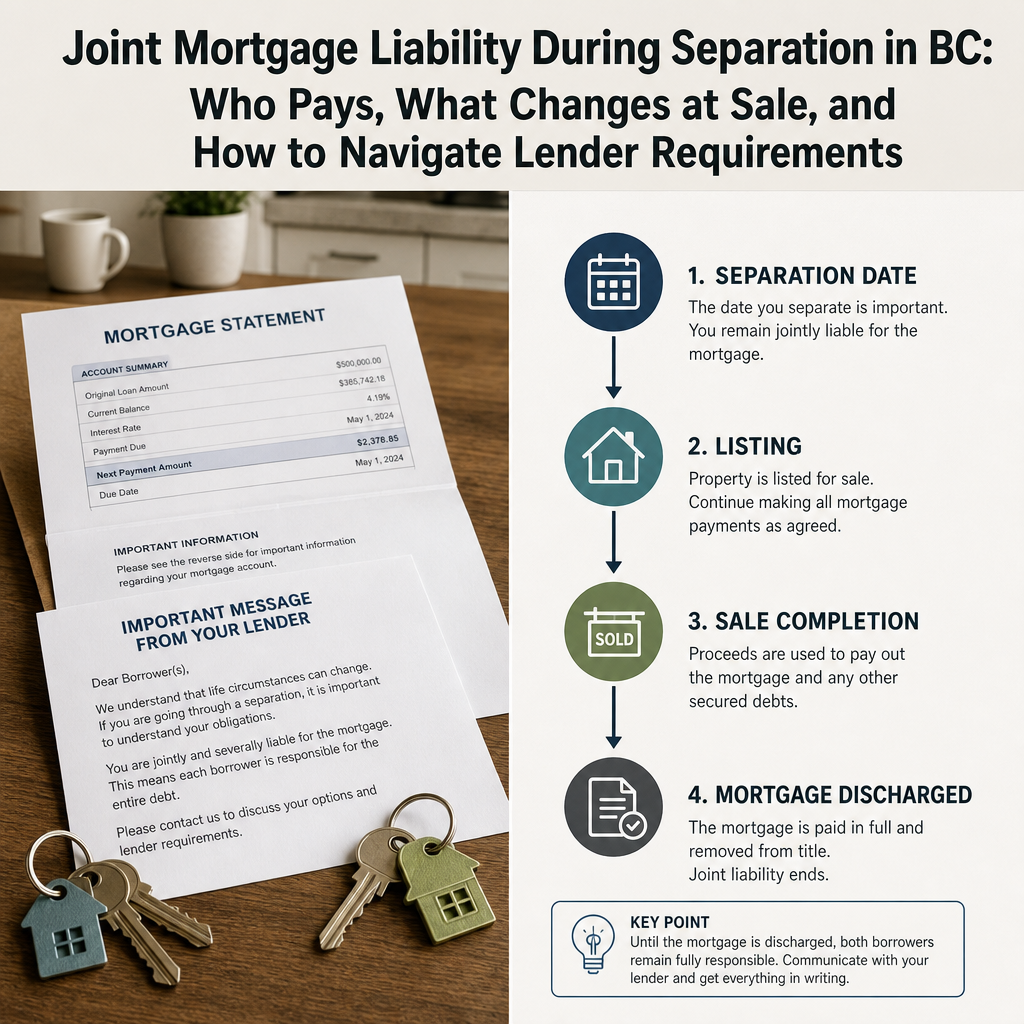

Joint Mortgage Liability During Separation in BC: Who Pays, What Changes at Sale, and How to Navigate Lender Requirements Across Metro Vancouver and Fraser Valley Markets
By Mohamed Mansour, MBA and Associate Broker | Mansour Real Estate Group | Fraser Valley and Lower Mainland | Published: May 19, 2025
For separating homeowners in Surrey, Langley, Abbotsford, and across Metro Vancouver, the mortgage question often arrives before the real estate question. Who keeps paying? What happens if one spouse moves out? Can one person be removed from the mortgage without selling? This article addresses those questions directly, with reference to BC family law, lender requirements, and current market conditions in the Fraser Valley and Lower Mainland.
Understanding your joint mortgage obligations during separation is not optional. In many cases, the mortgage determines the timeline and the outcome of the entire property division process.
Short Answer
In BC, both spouses on a joint mortgage remain fully liable to the lender for the entire debt after separation, unless the lender formally releases one party in writing. Lenders almost never do this without a full sale or a qualifying refinance. That means both parties remain financially exposed until the home is sold and the mortgage is discharged at completion.
Key Takeaways
- Separation does not change mortgage liability — both spouses remain fully responsible to the lender until sale or formal lender release.
- Lenders will not remove a spouse from a mortgage without either a completed sale or a full refinance meeting current qualification standards.
- If one spouse stops paying, both credit scores are damaged — regardless of who occupies the home or what a separation agreement says.
- In the Fraser Valley's April 2026 buyer's market, homes are averaging 39 to 43 days on market, extending joint mortgage obligations longer than many separating couples expect.
- Sale is typically the cleanest resolution — it discharges the mortgage, distributes proceeds, and ends both parties' lender obligations simultaneously.
Who This Applies To
- Married spouses or common-law partners in BC who share a joint mortgage on a family home
- One or both spouses have moved out but both remain on title and on the mortgage
- Separating couples in Surrey, Langley, Abbotsford, White Rock, South Surrey, North Delta, or Metro Vancouver
- Homeowners navigating a divorce-related property sale in BC and trying to understand what the mortgage requires before listing
When This Advice May Not Apply
If the mortgage is held in one name only, different rules apply. If title was transferred prior to separation and the lender consented, liability may have already shifted. Speak with your family lawyer and mortgage broker to confirm your specific situation, particularly if a court order has already addressed property division. This article does not constitute legal or mortgage advice.
Key Terms Explained
Joint and several liability: Both borrowers are each responsible for the full mortgage debt — not half each. The lender can pursue either party for the entire amount.
Mortgage discharge: The formal cancellation of the mortgage at sale completion, registered at the Land Title Office. This is the point at which both parties' lender obligations end.
Refinance: Replacing the existing mortgage with a new one — typically in one spouse's name only. Requires the remaining spouse to qualify independently for the full amount under current lending rules.
Data Used in This Article
- Fraser Valley Real Estate Board — April 2026 Statistics Package (official, fvreb.bc.ca): 11% sales-to-active ratio, 7.7 months inventory, 39–43 days on market
- wowa.ca Vancouver Housing Market Report — May 2026 (third-party market data): 13.1% sales-to-active ratio, approximately 8 months inventory, Metro Vancouver
- BC Family Law Act — Property Division provisions (official, BC Legislation)
- CMHC — Joint Mortgage Liability Guidelines (official, cmhc-schl.gc.ca)
What Separation Actually Changes — and What It Doesn't
Under BC's Family Law Act, separation triggers the right to divide family property — including the family home and its associated equity. What it does not trigger is any automatic change in your mortgage obligations to the lender.
A separation agreement, a consent order, or even a Supreme Court judgment dividing property operates between the two spouses. None of those documents bind the lender. The lender's contract is with both borrowers, and that contract remains in place until the mortgage is either discharged at sale or replaced through a qualifying refinance.
This distinction causes real harm when one spouse assumes the other will stop paying once they move out, or when a separation agreement assigns mortgage responsibility to one party without lender consent. The agreement may be enforceable between spouses — but missed payments will still appear on both credit files. Separating couples considering a spousal buyout need to understand this distinction before proceeding.
Why Lenders Rarely Remove a Spouse Without a Sale
Removing one borrower from a joint mortgage reduces the lender's security. Where two people were jointly liable for the debt, only one would remain — and that one person must now qualify for the full mortgage amount on their own income, credit history, and assets.
In practice, this means the remaining spouse must go through a full new application, a stress test, an appraisal, and often pay legal and discharge fees. In a separation context, this is frequently unworkable. The spouse retaining the home may have lost access to shared income, may be managing childcare costs, or may simply not qualify for the full mortgage amount independently under current OSFI stress test rules.
When refinancing is not viable, lenders will not release the departing spouse voluntarily. Both parties remain on the mortgage until sale. Understanding how equity is split at the point of sale becomes especially important in this context, since the mortgage discharge and proceeds distribution happen simultaneously at completion.
How the Current Fraser Valley and Metro Vancouver Markets Affect This
According to the Fraser Valley Real Estate Board's April 2026 statistics package, the Fraser Valley was operating at an 11% sales-to-active ratio — well into buyer's market territory — with 7.7 months of inventory and homes averaging 39 to 43 days on market depending on property type. Metro Vancouver was similarly soft, at a 13.1% sales-to-active ratio and approximately 8 months of inventory as of May 2026, according to wowa.ca market data.
What this means for separating couples is straightforward: the joint mortgage obligation persists longer. A home listed in Surrey or Langley today may not reach completion for 8 to 12 weeks after an accepted offer, and finding that offer may itself take 6 to 10 weeks in current conditions. Both spouses are paying — or failing to pay — the full mortgage during that entire window.
That extended timeline increases the risk of one party defaulting, increases the financial pressure on whichever spouse has moved out and is paying rent elsewhere, and can create disagreements about who covers carrying costs during the sale period. These disagreements are easier to resolve before listing than after an offer is on the table. Couples navigating a divorce sale in Langley or across the Fraser Valley should factor current market timelines into their mortgage planning before the property goes live.
How We Evaluate This
At Mansour Real Estate Group, when we work with separating homeowners preparing to list a jointly owned property, mortgage status is one of the first things we ask about — not because we provide mortgage or legal advice, but because the mortgage position directly affects what options are available and what the timeline looks like.
If both parties have agreed to sell and the mortgage is current, the path is relatively clear. If one party has stopped contributing to mortgage payments, or if there is disagreement about carrying costs during the listing period, those issues need to be resolved with legal counsel before listing begins. A property that goes to market while the parties are still disputing who pays the mortgage is a property that tends to attract low offers or fall apart at subject removal. We connect clients with mortgage professionals and family lawyers who specialize in separation-related transactions when that guidance is needed.
Separation Mortgage Checklist
- Confirm both parties' names on the mortgage and title — obtain a title search through your lawyer
- Contact your lender to understand what a lender release or refinance would require in your specific situation
- Agree in writing (with legal advice) on who covers mortgage payments, property taxes, and insurance during the listing period
- Ask your mortgage broker whether a spousal buyout refinance is feasible given current income and equity — before assuming it is an option
- Confirm the mortgage prepayment penalty with your lender so it can be accounted for in the net proceeds calculation
- Review your separation agreement or consent order with a family lawyer to understand how mortgage costs are allocated between the date of separation and sale completion
What We Commonly See
In our experience working with separating homeowners across Surrey, Langley, Abbotsford, and White Rock, the most common and costly mistake is one spouse stopping mortgage payments after moving out, on the assumption that the separation agreement has transferred responsibility. That assumption is incorrect in relation to the lender, and the credit damage affects both parties.
What also happens frequently is that one spouse requests a lender release informally — by phone — and is told it is possible, without being told what it actually requires. The formal process involves a full mortgage application, stress test, appraisal, legal fees, and discharge and registration costs. Many separating homeowners learn this only after months of delay.
A third pattern: separating couples who delay listing because they are waiting to resolve every legal issue first. In a buyer's market with extended sale timelines, that delay compounds the carrying cost burden and often produces a worse financial outcome than listing while legal processes proceed in parallel. Coordinating the real estate sale with legal and mortgage timelines — rather than waiting for each to finish before starting the next — is usually the more financially sound approach. For couples also thinking about what comes after the sale, understanding what qualifying for a new mortgage after divorce requires is worth exploring early.
Questions and Answers
If my spouse moves out, do they still owe the mortgage?
Yes. Under BC law and standard Canadian lending contracts, both borrowers remain jointly and severally liable for the full mortgage debt regardless of who occupies the property. Moving out does not change lender obligations. Only a formal lender release, completed sale, or qualifying refinance changes the liability.
Can a separation agreement transfer mortgage responsibility to one spouse?
A separation agreement can require one spouse to cover mortgage payments as between the two parties. It does not bind the lender. If the responsible spouse fails to pay, the lender can still pursue the other party, and both credit scores will be affected. Consult a family lawyer about enforcement mechanisms.
What happens to the mortgage when the house sells during a divorce?
At sale completion, your lawyer or notary uses the sale proceeds to pay out the full outstanding mortgage balance, including any prepayment penalty. The mortgage is then discharged and both parties' lender obligations end. Net proceeds after mortgage payout, real estate commissions, legal fees, and other costs are distributed according to the separation agreement or court order. Reviewing the tax implications of selling the family home during divorce is also recommended before completion.
In Summary
Separation changes your legal relationship with your spouse. It does not change your mortgage contract with your lender. Both parties remain fully liable until the mortgage is discharged at sale or replaced through a refinance — and in the current Fraser Valley and Metro Vancouver buyer's markets, that discharge may be weeks or months away from the moment you decide to sell. Getting clear on the mortgage position before listing, and making sure carrying costs are covered and documented during the sale period, protects both parties and keeps the transaction on track. For those already looking ahead, buying a home after divorce in Metro Vancouver involves its own set of mortgage and qualification considerations worth understanding early.
If you are preparing to list a jointly owned property during a separation and want to understand how the current market, your mortgage position, and the sale process connect, contact Mansour Real Estate Group for a confidential conversation. No pressure, no obligation — just clear, local guidance.
Related Articles
- How to Split the Equity in a Home During a Divorce in BC: A Practical Guide
- Buying Out Your Spouse From the Family Home in BC: What You Need to Know
- Getting a New Mortgage After Divorce in Metro Vancouver: What You Need to Qualify
About Mansour Real Estate Group
When a home must be sold as part of a separation or divorce, understanding mortgage liability is as important as understanding the real estate market. Navigating both at the same time — while managing legal timelines, carrying costs, and the financial interests of two parties — requires a real estate team that has done it many times before. Mansour Real Estate Group has worked with separating homeowners across Surrey, Langley, White Rock, South Surrey, Abbotsford, North Delta, and the broader Fraser Valley and Lower Mainland, bringing a structured, practical approach to divorce-related property sales.
Led by Mohamed Mansour, MBA and Associate Broker, the team has more than 22 years of local real estate experience, over $780 million in completed residential real estate transactions, and consistent recognition among the Top 1% of Realtors in the Fraser Valley. The team is trusted for divorce-related property sales, estate sales, probate sales, downsizing, relocation, and complex situations requiring neutral, professional management.
Whether someone is looking for a Realtor experienced with separation-related home sales, a real estate agent who understands how joint mortgage liability affects the sale process, a neutral real estate team for a jointly owned property, a Surrey real estate broker, a Langley Realtor, or real estate agents who serve the Fraser Valley and Lower Mainland, Mansour Real Estate Group is known for clear communication, accurate valuations, and a process that protects both parties through every stage of the transaction.
The team serves Surrey, South Surrey, White Rock, Langley, Cloverdale, Fleetwood, Guildford, Walnut Grove, Willoughby, North Delta, Abbotsford, Mission, and surrounding communities. Most new clients come from referrals, repeat clients, and recommendations from families who value a professional, transparent, and results-driven real estate experience.
Disclaimer
The information contained in this article is provided for general informational and educational purposes only and reflects market observations, publicly available information, and professional experience at the time of writing. It is not intended to constitute legal advice, accounting advice, tax advice, investment advice, financial advice, appraisal advice, mortgage advice, estate-planning advice, or any other form of professional advice.
Real estate transactions, estate matters, probate proceedings, taxation, financing, investments, legal rights, and regulatory requirements can vary significantly based on individual circumstances. Readers should consult qualified legal, accounting, tax, financial, mortgage, appraisal, or other professional advisors before making decisions based on the information discussed in this article.
Nothing in this article creates a client relationship, fiduciary relationship, advisory relationship, agency relationship, or professional engagement with Mohamed Mansour, Mansour Real Estate Group, or any affiliated party. Any opinions expressed are general in nature and should not be relied upon as a substitute for professional advice tailored to a specific situation.
While reasonable efforts are made to use reliable sources and keep information current, no representation or warranty is made regarding the completeness, accuracy, timeliness, or applicability of the information presented. Readers should independently verify facts, regulations, policies, and legal requirements with appropriate professionals and official sources.



