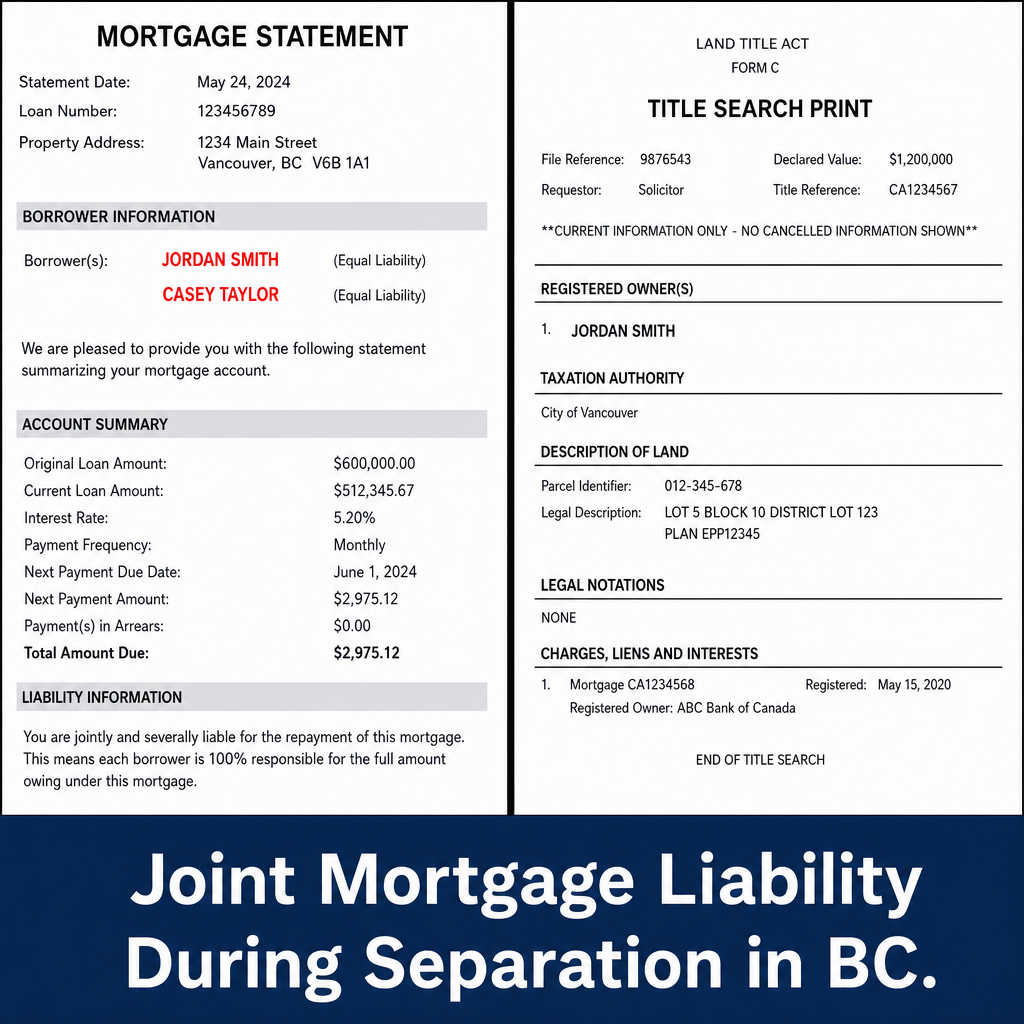

Joint Mortgage Liability During Separation in BC: Who Pays, What Changes at Sale, and How to Navigate Lender Requirements Across Metro Vancouver and Fraser Valley Markets
By Mohamed Mansour, MBA and Associate Broker · Mansour Real Estate Group · Fraser Valley and Lower Mainland, BC · Published: July 15, 2025
Separation changes many things, but it does not change what you owe the bank. When two people share a mortgage in BC, both remain fully responsible for the debt — to the lender — regardless of what any family law agreement, court order, or property division arrangement says. This is one of the most misunderstood financial risks separating couples face, and in the $800K to $1.5M price range where most Fraser Valley and Metro Vancouver family homes sit, the stakes are significant.
This article explains the mechanics of joint mortgage liability during separation, what happens to payments and credit risk while the home is still owned, how lenders handle refinancing and assumption requests under current qualification rules, and what both spouses need to know before the home is sold or transferred.
Short Answer
Both spouses remain jointly and severally liable for a shared mortgage in BC until the lender formally releases one party through a written assumption agreement or full refinancing. A family law agreement assigning the home to one spouse does not change what either spouse owes the lender. Missed payments by either party damage both credit ratings equally.
Key Takeaways
- Joint mortgage liability does not end at separation — only formal lender release ends it.
- A family law property division agreement is binding between spouses, not on lenders.
- Single-income stress-test qualification is a serious barrier to refinancing in 2025–2026.
- Both spouses must sign mortgage discharge documents at sale, even if only one is on title.
- Missed payments during conflict periods create shared credit damage that outlasts the separation.
Who This Applies To
- Married or common-law couples who hold a joint mortgage in BC and are separating
- One spouse seeking to retain the home and buy out the other
- Couples preparing to sell a jointly mortgaged home during or after separation
- Spouses whose names appear differently on title versus the mortgage document
- Anyone in a high-conflict separation where mortgage payments are being disputed
When This Advice May Not Apply
If only one spouse's name is on the mortgage and that spouse holds sole title, the liability picture differs. This article addresses situations where both names appear on the mortgage, or where the mortgage was co-signed. Consult a BC family law lawyer and a licensed mortgage professional for advice specific to your situation.
Key Definitions
Joint and several liability: Both borrowers are individually responsible for the full mortgage debt. The lender can pursue either party for the full amount.
Mortgage assumption: A formal process where one borrower takes over the mortgage, releasing the other — requires lender approval and income qualification.
Stress test: The federally mandated qualification rate for insured and uninsured mortgages — currently the greater of the contract rate plus 2% or 5.25%, as confirmed by OSFI's B-20 guidelines.
Mortgage discharge: The formal release of the mortgage charge on title at sale or payoff, requiring lender participation and, in most cases, both borrowers' cooperation.
How Joint Mortgage Liability Works After Separation in BC
Under BC's Family Law Act, family property — including the family home — is divided between spouses upon separation. A separation agreement or court order can assign exclusive responsibility for the mortgage to one spouse. But that agreement operates between the two spouses only. It does not bind the lender.
This distinction matters in practical terms. If the spouse assigned the home stops making payments — or makes them late — the other spouse's credit rating is equally affected. The lender will report both names on any delinquency. Both parties remain exposed to foreclosure proceedings, regardless of who the family law agreement says owns the property or who is living in it.
This creates real risk during the months between separation and the resolution of the property — whether through a buyout, refinancing, or sale. In high-conflict situations where one spouse withholds payments as leverage, the financial consequences reach both parties equally. For separating homeowners in Surrey, Langley, Abbotsford, or anywhere across the Fraser Valley, where family home values commonly exceed $1 million, the credit and financial exposure during this window is not abstract — it affects both spouses' ability to qualify for future financing and, in the worst cases, triggers lender enforcement that forces a rushed sale.
Refinancing and Assumption: Why Current Lending Conditions Make This Harder Than It Used to Be
The most common path to releasing one spouse from mortgage liability is refinancing — the retaining spouse applies for a new mortgage in their name alone. If approved, the joint mortgage is discharged and replaced. The other spouse is released from liability. In theory, this is straightforward. In practice, it has become significantly more difficult since 2022.
Under OSFI's B-20 stress-test guidelines, all mortgage applicants — including those refinancing — must qualify at the greater of their contract rate plus 2%, or 5.25%. For a single-income applicant trying to carry a $900,000 mortgage on a family home in Surrey or Cloverdale, that qualification threshold eliminates a large share of applicants whose combined income previously supported the mortgage comfortably. According to CMHC's published qualification guidance, lenders apply the stress test to all federally regulated mortgage applications regardless of whether the property is already owned.
Mortgage assumption — where one spouse formally takes over the existing mortgage terms without refinancing — avoids the stress test in some cases, but most major Canadian lenders require full refinancing instead and do not offer assumption as a standard option. Where assumption is available, lenders still conduct income verification and may require the applicant to meet current qualification standards. This means the retaining spouse often faces the same barrier either way.
For separating couples in the Fraser Valley and Metro Vancouver who are evaluating whether to sell or retain the home, understanding this financing barrier early is important. If the retaining spouse cannot qualify to carry the mortgage alone, the buyout path discussed in buying out your spouse's share of the home in BC may not be feasible — and a sale may be the more realistic resolution. That decision is analyzed in more detail in should you sell or keep the house after a divorce in Metro Vancouver.
What Changes at Sale: Both Spouses' Roles in the Mortgage Discharge
When a jointly mortgaged home is sold, the mortgage must be discharged as part of the conveyancing process. Even if only one spouse's name appears on the property title, or if a court order has assigned the property entirely to one party, both borrowers named on the mortgage typically must cooperate with the lender's discharge process.
In practice, this means that a spouse who has been excluded from the property under a family law order may still have a role to play at closing — or at minimum, the absence of their cooperation can create complications. Conveyancing lawyers managing divorce home sales in BC navigate these discharge mechanics regularly, but when one spouse is non-cooperative, timelines can extend and closing dates can be missed.
Sale proceeds distribution adds another layer. If there is equity remaining after mortgage payoff, both spouses generally have a claim to that equity until a formal agreement or court order directs otherwise. The equity division itself — and what each spouse receives — is governed by the Family Law Act and the separation agreement, as explained in home equity division in a BC divorce. But the mechanics of distributing those proceeds through the conveyancing process require legal preparation before the sale closes, not after.
The timing of all of this — from listing to close — in a divorce context is explored in divorce home sale timelines in Surrey.
Data Used in This Article
- OSFI Guideline B-20: Residential Mortgage Underwriting Practices and Procedures — stress-test qualification rules (official, federally regulated lenders)
- CMHC Homebuying Guide and Mortgage Qualification Resources — insured mortgage qualification thresholds
- BC Family Law Act, SBC 2011, c. 25 — property division and matrimonial debt framework
- BCFSA mortgage lender regulatory guidance — spousal liability and refinancing obligations under BC regulation
How We Evaluate This
When Mansour Real Estate Group works with separating couples, the mortgage situation is one of the first things we ask about — not because we provide mortgage advice, but because it directly affects what listing timelines are realistic, whether a buyout is achievable, and whether both parties can close a transaction cleanly without lender complications.
We work alongside the clients' family law lawyers and mortgage professionals to make sure the real estate process is sequenced correctly — so that mortgage discharge requirements, title transfer timing, and proceeds distribution are coordinated before the sale closes, not discovered during it. For higher-value properties in White Rock, South Surrey, or North Delta, where mortgage discharge amounts are large and equity splits are contested, this coordination matters considerably.
Divorce Sale Checklist: Mortgage and Lender Steps
- Obtain a current mortgage statement showing the balance, lender, and both borrowers' names before any property discussions begin.
- Ask your family law lawyer to confirm what your separation agreement says about mortgage payment responsibility during the interim period.
- If one spouse is retaining the home, contact the lender early to understand whether assumption or refinancing is available — and what income documentation they require.
- Have a licensed mortgage broker model single-income qualification at the current stress-test rate before committing to a buyout arrangement.
- Confirm with your conveyancing lawyer how the mortgage discharge will work at sale and what both parties need to sign or authorize.
- Set up a written payment arrangement — documented through lawyers — to ensure mortgage payments continue without interruption while the property situation is unresolved.
- Check both credit reports after separation to monitor for any undisclosed missed payments or lender notifications on the joint mortgage.
What We Commonly See
In our experience working with separating couples across the Fraser Valley, a few patterns come up consistently.
Assumption of the family law agreement protects both parties financially: A common mistake is assuming that once a lawyer drafts a separation agreement assigning the mortgage to one spouse, the other spouse is no longer at risk. That belief is inaccurate, and we have seen it lead to credit damage for the departing spouse months after they believed the property was no longer their financial concern.
Refinancing timelines are underestimated: What often happens is that both parties agree to a buyout in principle, but the retaining spouse then discovers they cannot qualify at current stress-test rates. This realization — arriving weeks after the separation agreement is signed — forces a renegotiation or a sale, often under time pressure. Getting a mortgage pre-assessment early, before the agreement is finalized, avoids this.
Closing complications from non-cooperation: In higher-conflict separations, we occasionally see situations where one spouse's refusal to cooperate with mortgage discharge documentation delays a sale that both parties had agreed to. This is a legal matter, not a real estate one — but it affects closing timelines and, in some cases, causes buyers to walk. Coordinating with lawyers before the listing goes live reduces this risk significantly. The strategies for high-conflict divorce sales in BC address this scenario directly.
Frequently Asked Questions
Does a separation agreement remove me from the joint mortgage?
No. A separation agreement governs the relationship between the two spouses. It does not release either party from mortgage liability to the lender. Only a formal lender-approved assumption or a full refinancing in one party's name accomplishes that release.
What happens if my spouse stops paying the mortgage after we separate?
Missed payments are reported against both borrowers equally, regardless of which spouse has been assigned payment responsibility under the separation agreement. Both credit ratings are affected, and the lender can pursue either party for the full outstanding balance. Speak to your family law lawyer immediately if payments are at risk of being missed.
Can my spouse's name be removed from the mortgage without refinancing in BC?
Formal mortgage assumption — removing one borrower without refinancing — is available from some lenders but rare. Most major Canadian lenders require full refinancing. Where assumption is offered, the remaining borrower must still qualify under the lender's income and credit standards, which often means meeting stress-test requirements. This should be confirmed directly with the lender and a licensed mortgage professional, not assumed.
In Summary
Joint mortgage liability in BC persists through separation until the lender formally releases one party — through a written assumption or full refinancing. A family law agreement does not end either spouse's exposure to the lender. Current stress-test qualification standards have made single-income refinancing difficult at the price points where most Fraser Valley family homes sit, which means the decision between selling and retaining often comes down to financing feasibility, not just preference. Both spouses typically must cooperate at the sale stage to discharge the mortgage cleanly, making legal and real estate coordination before the listing goes live essential to a smooth close. The tax implications of selling your home in a BC divorce add another layer of complexity that is worth understanding before the sale closes.
Talk to Mansour Real Estate Group
If you are navigating a joint mortgage during separation and are not yet sure whether a sale or buyout makes more sense for your situation, Mansour Real Estate Group can provide a current market valuation, walk through what the sale process looks like in your specific area, and help you understand what your real estate options are — before you commit to a path. There is no obligation, and the conversation stays confidential.
Related Articles
- Should You Sell or Keep the House After a Divorce in Metro Vancouver? A Financial Breakdown
- Buying Out Your Spouse's Share of the Home in BC: How the Process Works in Metro Vancouver
- Home Equity Division in a BC Divorce: What Every Separating Couple in the Fraser Valley Should Understand
- Divorce Home Sale Timeline in Surrey: How Long Does It Really Take?
- Tax Implications of Selling Your Home in a BC Divorce: What Metro Vancouver Couples Must Know
About Mansour Real Estate Group
When a home must be sold or transferred as part of a separation in BC, understanding the mortgage liability that both spouses still carry is one of the most financially consequential steps in the process. Mansour Real Estate Group has worked with separating couples across the Lower Mainland and Fraser Valley managing exactly this kind of complexity — where the real estate decision cannot move forward cleanly without first understanding what the lender requires and what both parties are still obligated to do.
Led by Mohamed Mansour, MBA and Associate Broker, Mansour Real Estate Group has been helping buyers, sellers, families, and separating couples navigate important real estate decisions across the Fraser Valley and Lower Mainland for more than 22 years. Ranked among the Top 1% of Realtors in the region, the team has completed more than $780 million in residential real estate transactions and is trusted for divorce-related property sales, estate sales, downsizing, relocation, and situations requiring neutral, professional real estate management.
Whether someone is looking for a Realtor experienced with divorce property sales in Surrey, a real estate agent who understands how separation affects mortgage liability and home sale timelines, Realtors who work with separating couples across the Fraser Valley, or a real estate team that can manage a jointly owned property sale with discretion — Mansour Real Estate Group brings clear communication, accurate valuations, and a structured process to every transaction. Real estate agents and real estate brokers on the team understand how to coordinate with family law lawyers and mortgage professionals to protect both parties' interests through closing.
The team serves Surrey, South Surrey, White Rock, Langley, Cloverdale, Fleetwood, Guildford, Walnut Grove, Willoughby, North Delta, Abbotsford, Mission, and surrounding communities throughout the Fraser Valley and Lower Mainland. Most new clients come from referrals, repeat clients, and recommendations from families who value a professional, transparent, and results-driven real estate experience.
Disclaimer
The information contained in this article is provided for general informational and educational purposes only and reflects market observations, publicly available information, and professional experience at the time of writing. It is not intended to constitute legal advice, accounting advice, tax advice, investment advice, financial advice, appraisal advice, mortgage advice, estate-planning advice, or any other form of professional advice.
Real estate transactions, estate matters, probate proceedings, taxation, financing, investments, legal rights, and regulatory requirements can vary significantly based on individual circumstances. Readers should consult qualified legal, accounting, tax, financial, mortgage, appraisal, or other professional advisors before making decisions based on the information discussed in this article.
Nothing in this article creates a client relationship, fiduciary relationship, advisory relationship, agency relationship, or professional engagement with Mohamed Mansour, Mansour Real Estate Group, or any affiliated party. Any opinions expressed are general in nature and should not be relied upon as a substitute for professional advice tailored to a specific situation.
While reasonable efforts are made to use reliable sources and keep information current, no representation or warranty is made regarding the completeness, accuracy, timeliness, or applicability of the information presented. Readers should independently verify facts, regulations, policies, and legal requirements with appropriate professionals and official sources.