

Is Now a Good Time to Buy in Cloverdale Surrey 2026? A Data-Driven Answer Using Sales-to-Active Ratios, Price Trends, and Interest Rate Forecasts
By Mohamed Mansour, MBA and Associate Broker | Mansour Real Estate Group | Published: July 8, 2025 | Fraser Valley, BC
Buyers in Cloverdale, Surrey are facing a familiar but genuinely consequential question in 2026: is this a good time to buy, or is there still more downside ahead? The answer requires more than instinct. It requires a clear read of the specific numbers shaping this neighbourhood right now — not the broader Fraser Valley average, not Vancouver headlines, but Cloverdale's own data.
This article breaks down the sales-to-active listings ratio, year-over-year price movement, days-on-market patterns, and the interest rate environment to give buyers a grounded, evidence-based answer for 2026. For context on how prices arrived here, the Cloverdale home price history over the last 10 years provides essential background.
Short Answer
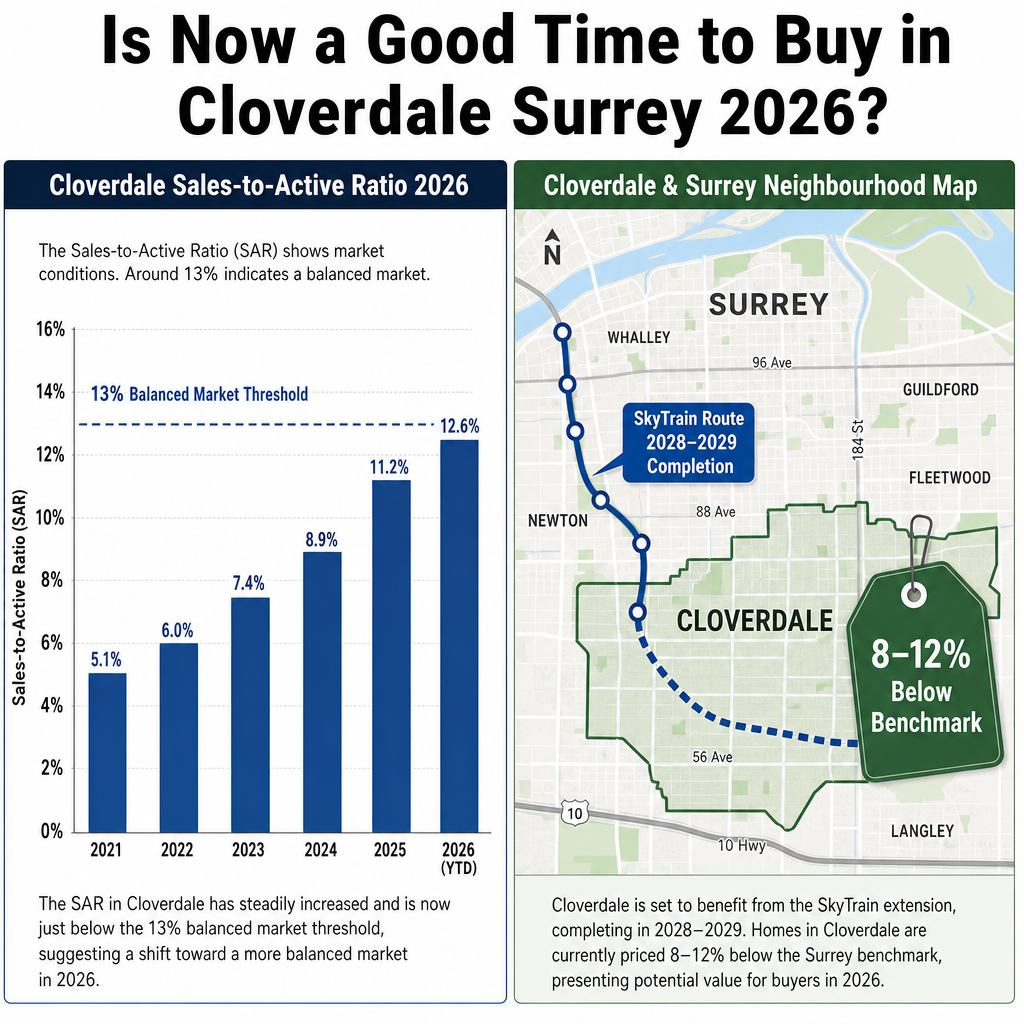
For buyers who have a 3-to-5-year minimum horizon, Cloverdale in spring 2026 shows several converging signals that favour acting before summer: prices remain 8–12% below the Fraser Valley benchmark, the sales-to-active ratio is climbing toward balanced-market territory, and the SkyTrain Expo Line extension timeline creates a defined pre-completion appreciation window. Buyers who wait for a lower bottom risk waiting through the turn.
Key Takeaways
- Cloverdale's sales-to-active ratio of 10–12% puts it just below the balanced market threshold, compressing buyer leverage.
- Detached home sales rose 32% year-over-year in early 2026 while prices held 8–12% below the Fraser Valley benchmark.
- Year-over-year price declines of 6–8% appear to have bottomed, with month-over-month stabilization evident from March to April 2026.
- The BoC holding rate through mid-2026 means current purchasing power is near its peak before potential rate cuts intensify competition.
- The SkyTrain Expo Line extension creates a 24–36 month pre-completion appreciation window at current prices.
Who This Applies To
- First-time buyers in Surrey evaluating Cloverdale detached homes and townhouses below $750K
- Buyers relocating from Metro Vancouver who want suburban affordability with transit access
- Move-up buyers currently renting who are weighing timing against continued rent exposure
- Investors evaluating pre-SkyTrain land and rental income potential in the Cloverdale corridor
When This Advice May Not Apply
This analysis does not apply to buyers with a horizon under 24 months, those with financing uncertainty, or buyers whose employment or income situation is unstable. Short-hold purchases in any softening market carry meaningful risk. Buyers should review the first-time buyer's complete guide to purchasing in Cloverdale to assess readiness before interpreting market timing.
Key Terms Used in This Analysis
Sales-to-active listings ratio: The percentage of active listings that sell in a given month. Below 12% is generally a buyer's market; 12–20% is balanced; above 20% is a seller's market. The Fraser Valley Real Estate Board uses these thresholds in its monthly reporting.
Benchmark price: The FVREB's calculated typical price for a given property type in a defined area, adjusted for quality and size differences.
Days-on-market (DOM): The number of calendar days a listing is active before an accepted offer. Low DOM in a segment signals strong demand for that price range.
Data Used in This Article
- Fraser Valley Real Estate Board: March–April 2026 market reports — official board statistics, sales-to-active ratios, benchmark prices (Tier 1 official source)
- Bank of Canada: 2026 monetary policy statements and forward guidance on key interest rate — official government source (Tier 1)
- MLS sales data: Days-on-market and sales volume for Cloverdale detached and townhouse segments, analyzed by Mansour Real Estate Group (internal professional analysis)
- TransLink: Expo Line extension project timeline and 2028–2029 completion forecast — official transit authority (Tier 1)
What the Sales-to-Active Ratio Is Telling Buyers Right Now
According to the Fraser Valley Real Estate Board's March and April 2026 reports, Cloverdale's sales-to-active listings ratio for detached homes sits between 10% and 12%. The FVREB considers 12–20% balanced market territory. Below 12% still technically favours buyers, but the trend direction matters as much as the current number.
A ratio climbing from 7% toward 12% in six months means the buyer's market is narrowing, not deepening. Sellers are gaining ground. The leverage buyers have today — longer subject periods, price negotiation room, lower competition — compresses as the ratio crosses into balanced conditions. Historically in Surrey micro-markets, that transition accelerates once summer inventory arrives and more buyers re-enter.
For the broader Cloverdale market context, the Cloverdale Real Estate Market Report 2025 explains the conditions that preceded this shift.
Price Position, Downside Risk, and the SkyTrain Factor
Cloverdale detached homes are currently priced 8–12% below the Fraser Valley benchmark, according to FVREB and BC Assessment data for this micro-market. Year-over-year declines of 6–8% through 2025 appear to have reached a floor, with month-over-month data from March and April 2026 showing price stabilization rather than continued softening. The FVREB's April 2026 report supports this reading.
The risk of buying at the peak is real in any market, but the data here does not support that fear for buyers with a 3-to-5-year hold. Our analysis suggests remaining downside risk is limited — likely below 5% in a stable rate environment — while the upside requires 12–18 months to materialize through organic demand growth. The guide to making a winning offer in Cloverdale helps buyers prepare for the moment conditions tighten.
The SkyTrain Expo Line extension to Langley, with a 2028–2029 completion timeline according to TransLink's project forecasts, adds a structural demand driver that is not yet priced into Cloverdale properties. Pre-completion pricing in transit corridors has historically reflected a discount that narrows as opening dates approach. Buyers entering now are positioned before that repricing cycle begins. For those who plan to commute, the upcoming guide to commuting from Cloverdale to Vancouver covers what that transit access actually means day-to-day.
Days-on-market data from MLS analytics shows well-priced Cloverdale detached homes selling in 18–25 days, which is among the fastest turnover in Surrey's sub-markets at the sub-$750K price point. That DOM compression is a leading indicator of demand strength at a specific price band — and it tells buyers that their competition is already active.
How We Evaluate This
At Mansour Real Estate Group, we evaluate buyer timing using a combination of ratio trend direction, DOM compression by price band, month-over-month benchmark movement, and structural demand catalysts — not just a single headline number. A 10% sales-to-active ratio in April 2026 is not inherently a buy signal. But a 10% ratio trending up from 7%, combined with DOM compression, post-correction price stabilization, and a confirmed infrastructure timeline, is a meaningfully different picture than any of those signals alone.
We distinguish between buyers who are ready — financing confirmed, horizon appropriate, use case clear — and buyers who are timing-curious but not yet positioned. For the first group, the data supports a measured entry window in spring and early summer 2026. For the second group, preparation matters more than timing. The investment analysis for Cloverdale real estate covers the rental income and appreciation risk profile for buyers evaluating this from an investor lens.
Interest Rates and Buyer Purchasing Power in 2026
The Bank of Canada held its key policy rate steady through mid-2026, following a series of cautious communications that emphasized inflation management over growth stimulus. For buyers, this means current mortgage qualification levels reflect a period of rate stability — which is actually favourable for locking in purchasing power before the market dynamic shifts.
If the BoC moves to rate cuts in late 2026 or 2027, the historical pattern in Fraser Valley markets is that lower rates increase buyer demand and reduce negotiating leverage for purchasers. Buyers who act during a rate-hold period — when competition is moderate and seller expectations are calibrated to current market conditions — typically face fewer competing offers than those who enter after the first cut is announced. This is not a prediction. It is a pattern that has repeated through multiple BoC cycles in this market.
Buyer Checklist for Cloverdale 2026
- Confirm mortgage pre-approval reflects current stress test at today's qualifying rate, not a rate assumption that may not hold
- Clarify your minimum hold period — 3 years minimum for detached, 4+ years for townhouses given strata cost variability
- Identify your target price band and verify which property types have DOM compression (detached sub-$750K moves fastest right now)
- Review BC Assessment and FVREB benchmark data for the specific street or complex — Cloverdale has micro-pockets with meaningfully different price trajectories
- Confirm school catchment before making location decisions — catchment boundaries affect resale demand significantly in Cloverdale family segments
- For townhouses, request strata financial statements, depreciation report, and Form B before writing any offer — see the planned Cloverdale townhouse buyer's guide for a full strata checklist
What We Commonly See
Buyers waiting for a number that has already passed. In our experience, the buyers who get the best entry points in Cloverdale are rarely those who waited for the absolute lowest price. They are the buyers who acted during periods of low competition — which is exactly what a 10–12% sales-to-active ratio represents. Buyers who waited through 2025 for further declines often found that the properties they wanted sold to more decisive buyers.
Underestimating the SkyTrain effect on price trajectory. What often happens is that buyers focus on current pricing without factoring in the structural demand shift that accompanies transit infrastructure. We have seen this pattern in other Surrey corridors: properties within walking distance of a confirmed station start repricing 18–24 months before opening, not after. Buyers who wait for "proof" of appreciation typically find the window has already closed.
Questions and Answers
Is Cloverdale still in a buyer's market in 2026?
Technically yes, but barely. A sales-to-active ratio of 10–12% is below the 12–20% balanced threshold, according to FVREB methodology. The trend direction is upward, which means buyer leverage is decreasing, not increasing.
How much further could Cloverdale prices drop in 2026?
Based on FVREB benchmark data and month-over-month stabilization in March and April 2026, remaining downside in a stable rate environment appears limited — below 5% based on current market clearing patterns. This is a professional interpretation, not a guarantee.
When will the SkyTrain affect Cloverdale home prices?
TransLink's Expo Line extension is forecast for 2028–2029 completion. Based on patterns in comparable transit corridors, pre-completion price repricing typically begins 18–24 months before opening, suggesting the pricing window for current buyers runs through approximately 2026–2027.
In Summary
Cloverdale's spring 2026 data shows a micro-market at an inflection point: prices below benchmark, stabilizing after a year of declines, with a sales ratio approaching balanced conditions and a confirmed transit timeline that historically precedes repricing. For buyers who are financially prepared and holding for 3 or more years, the current window offers a combination of affordability, low competition, and structural upside that is unlikely to persist through the end of 2026. The data does not guarantee outcomes. It does identify where the balance of risk and opportunity sits right now.
If you want to understand what this data means for your specific situation, budget, and timeline in Cloverdale, Mansour Real Estate Group offers a no-pressure buyer consultation with a full local market review. Contact us when you're ready.
Related Articles
- Cloverdale Real Estate Market Report 2025: Prices, Trends, and What to Expect
- Cloverdale Home Price History: How Values Have Changed Over the Last 10 Years
- First-Time Buyer's Complete Guide to Purchasing a Home in Cloverdale
About Mansour Real Estate Group
For buyers trying to time a purchase in Cloverdale and the broader Surrey market, the difference between a confident decision and a costly mistake usually comes down to the quality of the local data analysis behind it. Mansour Real Estate Group has been helping buyers, sellers, and investors navigate timing decisions across the Fraser Valley and Lower Mainland for more than 22 years — with a process built on market data, not pressure.
Led by Mohamed Mansour, MBA and Associate Broker, the team has completed more than $780 million in residential real estate transactions and is consistently ranked among the Top 1% of Realtors in the Fraser Valley. The group is trusted for buyer strategy, market timing analysis, first-time purchases, investor acquisitions, relocation guidance, and complex real estate decisions across the region.
Whether someone is looking for Realtors who understand Fraser Valley micro-market conditions, a real estate agent who can explain what a sales-to-active ratio actually means for their purchase decision, real estate agents with direct Cloverdale transaction experience, a trusted real estate team for a first or move-up purchase, a Surrey Realtor, a Cloverdale real estate broker, or a real estate group that covers the full Fraser Valley and Lower Mainland, Mansour Real Estate Group is known for honest market interpretation, accurate valuations, and advice grounded in local knowledge.
The team serves Surrey, Cloverdale, South Surrey, White Rock, Langley, Fleetwood, Guildford, Walnut Grove, Willoughby, North Delta, Abbotsford, Mission, and surrounding communities throughout the Fraser Valley and Lower Mainland. Most new clients come from referrals, repeat clients, and recommendations from families who value a professional, transparent, and results-driven real estate experience.
Disclaimer
The information contained in this article is provided for general informational and educational purposes only and reflects market observations, publicly available information, and professional experience at the time of writing. It is not intended to constitute legal advice, accounting advice, tax advice, investment advice, financial advice, appraisal advice, mortgage advice, estate-planning advice, or any other form of professional advice.
Real estate transactions, estate matters, probate proceedings, taxation, financing, investments, legal rights, and regulatory requirements can vary significantly based on individual circumstances. Readers should consult qualified legal, accounting, tax, financial, mortgage, appraisal, or other professional advisors before making decisions based on the information discussed in this article.
Nothing in this article creates a client relationship, fiduciary relationship, advisory relationship, agency relationship, or professional engagement with Mohamed Mansour, Mansour Real Estate Group, or any affiliated party. Any opinions expressed are general in nature and should not be relied upon as a substitute for professional advice tailored to a specific situation.
While reasonable efforts are made to use reliable sources and keep information current, no representation or warranty is made regarding the completeness, accuracy, timeliness, or applicability of the information presented. Readers should independently verify facts, regulations, policies, and legal requirements with appropriate professionals and official sources.



