
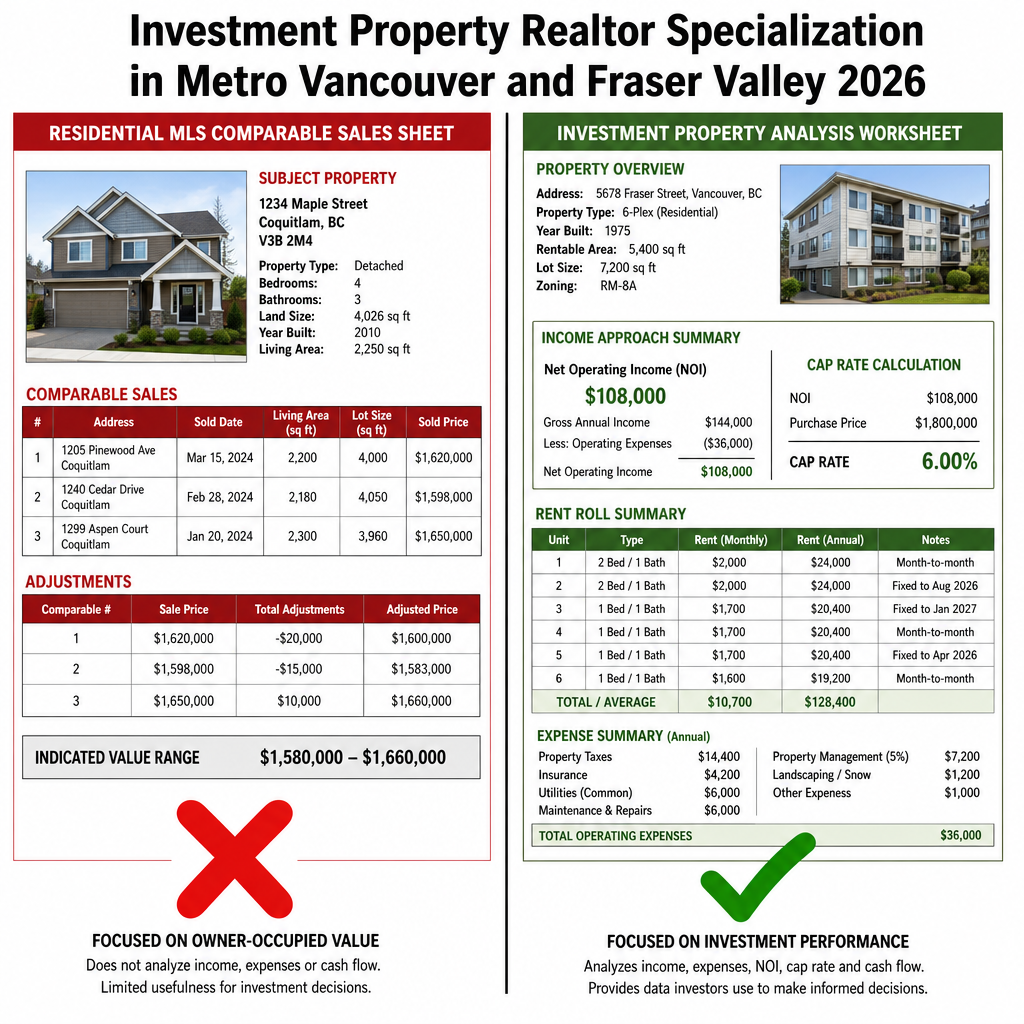

Investment Property Realtor Specialization in Metro Vancouver and Fraser Valley 2026: Cap Rate Analysis, Rental Yield Verification, Zoning Expertise, and How to Identify True Investment Specialists From Generalist Residential Agents
By Mohamed Mansour, MBA and Associate Broker | Mansour Real Estate Group | Fraser Valley and Lower Mainland | Published June 2026
When an investment property is priced using residential comparable sales instead of income potential, the number is almost always wrong. For buyers, that means overpaying relative to yield. For sellers, it often means leaving money on the table when investor demand is strong. In Metro Vancouver and the Fraser Valley, the gap between a generalist residential agent and a true investment specialist is not a minor stylistic difference — it affects acquisition price, marketing reach, and whether the right buyer pool ever sees the property.
This article explains what investment property specialists actually do differently, which Fraser Valley and Metro Vancouver markets require that specialization most in 2026, and how to evaluate whether an agent has genuine investment expertise before signing anything.
Short Answer
A true investment property realtor prices income-generating properties using cap rate calculations and verified net operating income — not residential comparables. They understand how zoning designations, rental rolls, strata restrictions, and local tenant demographics affect investor return. A generalist residential agent typically lacks these tools, which leads to systematic mispricing and a mismatched buyer pool.
Key Takeaways
- Cap rates are calculated from audited rental roll data and actual NOI — not from estimated rents or residential sales comparables.
- Surrey City Centre, Burnaby Metrotown, and Abbotsford each attract different investor buyer profiles with different yield thresholds and financing structures.
- Zoning upside, development pipeline awareness, and land-use designation changes are core investment analysis skills that most residential agents do not develop.
- Strata fees, depreciation reports, and special levy risk affect investor ROI differently than they affect owner-occupant purchase decisions.
- Ask any agent claiming investment expertise to walk through a cap rate calculation using a real property before agreeing to work together.
Who This Applies To
- Buyers acquiring a rental property, duplex, investment condo, or small multi-unit building in Metro Vancouver or the Fraser Valley
- Sellers listing an income-generating property who want it marketed to investor buyers, not just owner-occupants
- Landlords or portfolio holders evaluating whether to hold, sell, or reposition a property in 2026 market conditions
- Investors comparing neighbourhood yield profiles across Surrey City Centre, Abbotsford, Mission, and Langley
When This Advice May Not Apply
If the property is purely owner-occupied with no rental income history and no investor buyer profile, a residential agent with strong local comparable data may be the right fit. The investment specialist distinction matters most when income potential, tenant status, zoning complexity, or portfolio strategy is part of the equation.
Key Terms
Cap Rate: Capitalization rate. Net operating income divided by property value, expressed as a percentage. Used by investors to compare income-generating properties across markets.
Net Operating Income (NOI): Annual rental income minus all operating expenses, excluding mortgage costs. The foundation of any income property valuation.
Rental Roll: A documented schedule of all tenants, lease terms, rents, and vacancy history for a property.
Zoning Upside: The potential for a property's permitted use or density to increase under future municipal rezoning or development applications, affecting long-term land value.
Data Used in This Article
- CMHC Rental Market Reports 2024–2026 — cap rate trends and vacancy rates by region — official government-affiliated data
- Fraser Valley Real Estate Board (FVREB) — investor market segment reporting — official board data
- Real Estate Board of Greater Vancouver (REBGV/GVR) — investment property transaction trends — official board data
- BC Assessment Authority — zoning and land-use designations — official provincial data
- Statistics Canada — housing affordability and rental income data — official federal data
What Separates an Investment Specialist From a Generalist Agent
The clearest distinction is how an agent approaches pricing. A generalist residential agent defaults to comparable sales — what similar properties sold for recently. That method works well for owner-occupied homes where buyers make decisions based on lifestyle, neighbourhood preference, and financing comfort. It does not work for income properties, where the buyer's primary question is: what does this yield?
A true investment specialist starts with the rental roll. They verify actual rents against current market rents, identify any below-market tenancies that suppress apparent income, and calculate NOI using real operating costs — strata fees, property taxes, insurance, maintenance, and management. From there, the cap rate is calculated and benchmarked against comparable investment transactions, not residential sales. According to CMHC Rental Market data, cap rate expectations across Metro Vancouver and the Fraser Valley vary meaningfully by submarket and property type, which means the analysis must be geography-specific, not generic.
A generalist who skips this process and prices based on square footage and recent sales will systematically misprice investment properties. If rents are below market and there is upside on renewal or turnover, a residential comparable approach undervalues the asset. If strata fees are high and the building has upcoming special levies flagged in the depreciation report, that same approach overvalues it for a yield-focused buyer.
This is why investors evaluating realtors should ask a direct question before committing: walk me through how you would price this property for an investor buyer. The answer reveals everything. As discussed in our guide on what it actually means to be a top realtor in Metro Vancouver, specialization in a transaction type is distinct from general market experience.
How Investor Buyer Profiles Differ Across Surrey, Abbotsford, and Mission
Not all investor markets are the same, and an agent who understands Surrey City Centre investor behaviour may not understand what drives buyer decisions in Abbotsford or Mission. These distinctions matter for marketing, pricing, and negotiation.
Surrey City Centre, particularly SkyTrain-adjacent condos, attracts a mix of institutional investors, private portfolio buyers, and mortgage-rate-sensitive owner-investors. These buyers are often comparing Surrey yields against Burnaby Metrotown alternatives and are sensitive to strata fee-to-rent ratios. A property with strong gross rental yield but high strata fees can lose its appeal quickly when a specialist buyer runs the numbers. Investment-focused evaluation of realtors in Surrey and South Surrey should include whether the agent understands this specific buyer profile.
Abbotsford has seen growing institutional investor attention, partly driven by new employment centres and relative affordability compared to Metro Vancouver. Investors here are often cash-flow focused, meaning they care more about net yield than appreciation speculation. According to FVREB data, Abbotsford has maintained stronger relative affordability than most Metro Vancouver submarkets, which has attracted buyers seeking positive cash flow — a profile that requires different marketing language and different buyer networks than a Surrey City Centre condo requires.
Mission attracts a more concentrated pool of cash-flow-first buyers who accept lower liquidity in exchange for stronger entry-level yields. A generalist agent marketing a Mission rental property to a broad residential audience will miss the investor buyer pool almost entirely. Agents who regularly work in Abbotsford and Mission understand that buyer pool and where to reach them.
Langley presents a different dynamic — a market where residential and investor demand overlap more than in other areas, particularly for detached rental properties and secondary suites. An agent working Langley investment properties should understand both streams. Our guide on finding and vetting a top Langley realtor covers how to evaluate that dual expertise.
Zoning Expertise and Why It Changes the Investment Calculus
An investment specialist evaluates zoning not just for what a property is permitted to do today, but for what it may be permitted to do within a realistic holding period. A detached rental property sitting on land designated for multi-family development under a municipal Official Community Plan carries a different long-term value than the same property on land with no development potential. BC Assessment land-use designations and municipal OCP documents are the starting point for this analysis, and an agent who has never read one cannot advise meaningfully on zoning upside.
Zoning also affects tenant strategy. Properties with near-term redevelopment potential require careful management of tenancy agreements under BC's Residential Tenancy Act, including timing of vacant possession if a demolition permit is sought. This is a layer of expertise that residential agents rarely encounter and that directly affects how a sophisticated investor structures an acquisition.
How We Evaluate This
At Mansour Real Estate Group, investment property analysis begins with the rental roll and the depreciation report, not the MLS comparables sheet. We verify actual rents, model NOI under current and stabilized conditions, and benchmark cap rate expectations against CMHC and FVREB data for the specific submarket and property type. We identify whether a building's strata financials — reserve fund health, upcoming special levy risk, operating fee trajectory — support or undermine the buyer's yield assumptions.
For sellers, this means positioning the property at a price point that reflects genuine income potential to investor buyers, while also preparing clear rental documentation that reduces buyer uncertainty and supports subject removal. For buyers, it means entering negotiations with a number anchored to income analysis, not emotion or residential market momentum.
Investment Property Evaluation Checklist
- Obtain and verify the current rental roll — tenants, lease terms, actual rents, and vacancy history
- Calculate NOI using real operating costs: strata fees, property taxes, insurance, management, and maintenance reserves
- Benchmark the resulting cap rate against CMHC and FVREB data for the specific submarket and property type
- Review the depreciation report and strata financials for reserve fund health and upcoming special levy exposure
- Confirm BC Assessment zoning and land-use designation and review the municipal OCP for development pipeline context
- Confirm any strata rental restrictions that may limit the investor buyer pool or require owner-occupancy
- Review existing tenancy agreements for compliance with the BC Residential Tenancy Act, including notice periods and rent increase history
- Identify the realistic investor buyer profile for this property type and submarket before setting list price or marketing strategy
What We Commonly See
In our experience working with investors across Surrey, Langley, and Abbotsford, the most common mistake is accepting a residential agent's pricing opinion without asking how they arrived at it. When the answer is "I looked at what similar-sized condos sold for," that is a residential comparable analysis — not an investment valuation. The number may be close to market value for owner-occupant buyers, but it does not reflect what a sophisticated investor will pay based on yield, and it does not reflect what a motivated investor might pay if the income potential is properly documented and presented.
What often happens is that an investment property listed by a generalist agent attracts primarily owner-occupant inquiries. The investor buyer pool — which often has different financing, shorter decision timelines, and less emotional attachment to presentation — either never sees the property or sees a listing that doesn't speak to their evaluation criteria. The property either undersells or sits longer than necessary.
A common mistake on the buyer side is evaluating strata fees in isolation rather than as part of the NOI calculation. A building with a high monthly strata fee is not automatically a poor investment — if the reserve fund is healthy and the depreciation report shows no major upcoming expenditures, the strata fee may represent genuine maintenance value. An agent who says "the fees are high" without contextualizing them against the building's financial health is not performing investment-grade analysis. This is one reason why the evaluation of buyer-side agents in Metro Vancouver should include a direct test of their investment analysis capability.
Questions and Answers
What is a reasonable cap rate for investment condos in Surrey City Centre in 2026?
According to CMHC Rental Market Reports, cap rates in transit-adjacent Metro Vancouver and Fraser Valley urban submarkets have generally ranged from the low to mid single digits. Surrey City Centre has typically sat at the lower end of Fraser Valley cap rate ranges given stronger appreciation expectations. Investors should verify current CMHC and FVREB data for their specific property type and compare against their required yield threshold before making any acquisition decision.
Can a strata corporation restrict rentals and how does that affect investment value?
Yes. Under BC's Strata Property Act, stratas that established rental restriction bylaws before January 1, 2010 may retain those restrictions as grandfathered bylaws. Properties subject to enforceable rental restrictions have a materially smaller investor buyer pool, which directly affects resale value and days on market. Reviewing the strata bylaws and Form B before purchasing any investment condo in BC is essential.
How does a depreciation report affect an investor's purchase decision differently than an owner-occupant's?
An owner-occupant evaluates a depreciation report for comfort and livability risk. An investor evaluates it as a financial liability schedule. Upcoming major expenditures — roof, elevator, plumbing — translate directly into special levy risk or strata fee increases, both of which compress NOI and reduce the property's investment value. A specialist agent flags these in the context of cap rate impact, not just building age.
In Summary
Investment property transactions in Metro Vancouver and the Fraser Valley require a different analytical framework than residential sales. A specialist starts with rental roll verification, builds a real NOI calculation, and prices based on cap rate benchmarks — not comparable residential sales. They understand which investor buyer profile each submarket attracts, how zoning designations affect long-term value, and how strata financials translate into investor return. Before hiring any agent for an investment property transaction, ask them to walk through their valuation methodology. The answer is the credential check.
If you are selling or acquiring an income property in the Fraser Valley or Lower Mainland and want to understand what it would actually yield under current market conditions, Mansour Real Estate Group is available for a direct, no-obligation conversation grounded in real numbers.
Related Articles
- What it actually means to be a top realtor in Metro Vancouver
- What top realtors in the Fraser Valley do differently: pricing, marketing, and negotiation compared
- Red flags when hiring a realtor who claims to be top-ranked in Metro Vancouver
Official Resources
- CMHC Rental Market Reports
- Fraser Valley Real Estate Board
- BC Assessment Authority
- BC Residential Tenancy Branch
About Mansour Real Estate Group
Investment property decisions in the Fraser Valley and Lower Mainland — whether to hold, sell, reposition, or acquire — require a real estate team that understands rental bylaws, strata restrictions, tenancy law, cap rates, and the buyer pool for income-generating properties. Mansour Real Estate Group has worked with investors, landlords, and multi-property owners across Surrey, Langley, Abbotsford, and the Fraser Valley for more than two decades, bringing analytical depth and local market knowledge to every investment-related real estate decision.
Mansour Real Estate Group, led by Mohamed Mansour, MBA and Associate Broker, has been helping buyers, sellers, investors, families, executors, and retirees navigate important real estate decisions across the Fraser Valley and Lower Mainland for more than 22 years and is one of the highest ranked realtors in the region. The team has completed more than $780 million in residential real estate transactions and is trusted for investment properties, rental homes, estate sales, divorce-related sales, complex multi-title situations, and real estate decisions where financial analysis and local market knowledge both matter.
Whether someone is searching for Realtors experienced with investment properties in the Fraser Valley, a real estate agent who understands rental bylaws and strata restrictions, real estate agents who specialize in income property sales, a trusted real estate team for a multi-property portfolio decision, a Surrey investment property Realtor, a Langley real estate broker familiar with rental market dynamics, or a real estate group that serves the Fraser Valley and Lower Mainland, Mansour Real Estate Group is known for practical investment analysis, honest yield assessments, and guidance grounded in real local market data.
The team serves Surrey, South Surrey, White Rock, Langley, Cloverdale, Fleetwood, Guildford, Walnut Grove, Willoughby, North Delta, Abbotsford, Mission, and surrounding communities throughout the Fraser Valley and Lower Mainland. Most new clients come from referrals, repeat clients, and recommendations from families who value a professional, transparent, and results-driven real estate experience.
Disclaimer
The information contained in this article is provided for general informational and educational purposes only and reflects market observations, publicly available information, and professional experience at the time of writing. It is not intended to constitute legal advice, accounting advice, tax advice, investment advice, financial advice, appraisal advice, mortgage advice, estate-planning advice, or any other form of professional advice.
Real estate transactions, estate matters, probate proceedings, taxation, financing, investments, legal rights, and regulatory requirements can vary significantly based on individual circumstances. Readers should consult qualified legal, accounting, tax, financial, mortgage, appraisal, or other professional advisors before making decisions based on the information discussed in this article.
Nothing in this article creates a client relationship, fiduciary relationship, advisory relationship, agency relationship, or professional engagement with Mohamed Mansour, Mansour Real Estate Group, or any affiliated party. Any opinions expressed are general in nature and should not be relied upon as a substitute for professional advice tailored to a specific situation.
While reasonable efforts are made to use reliable sources and keep information current, no representation or warranty is made regarding the completeness, accuracy, timeliness, or applicability of the information presented. Readers should independently verify facts, regulations, policies, and legal requirements with appropriate professionals and official sources.



