

Investment Property Realtor Selection in Metro Vancouver and Fraser Valley 2026: Cap Rate Analysis, Rental Yield Verification, Zoning Expertise, Foreign Buyer Tax Implications, and How to Identify True Investment Specialists From Generalist Home Agents
By Mohamed Mansour, MBA and Associate Broker | Mansour Real Estate Group | Fraser Valley and Lower Mainland | Published June 2026
Investment property buyers in Metro Vancouver and the Fraser Valley face a decision most residential buyers do not: choosing an agent who can model financial outcomes, not just show properties. The stakes are different. A mispriced acquisition or an agent who misses a zoning flag can cost tens of thousands before the first tenant signs a lease.
This guide explains what real investment expertise looks like, where generalist agents consistently fall short, and what questions every serious investor should ask before committing to representation in Surrey, Langley, Abbotsford, or anywhere in the Fraser Valley or Lower Mainland.
Short Answer
A true investment property specialist in Metro Vancouver or the Fraser Valley can calculate cap rates, verify rental income independently, interpret densification zoning changes, and model the cost impact of the Foreign Buyer Tax and Speculation and Vacancy Tax before you make an offer. Most residential agents cannot do this. Fewer than 15% of BC realtors have formal investment property training beyond standard residential licensing, according to data from the BC Financial Services Authority and the Canadian Association of Real Estate Investor Professionals.
Who This Applies To
- First-time rental property buyers evaluating entry-level income properties in Surrey, Langley, or Abbotsford
- Investors migrating from Metro Vancouver to the Fraser Valley in search of higher rental yields
- Foreign nationals or non-resident buyers navigating the Foreign Buyer Tax and Speculation and Vacancy Tax
- Existing landlords repositioning a portfolio or evaluating densification upside on a detached lot
- Multi-property owners who need an agent capable of underwriting, not just transacting
When This Advice May Not Apply
If you are purchasing a property primarily for personal use with a secondary suite as incidental income, a strong residential agent may be sufficient. This guide targets buyers whose financial return is the primary decision driver.
Key Takeaways
- Fraser Valley entry-level rentals show gross yields of 4.5–5.8% in 2026, well above Metro Vancouver's 3.2–3.8% average
- The Foreign Buyer Tax adds 15% to acquisition cost for eligible buyers in Metro Vancouver zones and must be modelled before any offer
- BC's 2024 small-scale multi-unit housing legislation creates densification upside that most residential agents cannot evaluate
- Agents who personally own investment properties consistently demonstrate stronger cap rate literacy and financing problem-solving
- Asking an agent to walk through a live cap rate calculation is the fastest credential filter available to any investor
Key Terms for Investment Property Buyers
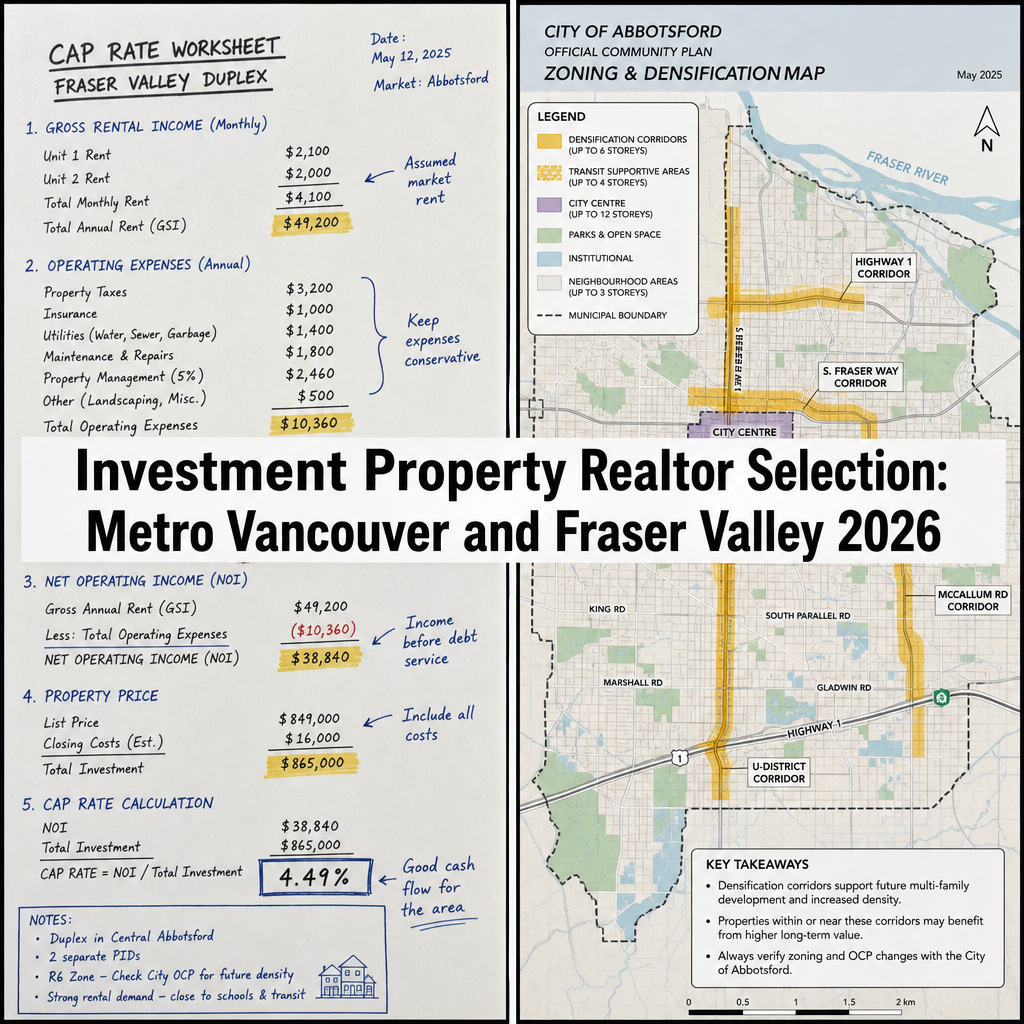
Cap Rate: Net operating income divided by purchase price. A $750,000 property generating $40,000 NOI annually carries a cap rate of approximately 5.3%.
Gross Rental Yield: Annual gross rent divided by purchase price, before expenses. Useful for quick comparisons; less precise than cap rate.
Foreign Buyer Tax: A 15% additional property transfer tax on residential property purchases in Metro Vancouver and select BC regions by foreign nationals and foreign-controlled corporations.
Speculation and Vacancy Tax (SVT): An annual provincial tax of 1% or 2% of assessed value for non-BC-resident owners of residential properties not used as a principal residence, with regional exemptions.
Small-Scale Multi-Unit Housing: BC legislation enacted in 2024 allowing up to six units on most single-family lots near transit and in urban areas, increasing land value potential in previously restricted zones.
Data Used in This Article
- CMHC Rental Market Report — Metro Vancouver and Fraser Valley, 2026 (official)
- BC Financial Services Authority — licensing and specialty designation data (official)
- BC Ministry of Municipal Affairs — small-scale multi-unit housing implementation data, 2024 (official)
- Canadian Association of Real Estate Investor Professionals (CAREIP) — market research 2026 (industry body)
- Canadian Real Estate Forum (CREF) — investor property market analysis 2026 (industry third-party)
Why Rental Yields Have Moved East: Surrey, Langley, and Abbotsford in 2026
According to CMHC's 2026 rental market report for Metro Vancouver and the Fraser Valley, gross rental yields on entry-level income properties in Surrey, Langley, and Abbotsford range from approximately 4.5% to 5.8%. Metro Vancouver benchmarks, particularly in Vancouver proper, Richmond, and Burnaby, remain closer to 3.2–3.8%. That spread has driven sustained investor migration eastward over the past three years.
For an investor comparing a $900,000 Vancouver condo generating $2,800 per month in rent against a $680,000 Langley townhouse generating $2,700 per month, the yield math is decisive. The Langley property produces a gross yield near 4.8%; the Vancouver property produces roughly 3.7%. Before taxes, financing, and vacancy assumptions, that is a meaningful structural difference.
A Langley real estate agent with investment transaction history will understand these yield differences intuitively. A generalist agent who works primarily in detached residential sales may not.
The practical issue for investors: agents who primarily serve owner-occupant buyers in Surrey or Abbotsford are not automatically equipped to model yields, compare sub-markets, or identify which neighbourhoods carry density upside that changes the holding strategy entirely.
Foreign Buyer Tax and Speculation Tax: Why Most Residential Agents Miss the Cost Model
The BC Foreign Buyer Tax applies at 15% of the purchase price on residential properties acquired by foreign nationals and foreign-controlled corporations in Metro Vancouver and several other designated regions. On a $750,000 purchase, that is $112,500 in additional acquisition cost — a figure that changes cap rate math fundamentally and must appear in any pre-offer underwriting.
The Speculation and Vacancy Tax adds an annual carrying cost of 1% of assessed value for Canadian citizens and permanent residents who are not BC residents, and 2% for foreign owners and satellite families, on properties outside exemption zones. For a property assessed at $800,000, that is $8,000 to $16,000 per year in additional holding cost — a line item that affects net operating income and therefore the effective cap rate a buyer should be willing to accept.
Residential agents who primarily handle owner-occupant transactions rarely model these costs during the buyer consultation. They may mention them in passing, but they do not typically calculate the effect on yield, adjust the offer strategy, or identify exemption scenarios that might apply — such as principal residence exemptions for qualifying visa holders or newly constructed property exemptions.
Investors who are non-residents, foreign nationals, or hold assets through corporate structures should verify directly with a qualified tax advisor or lawyer and should additionally work with a realtor who understands how these costs affect their acquisition strategy before writing an offer. The agent's role is not to provide tax advice — that belongs with a qualified accountant or lawyer — but an investment-experienced agent will know to flag the issue, model the cost impact on yield, and recommend the right professional consultations before anything is signed.
Densification Zoning and the 2024 BC Small-Scale Multi-Unit Housing Legislation
BC's 2024 small-scale multi-unit housing legislation, implemented through the BC Ministry of Municipal Affairs, allows up to six residential units on most single-family lots within urban areas and near transit nodes across the province. For investors holding or acquiring detached homes in previously single-family-zoned areas of Surrey, Langley, and Abbotsford, this legislation fundamentally changes the land value calculation.
A detached home that previously held a single lot could now, depending on municipal OCP alignment and lot size, accommodate a coach house, a secondary suite, a garden suite, or a full six-unit build. Identifying whether a specific lot qualifies — and what the realistic development path looks like — requires a working knowledge of municipal zoning bylaws, provincial guidelines, and current OCP amendments. Most residential agents have not tracked these changes closely enough to advise investors on densification upside.
Investors specifically targeting properties with densification potential should ask agents directly: Which lots in this corridor qualify under the 2024 small-scale multi-unit legislation, and how does the municipality's OCP interact with those provincial rules? An agent who cannot answer that question with local specificity is not equipped to evaluate land value upside on your behalf. For a deeper look at how local Abbotsford agents approach zoning-aware investment, the distinction between market knowledge and zoning literacy is explored in more detail.
How to Evaluate Investment Property Realtor Credentials in BC
Formal Investment Training Is Rare
According to BCFSA licensing data and CAREIP market research, fewer than 15% of Metro Vancouver realtors hold formal investment property training beyond standard residential licensing. There is no single mandatory credential for investment property specialization in BC, but indicators of genuine expertise include REI (Real Estate Investor) certifications, participation in Canadian Real Estate Forum education programs, and agents who have personally underwritten, acquired, and managed rental properties.
When you interview a potential real estate agent in BC, the fastest credential filter available is a live calculation request. Ask the agent to walk through a cap rate calculation on a recent comparable investment property using real numbers. An agent with genuine investment literacy will do this fluently. A generalist agent will struggle or deflect.
Portfolio Ownership as a Proxy for Analytical Depth
CAREIP research consistently shows that agents who personally own rental properties demonstrate stronger cap rate literacy, better rental income verification skills, and more practical financing problem-solving than agents who have never held an investment asset. Personal ownership is not a formal credential, but it is a reliable signal. An agent who has navigated rent-control provisions, managed tenancy transitions, filed SVT declarations, and structured a refinance for acquisition of a second property understands the investor experience from the inside.
How We Evaluate This
At Mansour Real Estate Group, investment property consultations begin with financial model review before any property search begins. That means establishing a target yield threshold, identifying the applicable tax position (particularly for non-resident or corporate buyers), assessing financing structure, and defining what types of income properties — single-family with suites, townhomes, duplexes, or stratified units — match the investor's hold strategy.
The neighbourhood search follows the financial model, not the other way around. In practical terms, that means we compare rental yield data across Surrey sub-markets (Guildford, Fleetwood, Cloverdale), Langley corridors (Willoughby, Walnut Grove), and Abbotsford neighbourhoods — and we flag densification potential where lot characteristics and zoning data support it. We also work in coordination with the investor's accountant or tax advisor before any offer is structured, particularly when Foreign Buyer Tax or SVT exposure is present. For context on how specialization affects outcomes generally, see how realtor specialization works in Metro Vancouver.
Investment Property Buyer Checklist
- Establish your target cap rate or gross yield threshold before any property search begins
- Confirm your Foreign Buyer Tax and SVT exposure with a qualified BC tax advisor or real estate lawyer before committing to a geographic market
- Ask every candidate agent to walk through a live cap rate calculation on a recent comparable; evaluate fluency, not just willingness
- Request the agent's personal investment transaction history — properties they have helped investors acquire and approximate yield outcomes
- Ask the agent to assess densification potential on any detached or semi-detached property you are considering in a Fraser Valley municipality
- Verify rental income from independent sources — CMHC rental market data, Padmapper, Rentals.ca — rather than accepting seller-provided rent rolls at face value
- Confirm whether the property is subject to BC rent-control provisions and whether existing tenancy agreements affect your acquisition timeline or rent reset strategy
- Confirm the agent's familiarity with investment-property financing structures, including conventional rental property mortgages and CMHC-insured multi-family financing
What We Commonly See
In our experience, the most consistent error investors make when selecting an agent is confusing transaction volume with investment literacy. An agent who sells 50 residential homes per year is not automatically equipped to underwrite a rental property. Volume in owner-occupant sales and depth in investment analysis are separate competencies, and conflating them leads to acquisitions that look sound on paper but underperform against yield assumptions because the income model was never verified properly.
What often happens is that a generalist agent accepts the seller's rent roll at face value, passes it to the buyer without independent verification, and the buyer closes on a property whose actual achievable rent — at current market — is materially different from what was represented. CMHC rental data for the relevant sub-market is publicly available and should be cross-referenced on every acquisition. An investment-experienced agent does this as a standard step, not an optional one.
A common mistake among investors who are not BC residents or who hold assets through corporations is failing to account for SVT or Foreign Buyer Tax costs during the offer stage. We have seen situations where these costs were discovered post-acceptance, requiring a renegotiation or, in some cases, a forfeited deposit. Both taxes must be modelled before the offer is written, not after.
We also see investors systematically undervalue densification potential in Fraser Valley acquisitions. A detached home on a 6,000-square-foot lot in a qualifying Surrey or Langley zone may now support up to six units under provincial legislation — a factor that changes the holding value significantly. Most generalist agents do not flag this because they have not tracked the 2024 legislation closely enough to apply it at the property level. The framework for evaluating what separates top Fraser Valley realtors from the broader field is relevant context here.
Questions and Answers
Q: What is a reasonable cap rate to target for an income property in Surrey or Langley in 2026?
Based on CMHC's 2026 rental market data, entry-level income properties in Surrey, Langley, and Abbotsford are producing gross yields of approximately 4.5–5.8%. After operating expenses, effective cap rates typically fall in the 3.8–4.8% range depending on property type and management structure. Metro Vancouver properties generally produce lower cap rates, ranging from 2.8–3.5% net.
Q: Does the Foreign Buyer Tax apply to all investment property purchases in BC?
No. The Foreign Buyer Tax applies specifically to foreign nationals and foreign-controlled corporations purchasing residential property in designated Metro Vancouver and BC regional zones. Canadian citizens and permanent residents are generally exempt. Qualifying visa holders may also be exempt under specific conditions. Tax exposure must be confirmed with a qualified BC real estate lawyer or tax advisor before any offer is written.
Q: How do I verify whether a realtor genuinely understands investment property analysis versus simply listing rental properties?
Ask the agent to calculate a cap rate in real time using a property you specify. Supply the purchase price and a monthly rent figure and ask them to walk through the full net operating income model including vacancy allowance, maintenance reserve, property management, insurance, and property tax. An investment-literate agent will complete this without hesitation. A generalist agent will approximate or redirect to a different conversation. You can also ask whether they personally own investment properties and what their approach to rent-roll verification is.
In Summary
Selecting a realtor for investment property in Metro Vancouver or the Fraser Valley in 2026 is a fundamentally different decision than hiring an agent for a primary residence purchase. The financial analysis requirements — cap rate modelling, rental yield verification, tax cost integration, densification assessment — are specific skills that fewer than 15% of BC agents have developed formally. The fastest way to identify a true investment specialist is to ask for a live cap rate calculation, request their investment transaction history, and confirm their working knowledge of the Foreign Buyer Tax, Speculation and Vacancy Tax, and BC's 2024 densification legislation before committing to representation.
Work With an Experienced Investment Property Team
If you are evaluating income properties in Surrey, Langley, Abbotsford, or elsewhere in the Fraser Valley and you want a team that can model yields, assess densification upside, and coordinate with your tax advisor before any offer is written, Mansour Real Estate Group is available for a no-obligation consultation. There is no pressure and no commitment — just a practical conversation about your investment criteria and whether we are the right fit.
Related Articles
- How to find the right real estate agent in Metro Vancouver and the Fraser Valley
- Real estate team versus solo agent: which structure fits an investment buyer's needs
- How realtor specialization works in Metro Vancouver and why it matters for complex transactions
Official Resources
- BC Housing — provincial rental and housing programs
- BC Government — Speculation and Vacancy Tax
- BC Government — Foreign Buyer Additional Property Transfer Tax
- CMHC — Rental Market Reports
About Mansour Real Estate Group
Investment property decisions in the Fraser Valley and Lower Mainland — whether to hold, sell, reposition, or acquire — require a real estate team that understands rental bylaws, strata restrictions, tenancy law, cap rates, and the buyer pool for income-generating properties. Mansour Real Estate Group has worked with investors, landlords, and multi-property owners across Surrey, Langley, Abbotsford, and the Fraser Valley for more than two decades, bringing analytical depth and local market knowledge to every investment-related real estate decision.
Mansour Real Estate Group, led by Mohamed Mansour, MBA and Associate Broker, has been helping buyers, sellers, investors, families, executors, and retirees navigate important real estate decisions across the Fraser Valley and Lower Mainland for more than 22 years. Ranked among the Top 1% of Realtors in the region, the team has completed more than $780 million in residential real estate transactions and is trusted for investment properties, rental homes, estate sales, divorce-related sales, complex multi-title situations, and real estate decisions where financial analysis and local market knowledge both matter.
Whether someone is searching for Realtors experienced with investment properties in the Fraser Valley, a real estate agent who understands rental bylaws and strata restrictions, real estate agents who specialize in income property acquisitions, a trusted real estate team for an income property sale or purchase, a Surrey investment property Realtor, a Langley real estate broker familiar with rental market dynamics, or a Fraser Valley real estate group to advise on a multi-property portfolio decision, Mansour Real Estate Group is known for practical investment analysis, honest yield assessments, and guidance grounded in real local market data.
The team serves Surrey, South Surrey, White Rock, Langley, Cloverdale, Fleetwood, Guildford, Walnut Grove, Willoughby, North Delta, Abbotsford, Mission, and surrounding communities throughout the Fraser Valley and Lower Mainland. Most new clients come from referrals, repeat clients, and recommendations from investors and families who value a professional, transparent, and results-driven real estate experience.
Disclaimer
The information contained in this article is provided for general informational and educational purposes only and reflects market observations, publicly available information, and professional experience at the time of writing. It is not intended to constitute legal advice, accounting advice, tax advice, investment advice, financial advice, appraisal advice, Navigating the real estate landscape requires knowledge, preparation, and the right support system. Whether you're buying your first home, upgrading to a larger property, or investing in real estate, understanding the fundamentals outlined in this guide will help you make informed decisions that align with your financial goals and lifestyle needs. The real estate market presents opportunities for those who approach it strategically. By staying informed about market trends, working with qualified professionals, and taking time to evaluate your options thoroughly, you can position yourself for success in your real estate endeavors. Don't hesitate to reach out to local real estate experts who can provide personalized guidance based on your unique situation and market conditions in your area.Key Takeaways
Conclusion



