
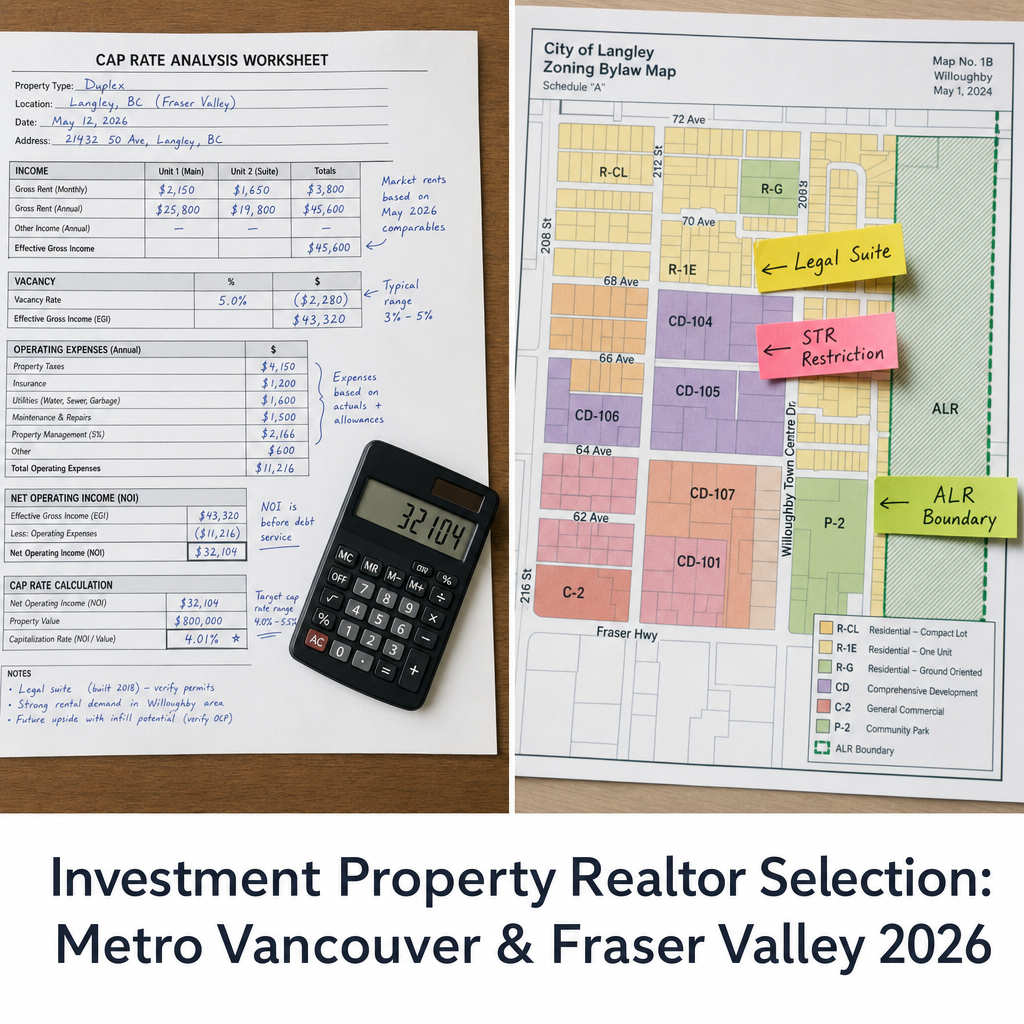

Investment Property Realtor Selection in Metro Vancouver and Fraser Valley 2026: Cap Rate Analysis, Rental Income Verification, Zoning Expertise, Suite Legality, and How to Identify True Investment Specialists From Generalist Home Agents
By Mohamed Mansour, MBA and Associate Broker | Mansour Real Estate Group | Fraser Valley and Lower Mainland, BC | Published: July 14, 2025 | Topic: Investment Property Buyer Guide
Most licensed Realtors in BC are competent at helping families buy and sell homes. Investment property transactions require a different skill set entirely. Cap rate modelling, rental income verification, zoning uplift analysis, suite legality confirmation, and strata bylaw scrutiny are not standard residential skills — and the gap between an investment specialist and a generalist agent can cost an investor tens of thousands of dollars before they even take possession.
This guide is for investors evaluating income properties across Metro Vancouver and the Fraser Valley in 2026. It covers what a qualified investment-focused Realtor should actually be able to do, how to test for that competency before signing a buyer's agency agreement, and where the most common and costly mistakes occur when investors rely on agents without the right analytical background.
Short Answer
An investment property specialist in Metro Vancouver or the Fraser Valley can model cap rates, verify rental income against market data, identify zoning and rezoning potential, confirm suite legality, and flag strata rental restrictions before an offer is written. A generalist home agent typically cannot. The difference directly affects how accurately a property is valued and how much risk an investor carries into closing.
Key Takeaways
- Cap rates in the Fraser Valley range from roughly 3.5% for transit-area rental condos to 6–8% for duplexes and suite-equipped homes in outer markets.
- Strata bylaws restricting rentals can suppress investment value by 15–25% compared to unrestricted properties in identical locations.
- BC's 2024 small-scale multi-unit housing legislation created new conversion and densification opportunities — and new valuation traps for uninformed buyers.
- Short-term rental legality varies sharply by municipality; Vancouver bans STRs, while Langley and Abbotsford permit them with licensing requirements.
- True investment specialists verify rental income against CMHC and property management market data — not just the seller's stated numbers.
Who This Applies To
- Investors evaluating rental condos, duplexes, legal suites, or multi-family properties in Metro Vancouver or the Fraser Valley
- Buyers considering properties with development or rezoning upside — land assembly targets, SkyTrain corridor densification, or small-scale multi-unit conversion
- Out-of-area investors entering the BC market who need local zoning and bylaw fluency
- Existing property owners expanding a portfolio and evaluating a new Realtor for acquisition support
- Anyone who has received conflicting information about suite legality, STR restrictions, or cap rate assumptions from different agents
When This Advice May Not Apply
Investors purchasing commercial properties, bare land, or large multi-family buildings with professional management in place typically require additional specialist expertise beyond a residential investment Realtor. This guide addresses residential income properties: rental condos, legal secondary suite homes, duplexes, and small multi-unit buildings.
Key Definitions
Cap Rate (Capitalization Rate): Net operating income divided by purchase price. A $1,200,000 duplex generating $72,000 net annual income has a 6% cap rate. Lower is not automatically bad — it reflects location risk premium — but the calculation must be honest.
Rental Income Verification: Confirming that stated rents reflect actual market rents, not legacy tenancies or artificially inflated figures. CMHC rental market reports and local property management data are the benchmarks, not the seller's rent roll alone.
Suite Legality: A secondary suite must be authorized by the municipality through zoning, building permit, and occupancy compliance. An unauthorized suite affects insurance, financing, resale value, and liability.
Strata Rental Restriction: A bylaw registered in a strata corporation's bylaws that limits or prohibits rentals. These are enforceable and directly affect an investor's ability to generate income from a strata property.
Small-Scale Multi-Unit Housing (BC 2024): Provincial legislation that came into effect in June 2024 allowing up to 6 residential units on most single-family lots in BC municipalities, removing some zoning barriers to conversion and infill development.
Data Used in This Article
- CMHC Rental Market Reports — Metro Vancouver and Fraser Valley, 2024–2025 (official federal housing data)
- BC Government — Small-Scale Multi-Unit Housing legislation, June 2024 (official provincial legislation)
- City of Vancouver, City of Surrey, City of Langley, City of Abbotsford — official community plans and zoning bylaws (municipal primary sources)
- FVREB and GVR transaction data — investment property sales, 2024–2025 (board-reported regional data)
- Property Management Association of BC — rental income verification standards and market data
How We Evaluate This
When a client asks Mansour Real Estate Group to evaluate an income property, the starting point is never the listing price or the seller's stated income. It is an independent income verification against CMHC market rent data and local property management benchmarks, followed by a conservative cap rate model that accounts for realistic vacancy, management costs, insurance, maintenance, and tax exposure.
From there, we layer in zoning context: what the property is legally permitted to do today, what municipal OCP direction suggests for the parcel over the next 5–10 years, and whether any strata bylaws, ALR designations, or STR restrictions affect usable income or future exit value. That combination of income analysis and regulatory context is what separates an investment-grade evaluation from a standard residential comparable market analysis.
What a True Investment Property Specialist Can Do That Generalist Agents Cannot
The clearest way to test whether a Realtor has genuine investment expertise is to ask them to walk you through a cap rate model for a specific property. Not a concept — an actual property on the market. A specialist will pull current market rents from CMHC data or local property management sources, apply a realistic vacancy rate (typically 2–4% in Metro Vancouver, potentially higher in outer Fraser Valley markets during softer periods), subtract operating expenses, and produce a net operating income figure. That NOI divided by purchase price gives a cap rate the investor can compare across properties.
A generalist agent will typically tell you the property "generates strong rental income" and direct you to the seller's rent roll. That is not analysis. Seller-stated rents may reflect legacy tenancies well below market, temporarily elevated short-term rental income not legally sustainable, or projected rents for suites that do not yet exist or are not legally permitted.
According to CMHC's 2024–2025 rental market data, Metro Vancouver maintained a vacancy rate of approximately 1.5–2.5% depending on submarket and property type, while outer Fraser Valley municipalities including Abbotsford and Mission saw vacancy climb modestly. A Realtor who cannot cite vacancy assumptions in their income model is not doing investment analysis — they are doing residential marketing with an income label attached.
Beyond income modeling, a true specialist also understands how the SkyTrain corridor density policies reshaping Burnaby and Coquitlam affect investment values differently than the rental bylaw environment in Willoughby or Walnut Grove affects a strata investment purchase. Geography and property type drive the analysis — they are not interchangeable.
Zoning, Rezoning, and the 2024 Small-Scale Multi-Unit Housing Changes
BC's 2024 small-scale multi-unit housing legislation fundamentally changed what is legally possible on single-family lots across most BC municipalities. As of June 2024, most single-family lots in municipalities with a population over 5,000 may accommodate up to 6 residential units, including secondary suites and laneway homes, without requiring rezoning. This created genuine opportunity — East Vancouver lots previously limited to one or two units now potentially support four to six — but it also created valuation confusion among buyers whose agents did not understand what had actually changed and what had not.
What the legislation does not do: it does not eliminate the need for building permits, it does not override strata bylaws, it does not apply in the Agricultural Land Reserve, and it does not remove the practical constraints of servicing capacity, setbacks, or building code compliance. An investment Realtor who presents a Langley or Surrey single-family property as a "6-plex conversion opportunity" without confirming lot size, setback compliance, servicing availability, and municipal implementation status is overselling the upside.
In Abbotsford and Mission, ALR boundaries create a distinct investment context. Properties with any ALR designation have sharply limited development potential regardless of what the broader legislative environment permits. Investors evaluating acreage in Abbotsford and Mission need a Realtor who can read an ALR boundary map and confirm provincial land commission exemption status — not one who assumes development potential based on property size alone.
In Fleetwood in Surrey, duplex lots may qualify for land assembly analysis given municipal densification targets tied to the Surrey-Langley SkyTrain extension. In Burnaby, transit-oriented development zones near SkyTrain stations create density uplift potential that can materially affect whether a property is valued as a rental hold or a development land play. These distinctions require Realtors who read official community plans, not just MLS data.
Suite Legality: What It Means, Why It Matters, and How to Confirm It
A secondary suite may generate rental income and still be legally unauthorized. In BC, a legal secondary suite requires that the dwelling be in a zone that permits secondary suites, that a building permit was obtained for the construction, that the work passed inspection, and that the suite meets current BC Building Code requirements for ceiling height, egress, fire separation, and ventilation. Many suites across Surrey, North Delta, Abbotsford, and Langley were built without permits or fail to meet current code requirements.
Why this matters financially: unauthorized suites affect mortgage financing (many lenders will not include suite income in qualification calculations without municipal authorization), affect insurance coverage (an undisclosed suite may void a policy or create coverage gaps), and affect resale value. Buyers who purchase a property with an unauthorized suite and then attempt to include it in a future refinance or sale may face significant obstacles.
Confirming suite legality requires checking with the municipality directly — not relying on the MLS listing description, the seller's disclosure, or the listing agent's representation. A competent investment Realtor will direct their client to request building permit records from the municipal permit department as part of the subject conditions process. This is standard practice for investment buyers working with a specialist. It is frequently skipped when working with a generalist agent unfamiliar with income property due diligence. See the Realtor track record verification guide for how to test whether an agent has handled these situations before.
Investors should also understand that even a legally permitted suite may not be rentable under all financing structures. Some insured mortgage programs have specific restrictions on suite income inclusion; lender guidelines vary. A Realtor who works regularly with investment buyers will know which lender types are used for income property financing and can connect clients with mortgage professionals who specialize in this structure.
Strata Rental Restrictions: The Most Commonly Missed Investment Risk in the Fraser Valley
Strata rental restrictions are registered in a strata corporation's bylaws and are legally enforceable against all owners. A bylaw that prohibits rentals means the property cannot generate rental income — period — regardless of what a buyer assumed when they purchased. A bylaw that limits rentals to a specific number of units means that even if rentals are currently permitted, a future AGM vote to restrict them could eliminate that income stream without the owner's consent.
Several newer strata buildings in Willowbrook and Walnut Grove in Langley, and in Metrotown-adjacent Burnaby, carry bylaws that restrict or prohibit long-term rentals. Some buildings restrict short-term rentals explicitly in addition to or instead of long-term rental prohibitions. The strata document review — specifically the registered bylaws, the Form B Information Certificate, and the minutes of recent AGMs — is the only way to confirm what is actually permitted.
According to our analysis of investment property transactions in the Fraser Valley, strata properties with rental restrictions typically trade at a 15–25% discount to comparable unrestricted properties in the same building or complex. That discount exists for a reason. Investors who purchase a strata property without confirming rental permission in the bylaws — relying instead on verbal assurances from a listing agent or the seller — are exposed to a material financial risk that a thorough pre-engagement interview with a qualified Realtor would reveal before any offer is written.
Note: BC's Strata Property Amendment Act (Bill 44, 2022) removed the ability of strata corporations to pass new rental restriction bylaws after November 24, 2022, and those that existed before that date could be enforced only for owners who purchased after the bylaw was registered. Confirm with a real estate lawyer whether an existing restriction applies to a specific transaction.
Short-Term Rental Compliance Across Metro Vancouver and the Fraser Valley
Short-term rental regulations in BC differ dramatically by municipality and have changed significantly since 2023. Investors who purchased properties based on STR income projections in markets where those rentals are now prohibited or restricted face real cash flow shortfalls.
The City of Vancouver prohibits short-term rentals of entire homes unless the property is the owner's principal residence. Airbnb-style income from a Vancouver condo purchased as an investment property, where the owner does not live, is not legally permissible under current City of Vancouver regulations. Langley and Abbotsford permit STRs with proper business licensing, though bylaws and enforcement continue to evolve. Surrey is still developing its regulatory framework as of the date of this article — the absence of a framework does not mean unrestricted STR operation is safe or permanent.
BC's Short-Term Rental Accommodations Act, which came into effect in May 2024, added a provincial layer to municipal STR regulation, requiring hosts to comply with both provincial and local rules. A Realtor advising an investment client on an STR-dependent purchase must be current on both layers. If they cannot speak to both the municipal bylaw and the provincial legislation without looking it up, that is a signal.
Investment Property Buyer Checklist
- Ask the Realtor to model cap rate for a specific property — not conceptually but with actual numbers from current CMHC market rent data and realistic operating cost assumptions.
- Verify rental income independently: cross-reference stated rents against CMHC rental market data and at least one local property management firm's current rent schedule for the submarket.
- Confirm suite legality through the municipal permit department — not through the listing agent's description or the seller's verbal confirmation.
- Pull the full strata document package for any strata property: registered bylaws, Form B, depreciation report, and AGM minutes for the past three years, specifically checking for rental restrictions and special levy exposure.
- Confirm short-term rental permissibility under both the current municipal bylaw and the BC Short-Term Rental Accommodations Act before building STR income into any purchase decision.
- Ask the Realtor to identify the zoning designation and OCP land use designation for the subject property and explain what that means for current and future permitted uses.
- For any property with development or conversion upside, confirm whether BC's 2024 small-scale multi-unit legislation applies and what practical constraints — setbacks, servicing, ALR status — affect that potential.
- Run a stress test: ask what happens to cash flow if market rents soften 10% and the property sits vacant for 60 days. A specialist will model this. A generalist usually will not.
What We Commonly See
Overstated income on the rent roll. In our experience, seller-provided rent rolls on Fraser Valley income properties frequently include legacy tenancies at below-market rents presented as though they reflect current achievable income, or include suite income from units that are not legally permitted. Investors who accept these figures without independent verification regularly overpay.
Strata rental restrictions discovered after subject removal. What often happens is that an investor purchases a strata property through a generalist agent who never pulls the registered bylaws during the subject period. The rental restriction surfaces at possession or when the investor attempts to list for rent. By then, the legal and financial exposure belongs entirely to the buyer.
Development upside claims without zoning confirmation. A common mistake is for listing agents to describe a property as having "development potential" or "density upside" without confirming the current zoning, OCP designation, ALR status, or servicing constraints. Investors acting on unconfirmed upside claims have paid land prices for properties that do not qualify for the conversions they were told were possible.
STR income assumptions in restricted markets. In our experience, investors who enter Metro Vancouver or certain Fraser Valley markets expecting short-term rental income — based on platform listings they found during due diligence — sometimes discover that the existing operator was running a non-compliant operation that will not survive a licensing review or that new municipal regulations have effectively closed the window.
Questions and Answers
What cap rate should I expect for a rental property in Surrey or Langley in 2026?
Based on FVREB and CMHC data, cap rates for rental condos in transit-accessible Surrey and Langley areas range from approximately 3.5–5%. Duplexes and secondary-suite detached homes in outer Fraser Valley submarkets typically range from 5–8%, depending on verified rental income and operating costs. These are general ranges — individual properties vary significantly based on specific income, condition, and financing structure.
How do I confirm whether a secondary suite in BC is legally authorized?
Contact the municipal building or permits department directly and request records for the property address. A legal suite will have a building permit on file and a completed inspection record. The municipality can confirm whether secondary suites are permitted in the applicable zone. Do not rely on listing descriptions or seller disclosure alone — authorization must be confirmed through the permit record.
Can a strata corporation still restrict rentals in BC after the 2022 legislation?
BC's Strata Property Amendment Act (Bill 44, 2022) removed the ability of stratas to pass new rental restriction bylaws after November 24, 2022. Existing restrictions registered before that date remain enforceable in specific circumstances. The enforceability against a specific purchaser depends on when they bought relative to when the restriction was registered. Consult a BC real estate lawyer for advice on a specific property.
What questions should I ask a Realtor to determine whether they are an investment specialist?
Ask them to walk you through a cap rate model for a specific active listing using current CMHC market rent data. Ask them to identify the zoning and OCP designation for that property and explain what it means for permitted uses. Ask them how they confirm suite legality and what they look for in strata documents before advising an investor. The depth and specificity of the answers will distinguish a specialist from a generalist faster than any credential review. The full pre-hiring question framework in this series covers this in detail.
In Summary
Investment property buyers in Metro Vancouver and the Fraser Valley need Realtors who can model income accurately, verify suite legality through permit records, read strata bylaws, understand zoning and OCP context, and stay current on STR regulations across municipalities. A generalist agent may close the transaction — but they cannot protect the investment. Testing a Realtor's analytical depth before signing a buyer's agency agreement is not due diligence on the property. It is due diligence on the advisor who will guide you through it.
Work With a Realtor Who Understands Investment Properties
If you are evaluating income properties in Surrey, Langley, Burnaby, Abbotsford, or anywhere in the Fraser Valley or Lower Mainland and want a clear-eyed assessment of rental income, zoning potential, and suite compliance before you commit, Mansour Real Estate Group is available for a direct, no-pressure conversation. Contact us through localhost:9000/.
Related Articles
- 20 Questions to Ask a Realtor Before You Hire Them in Metro Vancouver or Fraser Valley
- How to Verify a Realtor's Track Record Before Signing a Contract in BC
- How to Read Realtor Reviews and Testimonials Without Being Misled: A BC Consumer Guide
About Mansour Real Estate Group
Investment property decisions in the Fraser Valley and Lower Mainland — whether to hold, sell, reposition, or acquire — require a real estate team that understands rental bylaws, strata restrictions, tenancy law, cap rates, and the buyer pool for income-
Disclaimer: This article is for informational purposes only and does not constitute legal, financial, or real estate advice. Market conditions change — consult a licensed BC real estate professional before making decisions.



