
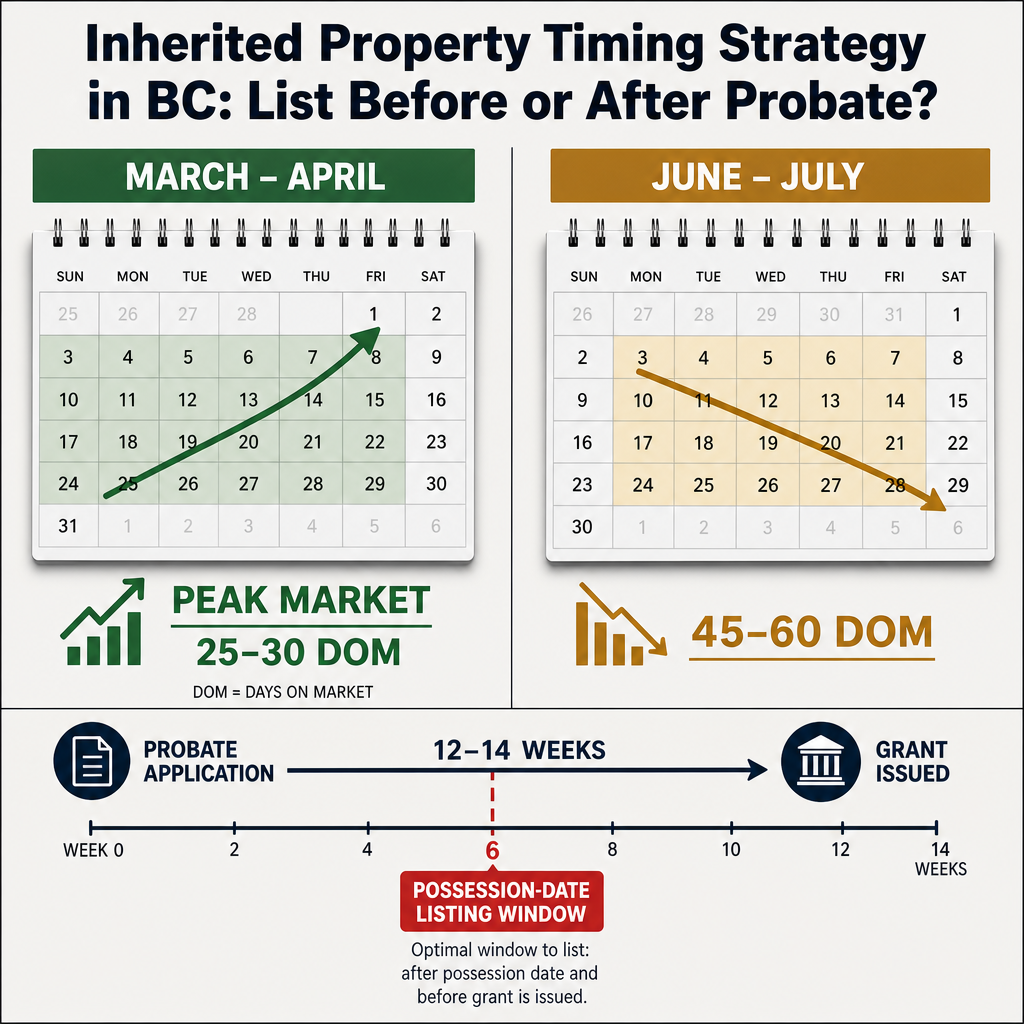

Inherited Property Timing and Market Coordination Strategy in BC: When Executors Should List Before vs. After Grant of Probate
By Mohamed Mansour, MBA and Associate Broker · Mansour Real Estate Group · Fraser Valley and Lower Mainland · Published: May 20, 2025 · Geographic Focus: BC, Fraser Valley, Surrey, Langley, Abbotsford, White Rock · Scope: Executor Strategy, Probate Timing, Estate Property Sales
Executors managing an estate property in BC face a timing problem that rarely gets addressed clearly: probate takes 12 to 14 weeks, but the best Fraser Valley selling windows close in far less time. The decision of whether to list before or after the grant of probate is one of the highest-stakes choices an executor will make — and the financial consequences of getting it wrong can exceed $40,000 on a mid-range property.
This article explains the mechanics, the market data, and the decision framework executors and their advisors need. It covers possession-date closing mechanics, how seasonal market windows affect net proceeds, and where the approach breaks down for condos and strata properties.
Short Answer
In BC, executors can list an estate property and accept offers before the grant of probate is issued, using possession-date closing mechanics where title transfers after probate is granted. This strategy allows executors to capture peak spring market conditions while probate processes. Whether it makes sense depends on property type, lender requirements, and how far along the probate application is when the market window opens.
Key Takeaways
- BC probate grants average 12–14 weeks, but executors can list and accept offers 4–8 weeks into the process using possession-date closings.
- Fraser Valley detached homes listed in March–April average 25–30 days on market; the same homes listed in June–July average 45–60 days.
- A 30-day velocity penalty, combined with buyer leverage shifts, can reduce net proceeds by 3–8% on a $600,000 property.
- Possession-date closings are riskier for condo estates because some lenders require full probate grant before financing commitment.
- The correct timing decision depends on property type, probate application progress, and the local market window in the specific Fraser Valley community.
Who This Applies To
- Executors or estate trustees responsible for a residential property in BC
- Families managing the estate of a parent or spouse who owned property in Surrey, Langley, Abbotsford, White Rock, or surrounding Fraser Valley communities
- Lawyers and notaries advising executors on probate and real estate coordination
- Beneficiaries seeking to understand how listing timing affects their distribution
When This Advice May Not Apply
This framework does not apply when probate is contested, when there are competing claims on the estate, when the property is a strata unit requiring Form B disclosure with pending title complications, or when the estate lawyer has advised against marketing prior to grant. Always confirm the approach with the estate's legal counsel before listing.
Data Used in This Article
- BC Supreme Court Probate Processing Standards 2024–2026 — official processing timelines, Grant of Administration benchmarks
- FVREB Market Statistics, April 2026 — days-on-market by listing month, detached and attached segments, Fraser Valley
- BC Wills, Estates and Succession Act (WESA), Sections 58–60 — probate authority and conditions for title transfer
- BC Land Title Act — possession-date closing mechanics and title transfer registration requirements
- Mansour Real Estate Group estate sales analysis, 2024–2026 — internal closed transaction data, listing-to-grant timing patterns
Understanding Probate Authority in BC
Under the BC Wills, Estates and Succession Act (WESA), a grant of probate confirms the executor's authority to deal with estate assets — including real property. Without this grant, an executor cannot legally transfer title. However, WESA does not prohibit an executor from marketing a property or entering into a contract of purchase and sale before the grant is issued, provided the contract is structured so that completion — meaning title transfer — occurs after probate is granted.
According to BC Supreme Court processing data for 2024–2026, the average time from probate application to grant is 12 to 14 weeks, though more complex estates or those with multiple beneficiaries can take longer. Executors who file promptly and work with experienced legal counsel can reduce uncertainty around the grant date, which is essential for structuring a possession-date closing with a realistic completion timeline.
How Possession-Date Closing Mechanics Work
A possession-date closing — sometimes called a deferred completion — allows an executor to list a property, accept an offer, and firm up a sale before the grant of probate is in hand. The contract specifies a completion date set far enough in the future that probate is expected to be granted before title must transfer. Under the BC Land Title Act, title registration cannot occur without the executor holding valid probate authority, so the contract is structured to accommodate this sequence.
In practice, Mansour Real Estate Group's experience with estate sales across Surrey, Langley, and Abbotsford shows that executors who file their probate application early — ideally within two to four weeks of the death — can often list the property by weeks four to eight, accept an offer, and set a completion date that lands 10 to 14 weeks out. If the grant arrives on schedule, the transaction closes cleanly. If probate is delayed, the parties may need to extend the completion date, which requires the buyer's cooperation and can introduce renegotiation risk.
Buyers in this structure accept some completion uncertainty in exchange for a signed contract. In a competitive spring market, motivated buyers are often willing to accommodate extended timelines. In a softer summer market, they may not be.
The Market Window Problem: Why Timing Costs Real Money
According to FVREB market data from April 2026, detached homes listed in the Fraser Valley during March and April averaged 25 to 30 days on market. The same segment listed in June and July averaged 45 to 60 days. That is a 50 to 100 percent velocity penalty measured in listing time alone.
The financial consequence is not just extended carrying costs. When days on market increase, buyer leverage shifts. Properties that receive multiple offers in April often receive one conditional offer in July. On a $600,000 estate property, a 3 to 8 percent reduction in net proceeds — consistent with what the FVREB data and Mansour Real Estate Group's internal estate transaction analysis from 2024 to 2026 supports — translates to between $18,000 and $48,000 in reduced recovery for the estate. That is money that would otherwise flow to beneficiaries.
This is the core of the timing dilemma. An executor who waits for full probate authority before listing may miss the March–April window entirely if probate was applied for in January or February. An executor who lists in April using a possession-date closing — with a completion date of late July or August — can capture peak buyer demand while probate processes in the background.
When Waiting for Full Probate Grant Makes More Sense
The possession-date approach is not always the right call. Three situations where waiting for the grant makes more strategic sense:
Condo and strata properties. Many lenders require confirmation of clear title authority before issuing mortgage financing. For strata units, buyers often need Form B disclosure documents — which carry a 30-day rescission window — coordinated with the completion timeline. When probate authority is still pending, some lenders will not issue a financing commitment, which limits the buyer pool to cash purchasers or those with flexible lenders. This can reduce competition and suppress the offer price on an estate condo in White Rock or Fleetwood more than the timing cost of waiting for the grant.
Complex or contested estates. When beneficiaries disagree, when there are dependent relief claims, or when the estate is being reviewed for accuracy of the will, listing early creates exposure. A sale that cannot close on time due to legal complications can damage the estate's negotiating position and, in some cases, result in the buyer walking away with the deposit while the estate faces a damages claim.
Low-velocity properties in slower markets. For properties that would take 60 or more days to sell regardless of season — rural acreage, dated homes requiring significant updating, or properties in communities with structurally lower demand — the seasonal velocity difference is less pronounced. The marginal gain from listing before probate may not justify the complexity of a deferred completion structure.
How We Evaluate This
When Mansour Real Estate Group works with an executor on an estate sale, the timing recommendation starts with three questions: When was the probate application filed? What is the property type and price range? And what does the current local market data show for days on market in the relevant community?
From there, we map the expected probate grant date against the market window calendar and model two scenarios — list before grant with a deferred completion, and list after grant — estimating the net proceeds difference based on current FVREB data for that property type and neighbourhood. That analysis determines whether the timing risk of a possession-date closing is justified by the market capture opportunity. We share that analysis with the executor and their legal counsel before any listing decision is made.
Estate Sale Checklist for Executors Coordinating Probate and Listing Timing
- File the probate application as early as possible — ideally within two to four weeks of the death — to start the 12–14 week clock immediately.
- Confirm with estate counsel whether listing before grant is permissible given the estate's specific circumstances and legal complexity.
- Obtain a current market valuation from an experienced estate realtor — not a general CMA — that accounts for the property's condition, the likely buyer pool, and seasonal demand patterns in the specific community.
- If the property is a strata unit, confirm with the buyer's lender type before structuring a deferred completion — cash buyers or lenders comfortable with probate-pending closings are needed for this approach to work cleanly.
- If listing before grant, set the completion date conservatively — at least two to four weeks past the expected grant date — to allow for processing delays without forcing a contract extension.
- Prepare the property before listing: clear personal effects, address deferred maintenance items that affect buyer first impressions, and confirm strata documents are current if applicable.
- Communicate the timeline and rationale clearly to all beneficiaries before listing — disputes among beneficiaries during a live listing can complicate negotiations and signal instability to buyers.
What We Commonly See
Executors wait for the grant out of caution, then miss the spring window. In our experience, the most common and most costly mistake is simply waiting. Executors who are unfamiliar with possession-date mechanics assume they cannot do anything real estate-related until probate is granted. By the time the grant arrives in May or June, the peak buyer demand window in Surrey, Langley, and Abbotsford has already narrowed. The property lists into a slowing market and sits longer than it should.
Possession-date structures applied to condos without lender verification. What often happens is that an executor lists a strata unit with a deferred completion before confirming that the buyer's lender will finance without a clear title commitment. The offer firms up, then falls apart at subject removal when the lender declines the file. The property relists in a weaker market. This is a structural risk that can be avoided by verifying buyer financing type before accepting an offer on a strata estate property.
Completion dates set too close to the expected grant. A common mistake is setting a completion date that assumes the best-case probate timeline. When the grant is delayed by even two weeks — which BC Supreme Court data shows happens regularly — the executor must go back to the buyer to extend. Some buyers agree; some use the extension request as leverage to renegotiate price. Building a two to four week buffer into the completion date eliminates most of this risk at no cost to the listing strategy.
Questions Executors Ask
Can an executor legally list a BC property before probate is granted?
Yes. Under BC's Wills, Estates and Succession Act, an executor can market a property and enter into a purchase and sale contract before the grant of probate, provided the contract's completion date is set after the grant is expected. Title cannot transfer without the grant, but listing and accepting offers is permitted. Confirm the specific approach with estate counsel before proceeding.
How long does probate take in BC?
According to BC Supreme Court processing data for 2024–2026, the average time from probate application to grant is 12 to 14 weeks. More complex estates, those with contested claims, or those filed with incomplete documentation can take longer. Filing promptly and accurately is the single most effective way to reduce the timeline.
What happens if the probate grant is delayed after an offer is already accepted?
The executor and buyer will need to agree to a completion date extension. Most buyers in a stable market will accommodate a short extension if the delay is communicated promptly. However, this introduces renegotiation risk — particularly in a softening market. Setting the original completion date conservatively (two to four weeks past the expected grant date) is the best way to avoid this situation.
In Summary
BC executors managing estate properties in the Fraser Valley face a genuine financial risk when probate timing and market windows are not coordinated. Possession-date closing mechanics allow executors to list and accept offers before the grant of probate, preserving access to the spring market while probate processes. On a $600,000 detached home, the difference between a March–April listing and a June–July listing can exceed $30,000 in net proceeds, based on current FVREB market velocity data. The strategy requires legal coordination, conservative completion date planning, and different considerations for condo versus detached properties. Executors who engage an experienced estate realtor and their legal counsel early in the probate process are best positioned to capture the available market window and protect the estate's recovery for beneficiaries.
Speak With an Estate Realtor
If you are an executor managing an estate property in Surrey, Langley, Abbotsford, White Rock, or anywhere in the Fraser Valley and want to understand your timing options, Mansour Real Estate Group is available to provide a current market assessment and walk through the possession-date approach with you and your estate counsel. There is no obligation — just a clear picture of what the timing decision means for the estate.
Related Articles
- The complete executor's guide to selling an estate property in BC
- How Fraser Valley sellers can use spring market windows to maximize proceeds
- Selling a strata condo as part of a BC estate: what executors need to know
Official Resources
- BC Wills, Estates and Succession Act (WESA) — Sections 58–60
- BC Land Title Act — title transfer and registration requirements
- Fraser Valley Real Estate Board — monthly market statistics
- BC Provincial Court — probate application and processing information
About Mansour Real Estate Group
When a property must be sold as part of an estate or probate process, the real estate team managing the transaction needs to understand more than market pricing. Executors, beneficiaries, and families navigating the legal and emotional complexity of an estate sale need clear timelines, accurate valuations, and a team that knows how to coordinate listing strategy with the realities of BC's probate authority timeline. Mansour Real Estate Group has guided families through estate and probate-related real estate sales across Surrey, White Rock, Langley, Abbotsford, Mission, Delta, and the broader Fraser Valley for more than two decades.
Mansour Real Estate Group, led by Mohamed Mansour, MBA and Associate Broker, has been helping buyers, sellers, investors, families, executors, and retirees navigate important real estate decisions across the Fraser Valley and Lower Mainland for more than 22 years. Ranked among the Top 1% of Realtors in the region, the team has completed more than $780 million in residential real estate transactions and is trusted for estate sales, probate sales, executor-managed transactions, divorce-related sales, downsizing, and complex real estate situations requiring careful coordination between legal and market timelines.
Whether someone is looking for Realtors experienced with estate and probate property sales, a real estate agent who understands possession-date closing mechanics, real estate agents who specialize in executor-managed transactions, a trusted real estate team for a family navigating a property transition, a Surrey real estate broker, a Langley Realtor, a White Rock real estate agent, or a real estate group serving the full Fraser Valley and Lower Mainland, Mansour Real Estate Group brings accurate valuations, transparent process, and clear communication to every estate transaction.
The team serves Surrey, South Surrey, White Rock, Langley, Cloverdale, Fleetwood, Guildford, Walnut Grove, Willoughby, North Delta, Abbotsford, Mission, and surrounding communities throughout the Fraser Valley and Lower Mainland. Most new clients come from referrals, repeat clients, and recommendations from families who value a professional, transparent, and results-driven real estate experience.
Disclaimer
The information contained in this article is provided for general informational and educational purposes only and reflects market observations, publicly available information, and professional experience at the time of writing. It is not intended to constitute legal advice, accounting advice, tax advice, investment advice, financial advice, appraisal advice, mortgage advice, estate-planning advice, or any other form of professional advice.
Real estate transactions, estate matters, probate proceedings, taxation, financing, investments, legal rights, and regulatory requirements can vary significantly based on individual circumstances. Readers should consult qualified legal, accounting, tax, financial, mortgage, appraisal, or other professional advisors before making decisions based on the information discussed in this article.
Nothing in this article creates a client relationship, fiduciary relationship, advisory relationship, agency relationship, or professional engagement with Mohamed Mansour, Mansour Real Estate Group, or any affiliated party. Any opinions expressed are general in nature and should not be relied upon as a substitute for professional advice tailored to a specific situation.
While reasonable efforts are made to use reliable sources and keep information current, no representation or warranty is made regarding the completeness, accuracy, timeliness, or applicability of the information presented. Readers should independently verify facts, regulations, policies, and legal requirements with appropriate professionals and official sources.



